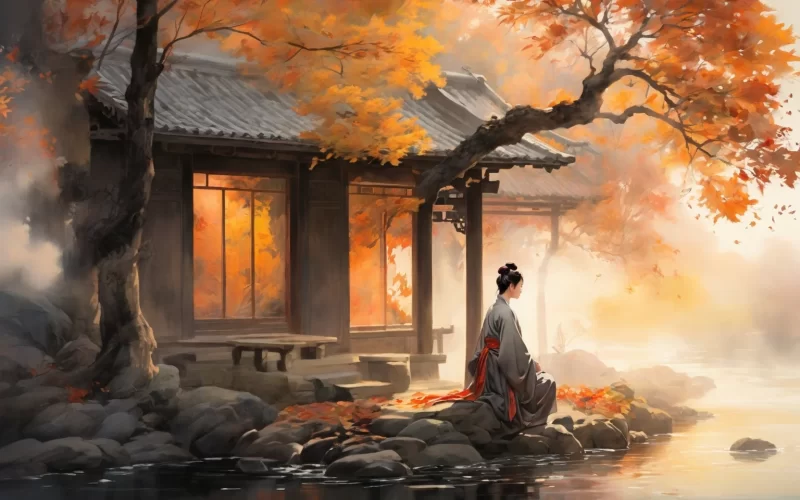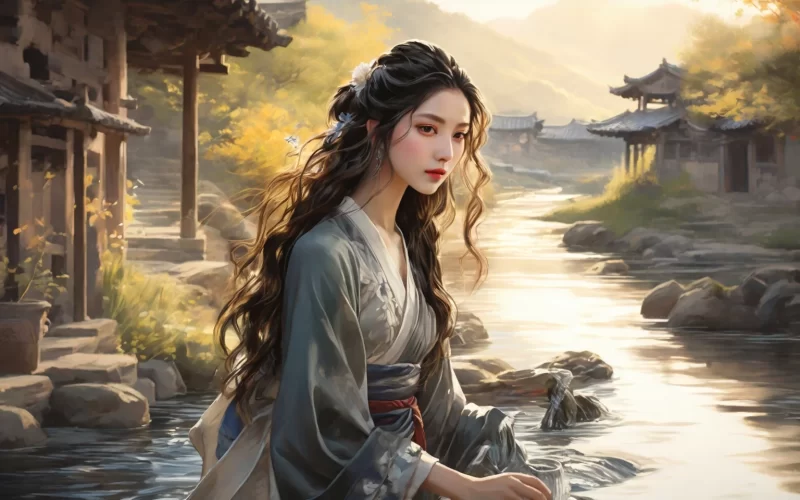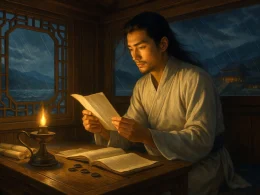



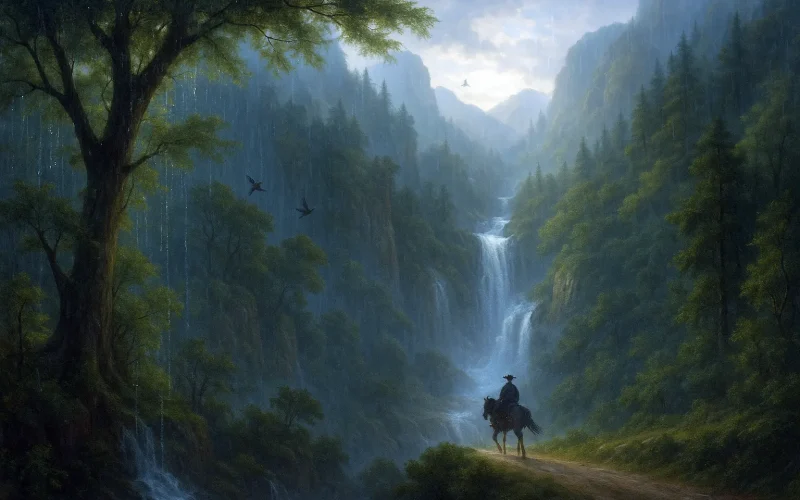
Trees touch the sky from countless valleys deep;
On myriad hilltops, cuckoos call and sweep.
After a night of rain among the mountains,
A hundred silken cascades leap from their fountains.

Should tribal women bring their cloth as tribute due,
Or farmers dispute o'er fields where taro grew,
May you preside with Wenweng's wisdom true —
Must glory be reserved for ancients, not for you?
Original Poem
「送梓州李使君」
王维
万壑树参天,千山响杜鹃。
山中一夜雨,树杪百重泉。
汉女输橦布,巴人讼芋田。
文翁翻教授,不敢倚先贤。
Interpretation
This poem is a poetic scroll interweaving grandeur with tenderness, giving equal weight to nature and human culture within Wang Wei's corpus of farewell poems. Composed during his middle years, a period of relative stability in his official career and the peak of his poetic artistry, Wang Wei does not indulge in the conventional sorrow of parting. Instead, with extraordinary imaginative power, he focuses his brush entirely on the Shu region where his friend is about to take up his post, constructing a "realm of the future" that is both magnificently vast and rich with the warmth of human life. The poem flows effortlessly between majestic natural description, vivid sketches of local custom, and profound historical allusion, showcasing the broad-mindedness, practical concern, and lofty political ideals characteristic of High Tang poets.
First Couplet: 万壑树参天,千山响杜鹃。
Wàn hè shù cāntiān, qiān shān xiǎng dùjuān.
Through countless ravines, trees soar to meet the sky; / Over a thousand hills, the cuckoo’s echoing cry.
The opening employs bold, sweeping strokes to capture the very soul of the Shu landscape. "Countless ravines" and "a thousand hills" are juxtaposed, emphasizing vast, deep space; "trees soar to meet the sky" suggests vertical vitality and solemnity, while "the cuckoo’s echoing cry" conveys a horizontal, pervasive melancholy. The cuckoo’s call, a quintessential sound of Shu, carries the traditional association of "better return home." Here, however, it is stripped of sentimentality, becoming part of the mountains' majestic symphony. These lines, with their visual sublimity and auditory pervasiveness, outline for the friend a stage for governance of exceptional character, also hinting at expectations for his pioneering spirit.
Second Couplet: 山中一夜雨,树杪百重泉。
Shān zhōng yī yè yǔ, shù miǎo bǎi chóng quán.
One night of rain within the hills, and then— / A hundred streams cascade from tips of trees, again.
Continuing from the previous couplet, this depicts the wondrous sight of Shu after rain, transforming static forest into a dynamic world of water. "One night of rain" is nature’s work; "a hundred streams" is its miraculous effect. "A hundred streams cascade from tips of trees" is the poet’s stroke of genius—illogical yet poetically true. How can streams flow from treetops? Precisely—it is the illusion created when viewing distant ridges, where mist, water, and forest intertwine, a poet’s expression of a painter’s sense of layered depth. This couplet uses water’s灵动 to temper the mountain’s沉雄 of the first, revealing Shu’s vital, life-nourishing natural endowment. It also metaphorically suggests the ideal governance of efficient administration and transformative education reaching all.
Third Couplet: 汉女输橦布,巴人讼芋田。
Hàn nǚ shū tóng bù, Bā rén sòng yù tián.
The river-maids bring their tapa-cloth as tax; / The Ba-people dispute their taro fields’ bounds.
The brush turns sharply from natural scenery to the realities of people’s lives, reflecting the poet’s deep concern for his friend’s practical administrative duties. "The river-maids bring their tapa-cloth as tax" depicts a scene of production and taxation, showcasing Shu’s unique local product (tapa-cloth) and folkways. "The Ba-people dispute their taro fields’ bounds" presents a scene of litigation and civil affairs, pinpointing land disputes—a common challenge in local governance. These lines are as plain as a local gazetteer’s record, yet they accurately capture typical features of Shu’s economy and society. The poet thus informs his friend: what awaits you is not only magnificent landscape but also the concrete minutiae of people’s conditions and administration. This is the most practical farewell gift—an expectation and empathy born of understanding.
Fourth Couplet: 文翁翻教授,不敢倚先贤。
Wén Wēng fān jiàoshòu, bù gǎn yǐ xiānxián.
May you, like Wen Weng, revive instruction’s art; / Dare not just lean upon the worthies of the past!
The conclusion reveals the theme, using history as a mirror to express the poem’s deepest encouragement and political ideal. Wen Weng was Governor of Shu Commandery during the reign of Emperor Jing of Han, celebrated for establishing public schools and promoting education in Shu. Wang Wei’s use of "revive instruction’s art" advocates not simple imitation but a spirit of governance that keeps pace with the times and dares to innovate. "Dare not just lean upon the worthies of the past!" is an even more stirring reminder: true inheritance lies not in resting on past achievements but in daring to surpass them. This is both an exhortation to Inspector Li and a concentrated expression of Wang Wei’s own Confucian ethos of social commitment and enterprising spirit.
Holistic Appreciation
This is a structurally rigorous, meaningfully layered "three-dimensional farewell poem." It follows a clear logical progression: "nature—people’s condition—governance and education." The first two couplets depict the awe-inspiring natural environment (where to dwell), the third sketches the social realities the friend must confront (how to administer), and the final couplet升华 to lofty expectations for his administrative legacy (how to be remembered). Together, the four couplets accomplish a panoramic envisioning and constructive mapping of the friend’s future career.
Wang Wei’s excellence lies in completely objectifying and externalizing the feeling of farewell into deep contemplation of the friend’s post and his mission. The poem contains not a single word of "reluctance," yet it is filled with profound care; not a direct word of "exhortation," yet it is entirely lofty encouragement. Through his magnificent imagining of Shu’s landscape and folkways, he successfully transforms a personal farewell into a public discourse on local governance, cultural transmission, and historical responsibility. This elevates the poem beyond the realm of personal emotion, granting it substantial intellectual weight and the spirit of its age.
Artistic Merits
- Transcendent and Integrated Spatio-temporal Imagination: Though physically at the moment of farewell, the poet’s mind and brush have already traveled afar to his friend’s future destination of Zizhou. This imaginative leap that transcends geographical distance breaks through the conventional spatio-temporal constraints of farewell poetry, giving rise to a majestic and expansive artistic vision.
- Balanced Parallelism with Fluid Meaning: All four couplets employ parallelism, yet without a sense of rigidity. "Countless ravines" parallels "a thousand hills" (spatial vastness); "one night of rain" parallels "a hundred streams" (temporal efficacy); "river-maids" parallels "Ba-people" (ethnic customs); "Wen Weng" parallels "worthies of the past" (historical mirror). The balance allows for variation, achieving perfect unity of formal beauty and substantive power.
- Typicality and Symbolism in Imagery Selection: The "cuckoo" is a symbol of Shu; "tapa-cloth" and "taro fields" are economic features; "Wen Weng" is a paragon of education. The poet carefully selects these images to construct a "poetic Zizhou" of highly concentrated cultural-geographical significance—both palpably real and profoundly meaningful.
- The Art of Sublimating Emotional Expression: The poem’s emotional arc moves from admiration for natural beauty (first two couplets), to empathetic observation of the people’s hardships (third couplet), culminating in the passionate expectation of achieving merit and forging new paths (final couplet). The emotional progression is deep yet uplifting, brimming with the positive vitality of the High Tang era.
Insights
This work is not merely a farewell poem but an ancient version of an "official’s guide to assuming a new post" and a "book of spiritual encouragement." It reveals that a true farewell, the finest blessing, can consist of deep understanding of a friend’s future work, clear-eyed recognition of his challenges, and sincere anticipation for his creation of greater value.
In a contemporary context, this poem transcends the realm of simple friendship, prompting us to consider how to respond to important transitions in others’ lives: should we dwell on the sadness of parting, or help the other envision prospects, recognize responsibilities, and ignite determination? Wang Wei provides a lofty yet warm answer. Furthermore, the concluding line, "May you, like Wen Weng, revive instruction’s art; / Dare not just lean upon the worthies of the past!" serves as an eternal admonition for successors and pioneers in any era or field—the best way to honor tradition is not through worship but through creative transformation and courageous surpassing.
This poem is Wang Wei’s gift to Imperial Inspector Li, and also a hymn of encouragement for all who hold ideals and are about to journey afar. It tells us that the road ahead holds both the wonder of "streams cascade from tips of trees" and the concrete tasks of "the Ba-people dispute their taro fields’ bounds." True value lies in employing the wisdom and sense of duty of a "Wen Weng" to inscribe one’s own new chapter upon that land.
Poem translator
Kiang Kanghu
About the poet
Wang Wei (王维), 701 - 761 A.D., was a native of Yuncheng, Shanxi Province. Wang Wei was a poet of landscape and idylls. His poems of landscape and idylls, with far-reaching images and mysterious meanings, were widely loved by readers in later generations, but Wang Wei never really became a man of landscape and idylls.