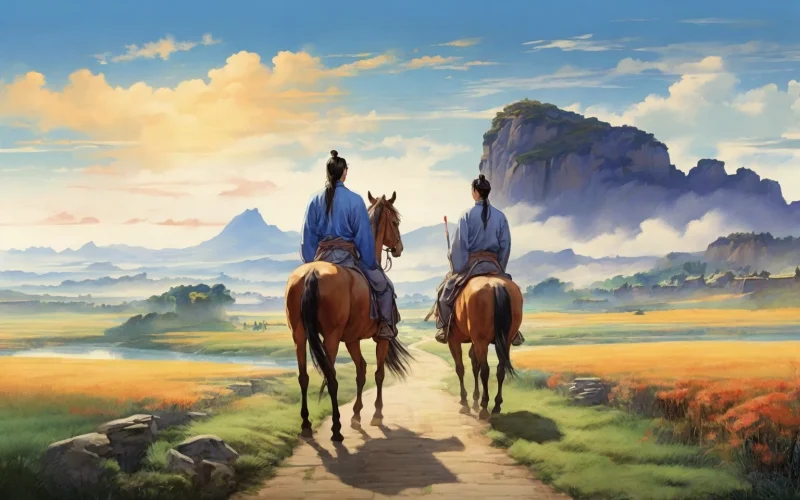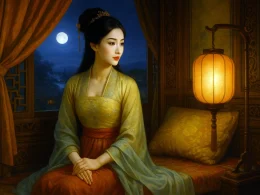



In vernal breeze outside town walls we stop our oar;
The cloudy weather turns fine on chilly river shore.
Our gowns are wet with drizzling rain although unseen;
The flowers fall at leisure unheard by ears keen.

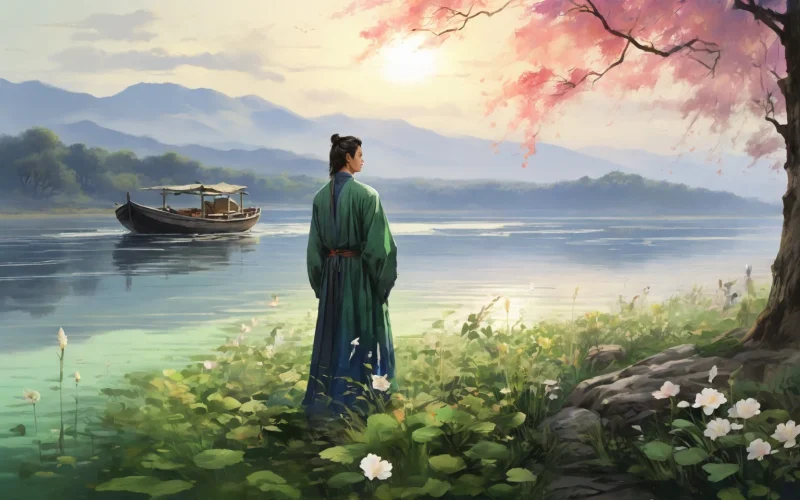
Your lonely sail sets off at sunset on the stream;
The grass will green for miles the southern shore in dream.
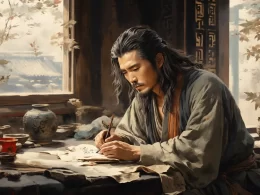
If you meet with some friends who inquire after me,
Tell them the blue-gowned petty official's carefree.
Original Poem
「送严士元」
刘长卿
春风倚棹阖闾城,水国春寒阴复晴。
细雨湿衣看不见,闲花落地听无声。
日斜江上孤帆影,草绿湖南万里情。
东道若逢相识问,青袍今已误儒生。
Interpretation
This poem is a fine work among Tang dynasty farewell poems. The author, Liu Changqing, is famous for his five-character regulated verse. His line, "柴门闻犬吠,风雪夜归人" is serene, subtle, and has been recited for centuries. However, his seven-character farewell poems also have a distinctive style—he excels at blending the scene before his eyes with the emotion in his heart, using delicate brushstrokes to write of parting sorrow, possessing both the misty artistic conception of an ink wash painting and the clear, cold tones of a lonely lamp on a winter night.
This poem was likely composed around the time of Liu Changqing's demotion. Although the exact year is difficult to verify, the "Helü City" (阖闾城, Hélǘ Chéng) mentioned in the poem is present-day Suzhou, located in the watery, lake-filled region south of the Yangtze. The spring breeze has just risen, yet the chill has not dispersed—this is precisely the characteristic changeable weather of early spring in Jiangnan. At that time, the poet was perhaps serving as an official there or passing through, seeing off his friend Yan Shiyuan on his long journey to Hunan. The misty obscurity of "silken rain wets our gowns unseen" in the poem, the quiet stillness of "idle blooms fall on the ground unheard," the desolate vastness of "the slanting sun sheds parting light on sails in view"—none of these are not an externalization of the poet's inner turmoil. A disappointed man bids farewell to a far-traveling guest; all the scenery before his eyes turns to sorrow.
Liu Changqing's official career was fraught with difficulty, suffering two demotions, and he drifted in hardship in his later years. It was precisely the vicissitudes of this life experience that gave him a deeper understanding of the word "farewell" than most: what is seen off is not only a friend, but also one's own youth and ideals. With refined and exquisite language, he sketches an early spring picture scroll of the watery Jiangnan region, and with a barely-there touch, he infuses the sorrow of parting into every scene. The entire poem has eight lines and fifty-six characters. The first six lines are pure scene description; the last two lines suddenly turn to a sigh of self-lament. Opening the scroll, one seems to see the misty, rainy Jiangnan; closing it, one seems to hear a long sigh.
First Couplet: "春风倚棹阖闾城,水国春寒阴复晴。"
Chūn fēng yǐ zhào Hélǘ chéng, shuǐ guó chūn hán yīn fù qíng.
The vernal breeze caresses moored boat on rivershore;
In water-bound southern clime it's warm, then cold again.
The poem opens by naming the place of farewell and the seasonal characteristics. The two characters "moored boat" (倚棹, yǐ zhào) imply the boat is docked, ready to depart—the boat is at the shore, the person is about to travel far; the moment of parting is at hand. And "in water-bound southern clime it's warm, then cold again" is both a realistic portrayal of early spring in Jiangnan and a metaphor for the poet's inner fluctuations. That weather, warm one moment, cold the next, that sky, overcast then clearing—is it not precisely the feeling at parting, of wanting to speak yet holding back, of wanting to stay yet having to go? This couplet appears purely descriptive, yet it already lays a layer of hazy, indistinct undertone for the entire poem.
Second Couplet: "细雨湿衣看不见,闲花落地听无声。"
Xì yǔ shī yī kàn bú jiàn, xián huā luò dì tīng wú shēng.
Silken rain wets our gowns unseen;
Idle blooms fall on the ground unheard.
These are the most subtle and moving two lines of the entire poem. "Unseen" and "unheard" do not describe the absence of rain or flowers, but the fineness of the rain, the lightness of the flowers—so fine the eye cannot capture it, so light the ear cannot distinguish it. Perhaps the poet and his friend are sitting in silence, letting the fine rain fall quietly, letting the petals drift down soundlessly—this barely-there rain, this soundless falling of flowers, is exactly like the inexpressible sorrow of parting, unnoticeably soaking the lapels of their gowns, piling up in their hearts. Using extremely minute images to write of extremely deep feelings—this is what is called "not using a single explicit word, yet capturing the entire spirit."
Third Couplet: "日斜江上孤帆影,草绿湖南万里情。"
Rì xié jiāng shàng gū fān yǐng, cǎo lǜ Húnán wàn lǐ qíng.
The slanting sun sheds parting light on sails in view;
Green grass spreads far and wide as my thought for you.
The previous two lines are close-up, the present moment; this couplet suddenly widens the perspective, pushing towards the distance. "The slanting sun sheds parting light on sails in view" is the actual scene before the eyes—the friend sails away, leaving only a lone sail merging into the afterglow of the setting sun. "Green grass spreads far and wide as my thought for you" is the imagination of the heart—the spring grass of Hunan must already be greening the plains, just as my thoughts of you stretch for miles, boundless. One real, one imaginary; one near, one far—pushing the feeling of farewell from the river surface before the eyes to the road ahead, unknowably remote.
Fourth Couplet: "东道若逢相识问,青袍今已误儒生。"
Dōngdào ruò féng xiāng shí wèn, qīng páo jīn yǐ wù rú shēng.
If you meet with a friend of mine on southern shore,
Tell him a blue-robed man's career is o'er.
The first six lines all describe scenes; the last two lines suddenly turn to a statement of self, like hearing a bell in the quiet night, its lingering sound trailing. "Blue robe" (青袍, qīng páo) was the official robe color of the eighth and ninth ranks in the Tang dynasty, denoting low status and minor position; "scholar" (儒生, rú shēng) was the poet's original identity—a scholar seeking office, originally to aid the world and bring peace to the people. The word "spoiled" (误, wù) carries immense weight, expressing a lifetime of hardship: it is not the scholar who spoiled the blue robe, but the blue robe that spoiled the scholar. This line is both self-mockery and self-sorrow; it is both a confession to a friend and a questioning of fate. Here, all the sorrow hidden within the scenery of the first six lines finds its destination in this single sigh.
Overall Appreciation
The most moving aspect of this poem lies in its technique of writing emotion through scene, with subtlety and rich implication. The first six lines are purely descriptive, yet every line is inseparable from parting sorrow: the changeable weather of the first couplet is the hesitation of mood; the fine rain and idle flowers of the second couplet are the sorrow arriving quietly; the lone sail and green grass of the third couplet are the boundless stretch of longing. The poet does not speak of sorrow, yet sorrow is seen; he does not speak of parting, yet parting runs deep. Only in the final couplet does he pierce through with the line, "a blue-robed man's career is o'er," making all the descriptive words of the first six lines become words of emotion, concluding powerfully with lingering resonance.
The poem's language is extremely plain, yet its emotional flavor is extremely rich. "Unseen" and "unheard" are plain speech, yet they completely capture the trance and melancholy of parting—because one is immersed in the sorrow of parting, the fine rain soaks the gown unnoticed, the idle flowers fall unheard. This is Liu Changqing's skill: using the most ordinary words to write the most subtle heartache, making the reader feel as if drinking clear tea—at first seeming flavorless, but upon reflection, realizing its sweetness and bitterness.
Artistic Merits
- Writing Emotion Through Scene, Subtle and Rich in Implication: The first six lines of the entire poem are purely descriptive, yet every line implies parting sorrow—the changeable weather is the state of mind, the fine rain and idle flowers are the sorrow, the lone sail and green grass are the thoughts. Without speaking of sorrow, the sorrow already fills the page.
- Subtle Details, Profound Meaning: The two lines, "Silken rain wets our gowns unseen; / Idle blooms fall on the ground unheard," use extremely minute images to write of extremely deep feelings, capturing the trance and melancholy of parting to the very bone.
- Interplay of Real and Imagined, Interweaving of Time and Space: The third couplet's "the slanting sun sheds parting light on sails in view" is the real scene before the eyes; "green grass spreads far and wide as my thought for you" is the imagination of the heart. One real, one imaginary pushes the feeling of parting from the present moment to the days to come, from this place to miles away.
- Powerful Conclusion, Lingering Resonance: The final couplet suddenly turns to a sigh of self-lament, piercing through all the emotion accumulated in the first six lines at once, like hearing a bell in the quiet night, its lingering sound trailing, leaving one lost in reverie.
Insights
This poem, with the misty rain and falling flowers of early spring in Jiangnan, speaks to an eternal theme—life is full of partings, and the most difficult to express in parting is seeing one's own disappointment reflected when seeing off another.
First, it lets us see "deep feeling in the minutiae." That unseen fine rain, that unheard falling of flowers—they describe the scene, but even more, the feeling. The deepest emotions in life are often not declarations of spectacular passion, but this kind of quiet accumulation, "unseen" and "unheard." At the moment of parting, a thousand words don't know where to begin, ultimately turning into silence—and within that silence, the fine rain has already soaked the gown, the fallen flowers already cover the steps. This is the unique subtlety of Chinese poetry: not stating it explicitly makes it even more moving.
On a deeper level, this poem makes us contemplate the multiple meanings of "farewell." Yan Shiyuan's journey to Hunan lies ahead, the road long; the poet remains in Helü City, still confined to the lowly position of a blue-robed minor official. Bidding farewell to a friend—is it not also bidding farewell to one's own ideals? The line, "a blue-robed man's career is o'er," is both self-mockery and self-sorrow—a scholar's aspirations should not have ended with this humble official post. Yet fate plays tricks; what can one do? One can only entrust a friend to carry this sigh when seeing him off.
And what is most thought-provoking is the word "spoiled" (误, wù) in the poem. Who spoiled whom? Did the blue robe spoil the scholar, or did the era spoil the literati? Liu Changqing suffered two demotions in his life, his official career fraught with hardship. His experience was not an isolated case but a microcosm of countless literati and scholars after the Mid-Tang. Between ideal and reality, between aspiration and fate, they struggled, were distressed, mocked themselves, sorrowed for themselves, ultimately writing all of this into their poetry. The seven characters, "a blue-robed man's career is o'er," are not only the sigh of one man but also a footnote to an era.
This poem writes of the disappointed literati of the Tang dynasty, yet allows everyone who has hit a wall in reality to see their own reflection in it. That unseen fine rain is the silent wear and tear of life; that unheard falling of flowers is the unnoticed withering of ideals. And the line, "a blue-robed man's career is o'er," becomes the shared sigh of all who harbor ideals yet are trapped by reality.
Poem Translator
Xu Yuanchong (许渊冲)
About the Poet
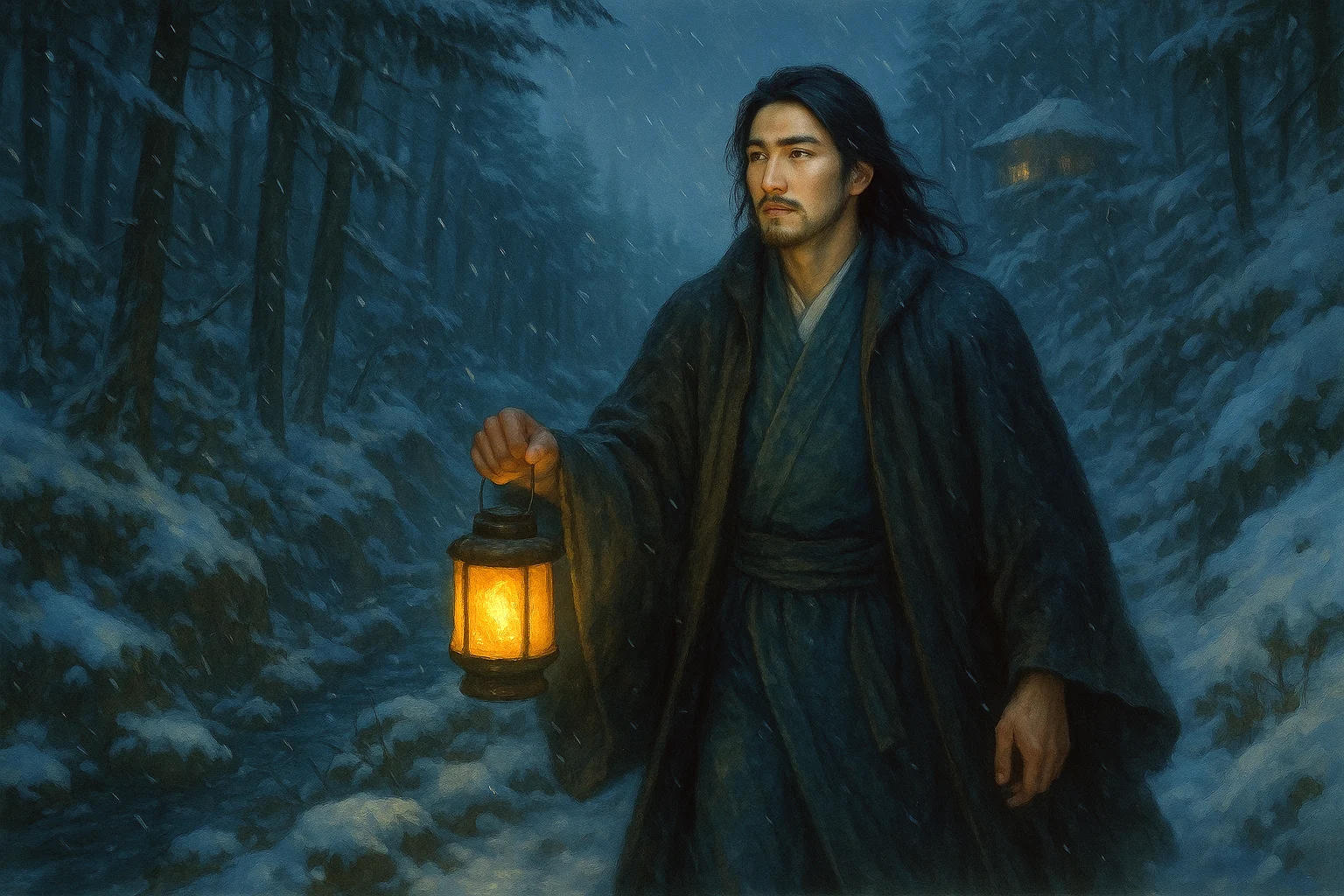
Liu Zhangqing (刘长卿 c. 726 – c. 786), a native of Xuancheng, Anhui Province, was a poet of the Mid-Tang Dynasty. He obtained the jinshi degree (presented scholar) in the late Tianbao era and successively held official posts such as Sheriff of Changzhou and Investigating Censor. Due to his upright and unyielding character, he was exiled twice. His poetry, particularly his five-character verses, achieved the highest distinction, often depicting the melancholy of exile and the joys of reclusion in landscapes. His poetic style is refined, elegant, and ethereal, blending a desolate undertone with the meticulousness characteristic of the Ten Talented Poets of the Dali era. He excelled in using plain sketching to create an atmosphere of tranquil emptiness and profound remoteness. As a pivotal poet bridging the High Tang and Mid-Tang periods, his work inherits the idyllic charm of Wang Wei and Meng Haoran while foreshadowing the bleak and cool elegance of Dali poetry. He exerted a certain influence on late Tang poets such as Yao He and Jia Dao, who belonged to the "painstaking school."