


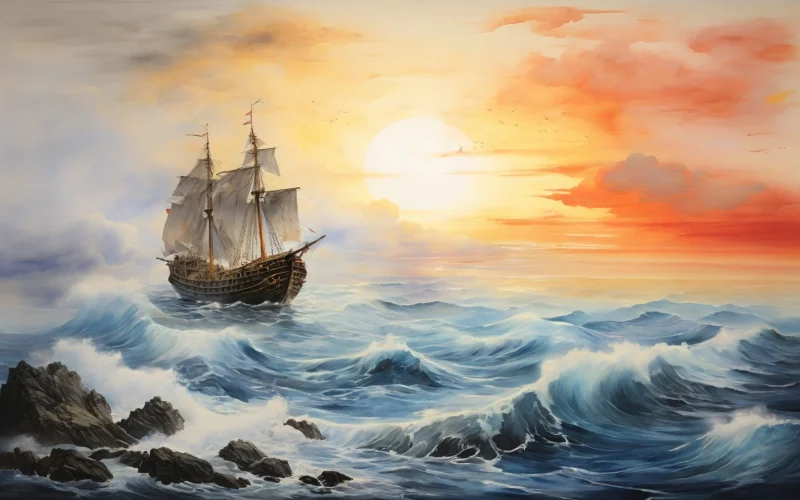
The sea is far and wide.
Who knows the other side?
How far is it away?
A thousand miles, you say.
Look at the sun, O please!
Your sail should trust the breeze.
Turtles bear the dark sky;
Giant fish raise waves high.
When you are in your isle,
There're trees from mile to mile.
Though we're separated for long,
Would you send me your song?
Original Poem
「送秘书晁监还日本国」
王维
积水不可极,安知沧海东。
九州何处远,万里若乘空。
向国唯看日,归帆但信风。
鳌身映天黑,鱼眼射波红。
乡树扶桑外,主人孤岛中。
别离方异域,音信若为通。
Interpretation
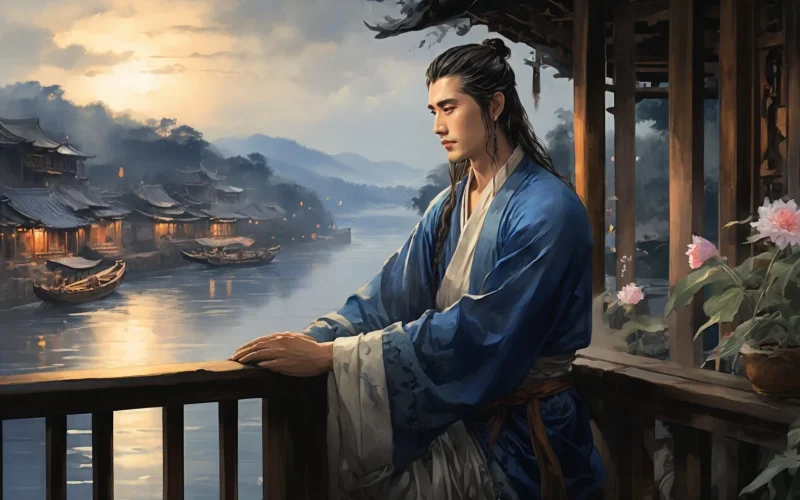
This poem was composed during the Kaiyuan era of Emperor Xuanzong's reign. The Japanese envoy Abe no Nakamaro (Chao Heng), who had served in the Tang court for nearly two decades, had received permission to return to his homeland. Wang Wei, then holding the post of Right Reminder, shared a deep friendship with Chao Heng and composed this poem to bid him farewell. This is no ordinary parting poem. It is a grand composition that fuses geographical speculation, mythical imagery, practical concern, and profound sorrow. Starting from the limited known (China), the poet contemplates the boundless unknown (the lands beyond the Eastern Sea), elevating a specific farewell into a majestic ode to vast space and time, a foreign civilization, and human friendship. It stands as one of the loftiest poetic farewells in the history of cultural exchange between China and the wider world.
First Couplet: 积水不可极,安知沧海东。
Jī shuǐ bù kě jí, ān zhī cāng hǎi dōng.
This gathered water—vast, impossible to span. / How can we know what lies east of the misty sea?
Explication: The poem begins not with a scene but with a philosophical question, establishing its expansive scope. "Gathered water" refers to the boundless ocean; "impossible to span" sets the tone of immense, unknowable vastness. "How can we know what lies east" expresses the limits of geographical knowledge and implicitly conveys deep concern for the friend's journey into the unknown. The poet places both himself and the reader at the edge of understanding, facing a mysterious and perilous blue expanse.
Second Couplet: 九州何处远,万里若乘空。
Jiǔzhōu hé chù yuǎn, wàn lǐ ruò chéng kōng.
Within the Nine Domains, what place lies most remote? / Ten thousand leagues—your journey seems to mount the void.
Explication: The couplet offers an answer to its own question, using parallel structure ("Nine Domains" vs. "Ten thousand leagues", "most remote" vs. "mount the void") to emphasize the immense distance. "Mount the void" is particularly inspired: it suggests the journey's length demands flight, while also evoking a sense of transcending the ordinary, filled with an ethereal uncertainty. Geographical distance is thus transformed into psychological experience.
Third Couplet: 向国唯看日,归帆但信风。
Xiàng guó wéi kàn rì, guī fān dàn xìn fēng.
Toward your homeland, you'll gaze only for the sun; / Your homebound sail must trust alone the fickle winds.
Explication: The focus shifts from abstract distance to concrete details of the voyage. "Gaze only for the sun" carries a double meaning: literally navigating by the sun's position, and alluding to Japan, the "land of the rising sun." "The fickle winds" highlights absolute dependence on natural forces. The restrictive words "only" and "alone" reveal human frailty before the immense ocean and convey profound anxiety for the traveler's fate.
Fourth Couplet: 鳌身映天黑,鱼眼射波红。
Áo shēn yìng tiān hēi, yú yǎn shè bō hóng.
The giant turtle's form blacks out the sky's own light; / The monstrous fish's eye shoots red through the waves' flight.
Explication: This couplet represents the peak of the poet's lavish imagination, using mythical imagery to envision fantastical perils at sea. The "giant turtle" and "monstrous fish" are legendary deep-sea creatures. The phenomena of "black[ing] out the sky" and "shoot[ing] red through the waves" transform the ocean's depth, mystery, and latent danger into surreal, visually stunning tableaux. The stark color contrast (black/red) and interplay of light ("blacks out," "shoots") create a bizarre, awe-inspiring atmosphere, giving extreme, tangible form to the poet's worry.
Fifth Couplet: 乡树扶桑外,主人孤岛中。
Xiāng shù fúsāng wài, zhǔrén gū dǎo zhōng.
Your village trees—beyond the Fusang's eastern gleam. / You, once our guest, return as master to that lone-isle realm.
Explication: The perspective shifts from seafaring marvels to the friend's ultimate destination. "Fusang" is the mythical solar tree, used here for Japan, adding an ethereal quality. "Beyond" and "lone-isle realm" emphasize its perceived remoteness and isolation. Chao Heng is called "master" as he will be host again in his homeland, contrasted with his status as a guest in Tang. This shift in identity carries layers of complex feeling.
Sixth Couplet: 别离方异域,音信若为通。
Biélí fāng yìyù, yīn xìn ruò wéi tōng.
Parting now parts us into realms worlds apart. / Tell me, how shall our words and tidings find a way?
Explication: The poem concludes with the most direct and profound human emotion. "Realms worlds apart" underscores that this is no ordinary parting, but a separation by civilizations. The plaintive question, "how shall… find a way?" voices the immense sorrow and helplessness of pre-modern transnational farewells, where parting could mean a silence akin to death. The note is sorrowful yet restrained, its resonance lingering.
Holistic Appreciation
This poem is a "parting epic that uses the unknown to express profound feeling, and myth to reflect reality." Its structure is monumental, its emotional progression deep: the first two couplets begin with metaphysical speculation, emphasizing vast space and a distant, uncertain journey; the middle two couplets blend reality and imagination, depicting both practical navigation (sun, winds) and conjuring terrifying maritime marvels (turtle, fish), materializing concern into fantastical spectacle; the final three couplets settle on destination and parting sentiment, moving from myth (Fusang) back to reality (lone isle, separate realms), culminating in the timeless human ache of "how shall word reach?" Wang Wei employs not only his gift for "painting within poetry," but also a majestic imagination for "myth within poetry" and "the vast sea within poetry," expanding the traditional farewell theme into an unprecedented realm of grandeur and a grand vision of civilizational dialogue.
Artistic Merits
- Layered Expansion of Spatial Imagination: The poem's spatial scope progressively expands outward and from concrete to abstract: from "gathered water" (the visible sea) to "east of the misty sea" (the unknown), to "Nine Domains" and "ten thousand leagues" (macro distance), to "giant turtle…monstrous fish" (mythic space), finally to "beyond the Fusang" (civilizational fringe). This creates a multi-layered, expanding imaginative space full of tension.
- Creative Use of Mythical Imagery: The "giant turtle" and "monstrous fish" are not simple allusions. They are fresh images born from the poet's fusion of textual lore (e.g., from the Liezi) and his own imagination. Their visual effects—"black[ing] out the sky" and "shoot[ing] red"—are both terrifying and spectacular, transforming ineffable worry and nature's power into tangible poetic wonder.
- Skillful Wordplay and Symbolism: "Gaze… for the sun" pivots on the word "sun," meaning both a navigational marker and Japan itself, a subtle and clever double meaning. "The fickle winds" are literal but also symbolize life's unpredictability and surrender to fate. "Fusang" is a mythical place-name, becoming a beautiful synonym for a foreign, distant land.
- Restrained yet Deepening Emotional Expression: The poem contains no direct lyrical outburst. Emotion is entirely entrusted to the layered depiction of space, voyage, and imagery, and to its rhetorical questions. The more it emphasizes the journey's uncertainty, the strangeness of its sights, and the difficulty of communication, the more profoundly moving the transnational friendship and deep concern become.
Insights
This poem not only records a beautiful moment in Sino-Japanese friendship but also reveals the broad-mindedness, rich imagination, and deep feeling of a High Tang literatus facing a different civilization. It teaches us that the deepest parting sentiment can transcend specific sorrow, rising into awe-inspiring imagination and well-wishing for a friend crossing the frontier into the unknown; the loftiest poetry can transform a specific farewell into a timeless parable about human exploration, communication, and emotional bonds.
In today's world of deepening globalization, this poem retains potent relevance. It reminds us that genuine friendship and understanding require the courage to imagine and respect each other's "east of the misty sea," the willingness to confront the unknowns and challenges like the "giant turtle" and "monstrous fish" on the path ahead, and the need to cherish that profound affection which persists even when we wonder, "how shall word reach?" With unmatched artistic power, Wang Wei crystallized a transnational farewell of a thousand years ago into one of the most luminous poetic moments in the history of human cultural exchange.
Poem translator
Xu Yuanchong (许渊冲)
About the poet
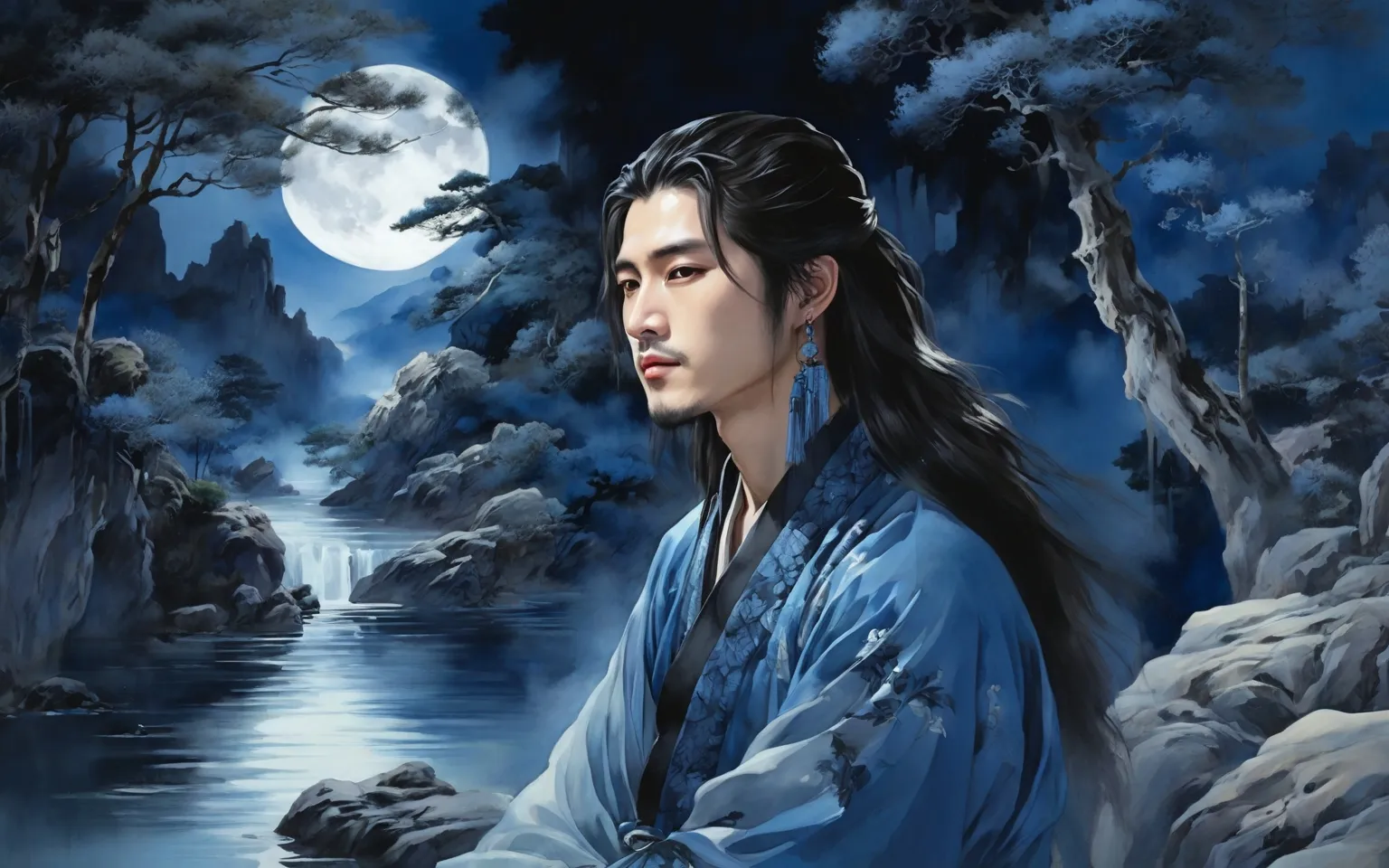
Wang Wei (王维), 701 - 761 A.D., was a native of Yuncheng, Shanxi Province. Wang Wei was a poet of landscape and idylls. His poems of landscape and idylls, with far-reaching images and mysterious meanings, were widely loved by readers in later generations, but Wang Wei never really became a man of landscape and idylls.