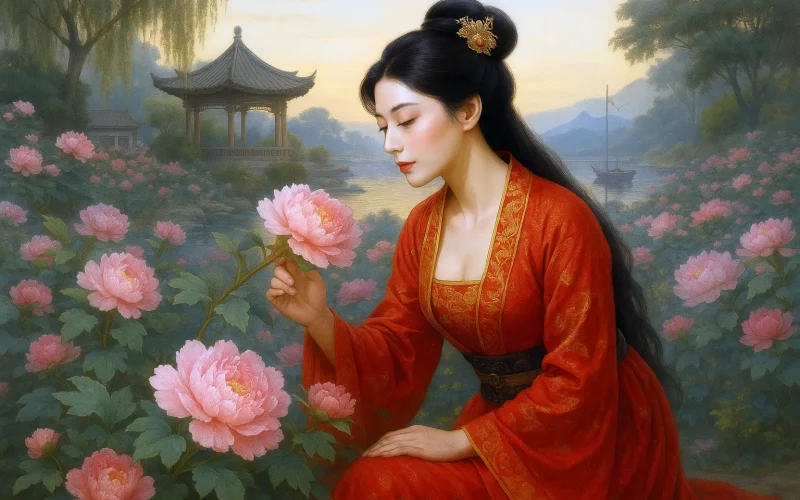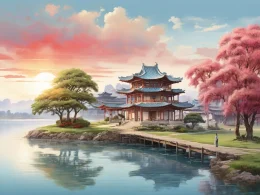

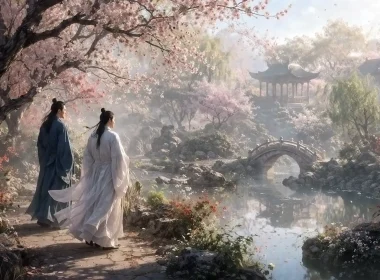


You have left me behind, old friend, at the Yellow Crane Terrace,
On your way to visit Yang-chou in the misty month of flowers;
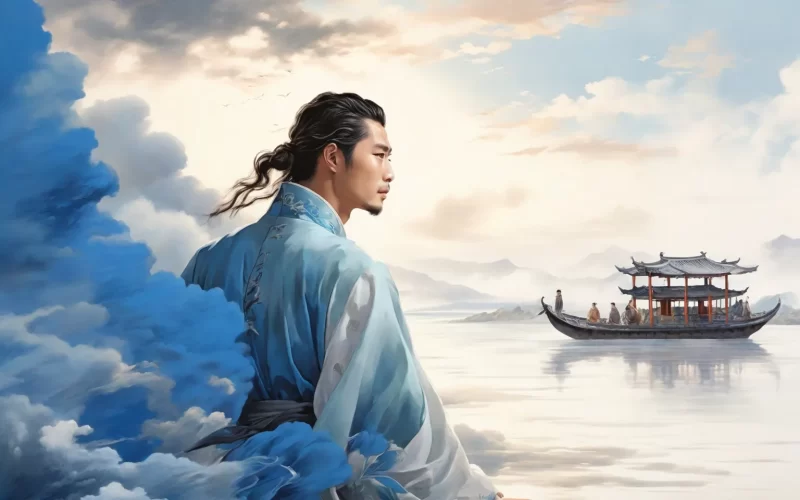
Your sail, a single shadow, becomes one with the blue sky,
Till now I see only the river, on its way to heaven.
Original Poem
「送孟浩然之广陵」
李白
故人西辞黄鹤楼, 烟花三月下扬州。
孤帆远影碧空尽, 惟见长江天际流。
Interpretation
This poem was composed in March 730 CE during the reign of Emperor Xuanzong. Li Bai, then around thirty years old, was living in Anlu. Meng Haoran, twelve years his senior, was already an acclaimed poet, and Li Bai held him in deep esteem, the two forming a close friendship across generations. On this occasion, as Meng Haoran set out east by boat from Wuchang (modern Wuhan) to Yangzhou, Li Bai bade him farewell at the renowned Yellow Crane Tower. In remarkably concise and lucid language, the poem sketches a riverside farewell scene of expansive atmosphere and profound sentiment, celebrated as an “everlasting lyrical gem” and a model of farewell poetry.
First Couplet: “故人西辞黄鹤楼,烟花三月下扬州。”
Gùrén xī cí Huánghè Lóu, yānhuā sānyuè xià Yángzhōu.
My old friend leaves Yellow Crane Tower, westward bound; Through mist-wreathed blooms of March, for Yangzhou outward bound.
The opening is plain yet resonant. “Old friend” speaks of a bond deeper than casual acquaintance. “Leaves westward” notes the direction—Yangzhou lying east of the tower. The tower itself is not merely a location but a site rich with myth and cultural memory, lending the parting an air of poetic transcendence. “Mist-wreathed blooms of March” is an immortal phrase, the “mist” evoking both the haze of spring and the ethereal quality of blossoms seen from afar, perfectly capturing the distinctive ambiance of Jiangnan in late spring. Placing the farewell in this most beautiful season tempers sorrow with loveliness. “For Yangzhou outward bound” conveys motion and anticipation—Yangzhou, then the prosperous cultural hub of the southeast, symbolizing a splendid, distant destination.
Second Couplet: “孤帆远影碧空尽,惟见长江天际流。”
Gū fān yuǎn yǐng bì kōng jìn, wéi jiàn Cháng Jiāng tiānjì liú.
His lone sail, a distant shade, fades where blue sky ends; Only the Long River flows on, to heaven’s edge it wends.
Here, farewell deepens into contemplation. Rather than voicing sorrow directly, the poet traces the slow dissolve of the departing vessel: from “lone sail” to “distant shade” to its vanishing point against the blue. “Lone” notes the sparse river traffic but, more tellingly, reflects the poet’s solitary focus on his friend. “Fades” captures the precise moment of disappearance, with all its attendant emptiness. Yet the gaze does not withdraw; “Only the Long River flows on…” entrusts the unsaid to the endless waters, broadening the scene into vast, quiet melancholy. The ceaseless flow mirrors ceaseless feeling; the distant horizon suggests journeys unknown. Ending on this image of flowing eternity gives the poem its lingering resonance.
Holistic Appreciation
The poem’s power lies in its expressive restraint—condensing deep friendship, vivid imagery, vast space, and unfolding time into just twenty-eight characters. The opening couplet states the occasion with graceful clarity; the closing couplet opens into contemplation through landscape. Not once does it name “sorrow” or “longing,” yet every line is suffused with both. Li Bai keeps himself almost invisible, conveying emotion entirely through what he sees: the lone sail, the clear sky, the endless river. This indirect, image-borne feeling aligns with the classical ideal where “meaning continues beyond the words.” Moreover, the poem is touched by the bright, confident spirit of the High Tang: the radiant “mist-wreathed blooms” and the majestic “Long River flowing to heaven’s edge” lift the farewell above private sadness into a tribute to magnificent nature and the expansive journey of life.
Artistic Merits
- Precise, Layered Imagery: “Yellow Crane Tower” (a site of cultural memory), “mist-wreathed blooms of March” (the season’s essence), and “Yangzhou” (a symbol of prosperity) together ground the farewell in a rich, pictorial context. “Lone sail,” “blue sky,” and “Long River” then build a sweeping visual field from near to far.
- Vivid yet Expansive Imagery: The “resplendent haze” of blossoms, the “crystalline blue” of the sky, and the “mighty flow” of the river create a bright, open riverscape that is both vivid and vast.
- Mastery of Verb and Perspective: The sequence “leaves,” “outward bound,” “fades,” and “flows” maps the physical and emotional arc of departure, while the poet’s fixed gaze (tranquil observation) allows the scene itself to convey the passage of time and depth of feeling.
- Unity of Plain Style and Deep Feeling: The language is clear and unadorned, relying on the purity of description and sincerity of emotion to achieve a perfected, understated artistry.
Insights
This work rises above the conventional melancholy of farewell verse, showing that parting can be tinged with freedom as much as longing, with spaciousness as much as regret. It reminds us that the truest feeling sometimes asks for no words—only a watchful gaze; that the best farewell is not to hinder the journey but to let the departing one be companioned by the beauty of the world they move toward. In life’s travels, we are all, by turns, the one who sails away and the one who remains watching. The poem encourages us to cherish each meeting, and to face each parting with an open heart—for genuine bonds cross distances as the river crosses the land, connecting us to one another and to the wider horizon. It stands as both an emblem of the High Tang spirit and a timeless poetic expression of our shared human experience.
Poem translator:
Kiang Kanghu
About the poet
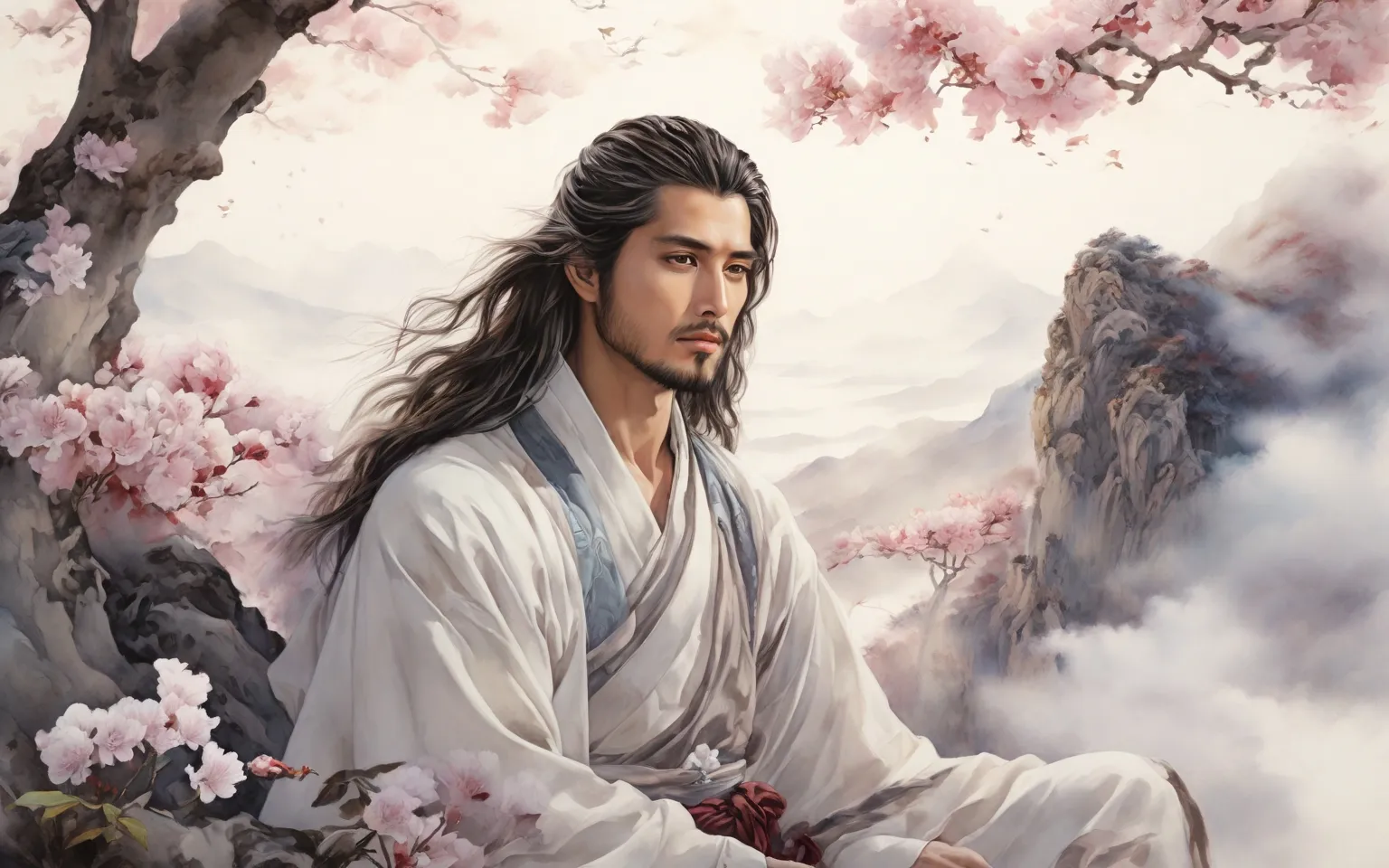
Li Bai (李白), 701 - 762 A.D., whose ancestral home was in Gansu, was preceded by Li Guang, a general of the Han Dynasty. Tang poetry is one of the brightest constellations in the history of Chinese literature, and one of the brightest stars is Li Bai.