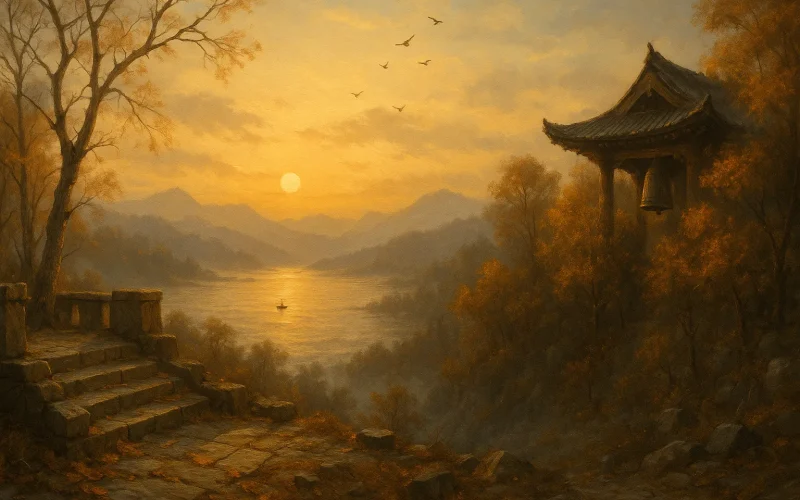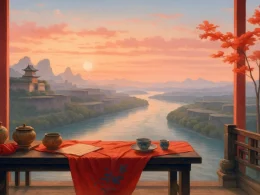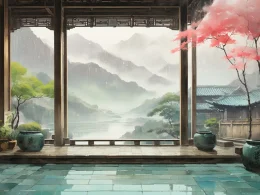



From the temple, deep in its tender bamboos,
Comes the low sound of an evening bell,
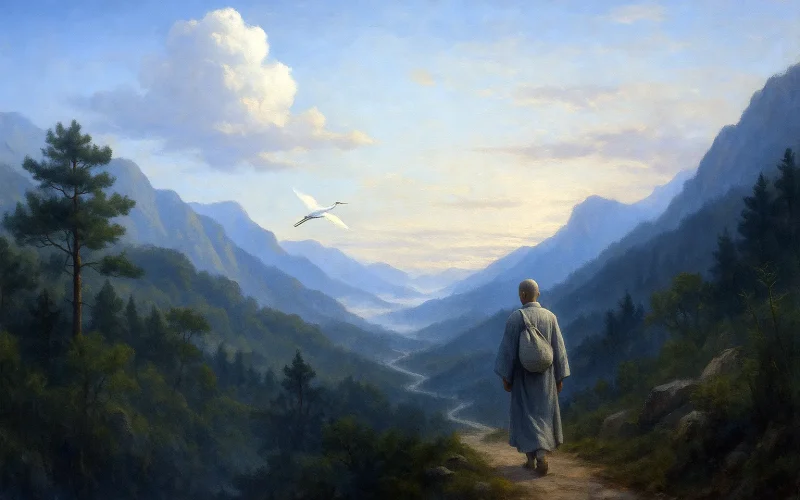
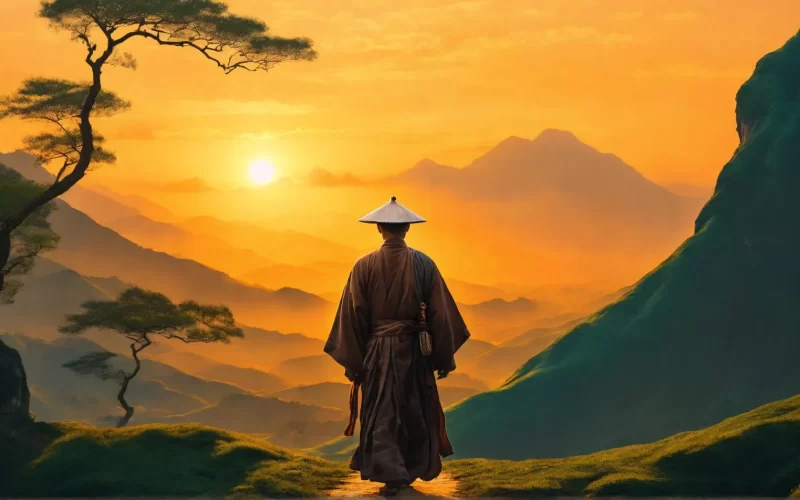
While the hat of a pilgrim carries the sunset
Farther and farther down the green mountain.
Original Poem
「送灵澈上人」
刘长卿
苍苍竹林寺,杳杳钟声晚。
荷笠带斜阳,青山独归远。
Interpretation
This poem was composed between the 4th and 5th years of the Dali era (769-770 AD), during a time when Liu Changqing, disappointed in his official career, was residing for an extended period in Runzhou (modern Zhenjiang, Jiangsu). The Buddhist monk Lingche was not yet famous at the time and was also drifting through various places in Jiangnan. One was a disappointed scholar-official struggling in the treacherous world of officialdom; the other was a young monk pursuing spiritual practice outside the mundane world. Although their paths diverged—one engaging with the world, one transcending it—their states of mind resonated deeply: both shared the loneliness of unrecognized talent, both harbored a longing to retreat to the mountains and forests.
Throughout his life, Liu Changqing was "unyielding and offending superiors, twice demoted." At this time, although he had been transferred from his place of exile, he was still not trusted with important posts, stranded in Runzhou, caught in a dilemma. The monk Lingche had left home young, roaming Jiangnan. Though physically outside the mundane world, he was not free from worldly clamor. Meeting at this time and place, one struggling in the mire of officialdom, the other journeying on the path of cultivation, the longing in their hearts for "purity" and a "place of return" was shared. This farewell took place at dusk. Lingche was to return to the Bamboo Grove Temple near Runzhou. Watching his friend, with his bamboo hat, recede into the lush mountains and the distant temple bell, what arose in the poet's heart was not only the sorrow of parting, but also a deep yearning for that place of peace deep in the green mountains, the source of the bell's sound. The figure in the poem who "returns alone into the distant blue" is both Lingche's and the poet's own: one returns physically to the mountains, the other's heart yearns to do the same.
First Couplet: "苍苍竹林寺,杳杩钟声晚。"
Cāng cāng zhúlín sì, yǎo yǎo zhōng shēng wǎn.
Green, green the temple mid bamboos;
Late bells unload their burden on your brows.
The poem opens with a vast, distant scene. The words "苍苍" (cāng cāng, lush green) describe the deep, secluded mountains where the Bamboo Grove Temple lies, representing both visual verdancy and a vast, melancholic state of mind. The words "杳杳" (yǎo yǎo, distant, faint) describe the distant, ethereal sound of the bell, representing both auditory faintness and the lingering stretch of thought. This couplet is purely descriptive scenery, yet it lays out the foundational意境 (yìjìng, artistic conception) of the entire poem—those lush mountains are the direction of Lingche's return; that distant bell is the lingering sound the poet stands listening to. The bell marks the word "晚" (wǎn, evening, late), which is both a marker of time and a footnote of mood: the dusk hour is when parting sorrow most easily arises. The poet does not speak of parting, yet the feeling of parting already permeates this lush, distant scene.
Second Couplet: "荷笠带斜阳,青山独归远。"
Hé lì dài xié yáng, qīng shān dú guī yuǎn.
Your bamboo hat laden with sunset light,
You turn alone into the distant blue.
This couplet describes a person, yet it is like a light ink landscape painting. The two words "荷笠" (hé lì, carrying/wearing a bamboo hat) sketch the monk's figure of Lingche—a bamboo hat on his head, a pack on his shoulder, the attire of a wandering monk. The three words "带斜阳" (dài xié yáng, carrying/laden with the setting sun) place this figure within the light and shadow of dusk; the setting sun gilds him with a warm golden rim, yet it adds to the melancholy of parting. The next line, "青山独归远" (qīng shān dú guī yuǎn, the green mountain, alone returning far), is the点睛 (diǎnjīng, finishing touch) of the entire poem. The word "独" (dú, alone) describes Lingche's figure returning alone to the mountains, and also the poet's figure standing alone. The word "归" (guī, to return) describes Lingche having the green mountains to return to, and also subtly implies the poet's own loss, having no branch to perch upon. The word "远" (yuǎn, far, distant) is both the spatial growing distance and the unending extension of mood. The poet watches his friend until the figure merges with the green mountains, disappears into the vast twilight, while he himself remains standing, listening to that distant bell, not leaving for a long time. This concluding word "远" infinitely extends the parting emotion, the words ending but the meaning endless.
Holistic Appreciation
This is a masterpiece among Liu Changqing's farewell poems. The entire poem consists of four lines and twenty characters. Using the farewell to Lingche's mountain return as its entry point, it merges twilight, bell sound, human figure, and green mountains, painting a clear, distant, ethereal, and resonant farewell picture.
Structurally, the poem presents a progressive layering from distance to closeness, from scenery to person, from concrete to abstract. The first couplet describes the distant view—lush mountains, distant bell sound—setting the background for Lingche's return and establishing the poem's clear, distant基调 (jīdiào, tone). The second couplet describes the close view—the bamboo-hatted figure, the glow of the setting sun—pulling the focus to the person before the eyes. And the five words "You turn alone into the distant blue" again push the gaze from near to far, from the person before the eyes to the mountain return journey, from visual sight to heartfelt feeling. Between the four lines, moving from far to near then near to far, from scenery to person then person to heart, the poem is a seamless whole with unending resonance.
Thematically, the core of this poem lies in the words "归" (return) and "远" (far). The "evening bell" of the first couplet is the bell calling for return; the "returns alone into the green mountains" of the second is Lingche's returning figure; and the closing word "远" makes this "return" a persistent longing in the poet's heart. Lingche has green mountains to return to, but the poet can only wander in the mundane world—this contrast between "returning" and "not returning" is the deepest, hidden pain of the entire poem. Yet the poet does not articulate this hidden pain, only hides it in that receding figure, in that endlessly distant bell sound, letting the reader taste and resonate with it themselves.
Artistically, the poem's most moving aspect lies in the subtle technique of "using painting to express emotion, using distance to express longing." The entire poem does not use a single word for "farewell," yet everywhere is the feeling of parting; not a word for "sorrow," yet every line contains sorrowful meaning. The poet does not write how reluctant he is, only writes of his friend's receding figure; he does not write how怅惘 (chàngwǎng, melancholy) he is, only writes of the distance of those green mountains, the faintness of that bell. This technique of entrusting all emotion to the picture, hiding all heart's concerns within the imagery, is precisely the highest realm of classical Chinese poetry: "not using a single word, yet capturing all the charm." That picture of "Your bamboo hat laden with sunset light" has since become one of the most classic images in Chinese farewell poetry; the lingering resonance of "You turn alone into the distant blue" has also become an inescapable melancholy in the hearts of countless readers.
Artistic Merits
- Using Painting to Express Emotion, Conception Profound: The entire poem is like a light ink landscape painting. Within twenty characters, there are mountains, a temple, a bell, a person, a shadow, and light; the sense of imagery is extremely strong, and emotion is completely within it.
- Language Refined, Simple Words Rich in Meaning: The opening with the reduplicated words "lush, lush" and "distant, distant" creates atmosphere; "bamboo hat" and "setting sun" are straightforward sketches of the person; the concluding three words "returns alone far" each carry immense weight, with lingering resonance.
- Using Distance to Express Longing, Subtle and Implied: The poem concludes with the word "far," infinitely extending the parting emotion, letting the reader, beyond the picture, feel the poet's figure standing long, watching, not returning.
- Sound and Image Combined, Complementing Each Other: The first two lines introduce sound (the bell) into the poem; the last two conclude with an image. Hearing and vision interweave, together constructing a three-dimensional and ethereal artistic space.
Insights
This poem sketches a farewell picture in twenty characters, yet lets everyone who reads it feel that faint melancholy and deep yearning.
It first lets us see the "power of the receding figure." The poet does not write how reluctant he is, nor what was said or what tears were shed at parting. He only writes of his friend's receding figure. That "bamboo hat laden with sunset light" figure, growing more distant, merging into the green mountains, disappearing into the vast twilight. This figure is more powerful than any words—because it makes the reader become the one watching, personally experiencing that wordless reluctance.
On a deeper level, this poem makes us contemplate the meaning of "a place of return." Lingche has green mountains to return to, a Bamboo Grove Temple to dwell in, a bell to guide his way home. And the poet himself? His official career is bumpy, caught in a dilemma, unsure whether to advance or retreat—where is his journey home? That figure who "returns alone into the distant blue" is both envy and self-sorrow—envy that Lingche has a place to return to, sorrow that he himself still drifts in the mundane world. This contrast of "others have a return, but I have none" is the deepest emotional resonance of disappointed literati through the ages.
And what is most evocative is the poem's peaceful quality of "no resentment, no anger." The poet, in adverse circumstances, bidding farewell to a friend returning to the mountains, even with ten thousand parts reluctance and a thousand melancholy feelings in his heart, transforms it all into these light twenty characters. No wailing, no accusation, no complaint against heaven or others, only a painting, a bell's sound, a receding figure. This restraint is not weakness, but cultivation; this peace is not numbness, but clarity. Truly deep emotion often does not need to be spoken loudly; truly moving poetry is often most powerful in its silence.
This poem writes of a Tang dynasty farewell, yet allows everyone who has ever watched a friend depart at dusk to find resonance within it. Those lush mountains are the backdrop in every farewell-giver's eyes; that distant bell's sound is the echo in every parting heart; that figure returning alone into the green mountains is the gaze that every watcher cannot withdraw for a long time. This is the vitality of poetry: it writes of one person's experience, but reads as the state of mind of all.
Poem translator
Kiang Kanghu
About the Poet
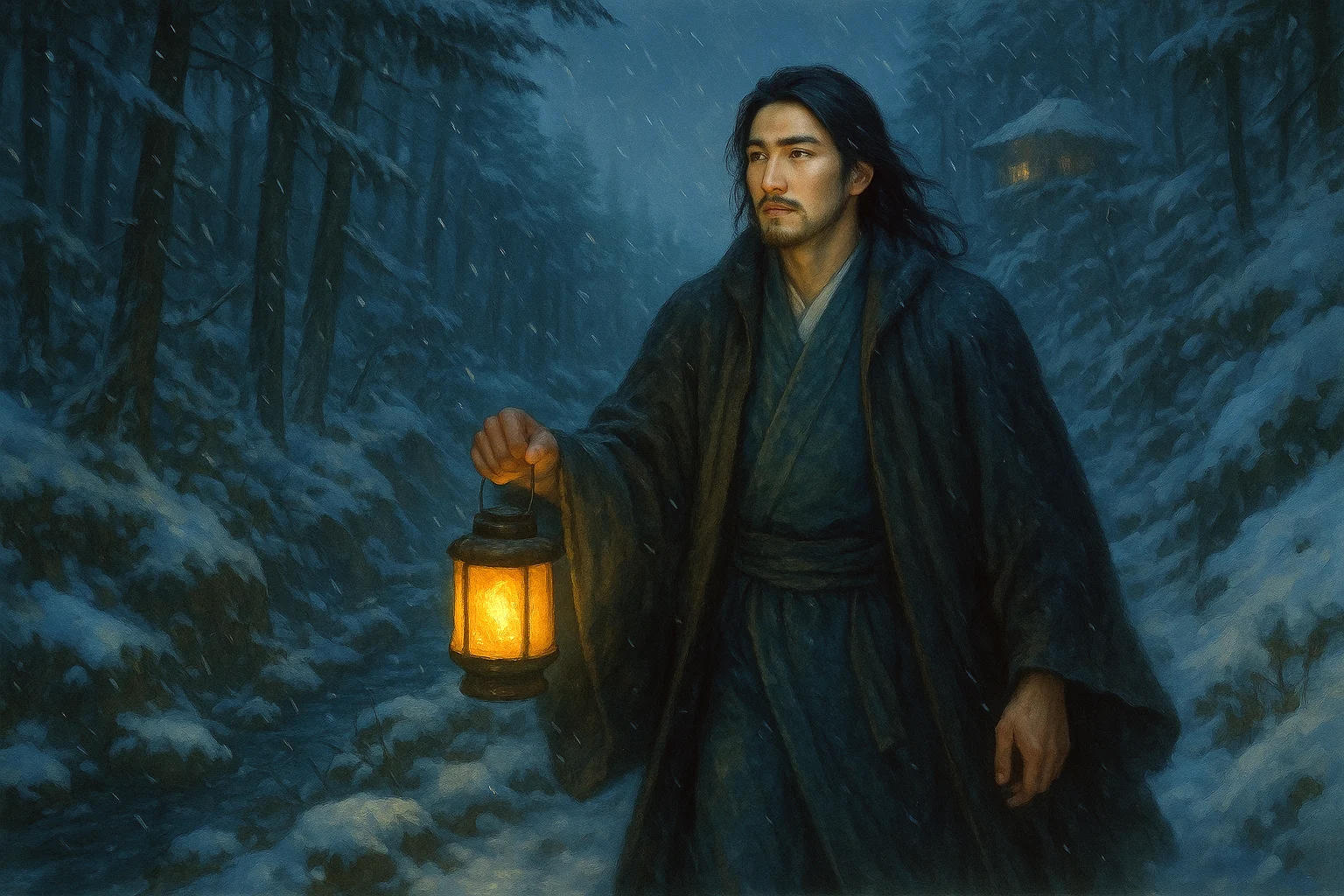
Liu Zhangqing (刘长卿 c. 726 – c. 786), a native of Xuancheng, Anhui Province, was a poet of the Mid-Tang Dynasty. He obtained the jinshi degree (presented scholar) in the late Tianbao era and successively held official posts such as Sheriff of Changzhou and Investigating Censor. Due to his upright and unyielding character, he was exiled twice. His poetry, particularly his five-character verses, achieved the highest distinction, often depicting the melancholy of exile and the joys of reclusion in landscapes. His poetic style is refined, elegant, and ethereal, blending a desolate undertone with the meticulousness characteristic of the Ten Talented Poets of the Dali era. He excelled in using plain sketching to create an atmosphere of tranquil emptiness and profound remoteness. As a pivotal poet bridging the High Tang and Mid-Tang periods, his work inherits the idyllic charm of Wang Wei and Meng Haoran while foreshadowing the bleak and cool elegance of Dali poetry. He exerted a certain influence on late Tang poets such as Yao He and Jia Dao, who belonged to the "painstaking school."