


What will you think, now, taking this road?
I drew rein, drank, asked where you’d unload.

Where the Wu Gorges take the gibbons’ cry
Your tears will start. Where Hengyang’s wild geese fly
Few words will follow. On the Blue Maple’s tide
Your sail will pale. Where the White King’s walls hide
The old trees thin. Our time — they call it blessed —
Sheds its damp bounty. We’re but a while distressed.
Original Poem
「送李少府贬峡中王少府贬长沙」
高适
嗟君此别意何如?驻马衔杯问谪居。
巫峡啼猿数行泪,衡阳归雁几封书。
青枫江上秋帆远,白帝城边古木疏。
圣代即今多雨露,暂时分手莫踌躇。
Interpretation
This poem was composed by the High Tang poet Gao Shi. Gao Shi is renowned for his frontier fortress poetry, characterized by its lofty spirit and majestic vigor. However, this farewell poem reveals a different, deeply tender and warm-hearted facet of his character. Vice-Prefect Li and Vice-Prefect Wang were both demoted due to some matter—one to Xiazhong (in the area of present-day Fengjie, Chongqing) and the other to Changsha. The poet bid them farewell in Chang'an and composed this poem to offer comfort. In the Tang dynasty, the official careers of scholars were fraught with ups and downs; demotions were a common occurrence. The fact that his friends were heading to two different places added further complexity to the sentiments of parting. In this poem, Gao Shi expresses profound sympathy for his friends' unfortunate plight, while also comforting them with the line "圣代多雨露" (In this enlightened age, favor falls like rain and dew), encouraging them to bear the separation for now and await their eventual recall. The entire poem is sincere in emotion and dignified in bearing. It possesses both a clear-eyed understanding of reality and an optimistic hope for the future, making it an outstanding example of Tang farewell poetry that excels in both feeling and artistic charm.
First Couplet: "嗟君此别意何如?驻马衔杯问谪居。"
Jiē jūn cǐ bié yì hé rú? Zhù mǎ xián bēi wèn zhé jū.
I sigh, and ask you what your thoughts are now, as you go forth;
We rein our horses, hold our cups, and ask about those distant towns.
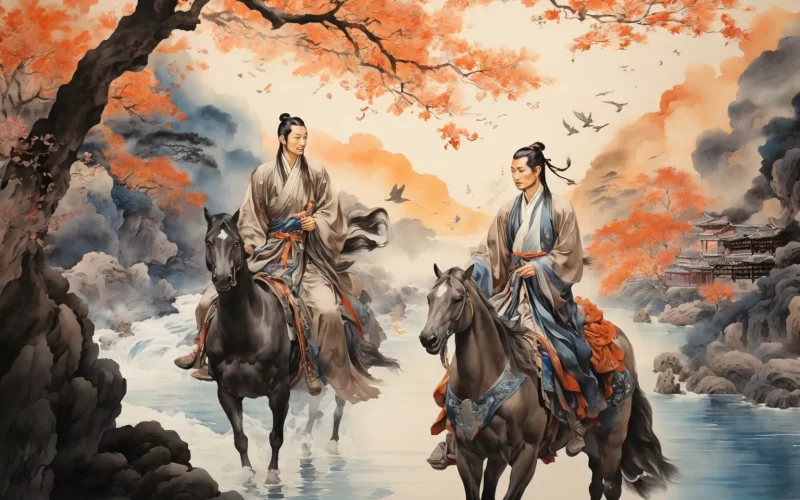
The poem opens with a leading question, which both highlights the act of "parting" and condenses the emotions of both parties into this single inquiry. The word "嗟" (I sigh) directly expresses lament, setting the poem's compassionate tone. The four characters "驻马衔杯" (We rein our horses, hold our cups) vividly sketch the reluctance and solemnity of the farewell feast—the horses are reined in, the cups are filled, yet they have no heart to drink, eager only to inquire about the conditions of the places of exile. This question is both an expression of concern and a form of comfort, demonstrating the poet's deep care for his friends' fate.
Second Couplet: "巫峡啼猿数行泪,衡阳归雁几封书。"
Wū xiá tí yuán shù háng lèi, Héng yáng guī yàn jǐ fēng shū.
The gibbons' wail in the Gorge of Witch will bring down showers of tears;
When wild geese cross Mount Heng, returning, will they bring us news?
This couplet describes the two destinations separately, blending the concrete and the abstract. "巫峡" (The Gorge of Witch) refers to Xiazhong, where Vice-Prefect Li is going. An ancient ballad says, "The Gorge of Witch is longest of the three; / Three gibbons' wails will bring tears from a stone." The poet subtly alludes to this reference, using "啼猿" (the gibbons' wail) to evoke the bitter desolation of the place of exile, naturally leading to "数行泪" (showers of tears)—which are both the tears of the gibbons and of the man. "衡阳" (Mount Heng) refers to Changsha, where Vice-Prefect Wang is going. Legend has it that wild geese flying south stop at the Wild Goose Return Peak of Mount Heng. The poet uses "归雁" (returning wild geese) to convey his hope for letters: he hopes his friend will often send word to ease the longing. The two lines form a neat parallelism. One speaks of the distance in space, the other of the scarcity of news, fusing the sorrows of the two places into one.
Third Couplet: "青枫江上秋帆远,白帝城边古木疏。"
Qīng fēng jiāng shàng qiū fān yuǎn, Bái dì chéng biān gǔ mù shū.
On the Green River, in autumn, a lone sail disappears;
In the White God City, sparse are ancient trees.
This couplet continues to describe the two places separately, but the technique shifts to scene-painting, concluding with emotion expressed through scenery. "青枫江" (Green River) refers to the Xiang River near Changsha. On the autumn river, the friend's sailboat disappears into the distance with the current. The word "远" (disappears) implies the poet's long gaze and the lingering sorrow of parting. "白帝城" (White God City) refers to Kuizhou (Xiazhong). The sparse, ancient trees by the city, withered by autumn, mirror the desolation of the friend's place of exile. These two lines are pure landscape sketches, with no explicit words of sorrow, yet sorrow resides within them. This is precisely what is meant by "all language describing scenery is language expressing emotion."
Final Couplet: "圣代即今多雨露,暂时分手莫踌躇。"
Shèng dài jí jīn duō yǔ lù, zàn shí fēn shǒu mò chóu chú.
In this enlightened age, favor falls like rain and dew;
We part for a little while, let us not be cast down.
The final couplet concludes the poem, turning from sorrow to comfort, lifting the spirit. "圣代多雨露" (In this enlightened age, favor falls like rain and dew) are words of consolation, meaning the court is wise and its grace widespread; they will surely be recalled soon and should not despair over their present demotion. The last line, "暂时分手莫踌躇" (We part for a little while, let us not be cast down), urges his friends with decisive tone not to hesitate but to resolutely set forth. This conclusion both resolves the sorrow expressed earlier and offers a blessing for his friends' future, sublimating the sadness of parting into confidence in the days to come. It embodies the characteristically broad-minded spirit of the High Tang people.
Overall Appreciation
This is a farewell poem of exquisite structure and rich emotion. The poem begins with "嗟" (I sigh) and concludes with "莫踌躇" (let us not be cast down). The two middle couplets separately describe the scenery and sorrows of the two destinations, fusing concern, consolation, and hope into one, revealing a lingering,含蓄 (subtle and restrained) style rarely seen in Gao Shi's poetry.
Structurally, the poem's most prominent feature is its "parallel dual narrative, interwoven into a single text." Two friends are heading to two different places. Instead of expressing emotion vaguely, the poet uses the parallel pairs "巫峡" (Gorge of Witch) and "衡阳" (Mount Heng), "青枫江" (Green River) and "白帝城" (White God City). This both accounts for the distinct features of the different places of exile and tightly intertwines the fates of the two men. This technique of parallel narration gives the poem rich layers and a graceful, swaying rhythm. The first and last couplets encompass the whole. The first couplet opens with a question full of deep feeling; the last couplet concludes with consolation that gathers the sorrow. The structure follows the classic pattern of introduction, development, turn, and conclusion with strict discipline.
Emotionally, the poem's value lies in being "sorrowful yet not debilitating, plaintive yet not angry." The first two couplets describe the desolation of the places of exile—gibbons' wails bringing tears, scarce letters from wild geese—painting a picture of bleak gloom. However, the later couplets transition with the distant,淡 (subtle) scenery of "autumn sail disappearing" and "sparse ancient trees," ultimately concluding with the comforting words "圣代多雨露" (In this enlightened age, favor falls like rain and dew), dissolving sorrow into hope for the future. This turn and sublimation of emotion precisely embodies the spiritual character of High Tang poets: even in adversity, they still believed that the times and fate would grant them fair treatment.
In terms of artistic technique, the poem uses allusions aptly and naturally. "巫峡啼猿" (The gibbons' wail in the Gorge of Witch) subtly employs an old ballad; "衡阳归雁" (When wild geese cross Mount Heng, returning) cleverly borrows a geographical legend. These allusions are fitting for the places of exile and add to the poem's subtlety and depth. The parallelism in the middle two couplets is neat yet不失灵动 (not lacking in liveliness). The four lines describe four scenes separately, yet they do not feel cluttered; instead, they form a cohesive whole through the unity of emotion.
Artistic Features
- Parallel Dual Narrative, Exquisite Structure: The entire poem describes the two friends' places of exile separately, using the parallel pairs "巫峡—衡阳" (Gorge of Witch—Mount Heng) and "青枫—白帝" (Green River—White God City). Each pair forms its own scene while echoing the other. This parallel narrative structure breaks new ground within the farewell poem genre.
- Fusion of Emotion and Scene, Emotion Concluded through Scene: The third couplet uses pure scenic description: "青枫江上秋帆远,白帝城边古木疏" (On the Green River, in autumn, a lone sail disappears; / In the White God City, sparse are ancient trees). Not a word of sorrow or resentment is explicitly stated, yet the feelings of parting reside within. The language of scenery is the language of emotion—subtle and enduring.
- Apt Allusions, Natural and Seamless: "巫峡啼猿" (The gibbons' wail in the Gorge of Witch) and "衡阳归雁" (When wild geese cross Mount Heng, returning) both incorporate allusions without showing traces. They clarify geographical features while deepening the emotional content. Allusions serve the poem, not the other way around.
- Emotional Turn, Well-Measured Restraint and Release: The poem moves from the lament of the opening, to the melancholy of the middle, and finally to the consolation of the end. The emotion advances layer by layer, ultimately rising to a positive note. This tone of "sorrowful yet not debilitating" is a manifestation of the High Tang spirit.
- Concise Language, Rich Meaning: The poem contains not a single superfluous word, yet it fuses concern, sorrow, consolation, and hope into one. Deep feeling is found in the plain; skill is revealed in the simple.
Insights
Using the send-off of demoted friends as its theme, this poem speaks of the preciousness of friendship in adversity and the magnanimity towards life, offering profound insights for later generations.
First, it teaches us: True comfort does not erase another's suffering but gives that suffering meaning and hope. The poet does not avoid the desolation of demotion—the gibbons' wail in the Gorge of Witch, the scarce letters from Mount Heng's wild geese, the lone autumn sail on the Green River, the sparse trees by White God City—everywhere there is sorrow. Yet he does not dwell in sorrow. Instead, he uplifts his friends with the belief of "圣代多雨露" (In this enlightened age, favor falls like rain and dew), allowing them to see that the temporary separation will eventually pass. This mode of consolation, which both faces reality squarely and does not lose hope, is far more powerful than a simple "don't be sad." It enlightens us: When a friend is in difficulty, the best support is to believe they can overcome it and to help them see the light of the future.
Second, the parting advice in the line "暂时分手莫踌躇" (We part for a little while, let us not be cast down) displays a life posture of facing separation with composure. The gatherings and partings of life are inconstant; separation is an eternal theme. Gao Shi does not indulge in "gazing at each other with tears in their eyes." Instead, he urges his friends to resolutely move forward with "莫踌躇" (let us not be cast down). This magnanimity is not born of indifference but of a deep understanding: a true reunion requires each to walk the path they must. It reminds us: Rather than expending our strength in the sorrow of parting, it is better to transform longing into motivation to move forward, letting each parting become the starting point for a better reunion.
On a deeper level, this poem also shows us: No matter the era, the warmth between people is always the most precious solace. Two friends were demoted simultaneously, sent to remote, desolate lands—this should have been the darkest moment of their lives. Yet, because of this one poem by Gao Shi, they received an eternal warmth. It tells us: A word of sincere comfort, a measure of steadfast trust, is enough to light up a dim stretch of another's life journey. A thousand years later, we can still feel the warmth of the poet's heart in the sigh of "嗟君此别意何如" (I sigh, and ask you what your thoughts are now, as you go forth).
About the poet
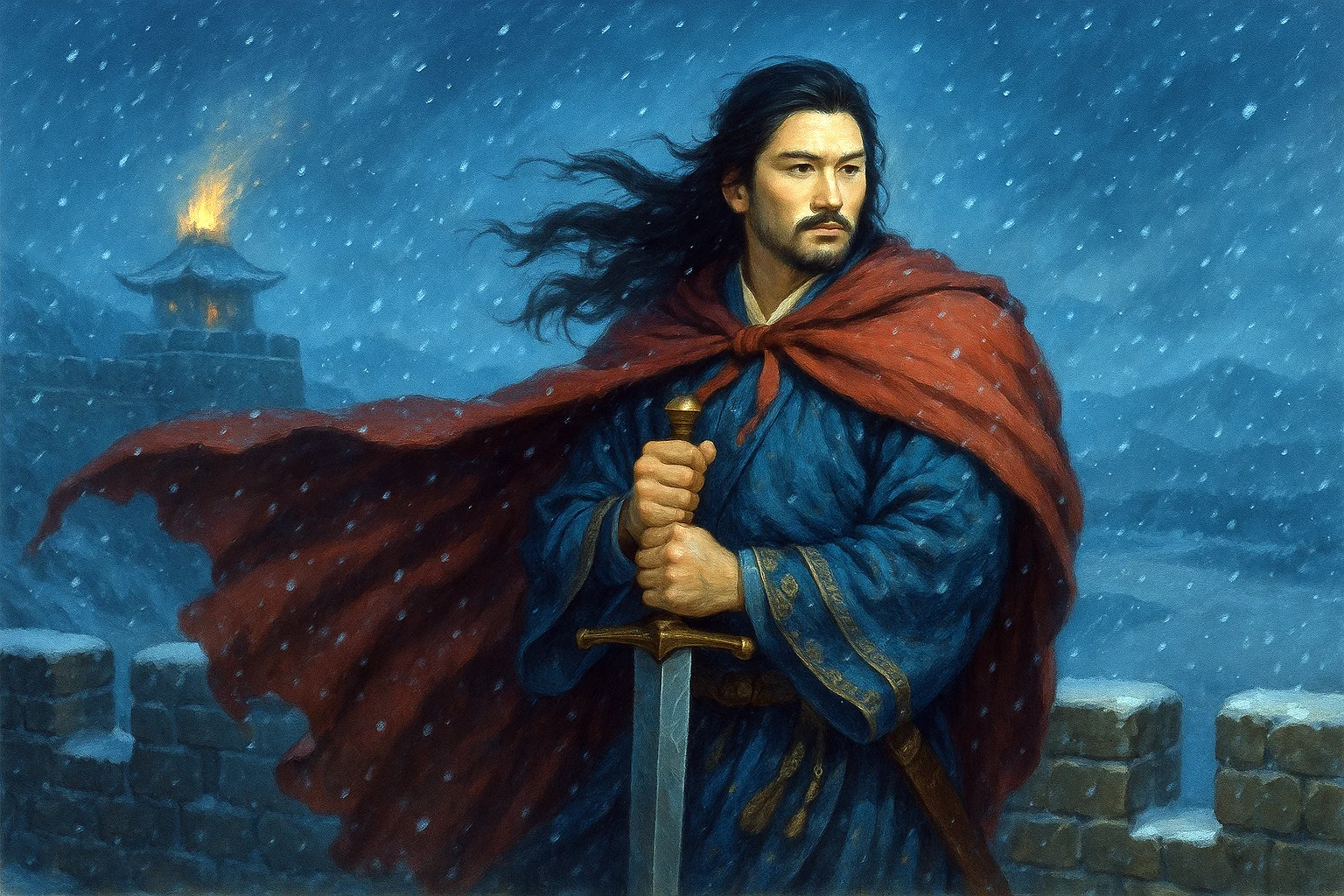
Cen Can(岑参), 715 - 770 AD, was a native of Jingzhou, Hubei Province. He studied at Mt. Songshan when he was young, and later traveled to Beijing, Luoyang and Shuohe. Cen Can was famous for his border poems, in which he wrote about the border scenery and the life of generals in a majestic and unrestrained manner, and together with Gao Shi, he was an outstanding representative of the border poetry school of the Sheng Tang Dynasty.