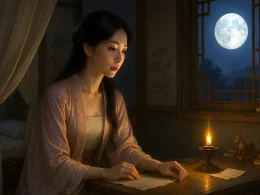
No cicadas trill when I first hear wild geese cry;
The high tower overlooks water blending with the sky.
The Moon Goddess and her Maid of Frost are cold-proof;
They vie in beauty in moonlight over frosty roof.
Original Poem
「霜月」
李商隐
初闻征雁已无蝉,百尺楼高水接天。
青女素娥俱耐冷,月中霜里斗婵娟。
Interpretation
This poem represents one of the most lucid, elevated, and spiritually transcendent works within Li Shangyin's poetic oeuvre and late Tang poetry as a whole. It transcends mere autumnal lament or scenery description, constructing on a deep autumn night of frost and moonlight a "resplendent yet cold cosmos" where myth, nature, and the poet's spirit reflect and illuminate one another. Devoid of mundane traces, it presents only an eternal beauty vying for expression within absolute clarity and chill—a supreme ode and conscious spiritual embrace by Li Shangyin of "cold" as an aesthetic and existential realm.
First Couplet: 初闻征雁已无蝉,百尺楼高水接天。
Chū wén zhēng yàn yǐ wú chán, bǎi chǐ lóu gāo shuǐ jiē tiān.
At the first cry of southbound geese, the cicada's drone is done;
From this hundred-foot tower's height, water and sky merge into one.
Explication: The poem opens with a subtle auditory shift, announcing a complete seasonal transition and the end of a purely sonic world. The "first cry" of migratory geese and the confirmed absence of cicadas mark time's passage from the bustling cusp of summer and autumn into the clear, silent heart of deep autumn. This is not merely a change in natural phenomena, but the poet's keen inner awareness of receding clamor and dawning clarity. The following line abruptly elevates the gaze to the isolated vantage of a "hundred-foot tower's height," revealing a vision of infinite, limpid space where "water and sky merge into one." The brilliance lies in the ambiguity of "water": it is both literal (lake, river) and, more importantly, a visual illusion woven by moonlight, filling and cleansing the world in a cold, aqueous luminescence, thus setting a stage of utmost purity and chill for the entrance of mythological figures.
Final Couplet: 青女素娥俱耐冷,月中霜里斗婵娟。
Qīng nǚ sù é jù nài lěng, yuè zhōng shuāng lǐ dòu chán juān.
The Frost Goddess and Moon Maiden both can bear the cold's keen sting;
Amidst the moonbeams and the frost, they vie in grace, contending.
Explication: This couplet, the soul of the poem, achieves an absolute spiritual ascent through sublime mythological imagination. The poet summons the Frost Goddess (Qingnü) and the Moon Maiden (Chang'e) onto this autumn night's stage. They are no longer distant deities but co-present "endurers of cold" whose essence resonates with the poet's own state of mind. The phrase "both can bear the cold" is the key spiritual declaration: this "cold" is not merely physical, but a state of spiritual purity, lucidity, and even asceticism, standing in opposition to the murky warmth of the mundane world. The poet admires, identifies with, and aspires to join this quality of "enduring the cold." "They vie in grace" imbues the scene with a dynamic sense of aesthetic competition: within the ultimate clear-cold medium of "moonbeams and the frost," they are not huddling in lament but actively, gloriously displaying their existence and beauty. This "vying" is an assertion of vitality, a self-affirmation of beauty in extremity.
Holistic Appreciation
This is a "poem of spiritual altitude," its structure crystalline, its imagery celestial. The poem follows a clear ascending trajectory: "withdrawal from the world—ascent and contemplation—mythic advent—spiritual contest of beauty." The first line purifies earthly sound (no cicadas), the second elevates the bodily position and purifies the vision (tower's height, merging water and sky), and the final two lines effect a complete shift and sublimation into the spiritual dimension (goddesses endure cold, vie in grace). In four lines, it completes a continuous leap from "hearing" to "seeing" to "comprehending," and from "earthly autumn" to "cosmic night" to "mythic realm."
Li Shangyin's extraordinary achievement lies in performing a complete aesthetic and spiritual inversion of deep autumn's bleak cold. What common eyes perceive as desolate and forlorn becomes, in his verse, a sublime performance of utmost purity and beauty, starring the most pristine spirits. "Enduring the cold" ceases to be mere tolerance and becomes an actively chosen capability and the very grounds for proud existence; "vying in grace" is the most positive, most splendid response to the "cold" environment. The poet himself is the viewer from the hundred-foot tower, and also a potential member of this spiritual fellowship of "cold-endurers." Through writing, he participates in this contest of beauty "amidst the moonbeams and the frost," thereby granting his personal solitude and nobility a mythic sublimity and timeless significance.
Artistic Merits
- Sensory Progression and World Purification: From auditory perception (geese's cry, absent cicadas) to visual (tower's height, merging water and sky), to transcendent spiritual vision (seeing the goddesses vie), the layers of perception progressively internalize and sublime, corresponding to a world moving from amalgamation to purity, from actuality to vision.
- Contemporization and Personification of Mythological Imagery: The Frost Goddess and Moon Maiden are not objects of antiquarian reflection but vivid presences "invited" by the poet to "perform" in the immediate scene. Their "enduring the cold" and "vying" possess strong volition and dramatic quality, imbuing myth with contemporary vitality.
- The Synesthetic Vision and Foundational Imagery of "Water and Sky Merge": This line is the threshold between reality and vision. The fluidity, clarity, and reflective quality of "water," combined with the vastness of "sky," both literally describes moonlight on water and, more crucially, etherealizes the spatial texture, providing the perfect, otherworldly backdrop for the goddesses' "resplendent yet cold" entrance.
- Transvaluation of "Enduring the Cold": The poet transforms "enduring the cold" from a negative hardship into a positive trait, directly linking it to "grace" (chánjuān), thereby establishing a new aesthetic judgment: extreme clarity and cold are the cradle and touchstone of extreme beauty.
Insights
This poem stands as a spiritual lighthouse built of clear light and frost, illuminating the possibility of "austerity" as a realm of being and an aesthetic pursuit. It reveals that when facing environmental "cold" — be it the chill of the age, the hardship of circumstance, or the lofty isolation of ideals — one need not merely lament. One can, like the Frost Goddess and Moon Maiden, transform it into a unique stage for displaying one's own grace. "Enduring the cold" is a capability, and even more an attitude: to actively seek and abide in a state of existence that is more lucid, more pure, and perhaps more demanding, a realm that exists beyond worldly "warmth."
In an era that often celebrates heat, social currency, and instant gratification, this poem offers precious "cold contemplation." It praises those who are spiritually "cold-tolerant"—the thinkers who hold fast to their solitude, the creators who do not chase trends, the practitioners who hone their craft in quiet dedication. Their "contest of beauty" may not be in bustling markets, but in the clear, lofty realms of the self, akin to "moonbeams and the frost." Li Shangyin's frost and moon ultimately invite us to ponder: Do we retain the courage and capacity to "endure the cold"? And can we, within our own "moonbeams and the frost," find and display that unique "grace"?
Poem translator
Xu Yuan-chong (许渊冲)
About the poet
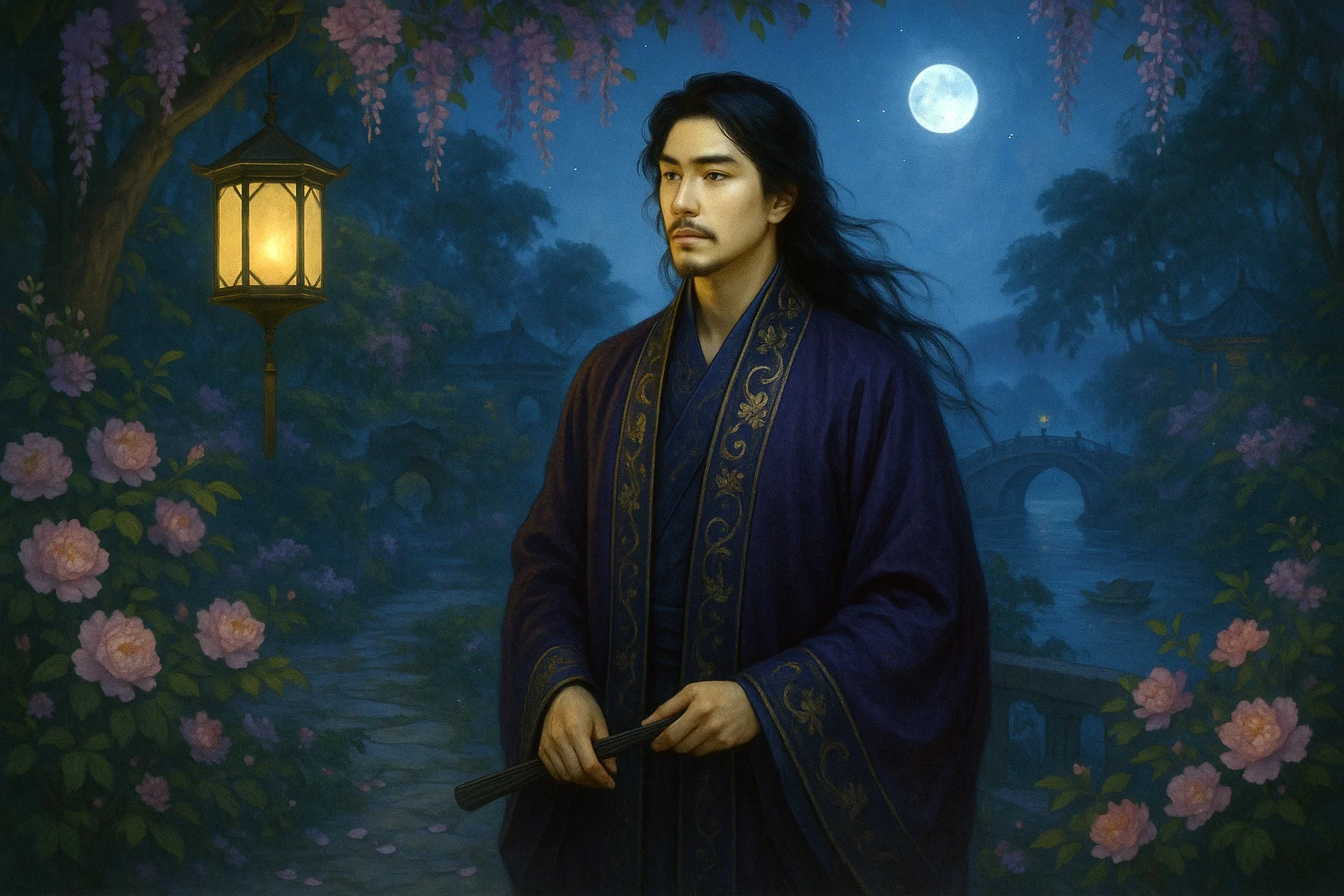
Li Shangyin (李商隐), 813 - 858 AD, was a great poet of the late Tang Dynasty. His poems were on a par with those of Du Mu, and he was known as "Little Li Du". Li Shangyin was a native of Qinyang, Jiaozuo City, Henan Province. When he was a teenager, he lost his father at the age of nine, and was called "Zheshui East and West, half a century of wandering".