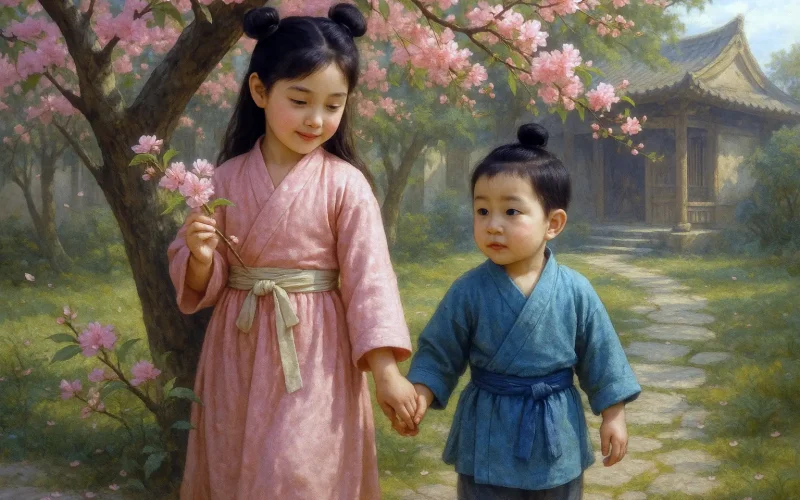
The Long River grieves over my long stay,
For my home is a thousand miles away.
Now blows the evening wind so high;
From mountain to mountain yellow leaves fly.
Original Poem
「山中」
王勃
长江悲已滞,万里念将归。
况属高风晚,山山黄叶飞。
Interpretation
This is a traveler’s homesick poem by the Early Tang poet Wang Bo. Wang Bo was renowned for his talent from a young age, and is ranked alongside Yang Jiong, Lu Zhaolin, and Luo Binwang as one of the "Four Paragons of the Early Tang." However, his life was marked by great talent and ill fortune: he was expelled from the court of the Prince of Pei for a satirical piece, Proclamation Against the Prince of Ying’s Cocks, and later sentenced for killing a government slave, an offense that led to his father’s banishment to Jiaozhi. This poem was likely composed during Wang Bo’s sojourn in the Sichuan region, a period of career setbacks. Roaming the heartland of Shu, he beheld the desolate autumn mountains and the swirling yellow leaves, feelings of endless sorrow as a long-staying wanderer yearning for home surging in his heart.
The poet’s body is in Sichuan, his heart longs for home. The endless, flowing Yangtze River seems to him to "悲已滞" (bēi yǐ zhì, grieve, already stagnate)—as if even the river’s current is stagnating with his sorrow; the journey home, ten thousand li away, feels ever more distant and remote. Just at this moment, the autumn wind rises, and yellow leaves from the full mountains swirl down; the desolation of autumn and the poet’s inner loneliness completely merge in this instant. The entire poem comprises only twenty characters, yet it concentrates within them the vastness of distance, the length of time, the depth of autumn’s mood, and the weight of a traveler’s sorrow, making it a quintessential example of Wang Bo’s concise, potent style where scene and emotion perfectly fuse.
First Couplet: “长江悲已滞,万里念将归。”
Cháng Jiāng bēi yǐ zhì, wàn lǐ niàn jiāng guī.
The Yangtze also seems to grieve for me, its flow stagnated; I long for my home ten thousand li away, yearning to return.
The poem opens by projecting subjective emotion onto an objective scene. "长江悲已滞" (Cháng Jiāng bēi yǐ zhì, The Long River grieves, already stagnate): the Yangtze River is inherently without feeling, yet the poet says it feels "grief," says it "has stagnated"—that ceaselessly flowing river, in his eyes, seems to have stagnated, burdened by too much sorrow. The two words "已滞" (yǐ zhì, already stagnate) are both a portrayal of the poet’s long-stagnant situation in a foreign land and a masterful technique of externalizing inner melancholy onto the landscape. The next line, "万里念将归" (wàn lǐ niàn jiāng guī, ten thousand li, think, about to return), shifts from scene to feeling, speaking directly from the heart. "万里" (wàn lǐ, ten thousand li) emphasizes the immense spatial distance; "念将归" (niàn jiāng guī, long for, about to return) points to the urgency of homesickness. These two lines, from the spatial and psychological dimensions, vividly depict the poet’s mournful plight, far from home and stranded in a foreign place.
Final Couplet: “况属高风晚,山山黄叶飞。”
Kuàng shǔ gāo fēng wǎn, shān shān huáng yè fēi.
Moreover, it is the time of high winds and dusk; on mountain after mountain, yellow leaves fly.
This couplet is purely scenic description, yet it pushes the emotion to a deeper and more profound realm. The two words "况属" (kuàng shǔ, moreover, it belongs to) connect the sorrow of the preceding lines with the autumn scene before the eyes in a progressive stroke—sorrow is already hard to dispel, and on top of that, he encounters this season of desolate autumn winds and swirling yellow leaves. The three words "高风晚" (gāo fēng wǎn, high wind, evening) exhaustively describe the chill and severity of an autumn dusk; the five words "山山黄叶飞" (shān shān huáng yè fēi, mountain mountain, yellow leaves, fly) outline, with the most economical brush, a picture of yellow leaves dancing in the wind across the mountains. This word "飞" (fēi, to fly) describes both the swirling of the leaves and the fluttering of the poet’s thoughts; the two words "山山" (shān shān, mountain mountain) describe both the mountains everywhere and the omnipresence of sorrow. The poet concludes feeling with scene, entrusting all his unrelievable homesick sorrow to these sky-full, swirling yellow leaves. Shen Yifu, a Southern Song lyricist, stated in his Guides to the Ballad: "以景结情最好" (yǐ jǐng jié qíng zuì hǎo, using scene to conclude feeling is best)—this poem is a perfect example: the words end, but the meaning is endless, leaving readers boundless space for imagination.
Holistic Appreciation
This is a transcendent work among Wang Bo’s travel poems. In four lines and twenty characters, using the mountain autumn scene as its entry point, it merges the sorrow of stagnation, the eagerness for return, and the desolation of autumn, revealing the poet’s bitter state of mind as a long-term sojourner in a foreign land.
Structurally, the poem presents a progressive layering, moving from feeling to scene, with feeling deepening because of the scene. The first couplet opens with the personification of "长江悲已滞" (Cháng Jiāng bēi yǐ zhì, The Long River grieves, already stagnate), projecting subjective emotion onto the objective scene, then directly expresses feeling with "万里念将归" (wàn lǐ niàn jiāng guī, ten thousand li, think, about to return), clearly stating the theme of homesickness; the final couplet uses the two words "况属" (kuàng shǔ, moreover, it belongs to) to pivot, placing the preceding sorrow within the setting of the autumn wind and yellow leaves, concluding the whole piece with the scenic language of "山山黄叶飞" (shān shān huáng yè fēi, mountain mountain, yellow leaves, fly). Between the two couplets, the movement is from feeling to scene, from inner to outer; feeling deepens because of the scene, the scene grows sadder because of the feeling—a seamless whole.
Thematically, the poem’s core lies in the contrast between the word "归" (guī, to return) and the word "飞" (fēi, to fly). That "念将归" (niàn jiāng guī, long for, about to return) expresses the destination the poet yearns for day and night; that "黄叶飞" (huáng yè fēi, yellow leaves fly) is the rootless drifting before his eyes. Between this "return" and this "flying" lies the poet’s deepest helplessness: the swirling yellow leaves will, in time, return to their roots; but he, adrift ten thousand li away, sees no hope of return. The poet does not state this meaning directly, but lets the reader comprehend it through this contrast—the highest realm of subtle artistry.
Artistically, the poem’s most moving feature is the skillful use of "concluding with scene, subtle and meaningful" (yǐ jǐng jié qíng, hánxù juànyǒng). The poet does not exhaustively express his sorrow; he concludes with only the five words, "山山黄叶飞" (shān shān huáng yè fēi, mountain mountain, yellow leaves, fly), allowing the reader, amid these mountain-full swirling leaves, to feel the poet’s similarly adrift and rootless state of mind. This technique of entrusting boundless feeling to a limited scene is the highest realm of classical Chinese poetry, as captured in the phrase "言有尽而意无穷" (yán yǒu jìn ér yì wú qióng, words are exhausted, but meaning is endless).
Artistic Merits
- Scene and Feeling Fused, Feeling Lodged in Scene (qíngjǐng jiāoróng, yù qíng yú jǐng): Projecting subjective emotion onto the objective scene, making the "Yangtze" feel woe, the "yellow leaves" contain sorrow. The language of scene is the language of feeling; the physical images are images of the mind.
- Subjective and Objective Combined, Real and Unreal Intertwined (zhǔkè jiéhé, xūshí xiāngshēng): The first couplet uses the subjective to write the objective; the final couplet uses the objective to write the subjective. Between the real and unreal, emotion and scenery merge into one.
- Allusion Seamless, Meaning Profound (yòngdiǎn wú hén, yìyùn shēnyuǎn): It subtly resonates with the sentiment from Song Yu’s Nine Arguments: "悲哉秋之为气也,草木摇落而变衰" (bēi zāi qiū zhī wéi qì yě, cǎomù yáoluò ér biàn shuāi, Sorrowful, alas! is the breath of autumn, Withering and falling, the trees and plants decay and fade). It transforms and uses allusion without a trace, enriching the poetic meaning.
- Concluding with Scene, Resonance Lingers (yǐ jǐng jié qíng, yúyùn yōucháng): The five words "山山黄叶飞" (shān shān huáng yè fēi, mountain mountain, yellow leaves, fly) conclude the whole piece. The words end, but the meaning is endless, leaving readers boundless space for imagination.
Insights
With its mountain autumn scene, this poem speaks to an eternal theme—when one is at the world’s edge, nothing is more daunting than the rise of the autumn wind, the swirling of yellow leaves.
First, it allows us to see the "projection of emotion." The Yangtze River inherently has no sorrow or joy, yet the poet reads sorrow in it; yellow leaves inherently have no feeling, yet the poet sees drifting in them. This tells us: the world in our eyes is never the objective world, but a world tinted by the colors of our state of mind. When the heart holds sorrow, all things are sorrowful; when the heart yearns for return, all things point the way home.
On a deeper level, this poem prompts us to contemplate the power of "concluding with scene." The poet does not say how sorrowful he is; he only says, "山山黄叶飞" (shān shān huáng yè fēi, mountain mountain, yellow leaves, fly). Yet it is precisely these five words that allow all who read them to feel the autumn mood that assails the senses and the sorrow from which there is no escape. Truly powerful expression is often not about stating the emotion, but about letting the reader feel that emotion within the picture.
And most resonant is the feeling of "nowhere to return" in the poem. The yellow leaves swirl, yet they have a time to return to their roots; the poet drifts, with no hope for a return date. This contrast makes homesickness not just a longing, but a kind of insoluble desolation. It reminds us: home is not just a geographical belonging, but a resting place for the soul; true homecoming is not just the body’s arrival, but the soul’s settling.
This poem writes of an autumn day in the Early Tang, yet allows every wanderer adrift far from home to resonate with it. That gaze at "长江悲已滞" is the scenery in every traveler's eyes; that longing in "万里念将归" is the shared cry in every wanderer's breast; that picture of "山山黄叶飞" is, in every autumn, the shared sigh of countless souls adrift. This is the vitality of poetry: it writes of one poet's heart's concerns, yet speaks to the heart of every wanderer.
Poem Translator
Xu Yuanchong (许渊冲)
About the Poet
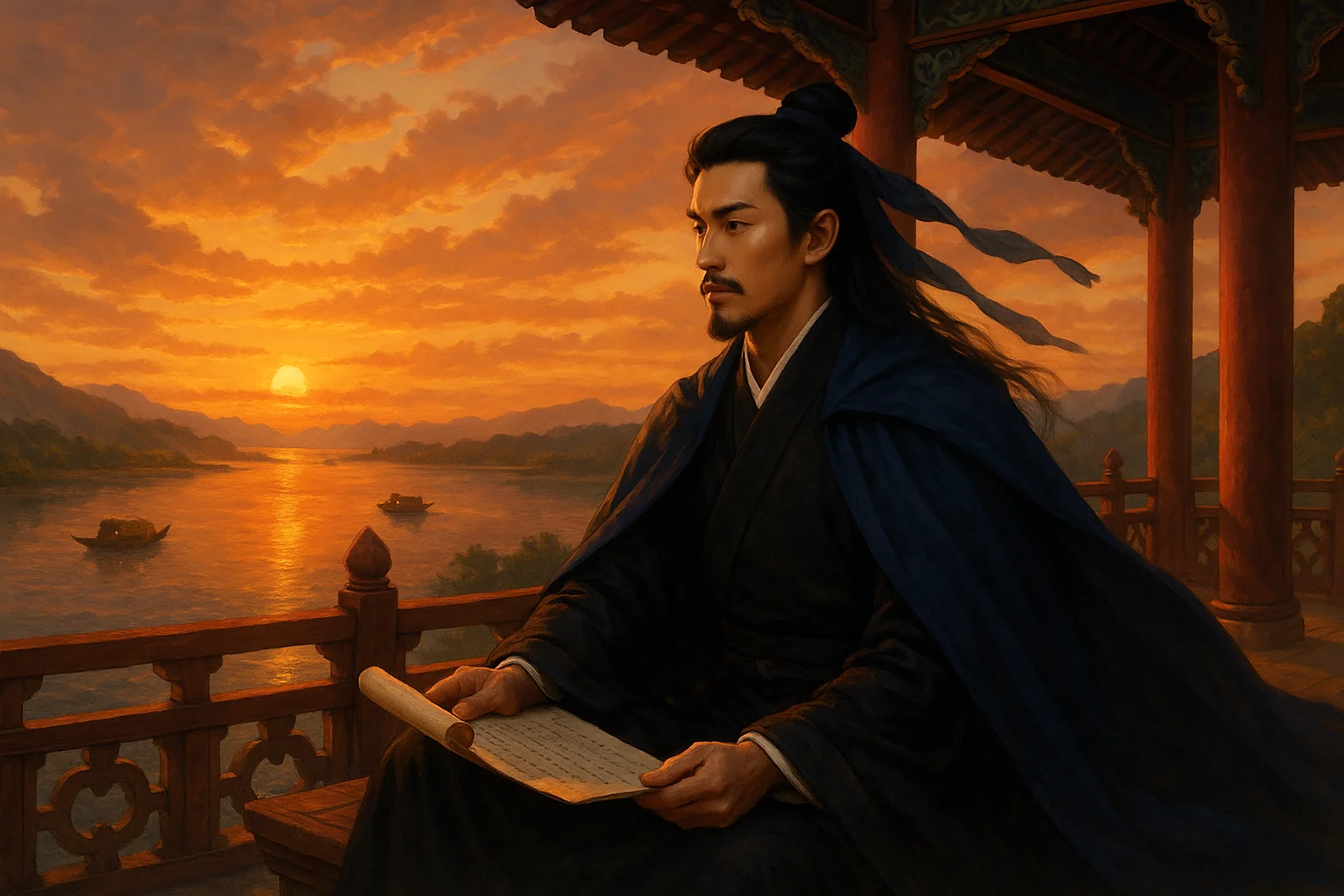
Wang Bo (王勃 c. 650 – 676), a native of Hejin, Shanxi Province, was a renowned writer of the Early Tang Dynasty and the foremost of the "Four Elites of the Early Tang." Exceptionally gifted from childhood, he could compose literary works at the age of six and passed the special imperial examination at sixteen, earning him the position of Gentleman for Court Service. Later, due to an incident, he was dismissed from office. In the third year of the Shangyuan era (676 AD), while crossing the sea to visit relatives, he fell into the water and died of fright at the young age of twenty-seven. His poetry and prose are celebrated for their abundant talent and grand vision. Wang Bo occupies a crucial position in the literary history of the Tang Dynasty. Together with Yang Jiong, Lu Zhaolin, and Luo Binwang, he collectively reversed the ornate and decadent literary style that had prevailed since the Qi and Liang dynasties, heralding the dawn of the resounding voice of the High Tang.