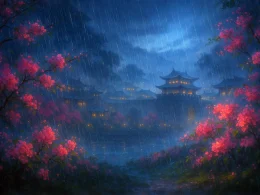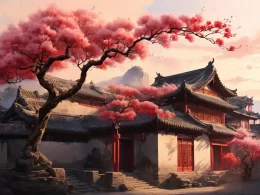



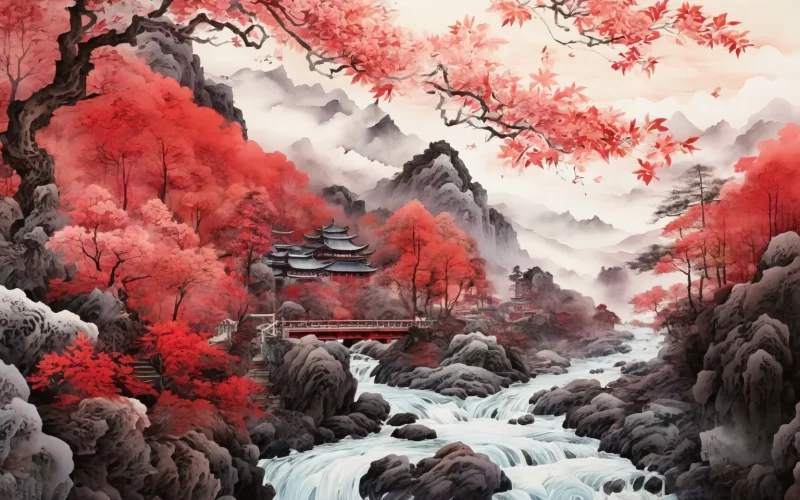
White pebbles hear a blue stream glide;
Red leaves are strewn on cold hillside.
Along the path no rain is seen,
My gown is moist with drizzling green.
Original Poem
「山中」
王维
荆溪白石出,天寒红叶稀。
山路元无雨,空翠湿人衣。
Interpretation
This poem was composed during Wang Wei’s later years of seclusion, representing the pinnacle of his landscape poetry style characterized by "infusing painting with Zen" and the fusion of mind and object. It depicts the sensory experience of walking in the mountains in early winter. The language is extremely spare, yet the conception is profoundly serene, building within a mere twenty characters a perceptual world that is both transparent and misty, both crisp and softly moist. It is not merely an objective depiction of natural scenery but, more importantly, a revelation of Zen insight arising from the complete interpenetration of the poet's mental state and the physical scene. It showcases the supreme artistic achievement of Wang Wei’s late poetry: "without using a single direct word, capturing the entire spirit."
First Couplet: 荆溪白石出,天寒红叶稀。
Jīng xī bái shí chū, tiān hán hóng yè xī.
White stones emerge from the stony stream, shallow and clear;
The heavens chill; the red leaves on the branches, few appear.
The opening sketches the visual essence of the early winter mountains with a nearly sketch-like touch. The five characters, "White stones emerge from the stony stream," unfold like a tracking shot: first, the name "Jing Stream" evokes a rustic, mountainous air; then, "white stones" leap forth—the stream must be extremely clear and shallow for the stones to distinctly "emerge." The word "emerge" (出) grants the white stones an active posture of manifestation, instantly evoking a sense of crystalline coolness. "The heavens chill; the red leaves… few appear" then turns to the bank: the chill is the season's declaration; "the red leaves… few" is the specific imprint of that declaration. The word "few" (稀) precisely captures the residual beauty of leaves that are almost, but not entirely, gone. There is no sorrow of decay; instead, there is a Zen-like sense of "simplifying complexity, discarding ornament to preserve the essential." One line depicts the water, the other the bank; one white, one red; one "emerging," one growing "few"—in this clean contrast, the essential framework of the early winter mountain scene is laid out.
Second Couplet: 山路元无雨,空翠湿人衣。
Shān lù yuán wú yǔ, kōng cuì shī rén yī.
No rain falls on the mountain path, the sky is dry,
Yet the empty azure dampens the traveler’s clothes, passing by.
This couplet is a divinely inspired brushstroke celebrated through the ages, elevating the poem from visual description to the realm of synesthetic philosophy. "No rain falls on the mountain path" is a statement of rational fact, like a calm footnote. "Yet the empty azure dampens the traveler’s clothes" is a perception that transcends reason, engaging the entire being. The phrase "empty azure" (空翠) is supremely clever: "azure" (翠) is the deep green of the mountain foliage, a visual impression; "empty" (空) etherealizes and diffuses this visual impression, transforming it into an all-enveloping atmospheric presence. This "empty azure" is not a physical entity, yet it produces the tactile effect of "dampen[ing] the clothes." Through this, the poet dissolves the boundaries between color (azure) and touch (dampness), between being (color) and emptiness (the illusory nature of the dampness). Whether the traveler's clothes are truly damp becomes unimportant; what matters is that the poet's (and the reader's) mind is already moistened by this boundless azure hue. The boundary between self and object quietly dissolves within the trance of perception.
Holistic Appreciation
This is a poem of enlightenment born from completely opened senses and a seamlessly natural conception. The poem's structure subtly contains a progression "from the concrete to the abstract, from sight to spiritual insight." The first two lines present the concrete reality seen by the eyes—glistening white stones, sparse red leaves—a clear projection of the material world. The last two lines present the transformed realm felt by the heart—the empty azure dampening clothes—a transcendental experience born from the deep fusion of mind and nature. The poet's walk is not merely physical movement but a meditative practice of perception.
In this poem, Wang Wei completely effaces the lyrical or discursive "I," yet allows the "I's" perception to permeate the presentation of every scene. The "emerging" white stones mirror the poet's clear and tranquil state of mind; the "few" red leaves represent his serene contemplation of fading splendor; the "empty azure" that "dampens the clothes" is, even more, the poet's intuitive realization of a state where "mind and object are both forgotten, and heaven and human unite as one." The entire poem is like a light-ink wash painting; the blank spaces are filled with Zen meaning, the brushstrokes are nothing but ultimate reality. It shows us that true landscape poetry is not a person describing scenery, but scenery naturally flowing into poetry through a person's mind.
Artistic Merits
- The Supreme Application of Synesthesia: "The empty azure dampens the traveler’s clothes" is a classic example of synesthesia in classical poetry. It transforms the visual "azure" into the tactile "dampen," and modifies it with "empty," emphasizing the non-physical, purely spiritual nature of this sensation. This breaks the limits of everyday sensory experience, reaching directly the perceptual realm of Zen's "interuse of the six senses."
- Philosophy of Color and Its Correspondence to Mind: The colors in the poem are highly symbolic. "White" is the base color of the stream stones and a metaphor for the innate purity of mind; "red" is a warm but fading color, hinting at the impermanence of worldly phenomena; "azure" is the pervasive, penetrating dominant color, representing nature's eternal vitality and the mind's vibrant vitality. The transition of these three colors precisely maps a spiritual journey from lucidity (white) through brilliance (red) to a return to harmonious fusion (azure).
- Poetic Intensification Through Negative Statement: The negation in "No rain falls on the mountain path" serves not realism but the poetic intensification of a turn. It first establishes common sense (no rain), then subverts it (damp clothes), making the ensuing transcendental experience more impactful and paradoxically reasonable, guiding the reader from the logical world into the poetic world.
- The Subtlety and Zen Insight of Verbs: The three verbs—"emerge" (出), "few" (稀, implying the process of thinning), and "dampen" (湿)—are all light yet deeply meaningful. "Emerge" is an inward revelation; "few" is nature's subtraction; "dampen" is a pervasive infiltration. Together, they point to a natural transformative process that is unforced and uncontrived, resonating with the Zen view of cultivation: "Let things follow their own course."
Insights
This work is like a clear spring, reflecting Wang Wei's late-life state of being where "the mind is like a bright mirror, reflecting things without leaving a trace." It reveals to us that true perception is not the passive reception of information but the active intermingling of the mind with the world. When our minds are sufficiently quiet and clear, a stretch of white stones, a few remaining red leaves, a mountain of empty azure—all can become opportunities to awaken inner awareness.
In our contemporary era of information explosion and sensory overload, this poem feels even more precious. It reminds us: perhaps we need to occasionally walk into our own "mountains," letting stream-like thoughts settle, letting troubles like red leaves naturally thin, and finally immersing ourselves in that state of complete experience where "the empty azure dampens the clothes"—a place with no analysis or judgment, only being and perceiving; no subject or object, only the wholeness of life's fulfillment. In twenty characters, Wang Wei has opened a mountain path for us leading to an inner realm of clarity and coolness. Walking it, we too might feel that "empty azure"—where no rain falls, yet the soul is moistened—gently brushing against our dust-covered senses.
Poem translator
Xu Yuanchong (许渊冲)
About the poet
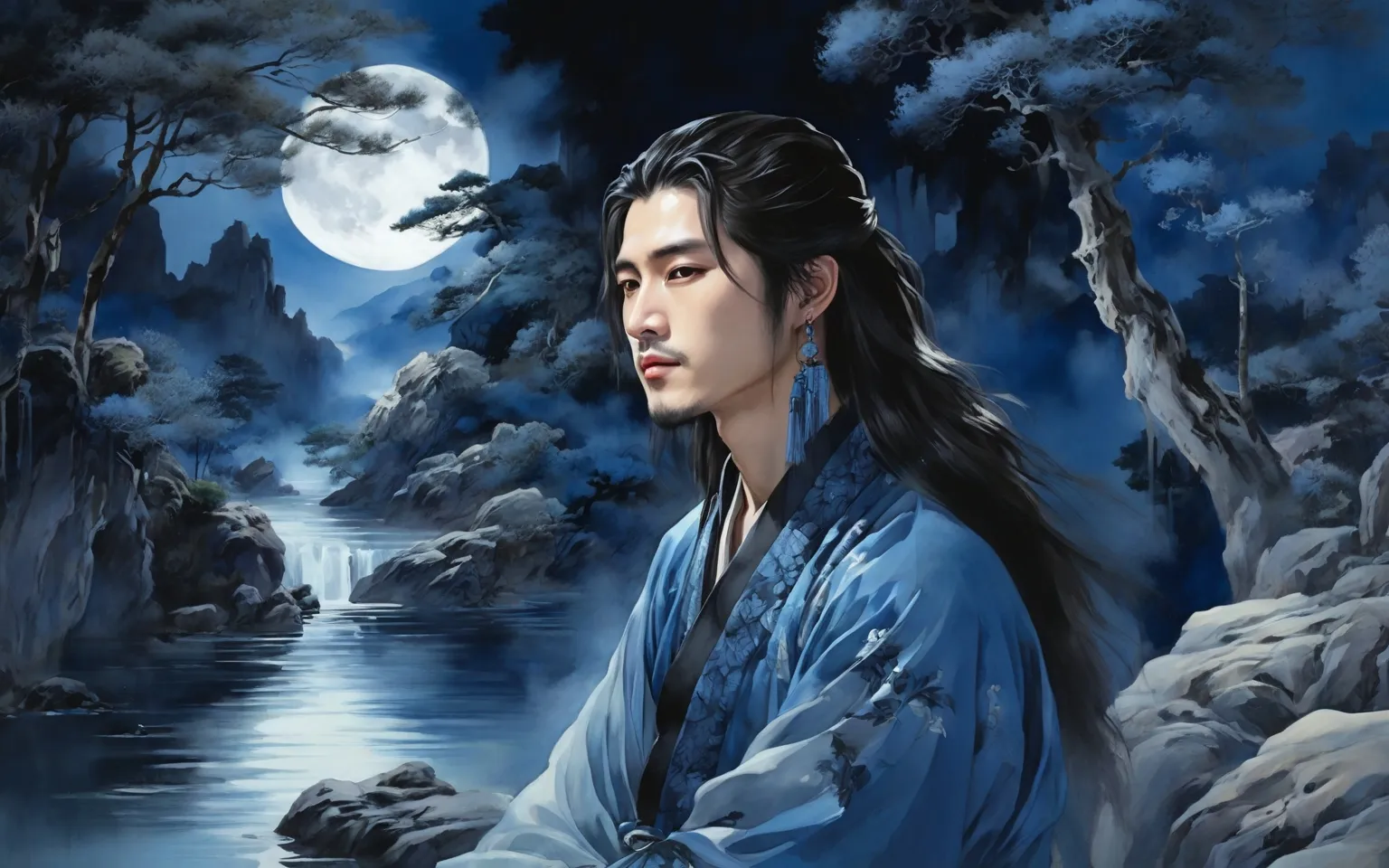
Wang Wei (王维), 701 - 761 A.D., was a native of Yuncheng, Shanxi Province. Wang Wei was a poet of landscape and idylls. His poems of landscape and idylls, with far-reaching images and mysterious meanings, were widely loved by readers in later generations, but Wang Wei never really became a man of landscape and idylls.