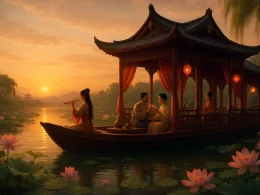



Returned beneath the precipice of sober grey,
I find the wattled hedge yet clad in hoar‑frost’s spray.

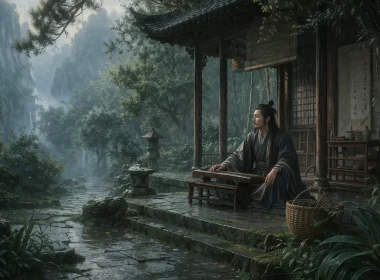
And now the quiet of the lute‑room seems more deep
And clear; and where the asters run to wildness, steep

In unkempt beauty, I with slow foot wander on.
The hill‑spring with the forest‑deer I drink upon;

Nor grudged the fruit to any holy man that came.
And oft I pluck the herbs of newly‑getted fame,

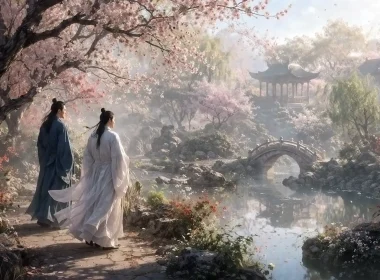
And cross the rocky bridge, companion of the cloud
That walks the silent ravine, wrapt in its own shroud.
Original Poem
「山居」
朱庆馀
归来青壁下,又见满篱霜。
转觉琴斋静,闲从菊地荒。
山泉共鹿饮,林果让僧尝。
时复收新药,随云过石梁。
Interpretation
This poem was composed during Zhu Qingyu's later years of seclusion in the mountains of Yuezhou. After resigning from his official post and returning to his hometown, he did not settle in the cottages of his old estate. Instead, he ventured deeper into the mountains, finding a dwelling at the foot of a green cliff, and began a life of true mountain seclusion. This was not a whim, but a choice made after deep contemplation. In his early years in officialdom, he had witnessed enough scheming and hypocrisy, growing increasingly certain that that path was was not what he wanted. When he finally hung up his official cap and left, he originally thought he would spend his remaining years in the rural cottages. Yet he discovered an even deeper call within his heart—to go deeper into the mountains and forests, to be farther from the dusty world, and closer to himself.
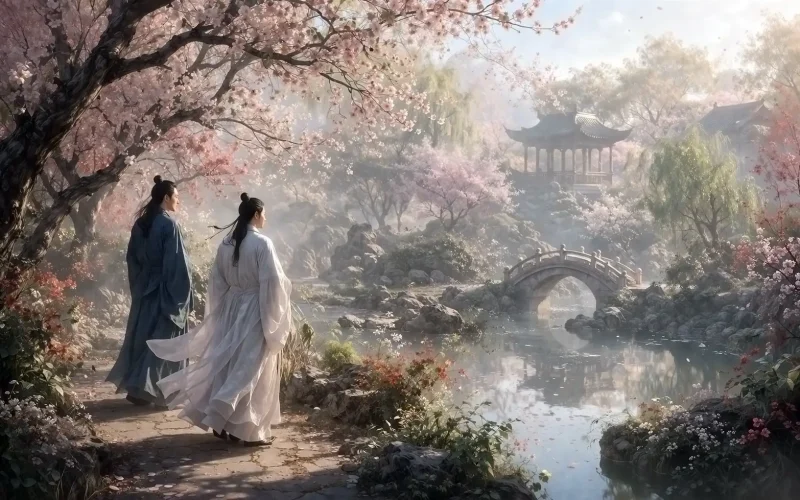
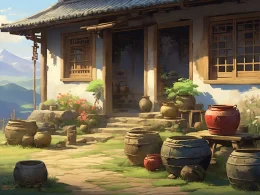
Thus came this dwelling at the foot of the green cliff. The house was not large, even crude one might say, but he felt it was just right. Far from any village, free from the clamor of carriages and horses, and the toil of official documents, there was only the changing mountain scenery with the seasons and the shifting cloud shadows from dawn to dusk. He cleared a small patch of wasteland, planted some medicinal herbs, and kept a qin. He lived among deer, befriended monks, and his daily activities consisted of nothing more than playing the qin, gathering herbs, observing the wild chrysanthemum patch, and drinking from the mountain spring. This poem describes his daily life in mountain seclusion—not a temporary excursion for sightseeing, but the real, day-to-day life of merging with nature. The word "又" (again) in "又见满篱霜" (again see frost filling the fence) reveals that he had already spent more than one autumn here; mountain dwelling had transitioned from novelty to settled life. The word "闲" (leisurely/idly) in "闲从菊地荒" (idly letting the chrysanthemum patch grow wild) is the ease that comes after letting go of worldly pursuits; he does not even bother to tend to the wild chrysanthemums. The actions of "山泉共鹿饮" (sharing mountain spring water with deer) and "林果让僧尝" (yielding forest fruits for a monk to taste) depict his daily harmonious coexistence with mountain creatures and those beyond worldly affairs—no possessiveness, no pretense, everything following its natural course. The figure in "随云过石梁" (following clouds across a stone bridge) is his transcendence upon returning from herb gathering, walking with the clouds, each step deliberate and unhurried. The entire poem contains not a single word explicitly about "seclusion" (隐), yet it is everywhere the life of a recluse; not a single line explicitly says "leisure" (闲), yet every line conveys the state of mind of one at leisure.
First Couplet: "归来青壁下,又见满篱霜。"
Guī lái qīng bì xià, yòu jiàn mǎn lí shuāng.
Returning beneath the verdant cliff, again I see frost filling the fence.
The poem opens with the two characters "归来" (returning), marking the beginning of mountain dwelling—this is not a first visit, but a "return," coming back to a place that is his own. "青壁下" (beneath the verdant cliff) describes the location of the dwelling: backed against a green mountain, the cliff's color emerald, secluded and cool. The next line, "又见满篱霜" (again I see frost filling the fence), uses the word "又" (again) to reveal that he has already spent more than one autumn here—the frost on the fence belongs to last year, and also to this year; it is the cycle of seasons, and also a witness to his years of mountain life. This word "又"is the first "eye" of the entire poem: it is not the curiosity of novelty, but the settled familiarity that comes after; it is not the surprise of a first arrival, but the calm of day after day. Within this couplet, the poet uses "归来" to write of belonging, and "又见" to write of the passage of time, conveying the stability and composure of mountain life with subtle depth.
Second Couplet: "转觉琴斋静,闲从菊地荒。"
Zhuǎn jué qín zhāi jìng, xián cóng jú dì huāng.
Turning, I feel the qin studio's quiet grows; at leisure, I let the chrysanthemum patch run wild.
This couplet shifts from the external scene to the indoor and courtyard space, writing of the spiritual life within mountain seclusion. "转觉琴斋静" (Turning, I feel the qin studio's quiet grows) describes the "静" (quiet) of the qin studio—this quiet is not a dead silence, but the clarity that comes after the mind is free of distracting thoughts. The word "转" (turning/feel) captures the subtle shift in mood upon moving from outdoors to indoors: the outside world is now distant, and the quiet of the qin studio becomes all the more distinct. The next line, "闲从菊地荒" (at leisure, I let the chrysanthemum patch run wild), describes the state of the chrysanthemum patch in the courtyard—chrysanthemums traditionally symbolize noble purity, yet the poet lets them grow "荒" (wild/overgrown), not tending to them deliberately. This word "荒"is the second "eye" of the poem: it is not laziness, but rather a letting go of the pretense of "picking chrysanthemums by the eastern hedge"; it is not neglect, but allowing nature to follow its own rhythm. The poet uses the two words "闲从" (at leisure, let) to describe his relationship with the chrysanthemum patch: he does not interfere, he simply "从" (follows/lets) it be natural. This kind of "wildness" is a higher form of "leisure."
Third Couplet: "山泉共鹿饮,林果让僧尝。"
Shān quán gòng lù yǐn, lín guǒ ràng sēng cháng.
With deer of the hills, I share the spring to drink; fruit from the woods, I yield for a monk to taste.
This couplet expands from the dwelling to the mountains, writing of the poet's harmonious coexistence with mountain creatures and those beyond worldly concerns. "山泉共鹿饮" (With deer of the hills, I share the spring to drink) describes him sharing the same spring water with deer—deer are spirits of the wild; being able to drink with them shows he has completely integrated into this mountain forest, is no longer a "guest," but part of the mountain. The next line, "林果让僧尝" (fruit from the woods, I yield for a monk to taste), describes him yielding the forest fruits for a monk to taste—the word "让" (yield) shows his humility and willingness to share, and also hints at the presence of monks in the mountains. This "共"(share/together with) and "让"(yield) are two key words of the poem: he is not a possessor, but a sharer; not a conqueror, but a co-inhabitor. This couplet vividly and warmly portrays the harmony and ease of mountain life.
Final Couplet: "时复收新药,随云过石梁。"
Shí fù shōu xīn yào, suí yún guò shí liáng.
From time to time, I gather freshly grown herbs; following the clouds, I cross the stone bridge.
The final couplet concludes with the image of returning from herb gathering, elevating the transcendence of mountain life to its peak. "时复收新药" (From time to time, I gather freshly grown herbs) describes one of his daily activities—gathering medicinal herbs. The two words "新药" (newly grown herbs/fresh herbs) refer both to the natural growth of mountain plants and the poet's sensitivity and curiosity towards the "new"—he does not gather for livelihood, but for interaction with the mountain forest and exploration of nature. The next line, "随云过石梁" (following the clouds, I cross the stone bridge), describes his posture upon returning—he follows the cloud shadows, walking across the stone bridge. The two words "随云"(following the clouds) are the third "eye" of the poem: he is not hurriedly rushing back, but walks in harmony with the clouds, deliberate and unhurried; that figure "过石梁"(crossing the stone bridge) seems to become part of the mountain scenery itself. Within this couplet, the poet uses "收新药" to write of daily life, and "随云" to write of transcendence, blending the simplicity and poetry of mountain life into one.
Holistic Appreciation
This is a representative work among Zhu Qingyu's mountain dwelling poems. The entire poem consists of eight lines and forty characters. Using the daily life of mountain seclusion as its thread, it unfolds layer by layer: the sense of belonging upon returning to the green cliff, the passage of time marked by frost filling the fence, the quiet of the qin studio, the wildness of the chrysanthemum patch, the harmony of sharing spring water with deer, the humility of yielding fruits to a monk, and the transcendence of gathering herbs and following clouds. It reveals the poet's clear state of mind after secluding himself in the mountains—merged with nature and reconciled with himself.
Structurally, the poem presents a progressive sequence from near to far, from stillness to movement. The first couplet describes the external scenery of the dwelling—"green cliff" and "fence frost", the first sight upon returning. The second couplet describes the indoor and courtyard space—"qin studio" and "chrysanthemum patch", the spiritual world of quiet abiding. The third couplet describes the mountain creatures—"mountain spring" and "forest fruits", the interaction with nature. The final couplet describes returning from herb gathering—"gathering fresh herbs" and "following clouds across a stone bridge", transcendence within daily activity. Between the four couplets, the poem moves from near to far, from stillness to movement, from settledness to ease, progressing layer by layer, forming a seamless whole.
Thematically, the core of this poem lies in the resonance between the word "又" (again) and the word "随" (follow). The "又" in "又见满篱霜" (again see frost filling the fence) is the sedimentation of time, the accumulation of years in mountain seclusion. The "随" in "随云过石梁" (following clouds across a stone bridge) is the unfolding of space, the synchronicity of the heart with nature. Between this "又" and "随" lies the poet's complete understanding of mountain life: it is not a temporary escape, but a long-term settlement; it is not deliberate reclusion, but ease that follows the natural course.
Artistically, the poem's most moving aspect lies in the plain technique of "revealing transcendence through the everyday, writing profundity through understatement." The poet does not describe spectacular mountains and exotic waters, nor earth-shattering events; he only writes of ordinary images like fence frost, qin studio, chrysanthemum patch, mountain spring, forest fruits, fresh herbs, and a stone bridge. He does not express passionate emotions, only uses plain words like "转觉" (feel/turning to feel), "闲从" (at leisure, let), "共" (share/together with), "让" (yield), and "随" (follow). Yet it is precisely this ordinariness and plainness that makes the poem's realm feel exceptionally genuine and intimate. The "wildness" in "闲从菊地荒" (idly letting the chrysanthemum patch grow wild) is the naturalness that comes after letting go of pretense. The "following" in "随云过石梁" (following clouds across a stone bridge) is the composure of moving in sync with heaven and earth.
Artistic Merits
- Ordinary Imagery, Profound Artistic Conception: Incorporating ordinary images like green cliff, fence frost, qin studio, chrysanthemum patch, mountain spring, forest fruits, fresh herbs, and stone bridge into the poem, constructing a tangible, palpable world of mountain dwelling.
- Exquisite Verbs, Rich Meaning: "转觉" (feel) conveys a change in mental state; "闲从" (at leisure, let) conveys an attitude of letting go; "共" (share) and "让" (yield) convey harmonious coexistence; "随" (follow) conveys a transcendent posture. Each word is plain, yet each is remarkably vivid.
- Natural Structure, Clear Layers: Moving from outer to inner, from near to far, from stillness to movement, the four couplets are interlinked like a slowly unfurling scroll of mountain life.
- Revealing Transcendence through the Everyday, Writing Profundity through Plainness: Not writing about the "loftiness" of reclusion, but only the "ordinariness" of mountain dwelling, finding extraordinary clarity and ease within the day-to-day ordinary.
Insights
Through the daily life of mountain dwelling, this poem speaks to an eternal theme—True reclusion is not escaping the dusty world, but finding peace for body and mind amidst mountains and waters. True ease is not idleness, but merging with all things within the ordinary.
First, it lets us see "settlement within time." "Again I see frost filling the fence"—the word "again" reveals the poet has spent more than one autumn here. Mountain dwelling is not a temporary novelty, but the perseverance of day after day; it is not an occasional escape, but a long-term belonging. It reminds us: True tranquility is not occasional emptying of the mind, but the composure that comes after the sedimentation of time.
On a deeper level, this poem makes us contemplate "the relationship with all things." "With deer of the hills, I share the spring to drink; fruit from the woods, I yield for a monk to taste"—the poet is not the master of the mountain, but part of the mountain. He drinks with deer, shares with monks, does not possess, does not plunder, but coexists as an equal. It makes us understand: True ease is not conquering nature, but merging with nature; it is not possessing resources, but sharing with all things.
And what is most memorable is that transcendent quality of "following clouds across a stone bridge." Upon returning from gathering herbs, he is in no hurry to go home, but walks "following the clouds"—where the clouds go, he goes; where the stone bridge is, he crosses. No purpose, no plan, only the composure of the present moment. This posture of "following the clouds" is the freedom that comes after letting go of all attachments, the broad-mindedness of moving in sync with heaven and earth.**
This poem is about mountain dwelling in the Mid-Tang era, yet it allows everyone longing for tranquility amidst noise and ease amidst busyness to find resonance within it. That place of return "beneath the verdant cliff" is the haven in the heart of every wanderer. The autumn sentiment of "frost filling the fence" is the scenery in the eyes of all who are at peace with time. The clarity of "the qin studio's quiet" is the inner voice of all who have let go of distracting thoughts. The spontaneity of "letting the chrysanthemum patch run wild" is the most natural posture of all who are no longer attached to "how things should be." The sharing in "sharing the spring to drink" and "yielding for a monk to taste" is the way of being in the world for all who understand the "oneness of all things." The figure of "following clouds across a stone bridge" is the silhouette left for the world by all who are truly at ease. This is the vitality of poetry: it writes of Zhu Qingyu's mountain dwelling, but one reads of people of all eras—those who find peace for body and mind amidst mountains and waters, and merge with all things within the ordinary.
About the Poet
Zhu Qingyu (朱庆馀 dates of birth and death unknown), also known by his given name Kejiu, was a poet of the Mid-Tang period, a native of Yuezhou (present-day Shaoxing, Zhejiang Province). He passed the jinshi examination in the second year of the Baoli era (826 AD) and held the position of Collator in the Imperial Library. His poetry excelled in the five-character regulated verse style, characterized by a refined and subtle elegance, with particular skill in depicting the emotions of boudoir women and palace maidens. In the Complete Tang Poems, two volumes containing 177 of his works are preserved. He was adept at using allegorical and metaphorical techniques, blending everyday emotions with political aspirations. Although not many of his poems survive, his exquisite craftsmanship secures him a unique place in the history of Tang poetry, with his poem Boudoir Sentiments becoming a quintessential example of the fusion of examination-themed and boudoir poetry in later generations.