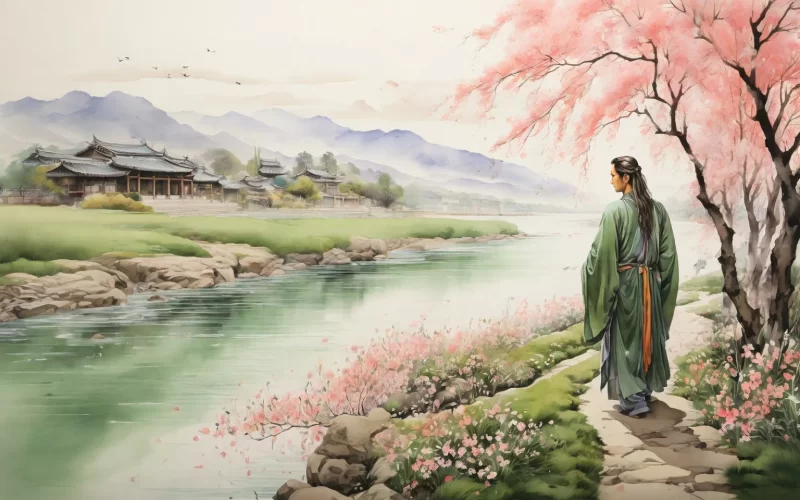



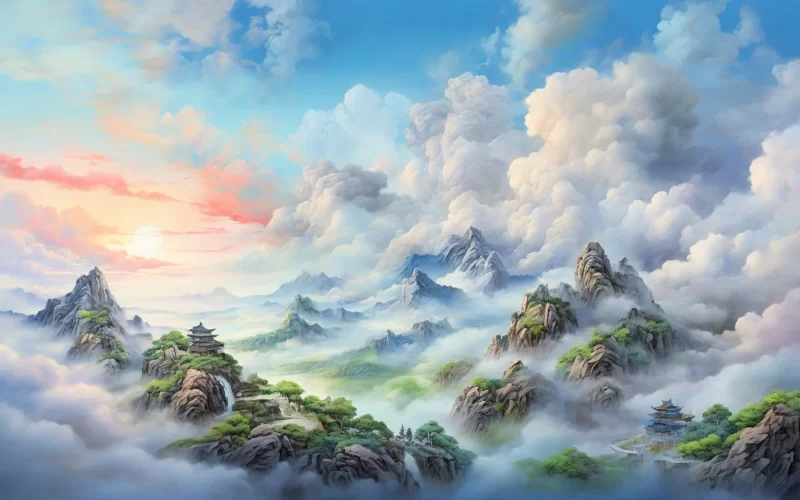
The pearly dews have chilled the maple woods to red;
The Gorge and Cliffs of Witch are steeped in boundless gloom.
Waves of upsurging river seem to vault the sky;
Dark clouds o'er mountains touch their shadows on the ground.

Twice full-blown, asters blown off draw tears from the past;
The lonely boat moored once and for all ties my heart to my homeland.
For winter robes are made all over with foot rule and scissors;
At sunset, in the City high, washing blocks pound hard.
Original Poem
「秋兴八首 · 其一」
杜甫
玉露凋伤枫树林,巫山巫峡气萧森。
江间波浪兼天涌,塞上风云接地阴。
丛菊两开他日泪,孤舟一系故园心。
寒衣处处催刀尺,白帝城高急暮砧。
Interpretation
This masterpiece serves as the prelude to Du Fu's series Eight Autumn Meditations, composed in the autumn of 766 CE, the first year of the Dali era under Emperor Daizong. At that time, the poet was residing in Kuizhou (present-day Fengjie, Chongqing). Although the An Lushan Rebellion had been suppressed, the nation remained weak, regional warlords held sway, Tibetan incursions persisted, and the entire empire was still mired in turbulence and uncertainty. Du Fu had drifted to Kuizhou for nearly two years, with no way to return home and no means to serve his country. The series, titled Autumn Meditations, uses the desolate scenery of autumn to evoke the poet’s vast and profound emotions regarding the nation’s decline, the twilight of life, and the passing of a golden age. This first poem acts as the overture to a grand tragedy, establishing with its majestic and sorrowful tone the emotional foundation for the entire cycle.
First Couplet: “玉露凋伤枫树林,巫山巫峡气萧森。”
Yù lù diāo shāng fēngshù lín, Wū Shān Wū Xiá qì xiāo sēn.
Jade‑like dew withers wounds the maple woods; / Through Witch’s Mountain, Gorge, a bleak and dreary air broods.
The opening is enveloped in an atmosphere of heavy, ornate decay. “Jade‑like dew” is itself a thing of crystalline beauty, yet it performs the cruel task of “withering wounds”—a contradictory description that hints at the fragility of beauty in the relentless march of time. “Witch’s Mountain, Gorge” are not merely geographical markers but cultural symbols, long associated in the Chu region with myth and melancholy. The two words “bleak and dreary” convey not only visual depth and gloom but also psychological oppression and chill, setting the tone of profound sorrow for the entire poem. Here, the poet’s personal state of mind and the mood of the era merge into one.
Second Couplet: “江间波浪兼天涌,塞上风云接地阴。”
Jiāng jiān bōlàng jiān tiān yǒng, sài shàng fēngyún jiē dì yīn.
Mid‑river waves surge upward, joining with the sky; / Frontier clouds press down, to the gloomy earth they tie.
The poet’s field of vision expands from mountain forests and gorges to a more vast and turbulent world. This couplet is renowned for its balanced parallelism and majestic imagery. “Mid‑river” and “frontier” juxtapose water and land; “surge upward, joining with the sky” and “press down, to the gloomy earth they tie” describe, respectively, an upward surge and a downward pressure, creating a suffocating sense of heaven and earth closing in, leaving no escape. This is not only the actual scene of the Three Gorges in Kuizhou but also a symbolic picture of the Tang Empire, battered by winds and waves, beset by internal troubles and external threats. The turbulence of nature directly mirrors the intense unrest in the poet’s heart and the broader historical landscape.
Third Couplet: “丛菊两开他日泪,孤舟一系故园心。”
Cóng jú liǎng kāi tā rì lèi, gū zhōu yī xì gùyuán xīn.
Chrysanthemums twice bloomed—tears for bygone days they start; / This lone boat moored—my homeland’s longing anchors in my heart.
The brush turns from the vast heavens and earth to focus on the minutiae of the self. “Twice bloomed” marks the passage of time, indicating that the poet has entered his second autumn in exile in Kuizhou. Each blooming brings not comfort but layers of past bitterness (“tears for bygone days”). The tears are shed for “bygone days,” showing that his grief has deep roots—a mixture of personal exile and the trauma of his country. The “lone boat” is the material support of his wandering life; “moored” signifies both anchorage and attachment, a bondage. That “my homeland’s longing” is “anchored” to the lone boat vividly expresses the eternal contradiction and pain of a heart that yearns to fly but a body that cannot move. This couplet exhibits exquisite parallelism and intense emotional concentration, a prime example of Du Fu’s technique of locking feeling within scenery.
Fourth Couplet: “寒衣处处催刀尺,白帝城高急暮砧。”
Hán yī chù chù cuī dāo chǐ, Báidì chéng gāo jí mù zhēn.
Winter robes—everywhere the shears and rulers hurry; / On White Emperor’s high walls, dusk’s pounding mallets flurry.
The poet’s attention shifts from himself to the surrounding social environment. “The shears and rulers hurry” and “dusk’s pounding mallets flurry” introduce sound into the poem, depicting a scene of universal busyness preparing for the coming winter. These sounds, arriving at dusk from the heights of the city walls, seem especially urgent, clear, cold, and unending. The sound of the fulling block, in the tradition of Chinese poetry, is an auditory symbol of boudoir longing, homesickness, and the suffering of soldiers on campaign. Here, the pounding from ten thousand households converges into the symphony of survival at the bottom of a troubled age. It both surrounds and stings the poet’s lonely heart, skillfully expanding personal sorrow into the common anxiety of countless homes, leaving a lingering resonance and endless sorrow.
Holistic Appreciation
This poem represents the pinnacle of Du Fu’s late-period artistry in regulated verse. Its greatness lies in achieving a perfect fusion of the “personal epic” and the “portrait of an era.” The entire poem takes “autumn” as its warp and “evoked feeling” as its weft, unfolding with a tightly layered structure that deepens progressively.
The first two couplets concentrate on constructing the “realm of autumn”: moving from the microcosmic withering of jade-like dew and maple woods, through the mesocosmic bleakness of the Wu Gorges’ atmosphere, to the macrocosmic turbulence of river waves and frontier clouds. As space expands continuously, the poetic atmosphere grows ever more vast and profound, building a stage of immense grandeur and equally immense oppression for the expression of emotion.
The latter two couplets focus on conveying the “stirred sentiment”: the immediate images of “chrysanthemums” and the “lone boat” draw forth the deeply accumulated “tears for bygone days” and “longing for home.” Then, through the surrounding sounds of “winter robes being cut” and “dusk’s urgent pounding of washing blocks,” the poet’s personal mood merges into the broader atmosphere of the entire age and society. Emotion flows from concentration toward diffusion, from the individual to the collective, achieving a powerful emotional transcendence.
The entire poem resembles a richly textured autumn scroll—somber in tone, measured in rhythm, and majestic in atmosphere. Every image is saturated with the shadows of the times and the poet’s own blood and tears, truly attaining that supreme artistic realm in which “feeling is born of scene, and scene is fused with history.”
Artistic Merits
- Precise Construction of an Imagistic System: Images such as “jade‑like dew,” “maple woods,” “waves,” “clouds,” “chrysanthemums,” “lone boat,” “shears and rulers,” and “dusk’s pounding” are not simply listed but together weave a multi‑layered, tension‑filled symbolic network, all pointing to the core themes of decay, turbulence, exile, and homesickness.
- Masterful Command of Parallelism: The parallelism in the two middle couplets is not only technically balanced and strict but also creates progression and complementarity in meaning. The “Mid‑river” couplet uses spatial grandeur to depict turbulence; the “Chrysanthemums” couplet uses accumulated time to express sorrow—one vast, one deep and subtle, each enhancing the other.
- Lyrical Technique of Interwoven Time and Space: “Twice bloomed” marks the passage of time; “tears for bygone days” pulls the past into the present. “Moored” is a spatial fixation, yet “homeland’s longing” points to a distant elsewhere. This interlacing and contradiction of time and space greatly deepen the layers and richness of emotion.
- Far‑Reaching Resonance of Concluding with Sound: The poem begins with visual imagery and ends with auditory imagery. The sound of the “pounding mallets” breaks the stillness of the scene, transforming boundless sorrow into perceptible sound waves that reverberate between twilight and high mountains, achieving the artistic effect of “the poem’s end meeting boundless vastness,” leaving an inexhaustible aftertaste.
Insights
This work shows us that poetry of the highest order can refine the most personal life experience into the most universal human emotion and historical echo. In the autumn of Kuizhou, Du Fu saw not only the withering of plants but the season of an entire civilization’s decline from peak to trough; what he lamented was not merely his own lack of a path home, but the spiritual exile and soul‑wandering of an era.
It reveals that the true spirit of “poetry as history” lies not in mechanically recording events, but in using an extremely sensitive and expansive heart to perceive the pulse of the times, transforming the weight of history into the intensity of emotion and the density of imagery. At the juncture where personal destiny and grand history violently rub against each other, Du Fu used poetry to erect an immortal monument, allowing us to see that even at the individual’s most difficult and powerless moment, the human spirit can still achieve, through art, a tragic and sublime fulfillment.
About the poet
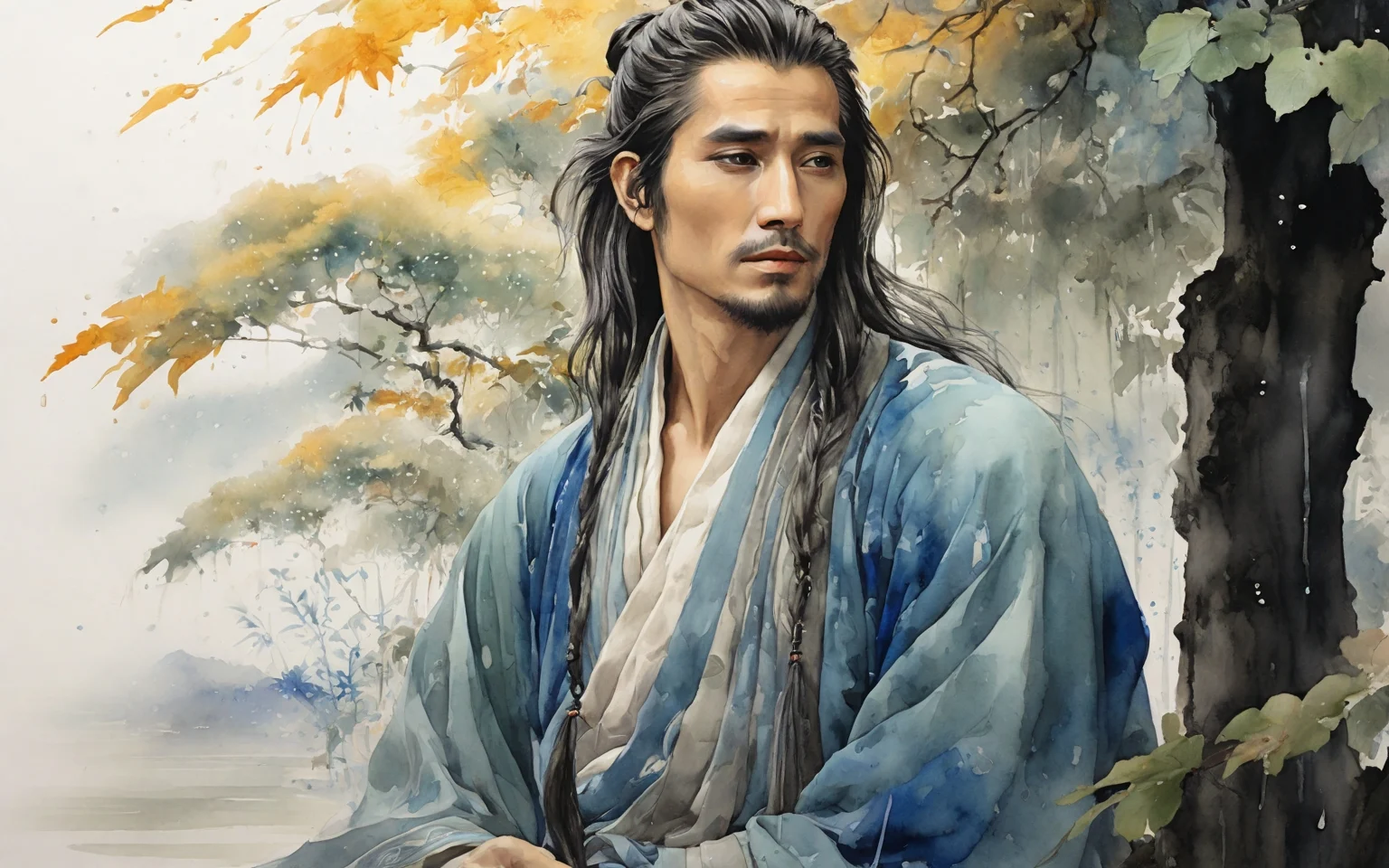
Du Fu (杜甫), 712 - 770 AD, was a great poet of the Tang Dynasty, known as the "Sage of Poetry". Born into a declining bureaucratic family, Du Fu had a rough life, and his turbulent and dislocated life made him keenly aware of the plight of the masses. Therefore, his poems were always closely related to the current affairs, reflecting the social life of that era in a more comprehensive way, with profound thoughts and a broad realm. In his poetic art, he was able to combine many styles, forming a unique style of "profound and thick", and becoming a great realist poet in the history of China.