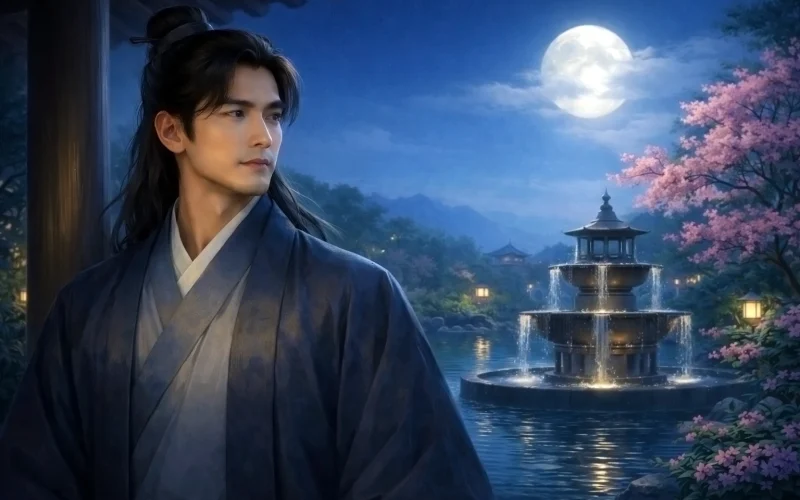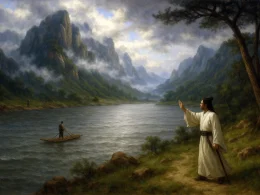
The traveler leans upon his wandering oar
When dusk comes creeping up the shore,
And just to cheer the lonely air
He sings a little travelling air.

But oh! the moon in the stream so clear
Is shining wonderful and near!
He laughs and tries to catch her beam —
“More light!” he cries, “more light to dream!”
Original Poem
「清溪泛舟」
张旭
旅人倚征棹,薄暮起劳歌。
笑揽清溪月,清辉不厌多。
Interpretation
This poem is a short lyrical landscape piece by the High Tang poet Zhang Xu. Zhang Xu was a famous calligrapher of the Tang Dynasty, renowned for his wild cursive script (caoshu), paired with Huaisu as the "Mad Zhang and Crazy Su" and historically called the "Sage of Cursive Script." He was a heavy drinker, often writing furiously after getting drunk, sometimes even using his hair dipped in ink to write. Upon sobering, he would regard his work as divinely aided, and his contemporaries called him "Mad Zhang." His calligraphy is known for its unrestrained momentum, unusual forms, and continuous, swirling strokes. His official career was undistinguished, serving in minor posts such as County Defender of Changshu and Chief of the Imperial Guard. In his later years, he resigned from office, retired to nature, and amused himself with poetry and wine. This poem was likely written while Zhang Xu was wandering the regions south of the Yangtze River. At that time, he had resigned and returned home, withdrawing from the world to travel afar. Known for his "madness," accompanied by wine, he indulged in mountains and rivers. At dusk, as his boat moved on the clear stream, the laborers' work songs arose. Leaning on the oar, half-drunk and half-awake, he saw the moon's reflection in the water, so crystal clear, that he actually laughed and reached out to "hold" it. The phrase "笑揽" (Laughing, I try to hold) is the vivid embodiment of "Mad Zhang's" true nature—not a refined scholar sitting quietly admiring the moon, but a wild wanderer indulging in nature; not a superficial appreciation, but the obsession of "The more crystal-clear, the more I like moonlight."
In classical poetry, those writing about travel by boat often express sorrow, and those writing about moonlit nights longing for people mostly tell of parting. Zhang Xu's poem, however, is unique. From the ordinary scene of dusk and work songs, with the unrestrained act of "Laughing, I try to hold the moon in the water," he transforms the sorrow of travel into the joy of indulgence; with the candid words "The more crystal-clear, the more I like moonlight," he transforms a fleeting scene into eternal delight. This technique of facing life with laughter and depicting nature with wild, unrestrained abandon is precisely a vivid portrayal of Zhang Xu's "poetry as the man, calligraphy as the man." He viewed landscapes with a calligrapher's eye and wrote poetry with the temperament of "Mad Zhang." Thus, the ordinary act of boating at dusk acquires an extraordinary, spirited brilliance. The entire poem is a mere twenty characters, yet it encompasses the traveler, the work songs, the clear stream, the bright moon, and the poet's wild, unrestrained state of indulging in nature. It is a crystal-clear slice of the transcendent, broad-minded spirit of High Tang literati.
First Couplet: "旅人倚征棹,薄暮起劳歌。"
Lǚ rén yǐ zhēng zhào, bó mù qǐ láo gē.
A traveler leans on the oar of his boat at dusk, When a boatman's song is heard on the stream.
The poem opens with a picture of boating at dusk. "旅人倚征棹" (A traveler leans on the oar of his boat) depicts the poet's posture leaning on the oar—the word "倚" (leans) conveys a temporary rest and leisure during the journey. "薄暮起劳歌" (When a boatman's song is heard on the stream) writes of the boatmen's work songs rising at twilight, breaking the silence of the water's surface. The term "劳歌" refers both to the boatmen's work chants and also to the traveler's chant of a journey. Between stillness and movement, man and boat, song and dusk, all merge into one. The traveler is no longer lonely; heaven and earth also come alive with the song.
Second Couplet: "笑揽清溪月,清辉不厌多。"
Xiào lǎn qīng xī yuè, qīng huī bù yàn duō.
Laughing, I try to hold the moon in the water; The more crystal-clear, the more I like moonlight.
This couplet is the soul of the entire poem, portraying the poet's fusion with nature with extremely romantic brushwork. "笑揽清溪月" (Laughing, I try to hold the moon in the water)—five words that capture the poet's unrestrained abandon and candidness. He is not quietly admiring the moon but "laughing" and trying to "hold" the moon in his embrace. The word "揽" (hold) makes the moon seem within reach, as if all things between heaven and earth can be embraced. The next line, "清辉不厌多" (The more crystal-clear, the more I like moonlight), concludes with the three words "不厌多", vividly expressing the poet's craving for the moonlight and his love for nature. The phrase "不厌" (the more... the more I like) is the "pivotal phrase" of the entire poem: it is not a superficial taste, but the more the better; it is not admiring from afar, but embracing to the fullest. In this couplet, with the unrestrained act of "laughing, I try to hold" and the obsessed words "the more... the more I like", the poet fully reveals his spiritual outlook of indulging in nature and transcending worldly vulgarity.
Holistic Appreciation
This is a masterpiece among Zhang Xu's landscape poems. The entire poem consists of four lines and twenty characters. Using a dusk boat ride as the entry point, it blends the traveler's momentary rest, the rhythm of the work songs, the unrestrained act of trying to hold the moon, and the craving for the clear moonlight, showcasing the poet's extraordinary enthusiasm and unrestrained passion for indulging in nature and transcending worldly vulgarity.
Structurally, the poem presents a progressive layering moving from stillness to motion, from outer to inner. The first couplet writes motion within stillness—"leans on the oar" is stillness, "a boatman's song is heard" is motion; the song breaks the silence, injecting vitality into the scene. The second couplet writes the inner within the outer—"try to hold the moon" is an external action, "the more... the more I like" is an internal feeling; "laughing, I try to hold" writes unrestrained abandon, "the more... the more I like" writes love. Between the two couplets, it moves from stillness to motion, from outer to inner, progressing layer by layer, forming a seamless whole.
Thematically, the core of this poem lies in the words "笑" (laughing) and "不厌" (the more... the more I like). That "笑" in "Laughing, I try to hold" is the poet's joy upon encountering nature, the externalization of a free spirit. That "不厌" in "The more... the more I like" is a craving for beautiful things, a love for life. Between this "laughing" and this "the more... the more I like" lies the poet's spiritual realm of indulging in nature and transcending worldly vulgarity—not becoming sorrowful because of travel, not becoming sentimental because of dusk, but rather, in every moment, in every scene, being able to find the joy of delighting together with heaven and earth.
Artistically, the poem's most moving aspect lies in the clever conception of "governing complexity with simplicity, writing stillness through motion." The poet uses "leans on the oar" to write stillness, "a boatman's song is heard" to write motion, "laughing, I try to hold" to write the interaction between man and nature, and "the more... the more I like" to write the love within. Within twenty characters, there is scene, sound, emotion, and attitude; the picture is vivid, full of charm and interest. This technique of writing an extremely rich realm with an extremely simple brush is precisely the highest state of Chinese classical poetry where "words end but meaning is inexhaustible."
Artistic Merits
- Using Motion to Contrast Stillness, Stillness and Motion in Harmony: Using the motion of "a boatman's song is heard" to contrast the stillness of "leans on the oar", the song breaks the silence, yet makes the leisurely vastness of heaven and earth even more apparent.
- Scene and Feeling Fused, Object and Self Merged: Using "Laughing, I try to hold the moon in the water" to write the fusion of man and nature. Scene contains feeling, feeling contains scene; both object and self are forgotten.
- Unrestrained Language, Soaring Unconventional Spirit: Phrases like "Laughing, I try to hold" and "the more... the more I like" fully display the poet's uninhibited, free-spirited personality; reading it is like seeing the man and hearing his voice.
- Achieving Much with Little, Full of Spirit and Resonance: The entire poem is only twenty characters, yet it encompasses character, environment, sound, and emotion. Within a short piece, spirit and resonance are seen; within simplicity and understatement, richness is seen.
Insights
This poem, through a single dusk boat ride, speaks to an eternal theme—on a hectic journey, one can still laugh and try to hold the moon in one's embrace; in ordinary scenery, one can still love to the extent of "the more, the better."
First, it lets us see "the poetry within the journey." A traveler leaning on the oar, work songs at dusk—originally an ordinary scene of travel. Yet the poet, within this ordinariness, discovers the poetry of "Laughing, I try to hold the moon in the water." It reminds us: Beauty is everywhere; the key lies in whether we have the eyes to discover it and the heart to embrace it.
On a deeper level, this poem makes us contemplate the power of "love." "The more crystal-clear, the more I like moonlight"—it is not dissatisfaction, but excessive love; it is not greed, but obsession. This craving for beautiful things where "the more, the better" is precisely a manifestation of vitality. It makes us understand: True love knows no upper limit; true life is about embracing fully.
And what is most lingering is the poem's unrestrained attitude of "facing life with laughter." Travel often brings much sorrow; dusk easily induces melancholy. Yet the poet, with the two words "laughing, I try to hold", transforms all melancholy into heroic sentiment. This posture of "facing life with laughter" is not ignorance of sorrow, but transcendence over it; it is not the absence of troubles, but not being trapped by them.
This poem writes of a boat ride in the High Tang, yet allows everyone seeking poetry amidst busyness to find resonance within it. That momentary rest of "leans on the oar" is every traveler's moment of peace. That rhythm of "a boatman's song is heard" is the rhythm of life for every laborer. That unrestrained posture of "Laughing, I try to hold the moon in the water" is the indulgent stance of everyone who loves life. That obsessed utterance of "The more crystal-clear, the more I like moonlight" is the truest voice in the hearts of everyone who discovers beauty in the ordinary. This is the vitality of poetry: it writes of Zhang Xu's boat ride, but one reads of people in all eras who, even on a journey, still love life.
About the poet
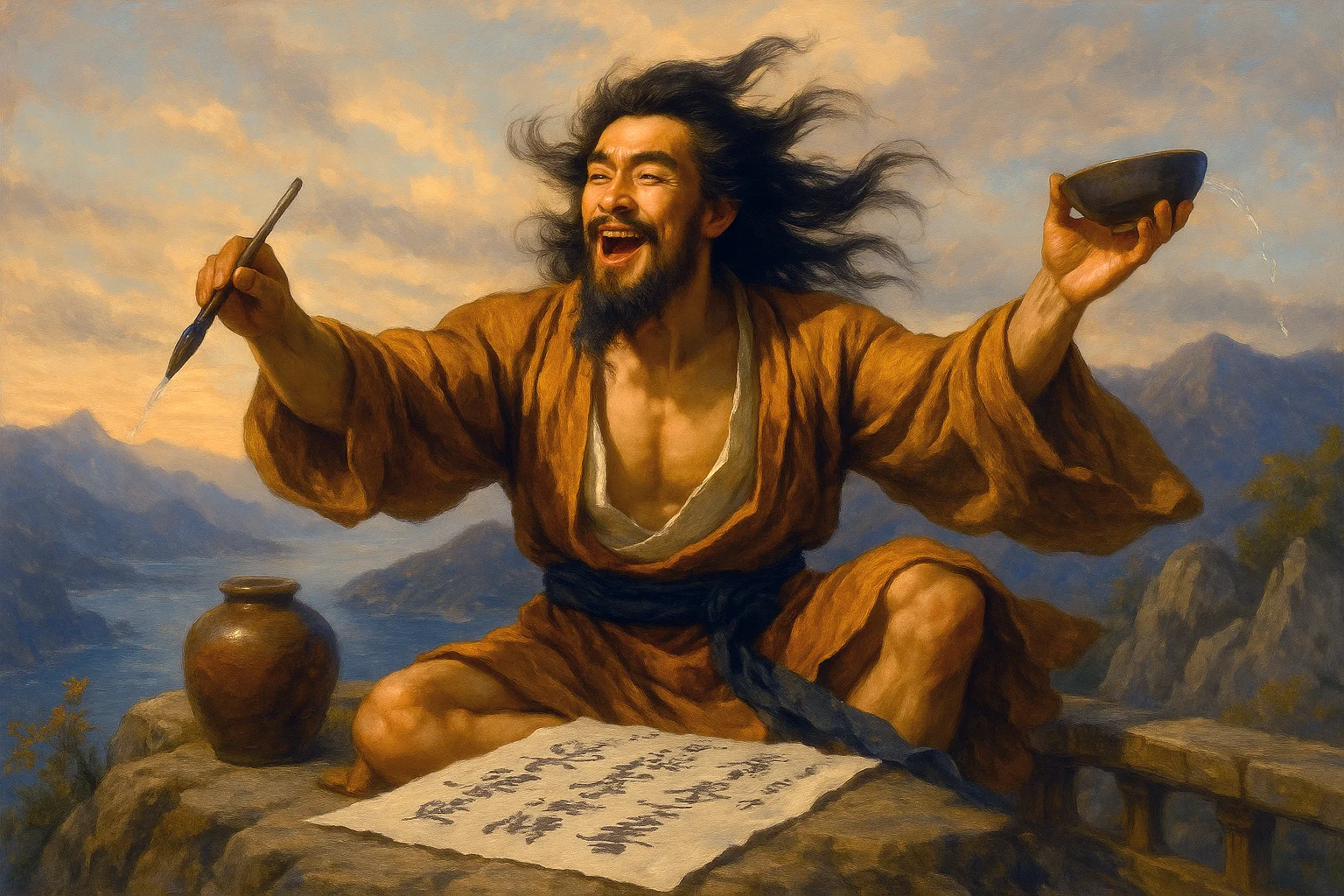
Zhang Xu (张旭 c. 675 - c. 750), a native of Suzhou, Jiangsu Province, was a renowned calligrapher and poet of the High Tang period. Born in the Early Tang but active during the High Tang, he was unrivaled in cursive calligraphy. His personality was wild and unrestrained, and he was famously addicted to wine. He often wielded his brush with great speed after drinking, sometimes even dipping his hair in ink. His contemporaries called him “Madman Zhang,” and Du Fu listed him as one of the “Eight Immortal Drinkers.” Although his poetic achievements were overshadowed by his fame in calligraphy, his poetry still embodies the spirit of the High Tang. His artistic hallmark lies in the “unity of calligraphy and poetry,” both distinguished by a seamless flow of energy and an untrammeled natural elegance.