


I have sailed upon the River of Yellow Blooms,
Following the course of this limpid green stream.
It coils ten thousand turns through the hills,
Though my journey is less than thirty miles long.

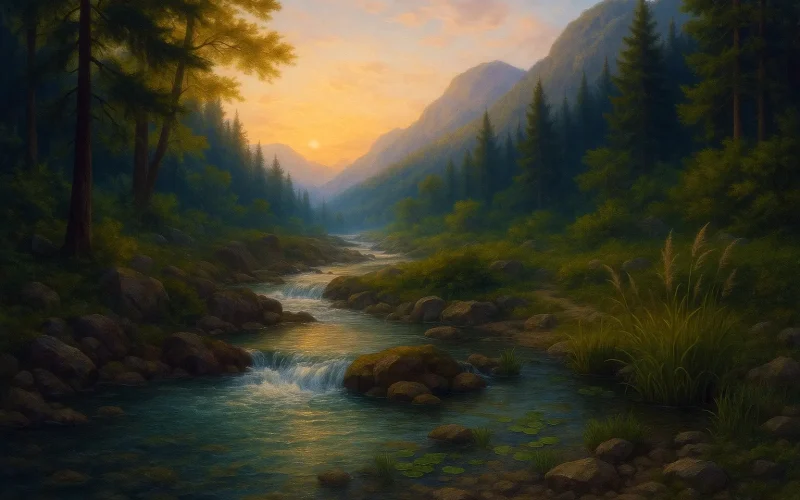
Rapids sing over rocks piled high;
Where light grows faint in the depth of pines,
Water-plantains sway on the placid surface,
And reeds grow lush along the banks.

Deep in my heart, I have always been as tranquil
As these clear waters…
Oh, to stay forever upon a broad, flat stone,
And cast my fishing line into this endless flow!
Original Poem
「青溪」
王维
言入黄花川,每逐青溪水。
随山将万转,趣途无百里。
声喧乱石中,色静深松里。
漾漾泛菱荇,澄澄映葭苇。
我心素已闲,清川澹如此。
请留盘石上,垂钓将已矣。
Interpretation
This poem stands as a luminously representative work of Wang Wei's early landscape poetry. It vividly illustrates how, at a pivotal turn in his life from officialdom towards nature, the poet used a single stream to conduct an exploration and, ultimately, a settling of his own soul. Composed likely during his initial reclusion at Lantian, a period of vacillation between public service and retirement, the entire poem traces the speaker's journey along the stream. It depicts not only the Green Stream's myriad twists and turns and its varied sights and sounds but also, through the repeated interplay of scene and state of mind, reveals the poet's complete spiritual journey from outward pursuit to inward affirmation, culminating in a state of psychic habitation. It is, in essence, a "stream of spiritual homecoming" charted with verse.
First Couplet: 言入黄花川,每逐青溪水。
Yán rù huánghuā chuān, měi zhú qīng xī shuǐ.
I enter the bounds of Yellow Flower River’s land;
And ever follow where the Green Stream’s waters flow.
The opening adopts a plain, narrative tone, stating a habitual, almost instinctive pursuit. "I enter" is a spatial initiation; "ever follow" denotes temporal repetition. The poet is not a casual visitor but one who "ever follow[s]"—repeatedly, consistently pursues it. This implies the Green Stream holds a continuous, mysterious allure for the poet, a fixed route for his spiritual wanderings. Yellow Flower River is the geographical starting point; the Green Stream is the soul-thread running through it.
Second Couplet: 随山将万转,趣途无百里。
Suí shān jiāng wàn zhuǎn, qù tú wú bǎi lǐ.
Following the hills, it coils and turns a thousand ways;
The winding path seems long, though the true course is short.
This couplet outlines the stream’s defining features, rich with philosophical metaphor. "Following the hills, it coils and turns" embodies the wisdom of adapting flexibly to external circumstance, and mirrors life’s circuitous path. "The winding path seems long, though the true course is short" speaks to the difference between appearance and essence: the perceived journey ("winding path") feels prolonged, while the actual physical distance ("true course is short") may not be great. This foreshadows the correspondence later between "my mind" and the "clear stream"—inner peace may lie just beyond the next "turn."
Third Couplet: 声喧乱石中,色静深松里。
Shēng xuān luàn shí zhōng, sè jìng shēn sōng lǐ.
Its voice is loud where it tumbles through ragged stones;
Its color grows serene deep under shadowy pines.
With masterful parallelism, the poet captures the stream’s two most dramatic aspects. "Voice… loud… through ragged stones" portrays a dynamic, effusive vitality, a release of conflict and energy. "Color… serene… under shadowy pines" depicts a static, introspective calm, a settling into harmony and depth. This contrast of "loud" and "serene," of "voice" and "color," not only animates the stream but also mirrors the dual states possible within the poet's (and any person’s) mind: agitation and tranquility, restlessness and peace.
Fourth Couplet: 漾漾泛菱荇,澄澄映葭苇。
Yàng yàng fàn líng xìng, chéng chéng yìng jiā wěi.
Rippling, it bears duckweed and water-mallows green;
Limpid, it mirrors reeds and rushes, crisp and clear.
The gaze shifts from the grand features to minute details, the rhythm gentling. "Rippling" describes the water’s soft movement, "limpid" its transparent clarity; "bears duckweed" is a vibrant close-up, "mirrors reeds" is a scene of intermingled reality and reflection. These lines depict the stream’s gentle, lucent, intricately beautiful aspect, a concentration of nature’s "grace" and "spirit." After the contrast of "loud" and "serene," the stream here reveals its most congenial, everyday face.
Fifth Couplet: 我心素已闲,清川澹如此。
Wǒ xīn sù yǐ xián, qīng chuān dàn rú cǐ.
My mind, by nature, ever was at rest and free;
And the clear stream, how placid its reflection seems!
This couplet is the poem’s emotional pivot and philosophical culmination, shifting abruptly from "observing the object" to "observing the mind." "By nature, ever was at rest" is the poet’s self-discovery and affirmation: this tranquility is not bestowed by the stream but is inherent within. "How placid its reflection seems" is the startling revelation: the external stream’s "placid" quality and the inner mind’s "rest" are, in fact, so alike, so identical. This is not simile, but resonance and confirmation on the level of being. The poet realizes in a flash: what he has been pursuing is not the stream itself, but that inner self, isomorphic to the stream, complete and sufficient from the start. The clear stream is a mirror, revealing the mind’s true nature.
Final Couplet: 请留盘石上,垂钓将已矣。
Qǐng liú pán shí shàng, chuí diào jiāng yǐ yǐ.
O let me linger on this solid rock’s broad base,
To cast my line, and thus bring all my days to end.
The poem concludes with a definitive gesture and an eternal pledge. "Solid rock" symbolizes something firm, stable, dependable, contrasting with the flowing stream—a point of stillness sought within a turbulent world. "To cast my line" is a classic image of reclusion, but here signifies more a poetic choice of existential mode—not utilitarian fishing, but contemplative stillness in the company of the clear stream, reconciled with time. The phrase "thus bring all my days to end" carries a tone peaceful yet resolute. It is a closure of the pursuits of a former life and a solemn inauguration of a new way of living (reclusion).
Holistic Appreciation
This is a travelogue-cum-poem of enlightenment, with the stream as its warp and the mind as its weft. Its structure subtly follows the complete spiritual journey of "setting forth—experience—discovery—realization—homecoming." The first couplet is the departure (pursuit), the second the overview (cognition), the third and fourth the close inspection (experience), the fifth the epiphany (discovery), and the final couplet the destination (choice). This Green Stream, initially an object of excursion, ultimately becomes the poet’s spiritual confidant and life’s final abode.
Wang Wei’s profundity lies in not simplistically viewing nature as an escape from reality, but as a mirror to reflect the original mind, a test of existence. The correspondence between "my mind" and the "clear stream" is not an imposition of subjective feeling (pathetic fallacy), but a recognition of objective congruence (confirmation). Through deep interaction with the stream, the poet gradually recognizes his mind’s original state ("by nature, ever was at rest"). Therefore, the final "thus bring all my days to end" is not a negative withdrawal, but an active return—a return to the authentic self, obscured by the dusty world, yet mirrored in the clear stream.
Artistic Merits
- Parallel Trails: Physical Journey and Mental Journey: The poem contains both a clear trajectory of spatial movement (entering the region, following the water, passing ragged stones, going through deep pines, seeing duckweed, mirroring reeds, staying on the rock) and a corresponding trajectory of inner change (pursuit, observation, contrast, appreciation, realization, resolution). The interweaving and progression of these inner and outer threads creates a structure both rigorous and richly layered.
- Parallelism Revealing Nature’s Rhythm: "Voice… loud" parallels "color… serene" (hearing vs. sight); "through ragged stones" parallels "under shadowy pines" (constriction vs. depth); "rippling" parallels "limpid" (movement vs. stillness); "bears duckweed" parallels "mirrors reeds" (real image vs. reflection). This precise parallelism is not mere formal beauty but poetically reveals the fundamental rhythm of nature as unity of opposites.
- The Melodic Beauty of Verbs and Reduplication: Verbs like "follow," "coils," "turns," "loud," "serene," "bears," "mirrors" are accurate and dynamic. Reduplicated words like "rippling" and "limpid" enhance the musicality of the language and the soft beauty of the scene, together creating a poetic rhythm that is light yet serene.
- The Philosophy of Verbs: From "Follow" to "Linger": The poem begins with "follow" (active pursuit) and ends with "linger" (active abiding). This shift from "follow" to "linger" marks the poet’s fundamental shift in stance from pursuing the external to dwelling in the internal.
Insights
This poem flows like a spiritual guide on paper, demonstrating how deep dialogue with nature can lead to self-knowledge and life orientation. It reveals that each of us may have a "Green Stream" within—a natural setting or spiritual activity that quiets us and reflects our authentic self. The key is not blindly "following" external things, but learning, in our encounter with it, to "linger," listening for the resonance between it and your inner mind ("My mind, by nature, ever was at rest and free; / And the clear stream, how placid its reflection seems!").
In the busyness and noise of modern life, we often, like the poet at the poem’s start, unconsciously "follow" various goals, information, and desires. This poem invites us to occasionally pause, seek our own "Green Stream," and, enlightened by its "thousand ways" of turning and its "placid reflection," recognize our essentially "restful" nature and find that life-anchoring "solid rock" from which we can peacefully "cast our line." This may not be literal retirement to the mountains, but an inner stability and clarity allowing us, amidst worldly turmoil, to retain the peace and transparency of the "clear stream."
Wang Wei’s Green Stream flows not only through the hills of Lantian but should also flow through the heart of every modern person yearning for peace.
Poem translator
Kiang Kanghu
About the poet
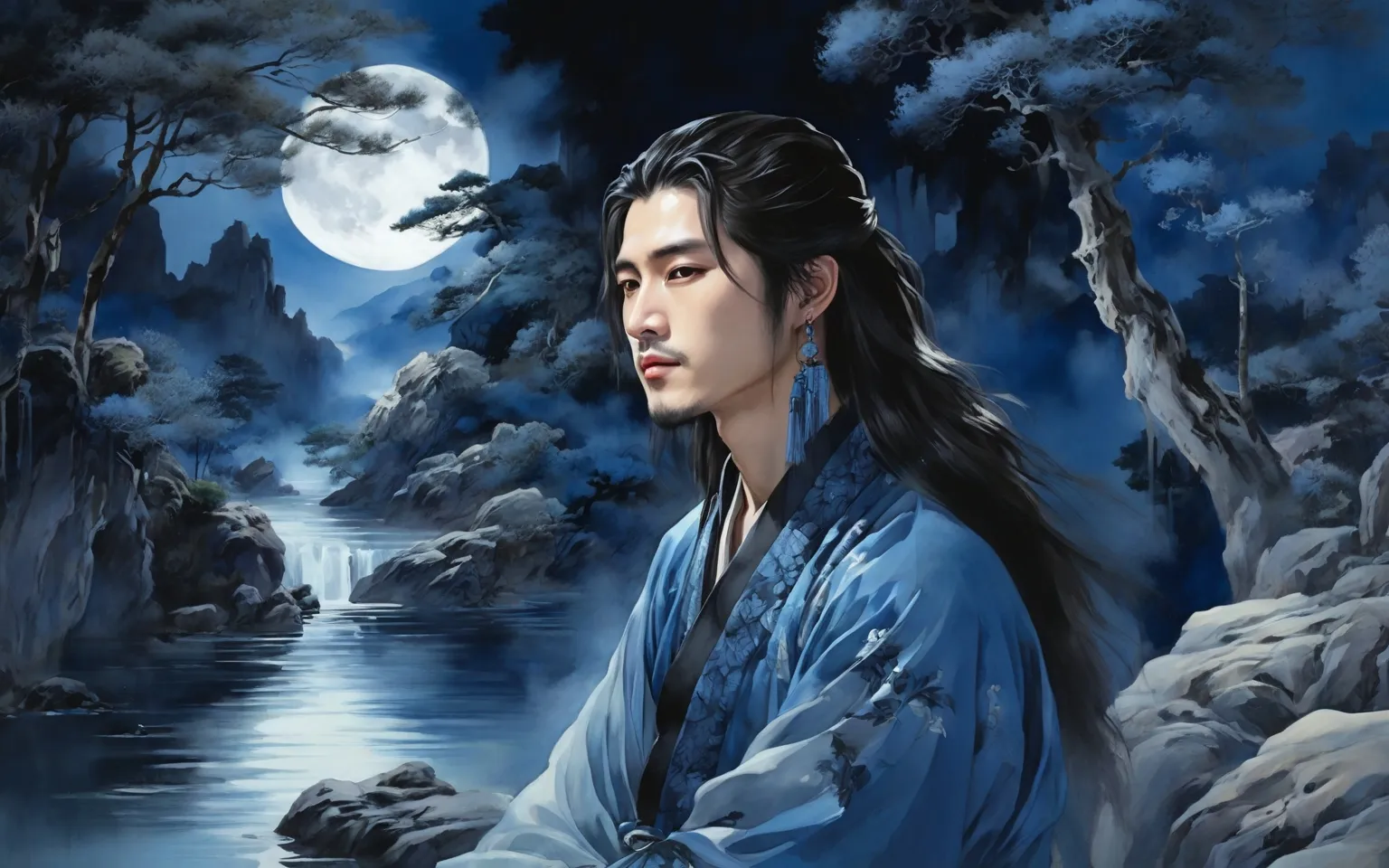
Wang Wei (王维), 701 - 761 A.D., was a native of Yuncheng, Shanxi Province. Wang Wei was a poet of landscape and idylls. His poems of landscape and idylls, with far-reaching images and mysterious meanings, were widely loved by readers in later generations, but Wang Wei never really became a man of landscape and idylls.