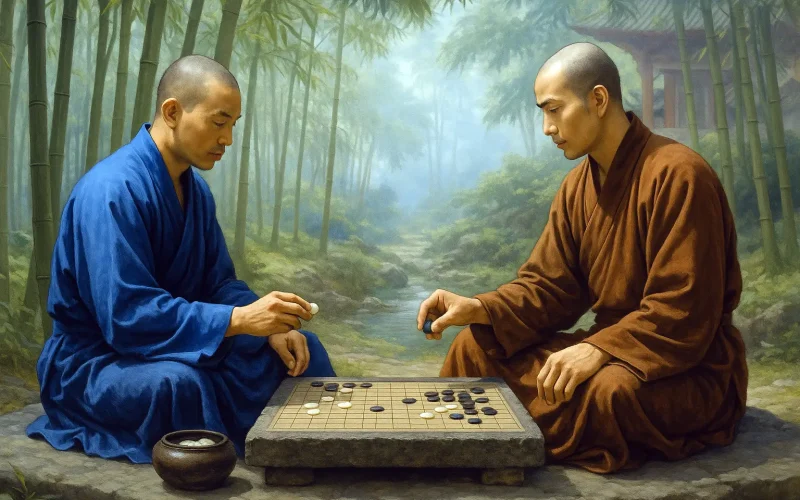



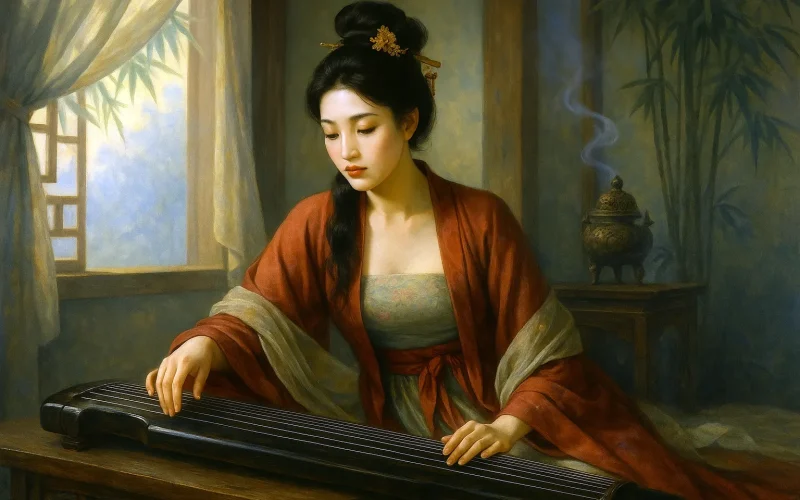
On the curved bench, the zither laid,
I sit with thoughts in languor swayed.
Why pluck the strings with artful hand?
The wind will make them understand.
Original Poem
「琴」
白居易
置琴曲机上,慵坐但含情。
何烦故挥弄,风弦自有声。
Interpretation
Throughout his life, Bai Juyi loved, understood, and excelled at the art of the qin (lute), frequently referencing the instrument and music in his poetry and prose. Though brief, this poem is rich in Zen spirit and philosophy, revealing the poet's unique understanding of musical artistry, nature, and his personal attitude towards life. Using the lute as a metaphor for his aspirations, the poem expresses his disdain for ornate, artificial sounds and his reverence for the music of nature itself, reflecting a mind that sought tranquility and distance, unwilling to simply follow the current. Likely composed during his later years after retreating from public life, Bai Juyi immersed himself in landscapes, living a transcendent existence. The poem thus conveys a sense of leisurely detachment from worldly affairs.
First Couplet: 置琴曲机上,慵坐但含情。
Zhì qín qǔ jī shàng, yōng zuò dàn hán qíng.
I place the lute upon the curved wooden stand, / And idle here, my quiet gaze imbued with feeling, as planned.
Explication: The opening depicts a nearly static, introspective scene. "I place the lute" completes an action; the lute transforms from a tool for performance into an object of contemplation. "The curved wooden stand" suggests an elegant, unconventional setting. "And idle here… imbued with feeling" captures the essence of the line: "idle here" is a physical posture of relinquishing active doing, shedding a performer's mindset; "imbued with feeling" discloses an inner state—this "feeling" is not agitation, but a deep, contemplative stillness containing infinite potential, awaiting its moment; it is the profound, silent communion between mind and object (the lute). The relationship between poet and lute shifts from the active "man plays lute" to the quietly expectant "man contemplates lute," foreshadowing the philosophical turn below.
Second Couplet: 何烦故挥弄,风弦自有声。
Hé fán gù huī nòng, fēng xián zì yǒu shēng.
Why trouble then to pluck the strings with practiced, artful hand? / The breeze across the lute-strings wakes a music self-begun, as planned.
This couplet, with its pointed rhetorical question and definitive statement, reveals the poem's core theme, elevating its meaning to a philosophical plane. "Why trouble… with practiced, artful hand?" is a critical challenge to conventional artistic views, even to a posture towards life. The words "trouble" and "practiced, artful" carry immense weight: "trouble" refers to human laboriousness, affectation; "practiced, artful" suggests purposeful, contrived action. "Pluck the strings" means to play, but in this context carries a pejorative sense of skill-display and seeking favor. The poet thoroughly rejects this kind of "doing" marked by strong subjective intervention and utilitarian purpose. Then, "The breeze across the lute-strings wakes a music self-begun" proposes a fresh aesthetic ideal rich in Daoist and Zen spirit: the "breeze" is natural, unintentional, uninvited force; the "lute-strings" are the instrument, the medium awaiting stimulation; "a music self-begun" is the spontaneously generated, perfectly natural sound arising from the confluence of conditions. This sound does not ring for human ears; it is the original state of being spontaneously revealed when cosmic breath (breeze) meets object (strings). It transcends the subject-object duality of "man-lute," entering the transformative realm where "heaven (breeze) - object (strings) - sound" merge into an inseparable whole.
Holistic Appreciation
This pentasyllabic quatrain is a miniature discourse on poetry that deconstructs traditional artistic views to construct a natural aesthetic. Its structure presents a clear logic of "suspension – negation – revelation." The first line, "I place the lute," suspends action (ceasing conventional play). The second line, "And idle here… imbued with feeling," prepares the mental state (entering contemplation). The third line, "Why trouble… with practiced, artful hand?" decisively negates human artifice and skill. The final line, "The breeze… wakes a music self-begun," ultimately reveals the highest artistic realm: spontaneous natural perfection. The four lines accomplish a spiritual leap from "conscious action" to "non-action," from "human music" to "heavenly music." Here, the "lute" is not merely an instrument but a metaphor for all art, even for life's conduct. "The breeze across the lute-strings wakes a music self-begun" symbolizes that state of being and creative realm which arrives unexpectedly, perfectly self-sufficient, when one abandons contrivance and artifice, submitting completely to nature. The poem's subtlety lies in completely integrating profound philosophical speculation into the everyday scene of idly contemplating a lute, achieving perfect unity of intellectual interest and poetic flavor.
Artistic Merits
- Philosophical Use of Opposing Concepts: The poem's core tension is built upon several sets of opposing concepts: "placing" (stillness) vs. "pluck[ing]" (action); "idl[ing]" (non-action) vs. "practiced, artful" (deliberate intent); "man pluck[ing]" (human artifice) vs. "breeze… wakes" (heavenly spontaneity). By negating the former and affirming the latter, the poet's aesthetic and life philosophy is clearly conveyed.
- Symbolism of the Imagery Chain: "Lute" – "man" – "breeze" – "music" forms a concise yet profound chain of symbolism. The lute is the vehicle of art; man is the traditional agent; the breeze is the Way of nature; the music is the manifestation of the Way. The shift in focus from the "man-lute" link to the "breeze-strings" link vividly illustrates the change in the source of the highest artistic realm.
- Language of Definitive Negation and Ethereal Affirmation: The phrase "Why trouble" is resolute in tone, full of disdain and transcendence. The three words "a music self-begun" are filled with confidence and serenity, revealing a state of being self-sufficient and needing nothing external. The language is extremely succinct, yet the force of both negation and affirmation is potent, creating great tension.
- Using Concrete Scenes to Convey Abstract Principle: The entire poem contains not a single line of abstract reasoning. All philosophical reflection is entrusted to concrete actions and images: "placing the lute," "idl[ing]" and "gaze," "breeze across the lute-strings." The reader comprehends from the picture and mood, attaining the marvelous Zen-poetry state of "not treading the path of logic, not falling into the net of words."
Insights
This poem is the crystallization of Bai Juyi's philosophy of art and wisdom of life. It transcends discussion of lute-playing skill itself, pointing directly to the core mystery of all creative activity: True creation often lies not in the deliberate striving of "addition," but in the "subtraction" of letting go and waiting, in making space for the "breeze" (inspiration, serendipity, the Way of nature) to pass through. The poet reveals that in art, work, or life, when we over-rely on technique, purpose, and human manipulation, we may instead lose the most authentic, most moving power.
In our contemporary era that venerates active intervention, supreme efficiency, and constant "plucking," this poem acts as a sobering tonic. It invites us to reflect: Are we "trouble[d]" by excessive "practiced, artful" plucking—that deliberate posturing, utilitarian pursuit, and unceasing busyness? Can we still recover, within the contemplative stillness of "idl[ing]… imbued with feeling," our inner focus and capacity to wait? Can we still trust and listen for those moments of "a music self-begun"—those moments of inspiration and opportunity arising not from careful planning, but from harmony and resonance within and with nature?
Through a lute, Bai Juyi tells us that the highest art of life may lie in knowing when to "place the lute upon the stand," when to "idle here… imbued with feeling," and finally, having the courage and wisdom to trust in that Way of nature where music is "self-begun." This is a form of "action through non-action" (wu-wei er wei) full of Eastern wisdom, a profound secret for maintaining inner peace and creative vitality in a clamorous world.
About the Poet
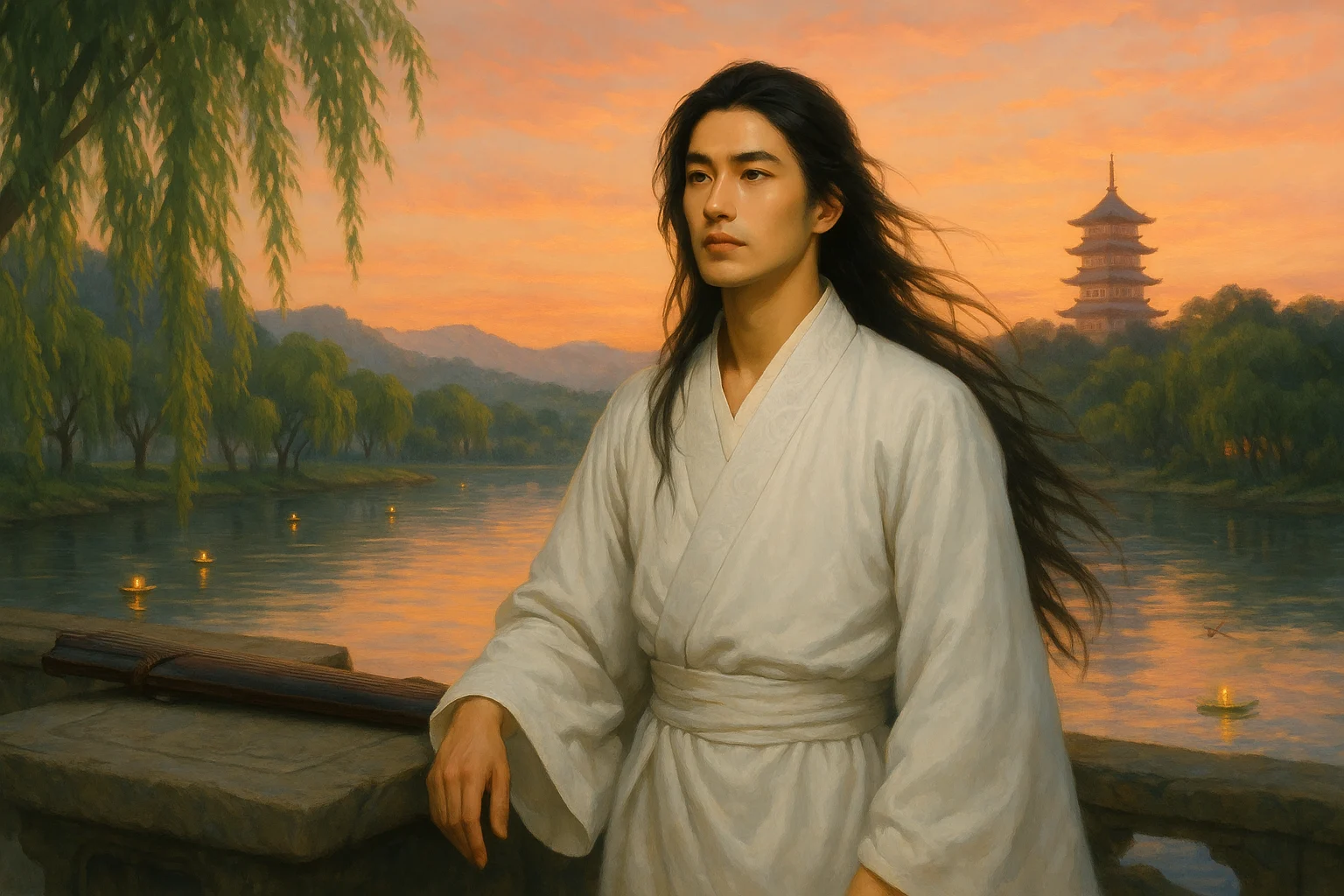
Bai Juyi (白居易), 772 - 846 AD, was originally from Taiyuan, then moved to Weinan in Shaanxi. Bai Juyi was the most prolific poet of the Tang Dynasty, with poems in the categories of satirical oracles, idleness, sentimentality, and miscellaneous rhythms, and the most influential poet after Li Bai Du Fu.