


The bow you carry should be strong;
The arrows you use should be long.
Shoot before a horseman his horse;
Capture the chief to beat his force,
Slaughter shan't go beyond its sphere;
Each State should guard its own frontier.
If an invasion is repelled,
Why shed more blood unless compelled?
Original Poem
「前出塞九首 · 其六」
杜甫
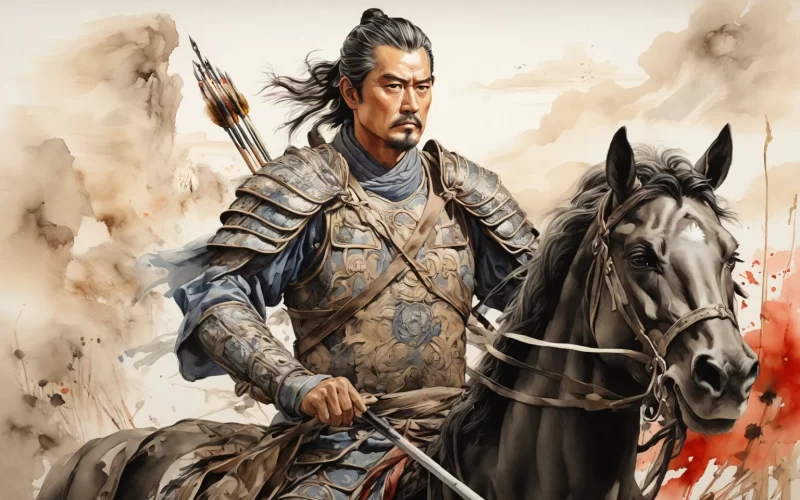
挽弓当挽强,用箭当用长。
射人先射马,擒贼先擒王。
杀人亦有限,列国自有疆。
苟能制侵陵,岂在多杀伤。
Interpretation
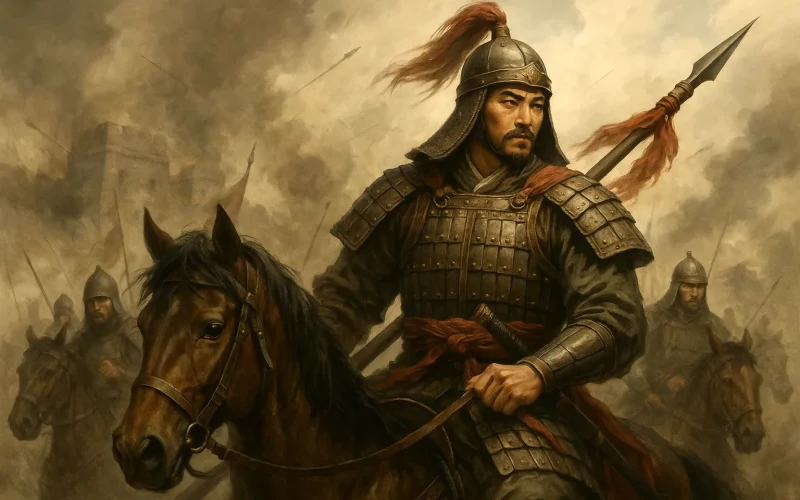
This work was composed during the Tianbao era of Emperor Xuanzong of the Tang Dynasty and is the sixth poem in Du Fu’s series Frontier Songs (Part I). At that time, the Tang dynasty frequently engaged in military campaigns along its northwestern frontier, with General Geshu Han’s expeditions against the Tibetan Empire being particularly intense. In this series, Du Fu adopts the voice of a frontier soldier, portraying not only the hardships of war but also directing pointed criticism toward the imperial court’s policy of military expansion and warmongering. This particular poem is especially distinctive: centered on argumentation, it elevates simple military proverbs into a profound philosophy of war and a declaration for peace, showcasing the poet’s visionary strategic insight and expansive humanity that transcended his era.
First Couplet: “挽弓当挽强,用箭当用长。”
Wǎn gōng dāng wǎn qiáng, yòng jiàn dāng yòng cháng.
To draw a bow, draw the strongest bow; / To choose an arrow, choose the longest arrow.
The opening lines are decisive and rhythmic, reminiscent of a military command or a folk ballad. “Strongest” and “longest” represent the pursuit of maximum martial effectiveness and also imply a simple truth: in any struggle, one must rely on the most effective means and the fullest preparation. These two lines establish the poem’s pragmatic and vigorous tone.
Second Couplet: “射人先射马,擒贼先擒王。”
Shè rén xiān shè mǎ, qín zéi xiān qín wáng.
To strike a rider, first strike his horse; / To capture rebels, first capture their chief.
Building upon the previous couplet, the focus shifts from “what to use” to “how to use it,” articulating a core tactical wisdom. These two lines, derived from circulated military experience and refined by Du Fu’s genius, have become immortal maxims. “First strike his horse” aims to cripple the enemy’s mobility; “first capture their chief” seeks to destroy the enemy’s command structure. Together, they embody an efficient strategic mindset that targets the crucial point, shining with cool rationality.
Third Couplet: “杀人亦有限,列国自有疆。”
Shā rén yì yǒu xiàn, liè guó zì yǒu jiāng.
For killing, too, there should be bounds; / Each nation has its proper bounds.
Here, the brushstroke turns sharply upward, leaping from the tactical level to the heights of ethics and political philosophy. The three words “should be bounds” ring out like a great bell, issuing a solemn critique against limitless slaughter. “Has its proper bounds” fundamentally negates the expansionist logic of “the king knows no frontiers.” From a higher civilizational standpoint, the poet asserts that war must be constrained by morality, and a state’s rights presuppose respect for the sovereignty of others.
Fourth Couplet: “苟能制侵陵,岂在多杀伤。”
Gǒu néng zhì qīn líng, qǐ zài duō shā shāng.
If we can but curb aggression and defeat the foe, / What need is there for slaughter on a scale of boundless woe?
The poem concludes with a powerful rhetorical question, revealing its central thesis—a shining page in ancient Chinese thought on war. “Curb aggression and defeat the foe” defines the sole legitimate aim of just war: defense and stopping injustice. “What need is there for” utterly rejects the savage logic that glorifies high casualties and prizes conquest as an achievement. These two lines resonate with force, perfectly unifying the instrumental and value rationality of war under the ultimate wisdom of “stopping warfare is the true martial virtue.”
Holistic Appreciation
The essence of this work lies in its accomplishment of a philosophical elevation from “method” to “principle.” The first four lines speak of “method”—concrete, detailed military wisdom; the last four lines speak of “principle”—fundamental ethics of war and political ideals. The poem’s structure ascends like steps: from the material level of “drawing bows and choosing arrows,” to the tactical level of “striking the horse, capturing the chief,” then to the ethical level of “killing should have bounds,” finally arriving at the value level of “curbing aggression.” It is logically rigorous and vast in scope.
The poem radiates a “doctrine of limited warfare” and a “defensive concept of justice.” In Du Fu’s view, the use of force must have strict limits: its purpose should be confined to stopping aggression (“curb aggression”), its degree should seek the minimum necessary (“what need is there for”), and its spatial scope must respect existing boundaries (“has its proper bounds”). This thought is deeply rooted in the Confucian tradition of “the benevolent are invincible,” and finds here its most concise and powerful poetic expression.
Artistic Merits
- Proverb and Discourse in Perfect Harmony: The opening quatrain adapts well‑known military maxims, embodying a robust folk‑vigor; the final quatrain shifts into profound and incisive scholarly reflection. This blending of the vernacular and the refined renders the work both highly memorable and imbued with deep intellectual resonance.
- Strong Logical Progression and Turn: The ideas in the four couplets advance layer by layer, moving from the concrete to the abstract. The phrase “should be bounds” in the third couplet is the crucial turning point of the entire poem, elevating it at once from a summation of military experience to the height of a humanitarian declaration.
- Dual Modulation of Linguistic Style: The language in the first half is brisk, decisive, and full of action; the language in the second half is solemn, rational, and contemplative. These two styles complement each other through contrast, jointly serving the profound theme.
- The Formidable Force of a Rhetorical Conclusion: The final couplet concludes with the rhetorical structure “If we can but… / What need is there for…” The answer is self-evident, and the tone is resolute, greatly enhancing the poem’s persuasive power and spiritual resonance.
Insights
This masterpiece is not merely an anti-war poem; it is a timeless philosophical verse on “how to wield power correctly.” It reveals that true strength lies not in the “strength” of the bow or the “length” of the arrow, nor even in the “ingenuity” or “precision” of tactics, but in understanding how to assign a just purpose to power and to set for it inviolable moral boundaries.
In today’s complex landscape of international relations and social competition, Du Fu’s thought remains profoundly resonant. It reminds us that whether in grand historical narratives or in personal life, the application of power should pursue a rational, limited, and justly targeted approach exemplified by “curbing aggression.” We must guard against the intoxication with power that revels in “slaughter on a boundless scale,” that knows no restraint, and that ultimately loses sight of its original purpose.
The wisdom of “to capture rebels, first capture their chief” teaches us to address problems by targeting their core. The admonition of “for killing, too, there should be bounds” warns us that no action may overstep the bounds of humanity. This spirit—both pragmatic and efficient, yet compassionate and benevolent; both wise and strategically sound, yet firmly principled—is the noble light that allows this work, across a millennium, to continue illuminating the path of the world and the human heart.
Poem translator
Xu Yuanchong (许渊冲)
About the poet
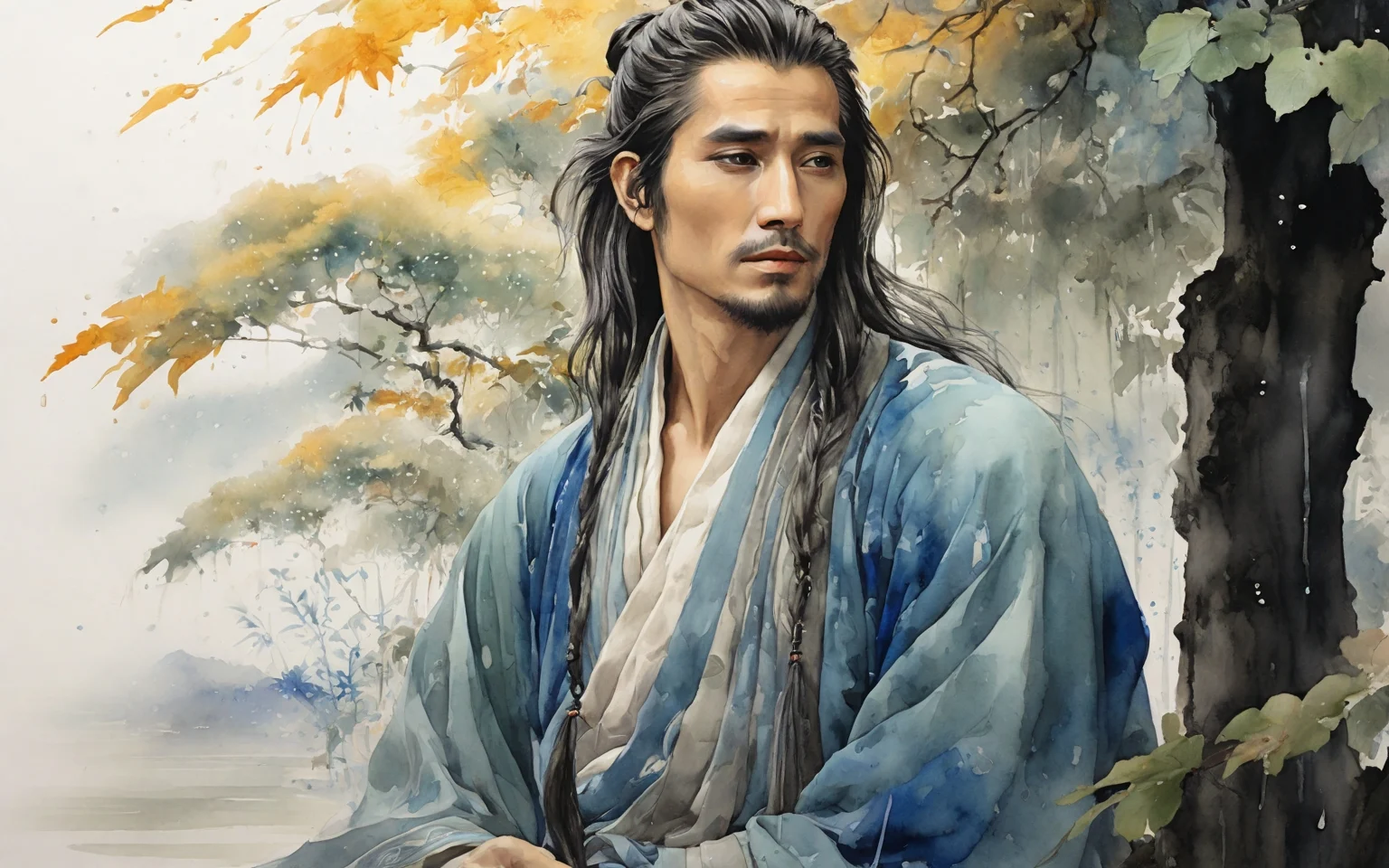
Du Fu (杜甫), 712 - 770 AD, was a great poet of the Tang Dynasty, known as the "Sage of Poetry". Born into a declining bureaucratic family, Du Fu had a rough life, and his turbulent and dislocated life made him keenly aware of the plight of the masses. Therefore, his poems were always closely related to the current affairs, reflecting the social life of that era in a more comprehensive way, with profound thoughts and a broad realm. In his poetic art, he was able to combine many styles, forming a unique style of "profound and thick", and becoming a great realist poet in the history of China.