


There are sobs when death is the cause of parting;
But life has its partings again and again.
…From the poisonous damps of the southern river
You had sent me not one sign from your exile --
Till you came to me last night in a dream,
Because I am always thinking of you.
I wondered if it were really you,
Venturing so long a journey.
You came to me through the green of a forest,
You disappeared by a shadowy fortress…
Yet out of the midmost mesh of your snare,
How could you lift your wings and use them?
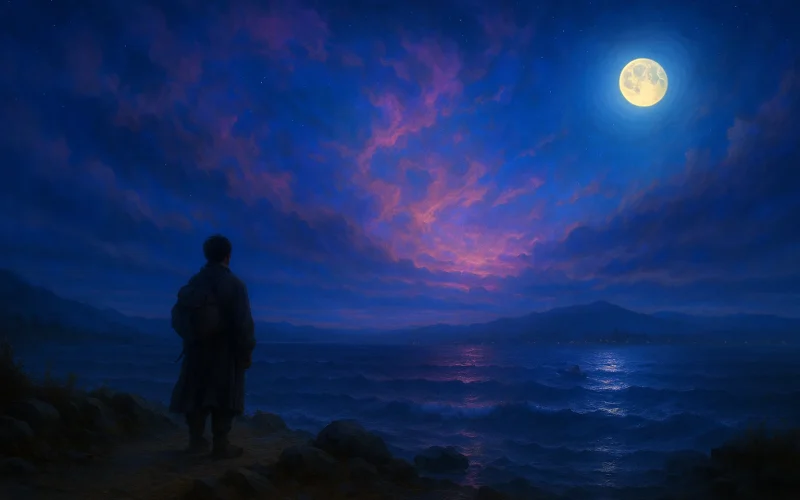
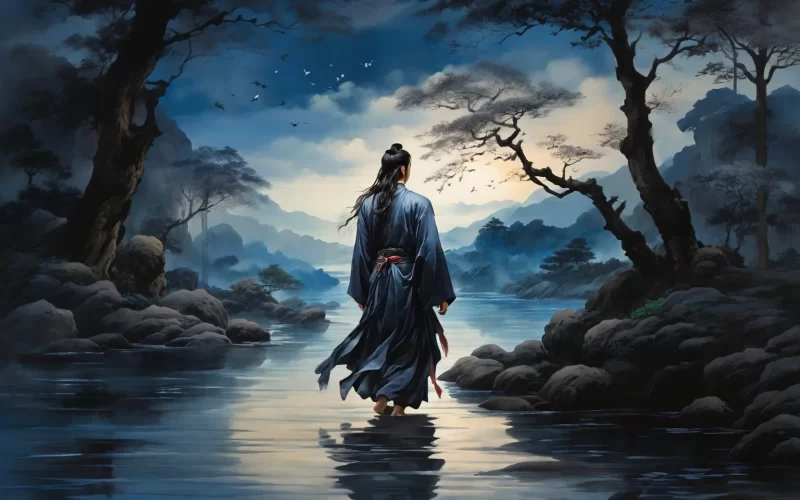
…I woke, and the low moon's glimmer on a rafter
Seemed to be your face, still floating in the air.
…There were waters to cross, they were wild and tossing;
If you fell, there were dragons and rivermonsters.
Original Poem
「梦李白二首 · 其一」
杜甫
死别已吞声,生别常恻恻。
江南瘴疠地,逐客无消息。
故人入我梦,明我长相忆。
君今在罗网,何以有羽翼。
恐非平生魂,路远不可测。
魂来枫林青,魂返关塞黑。
落月满屋梁,犹疑照颜色。
水深波浪阔,无使蛟龙得。
Interpretation
This poem was composed in the autumn of 759 CE, the second year of the Qianyuan era under Emperor Suzong of the Tang dynasty, during Du Fu's displacement in Qinzhou. The previous year, Li Bai had been convicted for joining the staff of Prince Yong, Li Lin, and exiled to Yelang. In the spring and summer of this year, while on his journey into exile, Li Bai was pardoned upon reaching Baidi City. However, this news had not yet reached the remote region of Qinzhou. Overwhelmed with anxiety for his dear friend's safety, Du Fu's accumulated longing took shape in a dream, upon waking from which he wrote this timeless masterpiece. The poem is not merely a profound expression of concern for a friend; it is a deep exploration, set against a turbulent era, of the fate of genius, the mystery of life and death, and the resonance of the human spirit.
First Couplet: “死别已吞声,生别常恻恻。”
Sǐ bié yǐ tūn shēng, shēng bié cháng cè cè.
The grief of death-parted silence must swallow; / For life-parted, sorrows forever will follow.
The opening penetrates the deepest layers of human emotion, using the pain of "death-parted" as a reference to highlight how "life-parted"—with its prolonged uncertainty and hopeless waiting—is an even more tormenting anguish. The reduplication in "cè cè" conveys, in its very cadence, a continuous, lingering sorrow, establishing the poem's overarching tone of poignant grief and anxious unease.
Second Couplet: “江南瘴疠地,逐客无消息。”
Jiāng nán zhàng lì dì, zhú kè wú xiāo xī.
To miasmic southern shores you are banished, friend; / No word comes from you, no news of your end.
This couplet specifies the tangible source of the poet's distress. "Miasmic southern shores" depicts the perilous, disease-ridden environment of the place of exile, while "No word comes from you" expresses the anguish of severed communication. The intersection of vast geographical distance and the terrifying obscurity surrounding life and death weighs upon the poet's concern, layering it with a dread of potential demise.
Third Couplet: “故人入我梦,明我长相忆。”
Gù rén rù wǒ mèng, míng wǒ cháng xiāng yì.
Last night you came into my dream anew; / You showed me that of me you often thought.
The focus transitions to the dreamscape, yet the expression remains measured. "Came into my dream" rather than "I dreamt of you" emphasizes the dream's perceived agency, as if the friend's spirit, sensing the poet's constant longing, had purposefully visited. "You showed me that of me you often thought" is the poet's interpretation of the dream's cause, emotionally sincere and psychologically poignant.
Fourth Couplet: “恐非平生魂,路远不可测。”
Kǒng fēi píng shēng hún, lù yuǎn bù kě cè.
I feared it was not your soul that I saw; / So far, so hard is the road you have fought.
The initial joy within the dream is instantly overlaid by the darkness of realistic dread. "I feared it was not" vividly captures the poet's complex psychology upon seeing his friend—a tumultuous mix of joy, terror, and uncertainty about what is real or illusory. "So far, so hard is the road" refers both to the immense physical distance and, more profoundly, to the unpredictable and perilous nature of his friend's fate, reflecting a worry of fathomless depth.
Fifth Couplet: “魂来枫林青,魂返关塞黑。”
Hún lái fēng lín qīng, hún fǎn guān sài hēi.
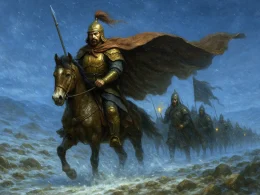
Coming, the maple woods were green with spring; / Going, you'd pass the Fortress of Dark Wall.
With language rich in painterly quality, this couplet visualizes the spirit's arduous journey. "Maple woods were green" alludes to imagery from The Songs of Chu - Summoning the Soul, hinting at the southern lands of exile; "Fortress of Dark Wall" corresponds to the poet's own location in the northern borderlands. The contrasting colors—lush green and somber black—against a vast spatial canvas evoke the hardship and eerie atmosphere of the spirit's trek.
Sixth Couplet: “君今在罗网,何以有羽翼?”
Jūn jīn zài luó wǎng, hé yǐ yǒu yǔ yì?
Now you are caught in meshes of the law; / How can you have wings to fly so far?
The focus shifts from imaginative vision to a direct, anguished question. "Caught in meshes of the law" metaphorizes political persecution and physical confinement, while "wings" symbolize freedom. This cry is both a rational doubt cast upon the dream's veracity and a painful acknowledgment of harsh reality: the living man is trapped, and only a spirit could traverse such barriers.
Seventh Couplet: “落月满屋梁,犹疑照颜色。”
Luò yuè mǎn wū liáng, yóu yí zhào yán sè.
The sinking moon's light on rafters seemed to linger, / Still holding the image of your face, its hue.
This describes the dazed state upon waking. "The sinking moon" indicates the late hour and underscores solitude; the interplay of light and shadow from "light on rafters" creates a visual ambiguity. The word "seemed" is masterful, depicting the poet's half-awake, entranced state where the friend's visage seems to persist before his eyes. The depth of longing allows the dream's illusion to linger in wakefulness.
Eighth Couplet: “水深波浪阔,无使蛟龙得。”
Shuǐ shēn bō làng kuò, wú shǐ jiāo lóng dé.
Now you are drowned in the deep, deep sea; / Do not become food for water dragons, please!
The poem concludes with a tender, protective admonition, elevating concern to its utmost intensity. "Drowned in the deep, deep sea" symbolizes both the natural perils on the spirit's return journey and the treacherous currents of the human world. "Water dragons" metaphorically represent the malevolent forces that prey upon the virtuous and talented. It is as if the poet is seeing off his friend's spirit; his caring sentiment transcends the boundary between life and death, and this profoundly moving, protective instinct knows no limits.
Holistic Appreciation
The poem's artistic power lies in its successful creation of a lyrical world where reality and illusion intertwine, and hearts and spirits commune. Du Fu seamlessly blends his genuine, tangible fears for his friend (the miasmic land, the absence of news, the legal entrapment) with the surreal experience of the dream (the spirit's journey, the moonlit visage). The poem's emotion flows and fluctuates between lingering sorrow, startled fear upon meeting, dazed uncertainty after waking, and the profound tenderness of the final plea, deeply revealing the shared pain felt for a beloved friend's fate.
On a deeper level, through his concern for and questioning of the "spirit," the poet grapples with eternal themes: life and death, spiritual resonance, and the capriciousness of fate. The "Li Bai" in the poem transcends his identity as a specific friend, becoming a symbol for all talented individuals who suffer injustice in times of chaos. The coming and going of his "spirit" symbolizes the unyielding wandering and tenuous connection of conscience and integrity in a dark age. This elevates the expression of personal friendship, imbuing it with profound contemporary significance and philosophical depth.
Artistic Merits
- Rich Emotional Layering, Subtle Transitions
The poem's emotion undergoes multiple shifts: from the sorrow of life's parting and the anxiety of silence, to the comfort of the dream-visit and the fear it provokes, then to the imagined hardship of the spirit's path and the lament over confinement, finally culminating in post-dream disorientation and the heartfelt tenderness of the final admonition. These nuanced waves embody the "somberness and rhythmic force" characteristic of Du Fu's emotional cadence. - Poignant Imagery, Ethereal Atmosphere
Images like "maple woods were green," "Fortress of Dark Wall," "sinking moon's light on rafters," and "deep, deep sea" collectively construct a poetic realm that is both tangible and phantom-like, somber yet deeply affectionate, perfectly bearing the poet's complex mood of intertwined worry and doubt. - Unadorned Language with Potent Inner Tension
The lines seem spoken plainly, almost colloquially (e.g., "How can you have wings to fly so far?"), yet the emotional intensity and existential questioning they contain are immense. Beneath the simple language lies a profound turmoil of the soul. - Interplay of Reality and Illusion, Transcending the Human-Spirit Divide
Using the "dream" as a medium, the poet moves freely between reality and hallucination, the living and the spectral. This technique springs from profound friendship and anxiety while also inheriting and advancing the lyrical tradition of works like The Songs of Chu and the Nineteen Old Poems.
Insights
This work reveals the spiritual depth true friendship can attain: Soulmates are those who can traverse geographical and political barriers, even transcend the boundary between life and death, connecting and protecting one another at the level of spirit. Du Fu's concern for Li Bai surpasses ordinary care, becoming a spiritual sharing of breath and fate.
The poem also shows how art, in the face of extreme injustice and suffering, becomes a sublime force for defending human dignity and sustaining spiritual bonds. While Li Bai was "caught in meshes of the law" in reality, Du Fu, through poetry, granted him "wings" to fly across "maple woods" and past the "Fortress," allowing his spirit to find solace and guardianship within the verse. This is not only a testament to personal friendship but also affirms the eternal value of literature in illuminating the human heart and gathering goodwill during dark times.
Poem translator
Kiang Kanghu
About the poet
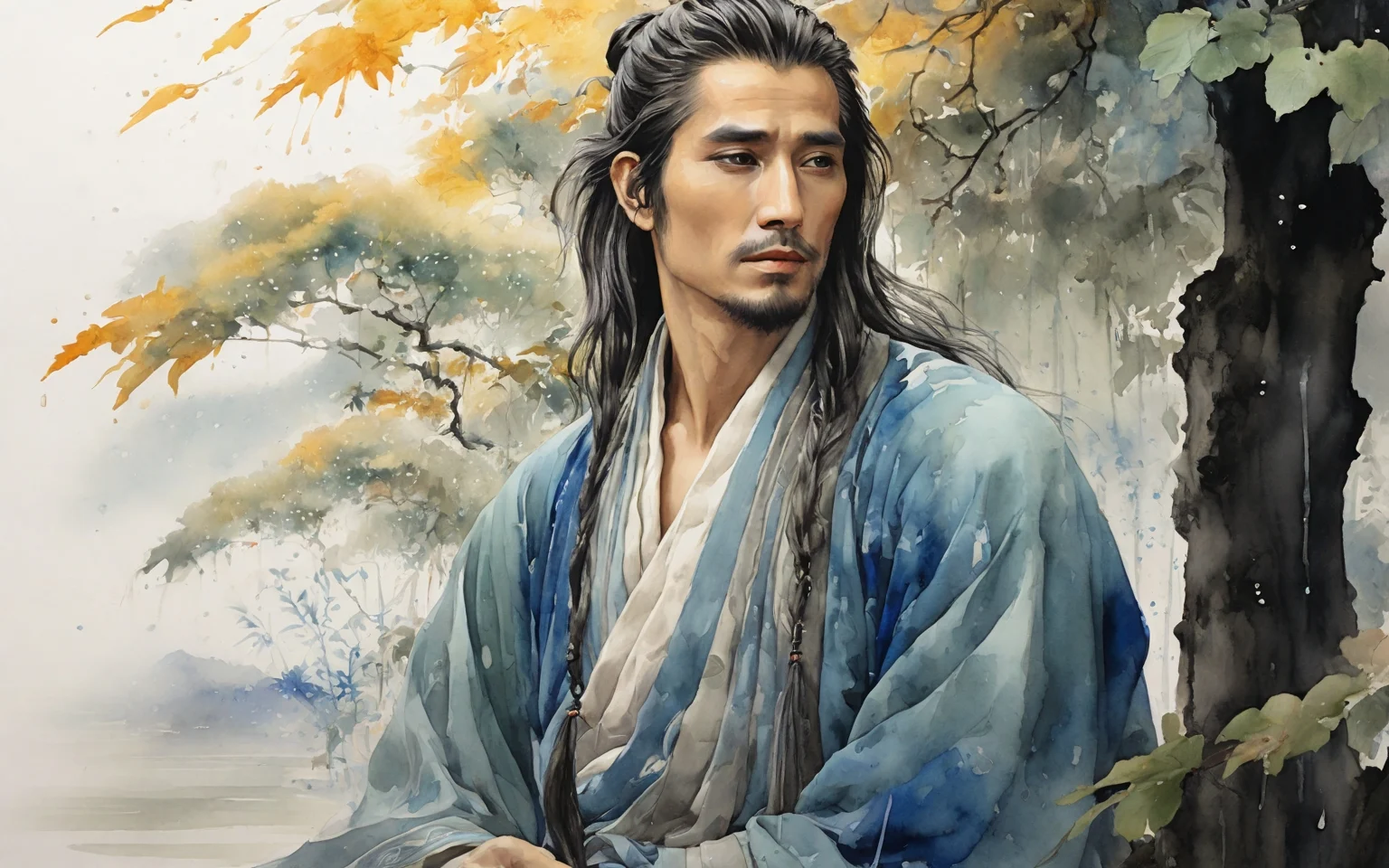
Du Fu (杜甫), 712 - 770 AD, was a great poet of the Tang Dynasty, known as the "Sage of Poetry". Born into a declining bureaucratic family, Du Fu had a rough life, and his turbulent and dislocated life made him keenly aware of the plight of the masses. Therefore, his poems were always closely related to the current affairs, reflecting the social life of that era in a more comprehensive way, with profound thoughts and a broad realm. In his poetic art, he was able to combine many styles, forming a unique style of "profound and thick", and becoming a great realist poet in the history of China.