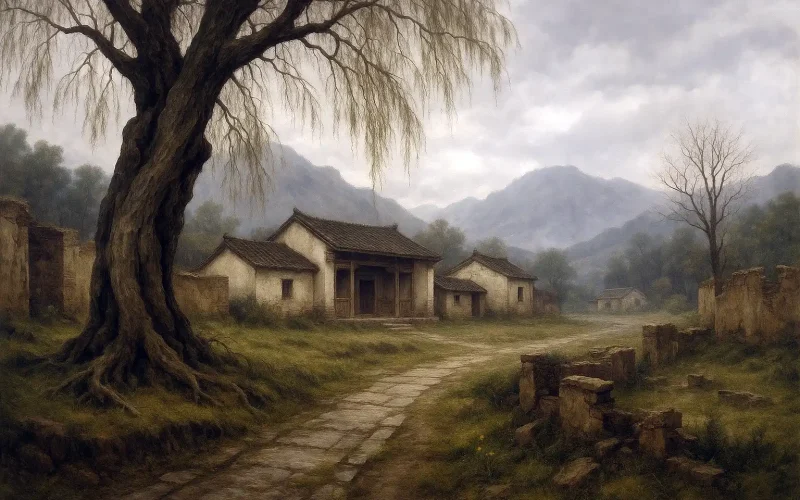
At Mengcheng’s mouth I make my new abode;
Only old willows by the ancient road.
Who’ll come after me here to live and grow?
I sigh for those who lived here long ago.
Original Poem
「孟城坳」
王维
新家孟城口,古木余衰柳。
来者复为谁?空悲昔人有。
Interpretation
This poem serves as the prologue to Wang Wei's Wang River Collection, a series of twenty poems composed during his later years of retirement at his Wang River estate. Having weathered the vicissitudes of official life and the profound trauma of the An-Shi Rebellion, the poet acquired the former country villa of Song Zhiwen in Lantian's Wang River area. His state of mind had by then settled into clarity and tranquility. Although the poem describes his new dwelling at Mengcheng Pass, it is not an expression of the joy of a new home. Rather, it uses a landscape steeped in historical memory as a mirror, reflecting deep Chan contemplation on possession, time, and existence. With the most economical brushstrokes, and through the tension between "new" and "ancient," "present arrival" and "past," it outlines a philosophical vision that penetrates personal joy and sorrow to arrive at the eternal cycle of all things.
First Couplet: 新家孟城口,古木余衰柳。
Xīn jiā Mèng chéng kǒu, gǔ mù yú shuāi liǔ.
My new home stands at Mengcheng Pass; / Only ancient trees and a few withered willows last.
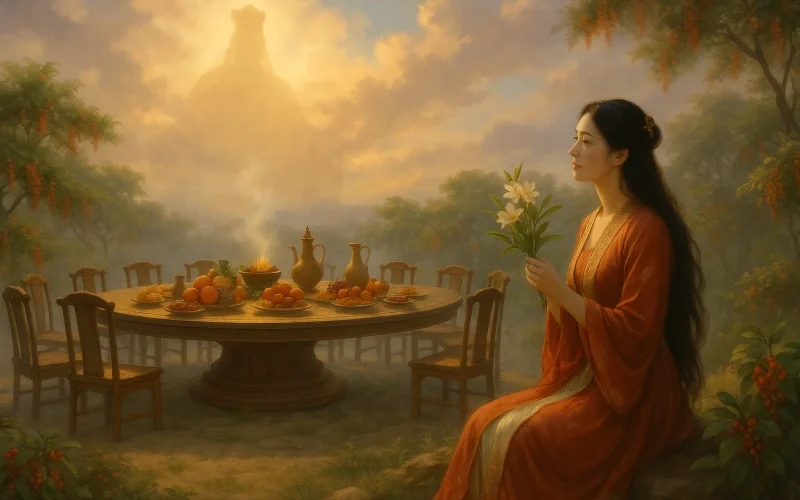
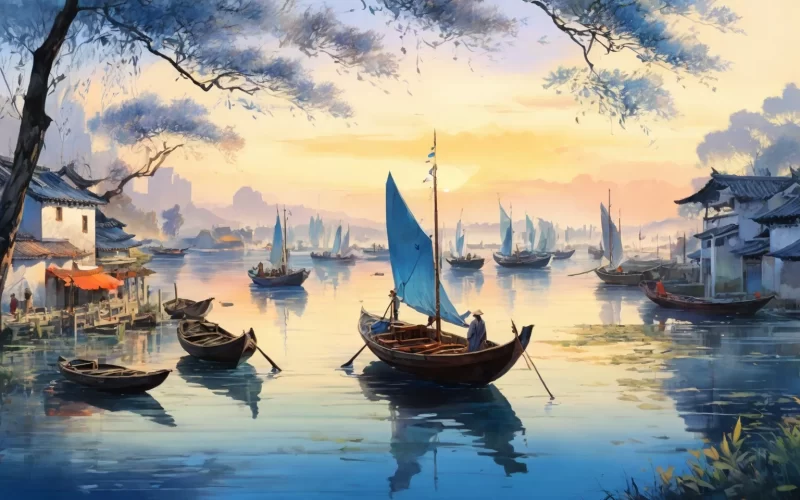
Explication: The opening seems straightforward, almost notative, yet contains a pointed paradox. "My new home" is the immediate, personal standpoint; "Mengcheng Pass" is a place-name laden with history (Mengcheng likely being the site of an ancient fort), hinting at past rises and falls. The "ancient trees" and "withered willows" are the actual scene before the eyes, yet are also time made concrete: the "ancient trees" witness the long-vanished past, the "withered willows" present present decay. The word "only" speaks volumes of the desolation and remnant left after glory has dispersed. The new owner does not face a vibrant pastoral scene, but a stark landscape washed by time. The contrast between new and old establishes, from the very start, a profound sense of historical vastness.
Second Couplet: 来者复为谁?空悲昔人有。
Láizhě fù wéi shuí? Kōng bēi xī rén yǒu.
Who, in turn, will be the one who comes hereafter? / In vain, I grieve for those of old who possessed this place.
Explication: This couplet is the soul of the poem. It moves from the concrete to the abstract, from scene to thought, accomplishing a leap of insight. "Who, in turn, will be the one who comes hereafter?" is a startling question. From the immediate present of his "new home," the poet suddenly leaps forward a century, envisioning himself becoming one of the "people of old," and this place inevitably having future "comers." This question shatters the illusion of "possession," revealing the temporariness of all "owners" within the sequence of time. "In vain, I grieve for those of old" is a clear-eyed examination of his own emotion: my present grief for the disappearance of former occupants (like Song Zhiwen) is essentially "in vain"—because I too will join their ranks, and future "comers" may likewise "vainly grieve" for my "possession." The two lines form a circular logic: The realization of the inevitability of "comers" reveals the emptiness of "grieving for the past." Here, "in vain" (空, kōng) reflects both a Buddhist contemplation on the emptiness of inherent nature, and a lucid rational understanding.
Holistic Appreciation
This quatrain is a "Chan poem on impermanence, using dwelling as its point of departure." Its structure is exquisite, presenting a complete cognitive spiral: the first line establishes the "I" and "this place" in the present moment (new home); the second line presents the historical state of "this place" (ancient trees, withered willows); the third line leaps from the present to interrogate the future relationship (who will come?); the fourth line returns to the present, reflecting on the substance of his own emotion (vain grief). The four lines form a cycle of "present—past—future—present (upon reflection)," elevating a specific experience of relocation into a universal meditation on the human condition within time. Wang Wei does not linger at the sorrow of "things remain, but people are gone" (as in "The sage on yellow crane has long since flown away"). He goes a step further. Through the probing question "Who, in turn, will be the one who comes hereafter?" he objectifies the "I" as merely a node within the flow of time. Thereby, he transcends the emotion of "grief" and arrives at the luminous realm of "emptiness."
Artistic Merits
- The Juxtaposition of Historically-Laden Place and Personal Experience: The place-name "Mengcheng Pass" carries its own historical depth. Juxtaposed with the highly personal, present-tense declaration "My new home," it instantly superimposes a temporal dimension onto the spatial coordinate, creating a powerful sense of historical vicissitude.
- The Philosophical Tension of the Question-Answer Form: "Who, in turn, will be the one who comes hereafter?" appears as a question that offers no answer, yet opens infinite space for contemplation. It is not a query for information but a revelatory device, compelling the reader (and the poet himself) to step outside the confines of the "I" and examine one's own existence from a broader perspective of time and space.
- The Pivotal and Transcendent Character "空" (Empty/Vain): The word "in vain" (空) is key to understanding the entire poem. It does not deny the existence of the emotion, but points out that the foundation of this "grief" is illusory—because all "having" (possession, existence) is ultimately transient. The precise use of this Buddhist term elevates the poem's philosophy from common historical sentiment to a contemplation on the nature of existence itself.
- Extreme Linguistic Sparseness and Extreme Semantic Richness: The entire poem contains only twenty characters, with no superfluous word or redundant description. Like the blank spaces in an ink-wash painting, the space between the brief sketch of "ancient trees and withered willows" and the abstract reflection on "comers" and "people of old" leaves vast room for meaning, allowing the reader to listen for the echoes of time within the silence.
Insights
The profundity of this work lies in its revelation of the brevity of "possession" and the liberation found in shifting "perspective." The poet shows us: When we dwell at a certain point in time and space ("My new home at Mengcheng Pass"), if we become immersed only in the immediate scene ("ancient trees and withered willows") or our personal emotions ("grieve for those of old"), we easily become trapped in finite joy and sorrow. Only by placing oneself within the endless flow of time ("Who, in turn, will be the one who comes hereafter?") can one see through the "attachment to self" and attain a more penetrating, serene contemplation ("in vain I grieve").
In the modern society of material abundance and accelerating change, people often rejoice in possession and grieve loss. Wang Wei's poem acts as a sobering tonic, reminding us: whether property, status, or affection, all "having" resides within the impermanent flux. True peace may come from recognizing that we are both the "comer" for the "people of old" and will ultimately become the "people of old" for future "comers." Thus, while living actively, we can maintain a transcendent perspective towards all "possession," finding genuine inner freedom and composure in the understanding of "vain grief." This wisdom from a thousand years ago still possesses a clear, reflective power to ease contemporary anxieties about possession and existential confusion.
About the poet
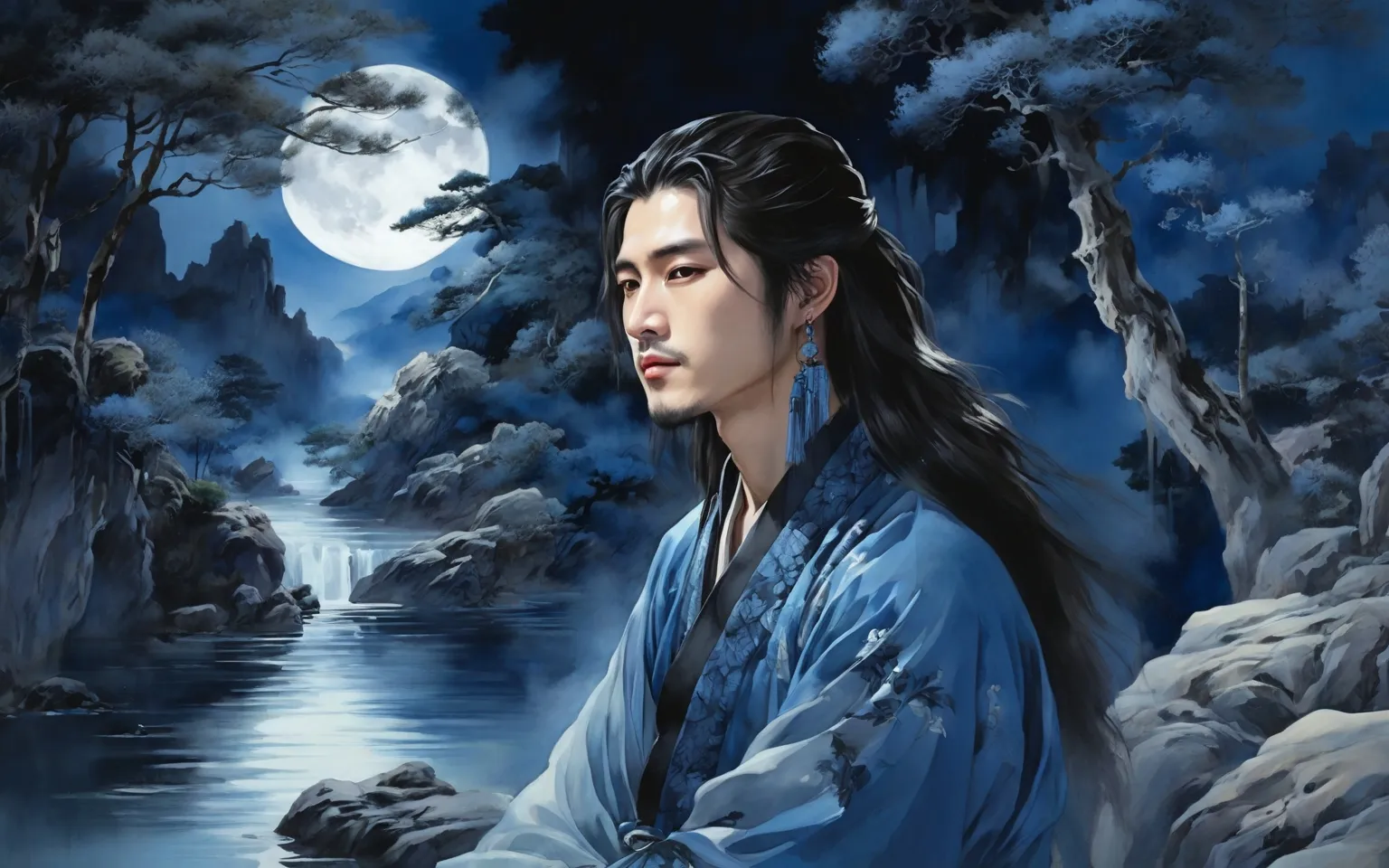
Wang Wei (王维), 701 - 761 A.D., was a native of Yuncheng, Shanxi Province. Wang Wei was a poet of landscape and idylls. His poems of landscape and idylls, with far-reaching images and mysterious meanings, were widely loved by readers in later generations, but Wang Wei never really became a man of landscape and idylls.