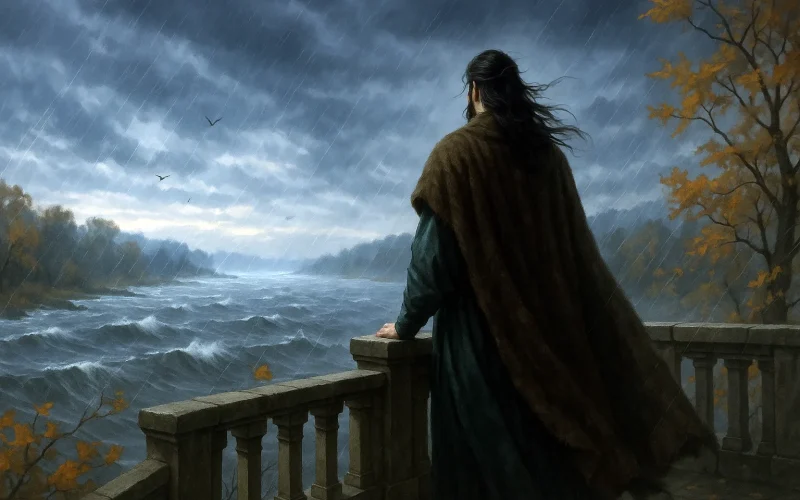



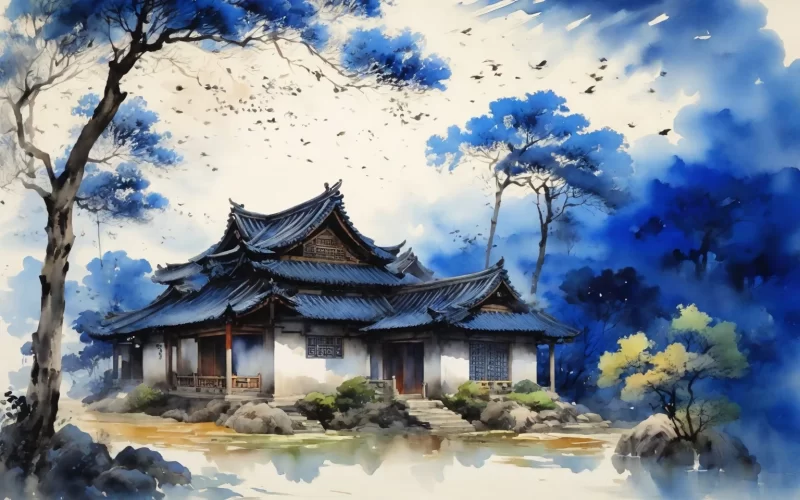
In the eighth moon the autumn gales furiously howl;
They roll up three layers of straw from my thatched bower.
The straw flies across the river and spreads in shower,
Some hanging knotted on the tops of trees that tower,
Some swirling down and sinking into water foul.

Urchins from southern village know I’m old and weak;
They rob me to my face without a blush on the cheek,
And holding armfuls of straw, into bamboos they sneak.
In vain I call them till my lips are parched and dry;
Again alone, I lean on my cane and sigh.

Shortly the gale subsides and clouds turn dark as ink;
The autumn skies are shrouded and in darkness sink.
My cotton quilt is cold, for years it has been worn;
My restless children kick in sleep and it is torn.
The roof leaks o’er beds, leaving no corner dry;
Without cease the rain falls thick and fast from the sky.
After the troubled times troubled has been my sleep.
Wet through, how can I pass the night so long, so deep!

Could I get mansions covering ten thousand miles,
I’d house all scholars poor and make them beam with smiles.
In wind and rain these mansions would stand like mountains high.
Alas! should these houses appear before my eye,
Frozen in my unroofed cot, content I’d die.
Original Poem
「茅屋为秋风所破歌」
杜甫
八月秋高风怒号,卷我屋上三重茅。茅飞渡江洒江郊,高者挂罥长林梢,下者飘转沉塘坳。
南村群童欺我老无力,忍能对面为盗贼。公然抱茅入竹去,唇焦口燥呼不得,归来倚杖自叹息。
俄顷风定云墨色,秋天漠漠向昏黑。布衾多年冷似铁,娇儿恶卧踏里裂。床头屋漏无干处,雨脚如麻未断绝。自经丧乱少睡眠,长夜沾湿何由彻!
安得广厦千万间,大庇天下寒士俱欢颜!风雨不动安如山。呜呼!何时眼前突兀见此屋,吾庐独破受冻死亦足!
Interpretation
This work was composed in the eighth lunar month of 761 CE, the second year of the Shangyuan era under Emperor Suzong, while Du Fu was living in his thatched cottage by the Huanhua Stream in Chengdu. The An Lushan Rebellion still smoldered. After years of displacement, the poet had found a brief respite here, only to be thrown back into the harsh realities of life by a sudden autumn gale. The destruction of his thatched hut was not merely a natural disaster but a microcosm of the precariousness of individual fate in that fractured age. It was precisely amid the storm and hardship that Du Fu achieved a sublime elevation from personal suffering to universal human compassion, making this poem one of the most radiantly humanitarian chapters in the history of Chinese poetry.
Section 1: “八月秋高风怒号,卷我屋上三重茅。茅飞渡江洒江郊,高者挂罥长林梢,下者飘转沉塘坳。”
Bā yuè qiū gāo fēng nù háo, juǎn wǒ wū shàng sān chóng máo. Máo fēi dù jiāng sǎ jiāng jiāo, gāo zhě guà juàn cháng lín shāo, xià zhě piāo zhuǎn chén táng ào.
The eighth month, high autumn, wind howls in wrathful spree; / It sweeps three layers of thatch clean off the roof of me. / The thatch flies o'er the river, scatters on the shores; / Some, caught on high, hang tangled in tall forest tops; / Some, swirling low, sink deep in muddy pond‑drops.
The poem opens with a “howls in wrath”, imbuing the autumn wind with a violent agency. “Sweeps… clean off the roof of me”—the word “me” immediately personalizes the disaster, making it visceral. The poet then traces the fate of the thatch with a cinematic eye: “flies o'er,” “scatters,” “hang tangled,” “sink deep.” This sequence of verbs vividly recreates the fury of the wind and the wide scattering of the thatch, and subtly metaphors the helpless, rootless fate of the poet himself, and indeed of all refugees in those troubled times—whether caught high or sunk low, none is master of its course.
Section 2: “南村群童欺我老无力,忍能对面为盗贼。公然抱茅入竹去,唇焦口燥呼不得,归来倚杖自叹息。”
Nán cūn qún tóng qī wǒ lǎo wú lì, rěn néng duì miàn wéi dào zéi. Gōng rán bào máo rù zhú qù, chún jiāo kǒu zào hū bù dé, guī lái yǐ zhàng zì tàn xī.
South village boys, seeing I'm old and have no might, / Dared rob me to my face—cruel hearts, an ugly sight! / Brazen, they hug the thatch, run off into the stands; / Lips parched, throat raw, my shouts cannot make loose their hands. / I come back, lean on my staff, and heave a sigh unmanned.
The disaster spreads from nature to the human world. The children act as “robbers” openly, not from innate wickedness but from poverty. The five words “seeing I'm old and have no might” express the fury of a hero in decline, a tiger fallen among dogs. “Lips parched, throat raw, my shouts cannot…” conveys a dual powerlessness, physical and spiritual. “Come back, lean on my staff, and heave a sigh unmanned” turns all external conflict into a deep, internal lament. This sigh is not just for a few bundles of thatch, but for a world where propriety has crumbled and the strong prey upon the weak.
Section 3: “俄顷风定云墨色,秋天漠漠向昏黑。布衾多年冷似铁,娇儿恶卧踏里裂。床头屋漏无干处,雨脚如麻未断绝。自经丧乱少睡眠,长夜沾湿何由彻!”
É qǐng fēng dìng yún mò sè, qiū tiān mò mò xiàng hūn hēi. Bù qīn duō nián lěng sì tiě, jiāo ér è wò tà lǐ liè. Chuáng tóu wū lòu wú gān chù, yǔ jiǎo rú má wèi duàn jué. Zì jīng sāng luàn shǎo shuì mián, cháng yè zhān shī hé yóu chè!
Soon the wind lulls, clouds blacken, ink‑like in the sky; / The autumn dusk turns vast and desolate and nigh. / Our quilt, for years like iron, icy to the touch; / My restless child kicks in his sleep and tears it much. / Where bed meets wall, no spot is dry, the leaking streams; / The raindrops fall like endless, dense, unbreaking seams. / Since times of chaos came, sound sleep has been but rare; / How can one get through soaking nights, this long, deep care?
The wind abates, but greater hardship follows. The poet retreats from the vast outdoors to his ruined interior, depicting a suffocating scene of existence. “Like iron, icy to the touch” uses tactile sensation to convey a poverty that chills to the bone; “raindrops fall like… unbreaking seams” uses visual imagery for the dense, incessant rain. Most poignant is “my restless child… tears it much”—the child's innocent restlessness intertwined with their plight deepens the poet's self‑reproach and sense of impotence. The final two lines, “Since times of chaos came…” link present suffering to the disorder of the age, and “How can one get through soaking nights…” is a temporal lament against endless misery—this cold, wet night seems to have no end in sight.
Section 4: “安得广厦千万间,大庇天下寒士俱欢颜!风雨不动安如山。呜呼!何时眼前突兀见此屋,吾庐独破受冻死亦足!”
Ān dé guǎng shà qiān wàn jiān, dà bì tiān xià hán shì jù huān yán! Fēng yǔ bú dòng ān rú shān. Wū hū! Hé shí yǎn qián tū wù jiàn cǐ wū, wú lú dú pò shòu dòng sǐ yì zú!
If I could have great mansions, thousands, tens of thousands, made, / To shelter all the scholars poor and give them welcome shade! / In wind or rain unmoving, firm as a mountain's mass. / Alas! If such a sight should burst before my eye, / My hut alone in ruins, I frozen, would be content to die!
Just as personal suffering reaches its peak, the poem makes a stunning, earth‑shattering turn. The poet's thoughts suddenly leap from his own hut to “great mansions, thousands, tens of thousands,” shifting from private pain to a universal love for “all the scholars poor.” This ideal is not a vague comfort but is concretely realized in the solid image of being “unmoving, firm as a mountain's mass.” The final vow, “My hut alone in ruins, I frozen, would be content to die!” completes a total transcendence from the “small self” to the “greater self.” The meaning of personal life and death, joy and sorrow, is found in a commitment that borders on the religious.
Holistic Appreciation
The artistic power of this work stems from the immense tension between the “ladder of suffering” and the “leap of the spirit.” The poem's structure clearly divides into four levels: nature's assault → human betrayal → utter destitution → spiritual升华. The first three sections elaborate exhaustively, rendering the hardship concrete, palpable, and inescapable, like drawing a bow of emotion to its fullest. The outcry of the final section is the arrow released from that fully drawn bow, possessing a soul‑stirring emotional impact and moral force.
Du Fu's greatness lies in not remaining at the level of “bemoaning poverty” or “voicing complaint.” Instead, he uses his personal misfortune as a prism through which to view the suffering of his age, and ultimately, amid shattered reality, he constructs a lofty ideal concerning human dignity, social justice, and universal well‑being. This elevates the poem beyond ordinary realism, endowing it with an idealistic radiance that shines across the centuries.
Artistic Merits
- Perfect Fusion of Narrative and Lyricism: The poem uses narrative as its skeleton, clearly recounting the events—the gale destroying the hut, the children stealing the thatch, the night rain leaking in. Yet lyricism is its soul, with each narrative section culminating in a powerful lament or outcry. Event and emotion are mutually reinforcing.
- Startlingly Evocative Detail: Details like “quilt… like iron, icy,” “raindrops fall like… seams,” and “my restless child… tears it” all stem from the rawest experience of survival. Their extreme specificity and authenticity give them the power to make the reader feel as if present.
- Poetic Form: Freedom and Dynamic Tension: The poem is composed in the older, freer gēxíng (song) style, characterized by lines of irregular length. Its rhythm shifts fluidly with the undulating emotions, moving from the storm‑like urgency of the opening, to the subdued, resigned sighs of the middle section, and finally to the volcanic intensity of the conclusion. In this way, form and content achieve perfect unity.
- Artistic Structure of Contrast and Sublimation: The poet deliberately juxtaposes the extreme “small suffering” (his ruined, freezing hut) with the ideal “great security” (widespread shelter and joy), and dramatically links them through the sacrificial vow, “I frozen, would be content to die!” This creates one of the most moving visions of “self‑sacrifice for others” in Chinese literary history.
Insights
This work continues to strike our hearts powerfully across a millennium because it touches upon core questions of the human spirit: How does one face suffering? How does one transcend the self? What constitutes true human compassion?
Du Fu's answer is: True compassion is not condescending charity, but profound empathy born of intimately felt pain. Great ideals often do not sprout in favorable times, but burst forth as the most dazzling light in the darkest hour of adversity. The cry for “great mansions… to shelter all the scholars poor” is a longing not only for material shelter but for a just society that guarantees the basic dignity of every person.
In our own age, this poem remains a mirror. It shows us: when facing personal hardship, do we wallow in self‑pity, or can we perceive the suffering of others more broadly? In pursuing personal success, do we still hold in our hearts a concern for collective well‑being? With his ruined hut and his searing verse, Du Fu teaches us that humanity's highest dignity and happiness are forever linked to care for the fate of others. This vast sentiment of “feeling the hunger and drowning of others as one's own,” of “extending from oneself to others,” is among the most precious legacies of Chinese culture, and an undying lamp illuminating the forward path of human civilization.
About the poet

Du Fu (杜甫), 712 - 770 AD, was a great poet of the Tang Dynasty, known as the "Sage of Poetry". Born into a declining bureaucratic family, Du Fu had a rough life, and his turbulent and dislocated life made him keenly aware of the plight of the masses. Therefore, his poems were always closely related to the current affairs, reflecting the social life of that era in a more comprehensive way, with profound thoughts and a broad realm. In his poetic art, he was able to combine many styles, forming a unique style of "profound and thick", and becoming a great realist poet in the history of China.