


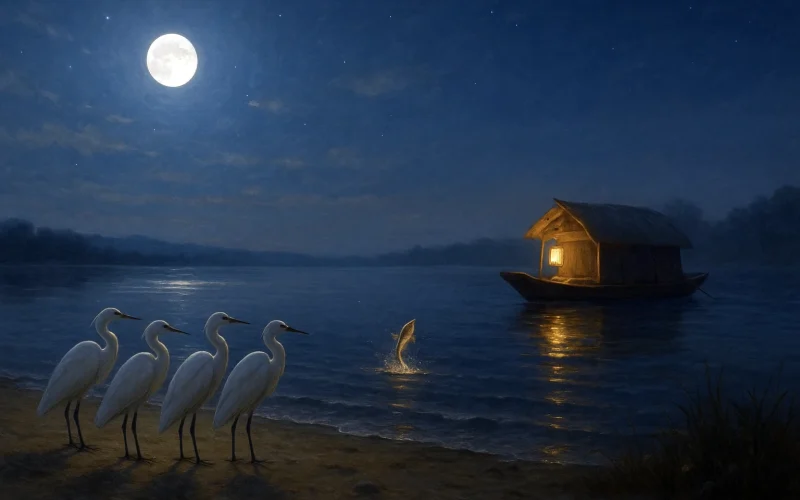
The river moon is just a few feet away from people;
The wind-lamp illuminates the night—the third watch is near.
On the sandbar, overnight egrets, tucked together in stillness;
At the stern of the boat, a leaping fish splashes and chirps.
Original Poem
「漫成」
杜甫
江月去人只数尺,风灯照夜欲三更。
沙头宿鹭联拳静,船尾跳鱼拨剌鸣。
Interpretation
This work was composed during Du Fu's period of exile in the Ba-Shu region (approximately 760-768 CE), vividly depicting an experience of mooring on a river at night. At that time, the poet was enduring prolonged hardship, his life marked by poverty and an uncertain future. Yet, against this turbulent backdrop, Du Fu captured and crystallized several utterly ordinary yet profoundly fleeting moments of a moonlit river night with a mind approaching meditative stillness. The poem is titled "Casually Composed" ("漫成"), suggesting an improvisational piece. However, through its pure poetic immediacy, it achieves the supreme artistic state of "purposiveness without purpose," standing as an exquisitely refined masterpiece within Du Fu's body of work.
First Couplet: “江月去人只数尺,风灯照夜欲三更。”
Jiāng yuè qù rén zhǐ shù chǐ, fēng dēng zhào yè yù sān gēng.
The river-moon hangs but a few feet from where I lie; / The mast-lamp lights the depth of night, as the third watch draws nigh.
The opening places the reader directly within an intimate and subtly charged moment in time and space. "The river-moon hangs but a few feet away" is an illusion both visual and psychological. Physically, the moon is distant at the sky's edge; subjectively, its reflection seems within arm's reach. This sense of "closeness" represents a solitary yet tender dialogue between the wanderer and eternal nature, narrowing the distance between the cosmos and the self, thereby creating an atmosphere of loneliness not devoid of solace. "The mast-lamp lights the depth of night, as the third watch draws nigh" introduces the human and temporal dimension. The mast-lamp's light is faint and flickering, contrasting with the eternal, cool moonlight. The word "draws nigh" ("欲") is masterful, describing time on the very cusp of arrival, like a threshold, hinting at the poet's state of wakeful, quiet contemplation through the long night. These two lines—one distant (moon) and one near (lamp), one eternal and one immediate, one natural and one human—together weave the essential fabric of the river-night.
Second Couplet: “沙头宿鹭联拳静,船尾跳鱼拨剌鸣。”
Shā tóu sù lù lián quán jìng, chuán wěi tiào yú bō là míng.
On the sandbar, egrets roost, curled like still, silent fists; / Astern, a fish leaps—'plash!'—the sound the night's hush resists.
The gaze shifts from the boat to the shore and water below, from silent imagery to the sudden intrusion of sound. "On the sandbar, egrets roost, curled like still, silent fists" depicts a scene of ultimate stillness. The term "curled like fists" vividly captures the charming, childlike posture of egrets sleeping with heads tucked into wings, resembling clenched fists, imbued with a sculptural solidity and the inner warmth of life. "Still" is the foundational tone and resolution of the line. Yet, this absolute stillness is abruptly broken by "astern, a fish leaps—'plash!'". "'Plish!'" ("拨剌") is an exceptionally precise onomatopoeia—clear, sharp, piercing the profound hush of the night. This "sound" does not shatter the tranquility; rather, it accentuates the silence by contrast, making the depth and quiet of the night palpable. The interplay of movement and stillness, revelation and concealment, forms an unexpected note in nature's nocturnal score, instantly filling the entire scene with a breath-like vitality.
Holistic Appreciation
This work resembles a delicate Song dynasty album leaf or a single frame of stilled black-and-white film. It does not express emotion directly nor narrate events; it simply "presents." Yet, within this extreme contemplative quiet resides profound emotion and philosophical insight.
The poem's core lies in the "tension born of contemplative observation." All four lines contain a pair of unified opposites: the moon's apparent nearness versus its actual celestial distance, the mast-lamp's feeble glow against the night's vast expanse, the frozen stillness of the roosting egrets containing latent vitality, the single, sharp sound of the leaping fish against the boundless silence of the river-night. This omnipresent tension keeps the scene dynamically balanced, quietly brimming with latent life. The poet seems a breath-held observer, his mind immersed in this profound quiet yet keenly attuned to its subtlest fluctuations.
On a deeper level, the poem reveals Du Fu's extraordinary ability, amidst wandering and hardship, to "settle his soul." The external world was one of war and displacement; his inner world, of anxiety and solitude. Yet, on this riverboat, by gazing intently at the moon "but a few feet away," the solitary mast-lamp, the "curled" egrets, and the "'plash!'" of the fish, he merges his entire being into the vast yet minute rhythm of nature. What he gains is not escape, but a higher understanding and acceptance—the individual's "small night" merges with the cosmos's "great night"; the transient sound resonates with eternal silence.
Artistic Merits
- Multidimensional Spatial Composition: The poem constructs an exquisite three-dimensional space: above, the distant moon and the nearby lamp; at the center, the person in the boat; below, the sandy shore and river water; nearby, the roosting egrets; farther off (astern), the leaping fish. The perspective shifts fluidly, creating a richly layered picture with striking spatial depth.
- A Paradigm of Using Sound to Heighten Silence: The single sound "'plash!'" is the poetic focal point of the entire poem and one of the most successful examples in classical Chinese poetry of using a sound to set off silence. It gives weight and texture to the accumulated sense of tranquility and elevates the scene from a two-dimensional "view" to a four-dimensional "world" (encompassing the dimensions of time and sound).
- Supreme Mastery of Diction and Phrasing: Words like "hangs but" (conveying a sense of deceptive distance), "draws nigh" (conveying a sense of impending time), "curled like fists" (vividly conveying form and posture), and "'plash!'" (precisely conveying an auditory sensation) are each perfectly chosen and irreplaceable. Particularly noteworthy is the adaptation of the colloquial "curled like fists" into poetry, which feels intimate, vivid, and full of life's warmth.
- Perfect Realization of the Quatrain Form: This work embodies the High Tang quatrain's artistic quality of suggesting "boundless vistas within a confined space." In just twenty-eight characters, with no word wasted, the first two lines establish the atmosphere, the latter two animate it with a spark of life. The progression is natural and seamless, the poetic conception complete and far-reaching.
Insights
This masterpiece offers its most precious insights concerning "how to dwell meaningfully within a state of wandering" and "how to contemplate the infinite within the confines of the finite." Du Fu, situated on a solitary boat, materially deprived and facing an uncertain future, could, through the pure contemplation of the moon "but a few feet away" and the "curled" egrets, render his spiritual world immensely vast and abundant.
In contemporary society, we may seldom experience the physical reality of mooring on a river at night, yet we often find ourselves in another kind of "wandering" and "solitary boat"—adrift in floods of information, a relentless pace, and uncertain tomorrows. This poem reminds us that peace of mind does not necessarily require complete external calm but can stem from an internalized capacity for "contemplative observation": pausing briefly amidst busyness to attentively feel the apparent nearness of moonlight, to listen for an occasional, crisp sound, to observe a life form in its tranquil repose.
It tells us that beauty and tranquility are never solely in some distant place. They are right before our eyes, "but a few feet" away, in our immediate present, as "the third watch draws nigh." With his poetic heart, Du Fu illuminated that ordinary river night, and in doing so, he lights a path for us: even if life seems an aimless wandering, we can still, in every moment, with an aesthetic and attentive spirit, "casually compose" ourselves into a poem of serenity and depth.
About the poet

Du Fu (杜甫), 712 - 770 AD, was a great poet of the Tang Dynasty, known as the "Sage of Poetry". Born into a declining bureaucratic family, Du Fu had a rough life, and his turbulent and dislocated life made him keenly aware of the plight of the masses. Therefore, his poems were always closely related to the current affairs, reflecting the social life of that era in a more comprehensive way, with profound thoughts and a broad realm. In his poetic art, he was able to combine many styles, forming a unique style of "profound and thick", and becoming a great realist poet in the history of China.