


There seems to be no one on the empty mountain...
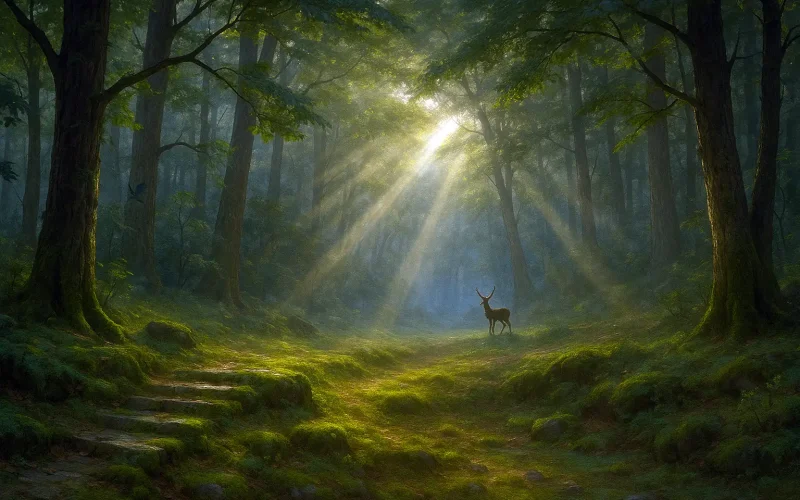
And yet I think I hear a voice,
Where sunlight, entering a grove,
Shines back to me from the green moss.
Original Poem
「鹿柴」
王维
空山不见人,但闻人语响。
返景入深林,复照青苔上。
Interpretation
This poem stands as one of the most ethereal and mysteriously profound pieces in Wang Wei's Wang River Collection, and a pinnacle of the aesthetic philosophy in classical Chinese poetry of "using sound to convey silence, using light to reveal the absence of light." Composed during his later years of deep seclusion at Wangchuan, a time of clear Zen insight, the poem comprises merely twenty characters. Yet, it constructs a perceptual world rich in paradoxical tension and philosophical depth: perceiving "presence" within "emptiness," capturing "movement" within "stillness," witnessing "endurance" within "transience." It is not merely a landscape vignette of mountain dwelling, but a miniature metaphysical meditation on existence, perception, and time, attaining the Zen-like realm of "not treading the path of logic, not falling into the trap of words."
First Couplet: 空山不见人,但闻人语响。
Kōng shān bú jiàn rén, dàn wén rén yǔ xiǎng.
On the empty mountain, no one is seen,
Yet echoes of human voices are heard.
The opening immediately subverts conventional spatial and existential perception with a paradoxical sensory experience. "Empty mountain" is a visual judgment, a confirmation of the reality of "no one is seen." This "emptiness" is the natural, primordial state of nature, stripped of human interference, a projection of a tranquil mind. "Yet echoes of human voices are heard" is an auditory disruption: the visual "emptiness" is instantly pierced by auditory "presence." This "echo" is not clamor, but distant, indistinct, seemingly-there-yet-not sound. Far from breaking the emptiness and silence, it instead becomes the measure of the depth of "emptiness" and the purity of "stillness." The word "echoes" imbues the sound with a sense of spatial diffusion and temporal prolongation. This couplet reveals a profound truth of awareness: absolute "emptiness" is not deathly silence, but a "silence pregnant with all possibilities"; it is often by perceiving the "edges" of existence (like distant human voices) that we more acutely recognize the "nothingness" at the center.
Final Couplet: 返景入深林,复照青苔上。
Fǎn yǐng rù shēn lín, fù zhào qīng tái shàng.
The setting sun's slanting rays enter the deep woods,
And shine once more upon the moss, so green.
This couplet shifts the poetic realm from the dimension of sound to that of light, completing a perceptual flow from "hearing" to "seeing." "The setting sun's slanting rays" are the last returning glow before dusk—brief, faint, warm, filled with the sense of departure and remembrance. "Enter the deep woods" is a dynamic process of intrusion, a contest between light and gloom. "And shine once more upon the moss" is the endpoint and focus of this process: the light finally falls upon the darkest, humblest, most unnoticed "moss." The word "once more" is crucial. It implies the chance occurrence, repetition, and transience of the light's visitation—perhaps it shone yesterday, the day before, and may return tomorrow, yet each occurrence is a unique instant. "Moss," a shade-loving plant, symbolizes shadow, antiquity, and quietude. Illuminated momentarily, it is as if the silent universe is fleetingly endowed with meaning, hidden life is suddenly revealed. This beam of light is not illumination, but a whisper; not creation, but discovery.
Holistic Appreciation
This is a tightly structured, richly layered "phenomenology of perception" in verse. The four lines form two exquisite pairs of "negation-affirmation" perceptual counterparts: the first couplet is "visual negation (no one seen)—auditory affirmation (voices heard)"; the second is "spatial negation (deep woods' gloom)—visual affirmation (slanting rays shine)." Together, these pairs point to a core truth: the world we perceive is always incomplete, full of profiles and echoes; true "existence" often hides from direct, frontal observation ("seeing people"), yet quietly manifests in indirect, oblique perception ("hearing voices," "seeing the slanting light").
In this poem, Wang Wei completely effaces the lyrical subject "I." The poet is no longer a commentator on the scenery or an expresser of emotion, but becomes a pair of pure, perceiving eyes and ears, a transparent medium allowing phenomena to present themselves. Everything in the poem—"empty mountain," "human voices," "slanting rays," "deep woods," "moss"—interweaves spontaneously in its suchness, forming a self-contained, self-sufficient poetic universe. This aligns perfectly with the Zen state of "acting with a mind unattached to anything": the mind clings to no extreme (empty or full, still or resonant, bright or dark), but mirrors phenomena like a clear mirror, letting the world's rich contradictions present themselves naturally, thereby achieving harmony on a higher level. The moment of "shine once more upon the moss" is the poetic manifestation of "sudden enlightenment"—seeing eternal radiance in the humblest place.
Artistic Merits
- Paradox and the Generation of Atmosphere: "No one is seen" yet "voices are heard"; the "deep woods" are gloomy, yet "slanting rays" enter. These surface contradictions work together to evoke in the reader's consciousness a deep atmosphere beyond the literal words—an ethereal quality more vivid and profound than simply describing "silence" and "gloom."
- Verbal Precision and the Shaping of Time-Space: "No one is seen" is a sustained visual absence; "are heard" is an instantaneous auditory capture; "enter" is the light's slow infiltration and progression; "shine" is the final encounter and fixation of light upon object. These four verbs precisely outline spatial relations, temporal flow, and the transmission path of energy (sound, light).
- Extreme Simplicity of Imagery and Infinite Symbolism: The poem's images are few, yet each carries powerful symbolic potential. "Empty mountain" can symbolize mental state; "human voices" can symbolize worldly echoes or inner distractions; "slanting rays" can symbolize opportunity, enlightenment, or passing time; "moss" can symbolize hidden life, enduring silence, or forgotten beauty. The combination of minimal images opens infinite space for interpretation.
- The Micro-Drama of Color and Light: The poem is almost colorless (except for the "green" moss), yet through the contrast between "slanting rays" (warm, oblique light) and "deep woods" (cool, dark shadows), and the dynamism of "shine once more," it stages a quiet yet magnificent micro-drama of light and shadow, full of painterly texture and musical rhythm.
Insights
This work is like a pool of wisdom, shallow yet deep, reflecting Wang Wei's most essential way of being with the world: with a mind empty and still, welcoming the spontaneous manifestation of all things. It teaches us that true "seeing" and "hearing" often require us first to learn "not seeing" and "not clinging." When we relinquish the desire to hastily fill space ("no one is seen"), we can hear the subtle, genuine echoes deep within life ("yet echoes of human voices are heard"). When we accept the gloom and silence in life ("deep woods"), perhaps in a "slanting rays" moment, we may discover the tiny, ever-present yet overlooked glimmer of light and vitality ("shine once more upon the moss").
In an age of information overload and fractured attention, this poem offers precious training in perception. It invites us to practice a "Deer Enclosure" mode of contemplation: by occasionally closing some sensory channels (like visual clutter) and opening others (like subtle hearing), we may discover a richer, more authentic world. More importantly, it offers hope: even in the gloomiest "deep woods" of life, there will always be "slanting rays" opportunities that "shine once more" upon that silent, resilient "moss" within us—be it a moment of inspiration, unexpected kindness, a distant memory, or simply the quiet joy of realizing one's own existence.
Wang Wei's Deer-Park Hermitage not only leaves a poetic landmark at Wangchuan but also marks, on the map of the human spirit, a permanent site for quiet contemplation and a step towards enlightenment.
Poem translator
Kiang Kanghu
About the poet
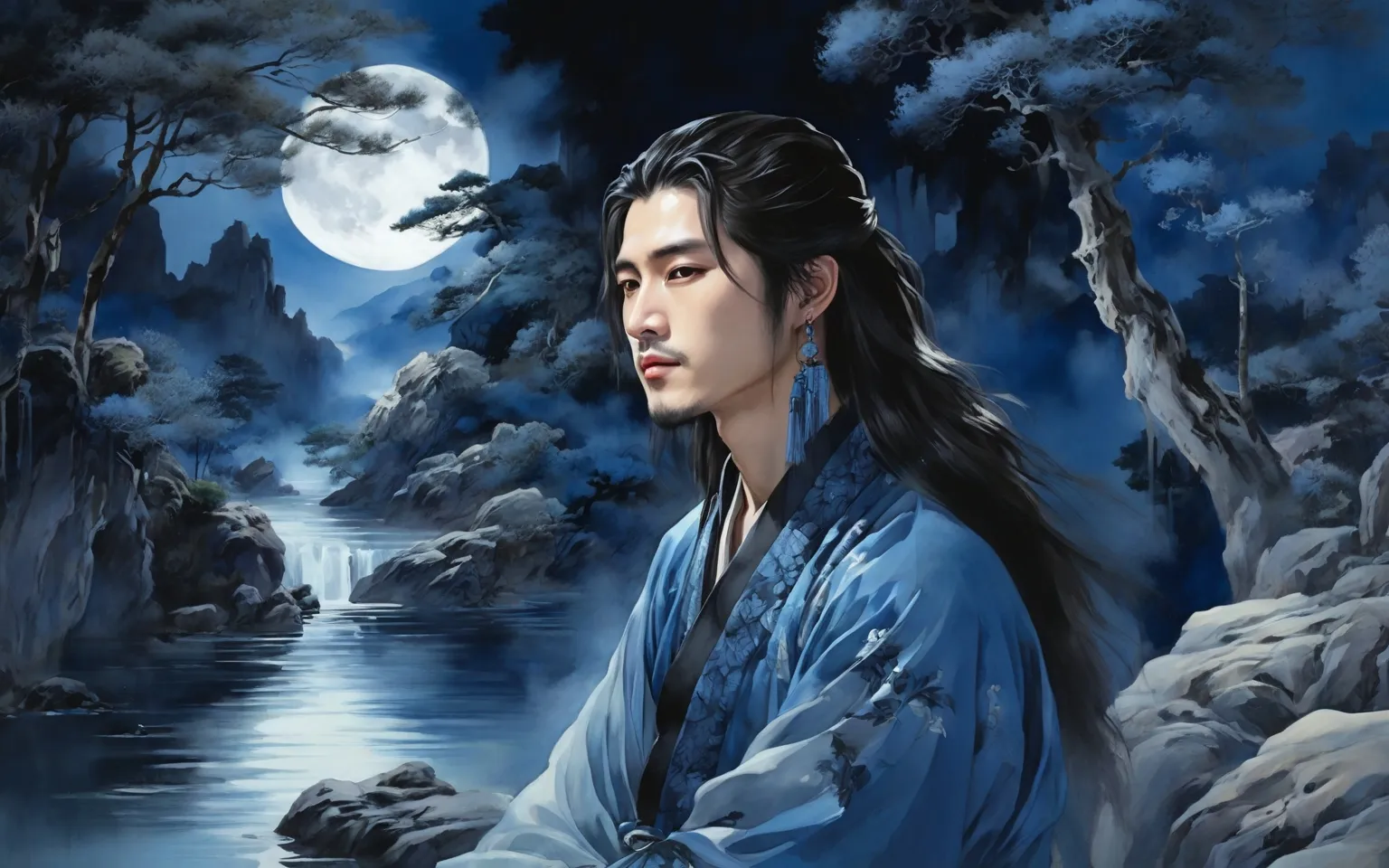
Wang Wei (王维), 701 - 761 A.D., was a native of Yuncheng, Shanxi Province. Wang Wei was a poet of landscape and idylls. His poems of landscape and idylls, with far-reaching images and mysterious meanings, were widely loved by readers in later generations, but Wang Wei never really became a man of landscape and idylls.