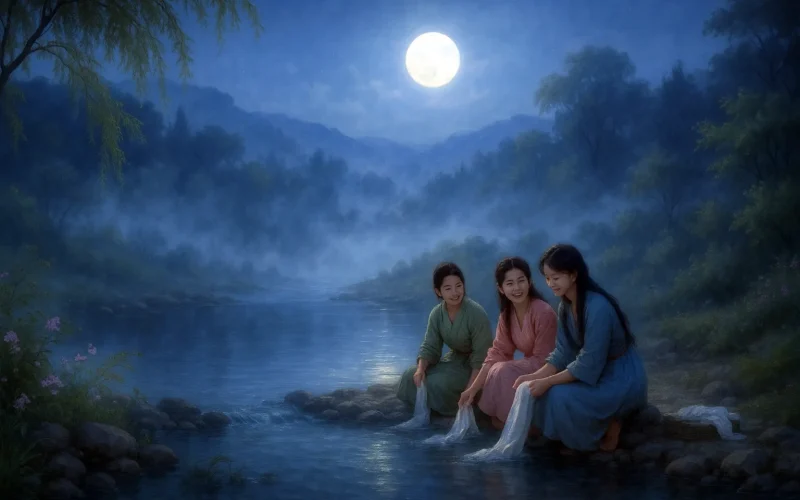



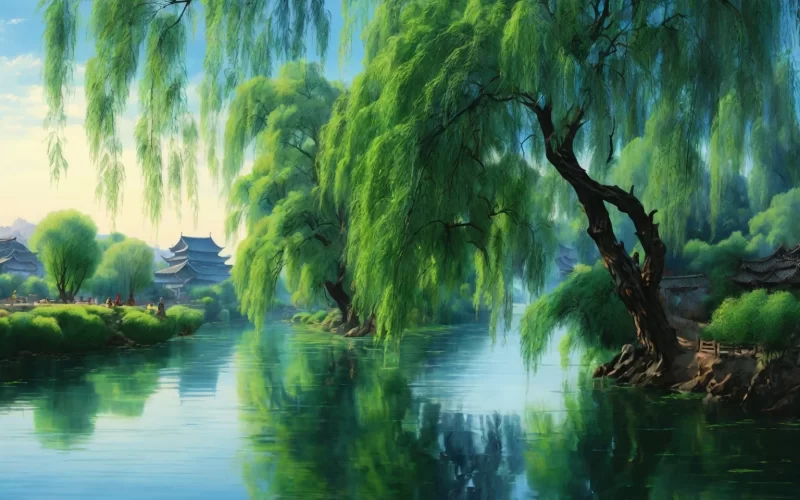
In rows they kiss the trees on land;
Their shade falls into ripples clear.
They won’t learn from those by Royal Moat’s strand,
Where spring breeze grieves o’er parting dear.
Original Poem
「柳浪」
王维
分行接绮树,倒影入清漪。
不学御沟上,春风伤别离。
Interpretation
This poem was composed during Wang Wei's youth (approximately in the early Kaiyuan era), showcasing the distinctive features of his early poetic style: fresh and luminous, using objects to convey emotions. Unlike the ethereal Zen-like tranquility of his later Wangchuan poems, this work depicts a refreshing scene while expressing the young poet’s unique understanding of parting and his pursuit of emotional transcendence. The "willow waves" refer not only to the visual image of rows of willows resembling undulating waves but also subtly allude to the traditional motif of "breaking willow branches to bid farewell." Yet, through a skillful poetic turn, Wang Wei imbues this conventional theme with a new meaning that is refreshingly original, rational, and philosophically detached.
First Couplet: 分行接绮树,倒影入清漪。
Fēn háng jiē qǐ shù, dǎo yǐng rù qīng yī.
In rows they stand, willows like brocade so fine;
Their reflections sink in clear ripples, a quivering line.
Explication: The poet composes the scene with a painter's eye, emphasizing the beauty of the willows' orderly arrangement and the interplay of light and shadow. "In rows" describes the neat alignment of the trees while subtly alluding to the formation of people or carriages during a farewell, lending the natural scene a quiet connection to human affairs. "Willows like brocade" uses the splendor of patterned silk to evoke the lush, delicate beauty of the willow foliage. "Their reflections sink in clear ripples" further deepens the spatial dimension: the gentle movement of the water causes the reflections to waver vividly, merging the light, the colors of the trees, and the shimmering surface into a captivating picture where reality and reflection enhance each other. Though these lines are purely descriptive, they quietly establish an elegant backdrop for the parting scene, devoid of sorrow and filled only with natural, radiant beauty.
Second Couplet: 不学御沟上,春风伤别离。
Bù xué yù gōu shàng, chūn fēng shāng bié lí.
I will not mimic those by the Royal Moat, willow strands,
Where spring winds stir only the sorrow of parting hands.
This couplet marks a decisive shift from scene to sentiment—a sentiment that reveals resolve. "Royal Moat" refers to the canal by the imperial palace, whose banks, laden with willows, were a classic setting for capital farewells, a place steeped in the cultural legacy of sorrowful parting since Han times. The phrase "spring winds stir only the sorrow of parting" encapsulates the essence of a longstanding poetic tradition where willow branches and spring breezes are freighted with melancholy. Wang Wei firmly rejects this trope with the words "I will not mimic," declaring his refusal to indulge in a conventional, grief-laden view of separation. This is not a lack of feeling, but rather a demonstration of rational clarity and emotional autonomy—the poet acknowledges the reality of parting but resists being confined by traditional emotional patterns, seeking a more expansive way of facing it, grounded in natural beauty and mental serenity.
Holistic Appreciation
This is a clever poem that reimagines the willow motif, using scenery to dispel sorrow. Its structure is built on contrast and complementarity: the first couplet celebrates the visual beauty of the willow waves, while the second rejects the willow's traditional association with grief; the first immerses the reader in sensory delight, the second offers reflection and philosophical transcendence. The poet seems to ask: why must the willow, which can be so vibrant and its light and shadow so pure, always bear the heavy burden of parting sorrow?
This approach reflects the young Wang Wei's poetic ambition to both inherit and transcend tradition. He does not ignore the cultural link between willow and parting. Instead, by first highlighting the willow's inherent, lush beauty ("willows like brocade") and placing it within a clear, flowing natural context ("clear ripples"), he grants the willow an independent, self-sufficient aesthetic value. Then, with "I will not mimic," he asserts his personal emotional stance. Thus, the willow waves become not merely a symbol of separation but a celebration of nature's perpetual vitality. Parting is no longer just an occasion for sadness but a life process that can be contemplated with clarity and soothed by natural beauty.
Artistic Merits
- Selection and Transformation of Imagery: Wang Wei chooses the dynamic image of "willow waves," which fits the context of traditional farewell poetry. He then refreshes it by cleansing its sorrowful connotations through vivid phrases like "in rows," "willows like brocade," and "clear ripples," restoring its beauty as a vibrant natural scene.
- Negative Employment of Allusion: "Willows by the Royal Moat" is a common poetic allusion to parting. Wang Wei's "I will not mimic" constitutes a deliberate reversal of this allusion, using contrast to underscore his distinct emotional attitude and thereby deepening the poem's meaning.
- Subtle Depiction of Color and Light: The word "brocade" suggests the willow's lush greenery and dappled light, while "clear ripples" conveys the water's translucence and gentle movement. Together, they create a bright, fluid visual atmosphere, consciously departing from the somber palette typical of parting poems.
- Restrained and Elevated Emotional Expression: The poem never directly mentions the sorrow of parting—it even explicitly refuses to "stir the sorrow." Yet, through its appreciation of beauty and its distance from convention, it reveals a deeper, more self-possessed emotional world—one fully engaged with nature's beauty and respectful of personal emotional integrity.
Insights
This work offers a wisdom for reconciling with emotion. Faced with parting—an enduring human experience—Wang Wei suggests a path distinct from either lingering in sorrow or forcibly suppressing it: to settle the heart in natural beauty and to maintain clarity through thoughtful reflection. He shows that the willow can be a symbol of farewell, but first, it is a splendor of spring, a shimmering reflection in water. Parting may bring sadness, but we need not be bound by inherited cultural scripts. With eyes that appreciate beauty and a mind that remains clear, we may each find our own path through feeling.
In an age where emotional expression grows increasingly patterned—even scripted by social media conventions—Wang Wei's "I will not mimic" feels especially resonant. It reminds us that genuine emotion arises from within, not from imitation of external forms. Like the poet, we may find in life's "willow waves" and "clear ripples" a way to feel that is both authentic and free, both deeply felt and luminous. This is not only the insight of a young poet from over a millennium ago but a gentle, enduring inspiration.
About the poet
Wang Wei (王维), 701 - 761 A.D., was a native of Yuncheng, Shanxi Province. Wang Wei was a poet of landscape and idylls. His poems of landscape and idylls, with far-reaching images and mysterious meanings, were widely loved by readers in later generations, but Wang Wei never really became a man of landscape and idylls.