


On the third day of the Third-month in the freshening weather
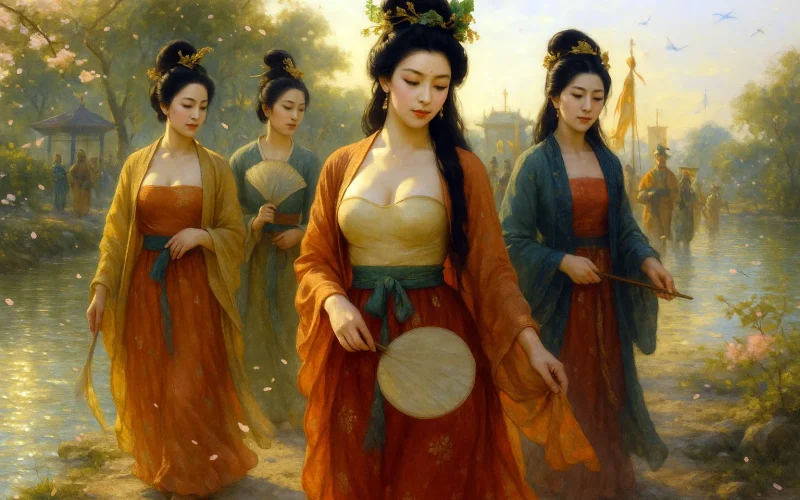
Many beauties take the air by the Changan waterfront,
Receptive, aloof, sweet-mannered, sincere,
With soft fine skin and well-balanced bone.
Their embroidered silk robes in the spring sun are gleaming --
With a mass of golden peacocks and silver unicorns.
And hanging far down from their temples
Are blue leaves of delicate kingfisher feathers.

And following behind them
Is a pearl-laden train, rhythmic with bearers.
Some of them are kindred to the Royal House --
The titled Princesses Guo and Qin.

Red camel-humps are brought them from jade broilers,
And sweet fish is ordered them on crystal trays.
Though their food-sticks of unicorn-horn are lifted languidly
And the finely wrought phoenix carving-knife is very little used,
Fleet horses from the Yellow Gate, stirring no dust,
Bring precious dishes constantly from the imperial kitchen.
...While a solemn sound of flutes and drums invokes gods and spirits,
Guests and courtiers gather, all of high rank;
And finally, riding slow, a dignified horseman
Dismounts at the pavilion on an embroidered rug.

In a snow of flying willow-cotton whitening the duckweed,
Bluebirds find their way with vermilion handkerchiefs --
But power can be as hot as flame and burn people's fingers.
Be wary of the Premier, watch for his frown.
Original Poem
「丽人行」
三月三日天气新, 长安水边多丽人。
态浓意远淑且真, 肌理细腻骨肉匀。
绣罗衣裳照暮春, 蹙金孔雀银麒麟。
头上何所有? 翠微盍叶垂鬓唇。
背后何所见? 珠压腰衱稳称身。就中云幕椒房亲, 赐名大国虢与秦。
紫驼之峰出翠釜, 水精之盘行素鳞。
犀箸餍饫久未下, 鸾刀缕切空纷纶。
黄门飞鞚不动尘, 御厨络绎送八珍。
箫鼓哀吟感鬼神, 宾从杂遝实要津。后来鞍马何逡巡? 当轩下马入锦茵。
杜甫
杨花雪落覆白苹, 青鸟飞去衔红巾。
炙手可热势绝伦, 慎莫近前丞相嗔。
Interpretation
This work was composed in the spring of 753 CE, the twelfth year of the Tianbao era under Emperor Xuanzong. By this time, Consort Yang Yuhuan had enjoyed the emperor's singular favor for nearly a decade. Her sisters—the Ladies of Guo and Qin—along with her cousin Yang Guozhong wielded overwhelming influence, living in unparalleled extravagance while court governance grew increasingly corrupt, with crises simmering beneath the surface. Stranded in Chang'an without official post, Du Fu witnessed the ostentatious spring outing of the Yang clan by the Qujiang River during the Shangsi Festival. With a historian's discernment and a poet's art, he composed The Beautiful Women. Superficially, the poem lavishly depicts the resplendent spectacle of noble ladies on a spring excursion; at its core, it is a dagger sheathed in brocade, delivering a precise thrust to the political reality of dominant imperial in-laws and a disordered state. It stands as the supreme achievement of Du Fu's satirical verse.
Section 1: 三月三日天气新,长安水边多丽人。态浓意远淑且真,肌理细腻骨肉匀。绣罗衣裳照暮春,蹙金孔雀银麒麟。头上何所有?翠微盍叶垂鬓唇。背后何所见?珠压腰衱稳称身。
Sān yuè sān rì tiānqì xīn, Cháng'ān shuǐ biān duō lìrén. Tài nóng yì yuǎn shū qiě zhēn, jīlǐ xìnì gǔròu yún. Xiù luó yīshang zhào mùchūn, cù jīn kǒngquè yín qílín. Tóu shàng hé suǒ yǒu? Cuì wēi hé yè chuí bìn chún. Bèi hòu hé suǒ jiàn? Zhū yā yāo jié wěn chèn shēn.
The third day of the third month, the air is fresh and new; / By Chang'an's water's edge, a bevy of beauties comes in view. / Their manner rich, their gaze aloof, yet chaste, sincere; / Their skin is fine, their form is perfectly proportioned, sheer. / Their embroidered silks shine bright against the late spring light; / Gold-wrought peacocks, silver unicorns dazzle the sight. / What do they wear upon their heads, pray, on this day? / Kingfisher-blue leaf pendants by their temples sway. / And what is to be seen behind, I ask, just there? / Pearl-weighted sashes, fitted with a perfect air.
The poem opens on the festive scene, unfurling a scroll of court ladies on spring excursion. The description is meticulously detailed, moving from their demeanor ("manner rich, gaze aloof") and complexion ("skin is fine") to the lavish patterns on their gowns ("gold-wrought peacocks"), their hair ornaments ("kingfisher-blue leaf pendants"), and their waist adornments ("pearl-weighted sashes"). Layers of opulent detail construct a portrait of dazzling excess. The line "Their manner rich, their gaze aloof, yet chaste, sincere" is particularly masterful: their bearing is ostentatiously gorgeous, their eyes deliberately assume a distant air, and the seemingly complimentary phrase "chaste, sincere" thinly veils a satire of their affectation. The folk-song-inspired question-and-answer format ("What do they wear…?" / "And what is to be seen…?") focuses the viewer's eye on these luxurious specifics. Within this blinding material display, the hollowness and superficiality of their world begins to show.
Section 2: 就中云幕椒房亲,赐名大国虢与秦。紫驼之峰出翠釜,水精之盘行素鳞。犀箸餍饫久未下,鸾刀缕切空纷纶。黄门飞鞚不动尘,御厨络绎送八珍。箫鼓哀吟感鬼神,宾从杂遝实要津。
Jiù zhōng yún mù jiāo fáng qīn, cì míng dà guó Guó yǔ Qín. Zǐ tuó zhī fēng chū cuì fǔ, shuǐjīng zhī pán xíng sù lín. Xī zhù yànyù jiǔ wèi xià, luán dāo lǚ qiē kōng fēn lún. Huángmén fēi kòng bú dòng chén, yù chú luòyì sòng bā zhēn. Xiāo gǔ āi yín gǎn guǐshén, bīn cóng zá tà shí yàojīn.
And mid them all, behind cloud-curtains, kin most dear, / Granted the titles of great fiefs: Lady Guo, Lady Qin, appear. / From jade-green cauldrons, humps of purple camel steam; / On crystal plates, pale-scaled fish like silver gleam. / Rhinoceros-horn chopsticks, sated, lie unused, inert; / Phoenix-patterned knives slice fine, their labor gone to dirt. / Palace eunuchs fly on bridles, raising not a speck of dust; / The royal kitchens send in streams rare delicacies, as they must. / Pipe and drum intone a plaint that ghosts and gods could move; / A pushing throng of guests and followers jams the crossroads, lane, and grove.
The focus narrows from the general scene to its central figures, directly naming "Lady Guo, Lady Qin" and thus aiming the satire at these beneficiaries of unearned privilege. The description then shifts to the banquet, portraying extreme decadence. "Humps of purple camel" served from "jade-green cauldrons" and "pale-scaled fish" on "crystal plates" present a spectacle of dazzling color and costly material. The pointed irony of "chopsticks… lie unused" and "knives slice… their labor gone to dirt", however, exposes this as a showy waste born of excessive wealth and power, laying bare an inner void and wanton disregard. "Palace eunuchs fly… raising not a speck of dust" depicts the massive, flawlessly managed spectacle; "Pipe and drum intone a plaint" casts a note of ominous, artificial melancholy over the revels; and "A pushing throng… jams the crossroads" directly points to the political reality of their factions clogging the vital arteries of power.
Section 3: 后来鞍马何逡巡?当轩下马入锦茵。杨花雪落覆白苹,青鸟飞去衔红巾。炙手可热势绝伦,慎莫近前丞相嗔。
Hòu lái ān mǎ hé qūnxún? Dāng xuān xià mǎ rù jǐn yīn. Yáng huā xuě luò fù bái píng, qīngniǎo fēi qù xián hóng jīn. Zhì shǒu kě rè shì juélún, shèn mò jìn qián chéngxiàng chēn.
That latecomer on horseback, why does he hesitate, then stride? / Dismounts before the porch, treads on brocade inside. / Willow down falls snow-like, covering the white duckweed; / A bluebird flies off, in its beak a crimson scarf indeed. / His power burns the hand—a heat beyond compare; / Beware! Draw not too near, lest you the Minister's wrath dare!
The lens finally settles on the belated "latecomer on horseback." The question "why does he hesitate" introduces the brazen act of "Dismounts before the porch," perfectly capturing Yang Guozhong's insolent swagger. Then, with a sudden, brilliant turn, the poet employs natural imagery for a devastatingly veiled satire: "Willow down falls snow-like, covering the white duckweed"—the willow catkin (杨 yang, homophonous with the Yang surname) obscuring the white weed hints at scandalous rumors enveloping the Yang siblings; "A bluebird flies off… a crimson scarf" uses the mythical messenger to suggest the carrying of illicit tokens. The conclusion delivers its warning with stark directness. "Burns the hand" has become the classic phrase for the scorching aura of unchecked power. The final, mock-admonitory line, "Beware!… lest you the Minister's wrath dare!" lays the dagger bare: this entire spectacle of extravagance stems from a chief minister whose terrifying power is leading the state to ruin.
Holistic Appreciation
This poem represents the pinnacle of Du Fu's satirical art. Its power derives from the technique of "using extreme beauty to portray extreme corruption, and concealing thunderous indignation within a veneer of calm description." The work unfolds like an elaborately detailed scroll painting of a spring outing, resplendent with color and intricate detail. Yet beneath this gilded surface flow three undercurrents of critique: a moral condemnation of the ruling elite's decadence, a political censure of the dominance of imperial in-laws, and a sharp satire on the collapse of social propriety.
Du Fu's genius lies in never inserting a word of direct authorial judgment. Instead, through the careful choice of imagery (the "plaintive" pipes and drums, the willow down "covering the white duckweed"), skillful juxtaposition of details ("chopsticks… lie unused" versus "knives slice… gone to dirt"), and the use of subtle allegory, the satirical intent seeps inexorably from the cracks between the opulent phrases. It achieves the highest form of satire: "devoid of overt criticism, yet every descriptive line cuts with ironic force."
Artistic Merits
- Lavish Accumulation: Using Splendor to Convey Decadence
The poem devotes most of its length to a painstaking, gorgeous depiction of appearances, attire, feasting, and spectacle. This very excess of beauty, this suffocating opulence, serves to highlight by contrast the moral ugliness within—the extravagance, hollowness, and corruption—creating a powerful aesthetic and critical tension. - Precise Structure, Progressive Revelation
The poem moves from a general scene of spring revellers, to specifying the Ladies of Guo and Qin, to detailing their lavish banquet, and finally to introducing Yang Guozhong and his transgressions. The focus tightens progressively, and the satirical thrust deepens with each layer until the final, unveiled warning. - Subtle Allegory, Biting Satire
The use of "willow down" (杨花) to allude to the Yang surname, "covering the white duckweed" to suggest obscuring scandal, and the "bluebird" carrying a token to imply illicit communication—these natural images and allusions deliver a satire that is both deeply subtle and profoundly penetrating. - Blend of Elegance and Directness, Folk-Song Inflection
The verse combines lines of refined description like "Their embroidered silks shine bright against the late spring light" with the lively, questioning cadence of folk poetry ("What do they wear…"). This blend maintains a formal elegance while sharpening the poem's exposé with a tone of direct, almost popular, challenge.
Insights
A song of fair women is more than a masterful political satire; it is a mirror held up to the relationship between power and human nature. It reveals a profound truth: When power escapes all balance and moral restraint, it inevitably breeds extreme luxury, corruption, and ethical decay. A gleaming exterior of gold, jade, and brocade may cloak a core of licentiousness and emptiness; a moment of "heat that burns the hand" often foreshadows systemic crisis and ultimate downfall.
The poem's enduring lesson is this: Observing any society requires looking past surface splendor to perceive the underlying essence. It demands the clarity and courage to see through the glittering facade. With a poet's conscience and a historian's pen, Du Fu shows us that the true mark of a flourishing age is not found in the "jade-green cauldrons" of a privileged few, but in social justice, equity, and the common good. This spirit of vigilance against the crises that fester beneath glamour, and the courage to speak against injustice, is the precious legacy Du Fu bequeaths to all who value conscience.
Poem translator:
Kiang Kanghu
About the poet
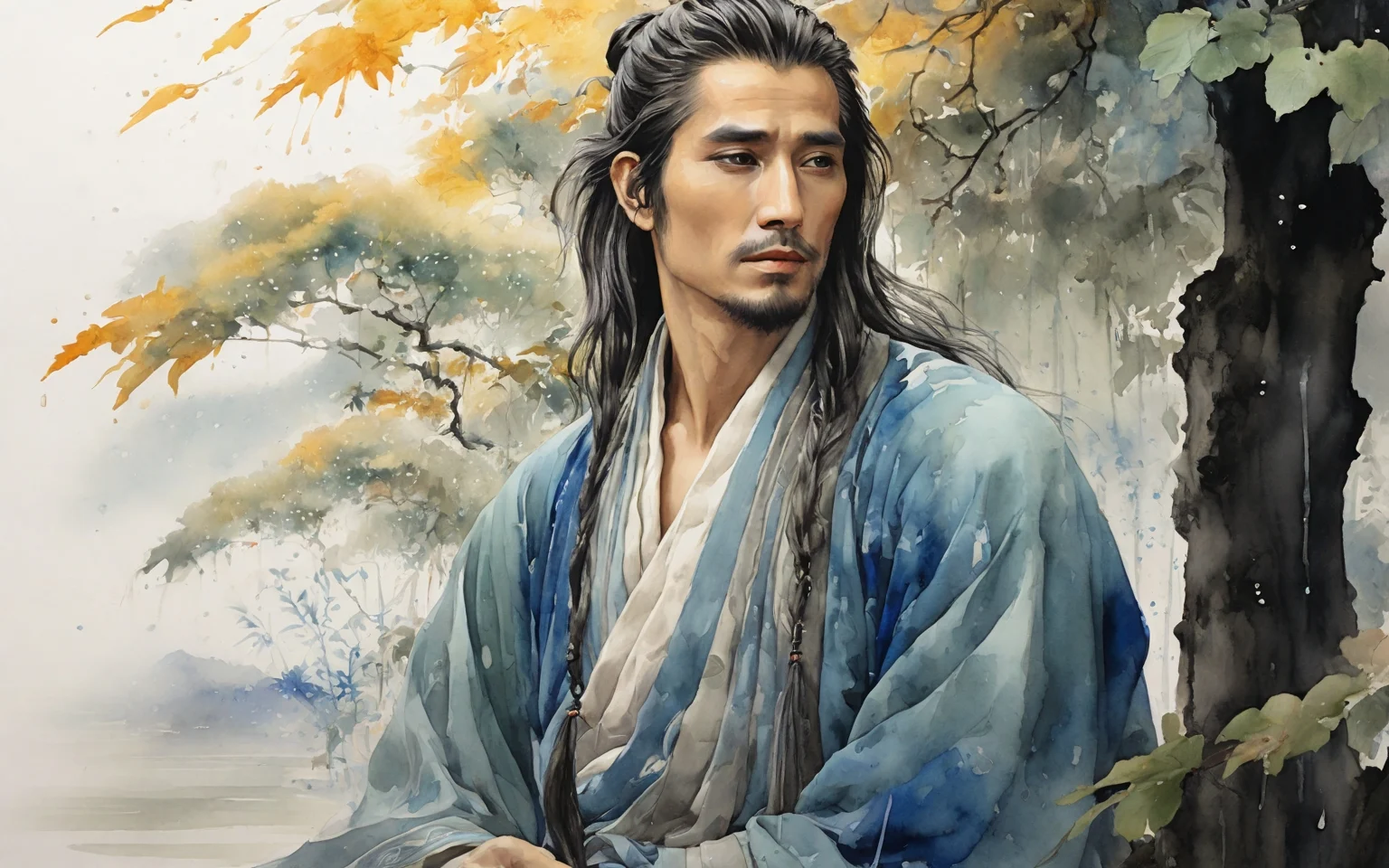
Du Fu (杜甫), 712 - 770 AD, was a great poet of the Tang Dynasty, known as the "Sage of Poetry". Born into a declining bureaucratic family, Du Fu had a rough life, and his turbulent and dislocated life made him keenly aware of the plight of the masses. Therefore, his poems were always closely related to the current affairs, reflecting the social life of that era in a more comprehensive way, with profound thoughts and a broad realm. In his poetic art, he was able to combine many styles, forming a unique style of "profound and thick", and becoming a great realist poet in the history of China.