


In his youth of fifteen or twenty years,
He chased a wild horse, caught and rode it with ease,
Shot down the white-browed mountain tiger,
Defied the “Yellow-Bearded Warrior,” lord of Ye.

Fighting alone across a thousand miles,
His naked blade could hold a host at bay.
True, our troops were swift as heaven’s thunder,
And Tartars fell in iron-fanged traps they lay,
Yet Wei Qing’s triumph was but heaven’s chance,
And Li Guang’s failure—fate, not his misplay.

Since retiring, he’s aged, worn by years;
Worldly cares have hastened his whitening hair.
Though once his arrow never missed a bird’s right eye,
Now knotted sinews make his left arm like willow bare.

Sometimes by the roadside he sells melons from his plot,
Sometimes plants willows round his humble cot.
A dense grove shuts away his lonely lane;
His empty window frames the cold, far mountain chain.

Yet, were he to pray, waters would gush for his men’s need,
Nor would he drown his cause in wine’s reckless deed.

Now war-clouds gather under the Helan Range;
Day and night, feathered dispatches speed.
In the Three River regions, governors call the young —
Five imperial decrees summon the old general, indeed.

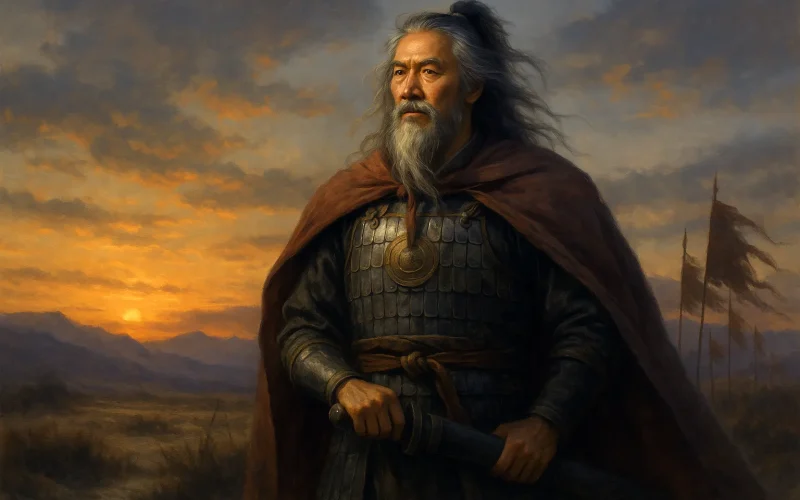
So he dusts his iron armor till it shines like snow,
Brandishes his star-patterned blade from its jade hilt, slow.
With his northern bow, he stands ready to strike the Tartar chief,
Lest any foreign war-dress dare affront our sovereign, lief.

There was an old prefect, once forgotten and remote,
Who could still achieve glory with a single stroke.
Original Poem
「老将行」
王维
少年十五二十时,步行夺得胡马骑。
射杀山中白额虎,肯数邺下黄须儿。
一身转战三千里,一剑曾当百万师。
汉兵奋迅如霹雳,虏骑崩腾畏蒺藜。
卫青不败由天幸,李广无功缘数奇。
自从弃置便衰朽,世事蹉跎成白首。
昔时飞箭无全目,今日垂杨生左肘。
路旁时卖故侯瓜,门前学种先生柳。
苍茫古木连穷巷,寥落寒山对虚牖。
誓令疏勒出飞泉,不似颍川空使酒。
贺兰山下阵如云,羽檄交驰日夕闻。
节使三河募年少,诏书五道出将军。
试拂铁衣如雪色,聊持宝剑动星文。
愿得燕弓射大将,耻令越甲鸣吾君。
莫嫌旧日云中守,犹堪一战取功勋。
Interpretation
"Song of an Old General" was composed by Wang Wei during the High Tang period, with the exact year unknown. However, its themes and style suggest it was written in his middle or later years. This era saw the Tang dynasty at the peak of its power, yet border conflicts were persistent. The fubing (garrison militia) system was gradually disintegrating, and injustices within the military merit system became increasingly apparent. Having lived through the Kaiyuan zenith, Wang Wei witnessed many figures like the old general depicted in the poem—veterans who had shed blood on distant battlefields yet received no recognition for various reasons, ending their lives in poverty and obscurity. This poem continues the tradition of narrating tragic fates like that of Li Guang, while also incorporating Wang Wei's profound observation of individual destiny beneath the radiant surface of the High Tang. The lament within the lines, "Wei Qing’s unbroken luck came from Heaven’s grace; / Li Guang won no success, his fate was out of place," not only voices injustice for the old general but also embodies philosophical reflection on the unpredictability of fate and the difficulty of judging merit.
Stanza 1
少年十五二十时,步行夺得胡马骑。
Shàonián shíwǔ èrshí shí, bùxíng duó dé hú mǎ qí.
射杀山中白额虎,肯数邺下黄须儿。
Shè shā shānzhōng bái é hǔ, kěn shǔ Yè xià huáng xū ér.
A youth of fifteen, then of twenty years, on his own feet could snatch a Tartar horse and ride. / He shot and killed the white-browed tiger in the hills; how could he deign to count those yellow-beards of Ye, for pride?
The opening boldly sketches the general's heroic youth. "On foot snatching a horse" displays his daring and skill, subtly alluding to the story of Li Guang; "shot the white-browed tiger" adapts the tale of Zhou Chu eliminating menaces, doubly layering the narrative to forge his image of extraordinary valor. "How could he deign to count those yellow-beards of Ye" uses a rhetorical question to highlight his supreme confidence. Cao Zhang (known as the "Yellow-beard") was a renowned Three Kingdoms warrior; this line implies the general's bravery surpassed even that of historical champions, foreshadowing the stark contrast with his later fate.
Stanza 2
一身转战三千里,一剑曾当百万师。
Yìshēn zhuǎn zhàn sān qiān lǐ, yī jiàn céng dāng bǎi wàn shī.
汉兵奋迅如霹雳,虏骑崩腾畏蒺藜。
Hàn bīng fènxùn rú pīlì, lǔ qí bēng téng wèi jíli.
*His single self campaigned three thousand *li* afar; / His solitary sword once matched a million foes. / Han troops, swift as the thunderclap, rushed to the war; / The Tartar horsemen, thrown in panic, feared the caltrops' rows.*
This section amplifies his monumental achievements with hyperbole. "Three thousand li" conveys the vast breadth of his campaigns, "a million foes" portrays the overwhelming might of his presence—the numerical contrast creates a powerful, majestic tension. The "thunderclap" metaphor captures the ferocity of the advance, while "caltrops" (an ancient defensive weapon) reveals his tactical brilliance. In just a few words, the image of a commander both brave and resourceful is vividly outlined. Yet such monumental merit brought no corresponding reward, building momentum for the thematic turn ahead.
Stanza 3
卫青不败由天幸,李广无功缘数奇。
Wèi Qīng bù bài yóu tiān xìng, Lǐ Guǎng wú gōng yuán shù jī.
自从弃置便衰朽,世事蹉跎成白首。
Zìcóng qìzhì biàn shuāixiǔ, shìshì cuōtuó chéng báishǒu.
Wei Qing’s unbroken luck came from Heaven’s grace; / Li Guang won no success, his fate was out of place. / Since cast aside, he’s fallen into decay; / The world’s affairs slipped by, his hair has turned to grey.
This couplet is the poem's pivotal turn. The poet borrows the historical allusions of Wei Qing and Li Guang to reveal that merit and reward are not directly correlated—"Heaven’s grace" and "fate… out of place" (ill fortune) are the determining factors. This both cries injustice for the old general and profoundly questions the system of evaluating achievement. The phrase "cast aside" is as cold and final as a verdict. The physical decline of "decay" and "hair… grey" intertwines with the psychological sense of wasted years in "slipped by," depicting the twin blows suffered by a hero who has lost his way.
Stanza 4
昔时飞箭无全目,今日垂杨生左肘。
Xīshí fēi jiàn wú quán mù, jīnrì chuí yáng shēng zuǒ zhǒu.
路旁时卖故侯瓜,门前学种先生柳。
Lùpáng shí mài gù hóu guā, mén qián xué zhǒng xiānshēng liǔ.
苍茫古木连穷巷,寥落寒山对虚牖。
Cāngmáng gǔ mù lián qióng xiàng, liáoluò hán shān duì xū yǒu.
In former days, his flying arrow spared no eye of bird in flight; / Now willow sprouts, they say, grow from his left arm, weak and slight. / He sometimes sells a melon by the road, like that marquis of old; / Before his gate he learns to plant those willows, as we’re told. / Vast, ancient trees connect with his poor lane’s confined retreat; / The bare, cold mountain faces his deserted window, bleak.
This stanza sharply contrasts past and present, describing his impoverished dwelling and striving to portray the general's destitute old age. "His flying arrow spared no eye" uses the allusion of Hou Yi's archery to describe his former divine skill; "willow sprouts… grow from his left arm" transforms the Zhuangzi's imagery of a diseased limb into a metaphor for his present frailty—the metaphor is strikingly original yet tragic. The allusions to selling melons (the tale of Marquis Dongling, Shao Ping, after the fall of Qin) and planting willows (Tao Yuanming, "Master Five Willows") overlay the落魄 of historical figures with the general's own situation, deepening the historical resonance of the tragedy. The concluding environmental depiction—"ancient trees," "poor lane," "cold mountain," "deserted window"—forms a bleak picture of a recluse living in impoverished, scholarly seclusion, the spatial confinement metaphorizing the end of his political life.
Stanza 5
誓令疏勒出飞泉,不似颍川空使酒。
Shì lìng Shūlè chū fēiquán, bù shì Yǐngchuān kōng shǐjiǔ.
贺兰山下阵如云,羽檄交驰日夕闻。
Hèlán Shān xià zhèn rú yún, yǔxí jiāo chí rì xī wén.
He swears to make a fountain stream from Shule’s barren earth, / Not to vent wine-fueled rage like that Yingchuan man of dearth. / At Helan Mountain’s base, the war arrays like clouds are spread; / Day and night, urgent dispatches fly, by rumors sped.
Amid extreme dejection, the general's spirit suddenly surges. "To make a fountain stream from Shule" alludes to the Eastern Han tale of Geng Gong, who, defending a孤城, prayed and brought forth a spring from a well, showcasing the will to create miracles in desperate straits. "Vent wine-fueled rage like that Yingchuan man" alludes to the Western Han's Guan Fu, who vented resentment through drunken insults,表明 the general disdains pointless, self-destructive complaint. These two contrasting historical choices reveal a character that transcends personal gain and loss. Just at this moment, warfare resumes "at Helan Mountain’s base"; the urgency of "dispatches fly" provides the historical stage for the general's reappearance.
Stanza 6
节使三河募年少,诏书五道出将军。
Jié shǐ Sānhé mù niánshào, zhàoshū wǔ dào chū jiāngjūn.
试拂铁衣如雪色,聊持宝剑动星文。
Shì fú tiěyī rú xuě sè, liáo chí bǎojiàn dòng xīng wén.
愿得燕弓射大将,耻令越甲鸣吾君。
Yuàn dé Yàn gōng shè dàjiàng, chǐ lìng Yuè jiǎ míng wú jūn.
莫嫌旧日云中守,犹堪一战取功勋。
Mò xián jiùrì Yúnzhōng shǒu, yóu kān yī zhàn qǔ gōngxūn.
Envoys recruit young men from the Three Rivers’ land; / Five imperial decrees send generals to command. / He tries his iron armor, brushed to snowy hue; / He takes his precious sword where starry patterns brew. / He’d wish a northern bow to shoot the chieftain dead, / Ashamed to let southern arms alarm his lord with dread. / Don’t scorn the old defender of Yunzhong Town! / He still can fight one battle to win his renown.
The final stanza bursts forth with a solemn and stirring vitality. "Iron armor, brushed to snowy hue" describes his well-kept gear, "precious sword where starry patterns brew" portrays the potent aura of his weapon—though aged in body, his martial spirit remains undiminished. "A northern bow to shoot the chieftain" shows his resolute will to kill the enemy commander; "ashamed to let southern arms alarm his lord" expresses his loyalty to the sovereign—personal honor and national security unite here. The last two lines, "Don’t scorn the old defender of Yunzhong Town! / He still can fight one battle to win his renown," use the allusion of Wei Shang, the Han dynasty governor of Yunzhong (who was once demoted for a minor fault but later reinstated after Feng Tang pleaded his case) as a self-comparison. It is both an earnest plea and a confident declaration—the old general's value has never diminished with time, awaiting only an opportunity to be seen anew.
Holistic Appreciation
This poem represents Wang Wei's creative development of the yuefu (Music Bureau poetry) tradition. Its unique value lies in perfectly integrating the grand narrative of heroic epic with the nuanced portrayal of individual fate. The poem employs a three-part structure of "glory – downfall – resurgence," but the focus is not on plot twists, but on the emotional vicissitudes and spiritual sublimation of the protagonist's inner world. Through the dense and precise use of allusion (over ten instances throughout the poem), the poet connects the general's personal experience to the grand lineage of "the unrecognized hero" in Chinese history, granting his fate a transcendent, symbolic significance. Particularly profound is Wang Wei's restraint and nobility in expressing indignation—the general's sorrow is not mere complaint but transforms into the positive will of "swears to make a fountain stream from Shule." His plea to fight is not for personal glory but stems from the sense of duty in "ashamed to let southern arms alarm his lord." This emotional texture of "sorrowful but not wounded, resentful but not angry" reflects the distinctive spiritual bearing of High Tang poetry.
Artistic Merits
- Unity of Epic Style and Lyrical Core: Lines like "campaign three thousand li" and "matched a million foes" possess epic grandeur, yet all serve the poet's focus on and sympathy for individual fate; the grand narrative ultimately points to a resonance in the depths of the human heart.
- Highly Mature Art of Allusion: Historical allusions are not mere ornamentation but carriers of meaning. Each allusion (Li Guang, Wei Qing, Geng Gong, Guan Fu, Wei Shang, etc.) precisely corresponds to different aspects of the old general's situation, creating multiple layers of historical echo.
- Meticulously Designed Contrastive Structure: The threefold contrast of youthful vigor vs. impoverished old age, historical glory vs. present neglect, and personal disappointment vs. national need, progresses layer by layer, highlighting the central theme through dramatic tension.
- Blend of Vigorous and Subtle Language: There is the robust, heroic tone of "on his own feet could snatch a Tartar horse," the original and subtly evocative quality of "willow sprouts… grow from his left arm," and the chilly and desolate imagery of "The bare, cold mountain faces his deserted window." Multiple linguistic textures serve the nuanced needs of emotional expression.
Insights
This work reveals to us a heroism that transcends success or failure—true glory lies not in receiving rewards, but in maintaining dignity when faced with injustice, holding fast to conviction in adversity, and stepping forward to answer the call of duty when the country needs it most. The general's "fate… out of place" is beyond individual control, but how he faces this ill fortune depends entirely on his own choices. The clarity of "Not to vent wine-fueled rage" and the commitment of "swears to make a fountain stream" constitute a noble height of character.
This enlightens us: In any era, systems of evaluation inevitably have limitations and injustices, but an individual's worth should not be entirely determined by external judgment. The general's ultimate affirmation of value comes not from an imperial edict, but from his own belief and capability embodied in "He still can fight one battle to win his renown." This dignity, grounded in inner conviction, is the most solid force against the vagaries of fate. Through this poem, Wang Wei shows us: Heroes may grow old, but the heroic spirit never becomes outdated—it is that sublime posture of holding fast to ideals and remaining ready to dedicate oneself, even after clearly recognizing the harsh truths of life.
Poem translator
Kiang Kanghu
About the poet
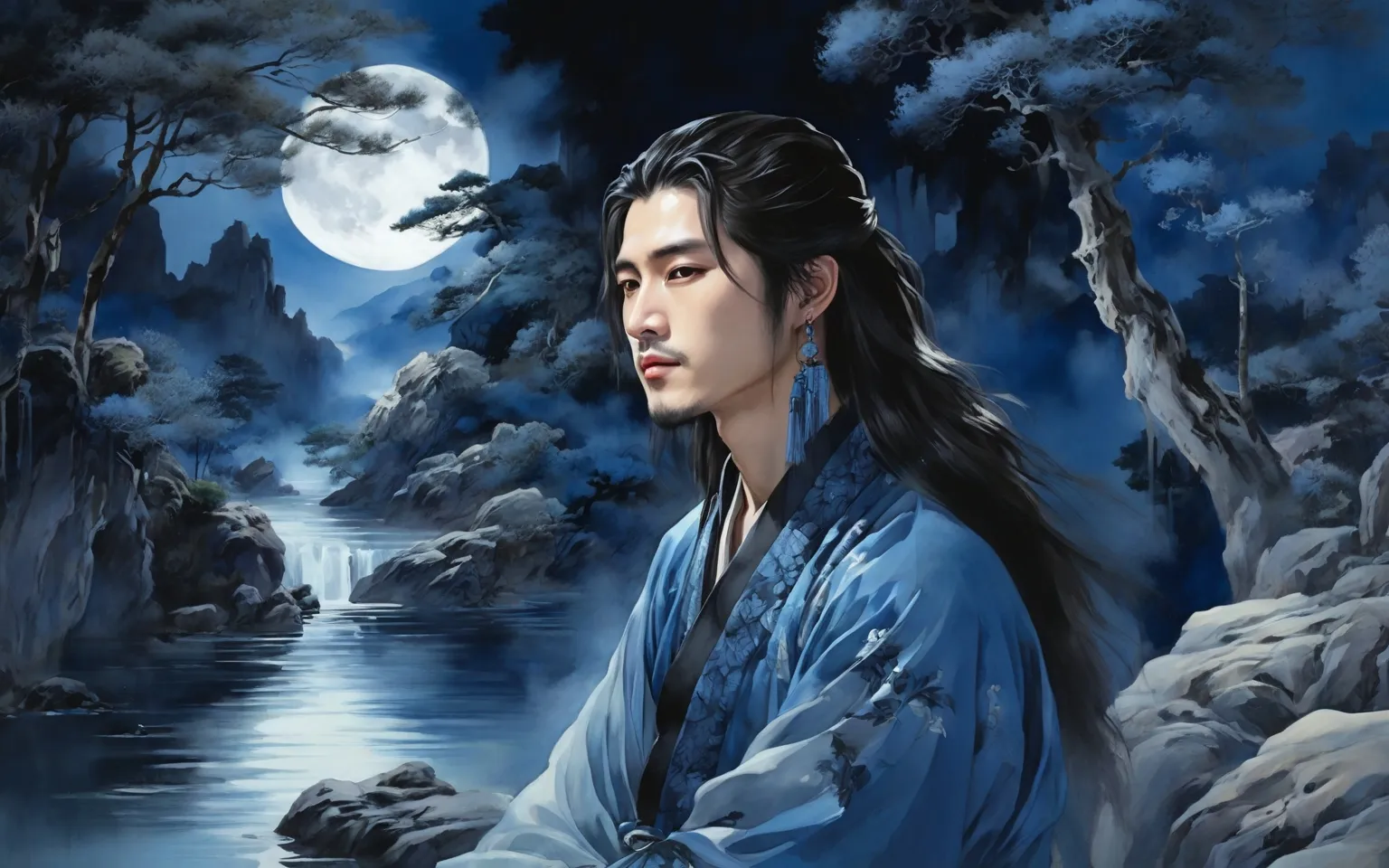
Wang Wei (王维), 701 - 761 A.D., was a native of Yuncheng, Shanxi Province. Wang Wei was a poet of landscape and idylls. His poems of landscape and idylls, with far-reaching images and mysterious meanings, were widely loved by readers in later generations, but Wang Wei never really became a man of landscape and idylls.