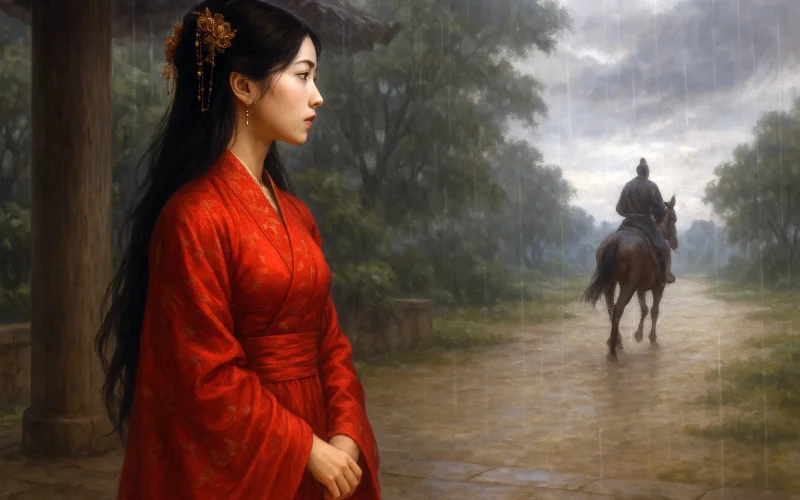



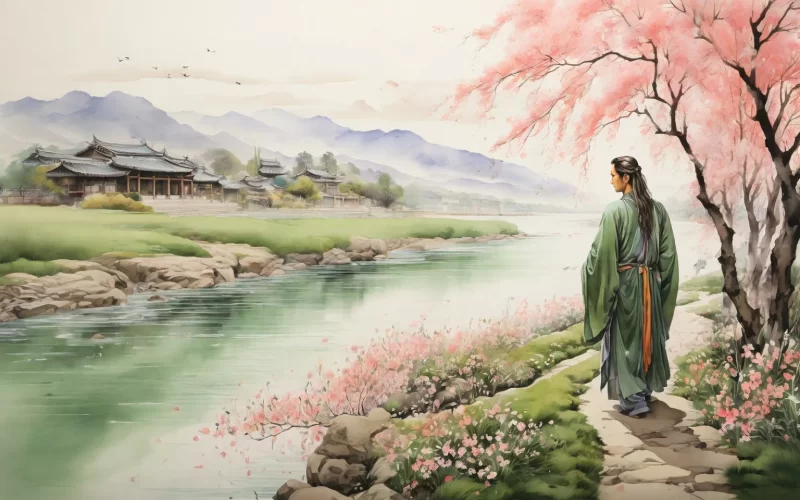
My broken heart is broken on the river's end;
Leaning on my cane, I stand on the isle of flowers.
The willow down runs mad, dancing in the breeze;
The wanton peach petals go with the stream for hours.
Original Poem
「绝句漫兴九首 · 其五」
杜甫
肠断春江欲尽头,杖藜徐步立芳洲。
颠狂柳絮随风舞,轻薄桃花逐水流。
Interpretation
This poem was likely composed in the spring of 761 CE, the second year of the Shangyuan era under Emperor Suzong, while Du Fu was living at his Thatched Hut by the Huanhua Stream in Chengdu. Although the An Lushan Rebellion was still ongoing and the Central Plains remained in turmoil, the poet had found temporary refuge in western Shu and enjoyed a period of relative stability. Yet, longing for his homeland and anxiety for the state perpetually weighed on his mind. The term “Casual Impressions” (漫兴, màn xìng) in the title suggests a spontaneous, informal composition. However, Du Fu’s “casual impressions” are far from light or trivial sketches; they subtly saturate the immediate spring scenery with profound historical lament and refined personal experience.
First Couplet: “肠断春江欲尽头,杖藜徐步立芳洲。”
Cháng duàn chūn jiāng yù jìntóu, zhàng lí xú bù lì fāng zhōu.
Heartbroken along the spring river, I walk to where it seems to end; / Leaning on my rustic cane, I slowly stand where fragrant grasses blend.
The opening line bursts forth with intense emotion. The phrase “heartbroken” strikes a sharp, sorrowful note that defines the entire poem. “To where it seems to end” describes literally reaching the river's extremity but also metaphorically suggests both the spring scene and the poet’s spirits have reached their limit. The slow, deliberate movement of “leaning on my cane, I slowly stand” acts as a physical counterpoint to the inner turmoil of grief and the external passage of the fleeting season. The verb “stand” seems to crystallize his boundless sorrow upon the fragrant shore, creating a moment of powerful, silent tension. Here, the aged poet and the spring landscape, sorrow and vitality, form the poem’s first layer of contradiction.
Second Couplet: “颠狂柳絮随风舞,轻薄桃花逐水流。”
Diānkuáng liǔxù suí fēng wǔ, qīngbó táohuā zhú shuǐ liú.
Reckless, willow down dances madly as the wind dictates; / Frivolous, peach blossoms chase the current—flecting, floating fates.
The poet’s gaze shifts from himself to the chaotic late-spring scene. With the highly subjective descriptors “reckless” and “frivolous,” he projects human traits onto nature. The willow down’s “dance” is not graceful but a “mad” loss of autonomy, wholly subject to the wind’s whim. The peach blossoms’ “chase” is not purposeful pursuit but a “frivolous,” helpless drift with the flow. These two images are vivid depictions of spring’s decline, yet also sharp metaphors for a rootless existence and a superficial, volatile world. Their swirling, drifting motion creates a stark, second contrast with the poet’s own still, steadfast figure.
Holistic Appreciation
This 28-character heptasyllabic quatrain carries the immense weight of Du Fu’s concern for his country and grief over his personal fate. It achieves an artistic transcendence, capturing vast themes within a minute focus and transforming immediate scenes into timeless history.
The poem’s structure implies a “dialectic of observation”: the first two lines present the poet as the “feeling subject” in his sorrowful wandering and static contemplation; the latter two lines show him as the “detached critic” coolly depicting the objects before him. The progression from the inward grief of “heartbroken,” to the situated stance of “stand where fragrant grasses blend,” to the critical observation of the willow down and peach blossoms, marks a shift from raw emotion to philosophical reflection.
The poem’s core lies in a “paradox of spring.” The “fragrant shore” should be a place of vibrant life; “willow down” and “peach blossoms” are classic symbols of spring’s beauty, typically evoking joy. Yet, through the poet’s eyes, they are tinged with decay, frivolity, and loss of control. This is not merely the “end of spring” in the seasonal cycle but signifies the loss of an ideal world of order, stability, and sincere depth in the poet’s heart. The more “reckless” and “frivolous” the spring scene appears, the more it contrasts with his inner yearning for “composure” and “substance.”
On a deeper level, the poem is Du Fu’s poetic meditation on “states of being.” “Willow down dancing as the wind dictates” and “peach blossoms chasing the current” symbolize an existence devoid of agency, utterly swept along by external forces (wind, water). The poet’s act of “leaning on my cane, I slowly stand,” however, represents an attempt to maintain an independent posture and a clear, critical mind amidst the torrent. This “standing” is an act of spiritual resistance.
Artistic Merits
- Intensification of Emotion and Imagery: “Heartbroken” expresses emotional extremity; “to where it seems to end” conveys a spatial limit; “reckless” and “frivolous” are potent moral and aesthetic judgments. Using this heightened language, the poet transforms ordinary spring scenery into powerfully evocative and symbolic emotional constructs.
- Deliberate Interplay of Movement and Stillness: The first couplet uses “slowly” and “stand” to depict human stillness and deliberation; the second uses “dances madly” and “chase” to depict the frantic movement of nature. This interplay creates a dynamic rhythm in the imagery and, more importantly, serves as a metaphor for the conflict between the poet’s inner steadfastness and the outer world’s chaos.
- Critical Edge in Personification: “Reckless” and “frivolous” are not neutral descriptions but clearly pejorative judgments. This elevates the scene beyond mere description into sharp commentary on certain life attitudes and the character of the era, reflecting the incisive aspect of Du Fu’s “profound and tightly wrought” style.
- A Masterclass in Using Joyful Scenes to Convey Sorrow: The entire poem depicts spring’s beauty, yet not a word conveys joy; it describes captivating scenes, yet everywhere strikes a note of lament. The poet pours his anxiety for the nation’s fate, his helplessness in exile, and his disdain for worldly trends into the radiant spring landscape, achieving the artistic effect of “redoubling the sorrow.”
Insights
This work reveals how a great poet can perceive the maladies of an age and the crises of existence within the most ordinary, even splendid, scenes. What Du Fu saw in the willow down and peach blossoms—“recklessness” and “frivolity”—was a profound insight into his time: when a society’s spirit trends toward superficiality and weightlessness, and drifting with the tide becomes the norm, the truly clear-sighted individual feels the acute pain of alienation.
For the modern reader, this poem poses a question: In today’s world of swirling information, multiple competing values, and rapidly shifting trends, do we too often find ourselves in a state of “dancing as the wind dictates” or “chasing the current”? Can we, within life’s torrent, find our own “fragrant shore” upon which to “slowly stand”—that is, maintain a posture of independent judgment, inner resolve, and spiritual substance?
With his “heartbroken” sensitivity and his posture of “standing,” Du Fu reminds us that true strength lies not in chasing every gust of wind or conforming to every current, but in holding fast to the weight and direction of one’s own soul, even after seeing through the “frivolity” and “recklessness” behind the glamour. This is perhaps why this small, “casually inspired” poem continues to resonate deeply across a millennium.
About the poet
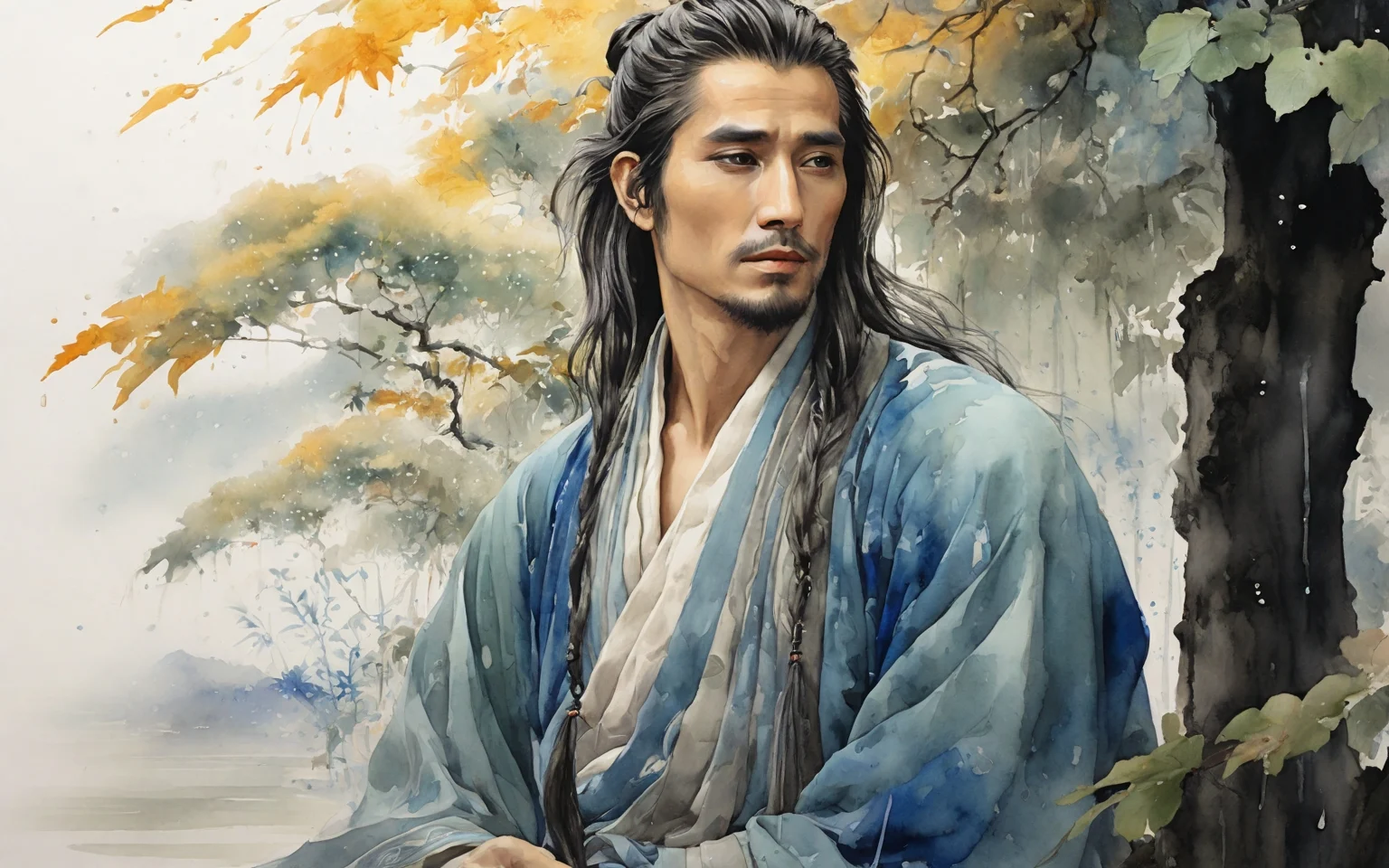
Du Fu (杜甫), 712 - 770 AD, was a great poet of the Tang Dynasty, known as the "Sage of Poetry". Born into a declining bureaucratic family, Du Fu had a rough life, and his turbulent and dislocated life made him keenly aware of the plight of the masses. Therefore, his poems were always closely related to the current affairs, reflecting the social life of that era in a more comprehensive way, with profound thoughts and a broad realm. In his poetic art, he was able to combine many styles, forming a unique style of "profound and thick", and becoming a great realist poet in the history of China.