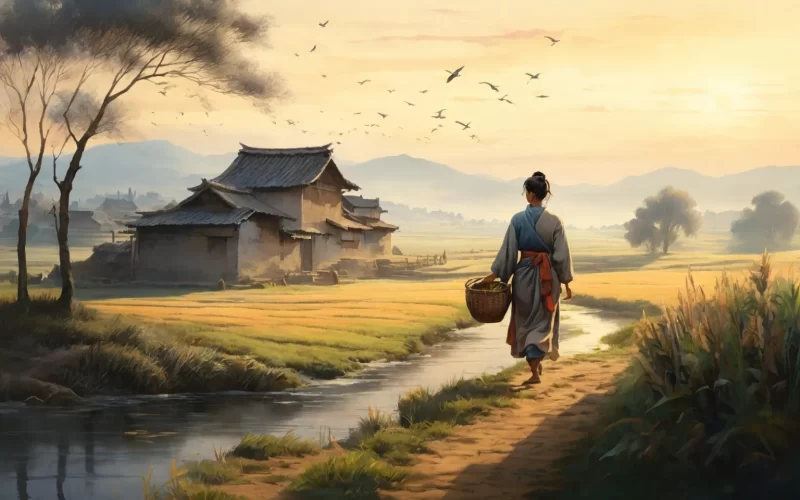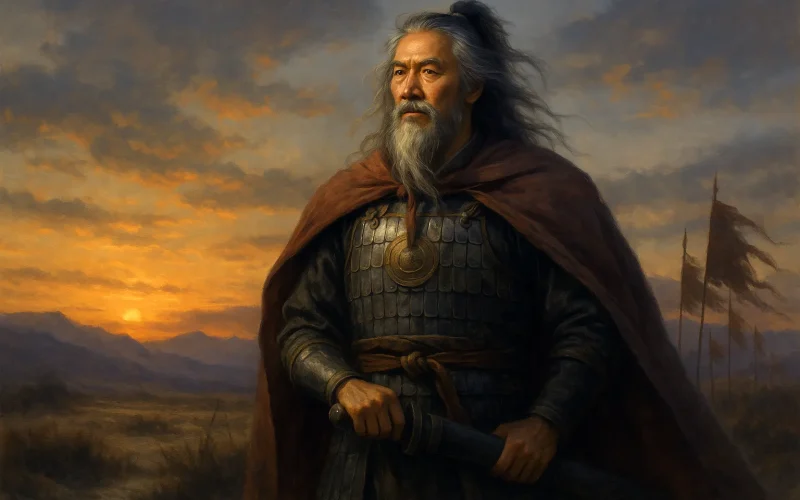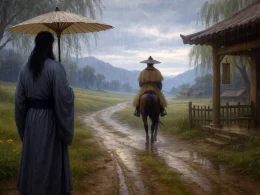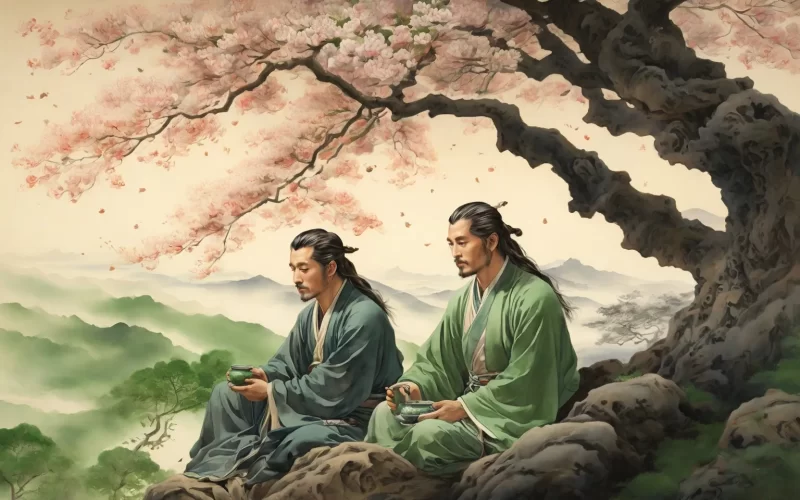
Here alone, a stranger in an unfamiliar place,
On this festival day, my longing for home finds no solace.
My brothers back east must be climbing the heights today,
Each wearing a sprig of dogwood — and I’m the one away.
Original Poem
「九月九日忆山东兄弟」
王维
独在异乡为异客,每逢佳节倍思亲。
遥知兄弟登高处,遍插茱萸少一人。
Interpretation
This poem is a paradigm in Chinese poetic history for fusing festival folklore, individual emotion, and spatiotemporal imagination into a cultural collective memory. Composed around the age of twenty, when he first took office in Chang'an, with achievements yet unmade and homesickness at its peak, the poem takes the Double Ninth Festival as its pivot. Within a mere twenty characters, it accomplishes an astonishing leap: from the personal loneliness of "alone, a stranger in a strange land" to the familial ritual of "planting dogwood everywhere", ultimately sublimating into the universal emotional symbol of "one body less", resonant across millennia. It is not merely an expression of longing for kin, but a profound poem about absence, presence, and cultural identity.
First Couplet: 独在异乡为异客,每逢佳节倍思亲。
Dú zài yìxiāng wéi yì kè, měi féng jiājié bèi sī qīn.
Alone, a stranger in a strange land I roam;
On every festive day, I miss my kinfolk more.
The opening ten characters, with the double use of "strange", push the dual alienation of space and psyche to its extreme. "Alone" is the state; "strange" is the essence. "Strange land" is geographical unfamiliarity; "strange guest" is a suspended status. This double alienation articulates the fundamental existential plight of all wanderers. "On every festive day, I miss my kinfolk more" reveals the catalytic mechanism of time on emotion: the "festive day", as a culturally designated moment of reunion, not only fails to alleviate loneliness but, with its intense sense of ritual and collectivity, doubly reflects the individual's isolation. The word "more" is mathematically precise yet brimming with life's warmth and bitterness, becoming the eternal unit for measuring the concentration of homesickness.
Final Couplet: 遥知兄弟登高处,遍插茱萸少一人。
Yáo zhī xiōngdì dēng gāo chù, biàn chā zhūyú shǎo yī rén.
Afar, I know my brothers, on heights, will mountain-wear
The dogwood spray—but one will find a place left bare.
This couplet is the very soul of the poem, accomplishing a threefold leap in artistic conception. The first is the penetration of imagination: the phrase "afar, I know" allows thought to instantly transcend geographical barriers, arriving at the scene in his hometown, embodying emotion's conquest of space. The second is cultural crystallization: "ascend the heights" and "wear the dogwood" are the core folkloric images of the Double Ninth Festival. By anchoring his personal longing within this deep cultural tradition, the poet grants private feeling a historical resonance and public form. The third, and most exquisite, is the poetics of absence: "one body less." These three simple words generate immense emotional force. It is not merely a numerical lack, but a rupture in wholeness, a fissure in the ritual, a conspicuous void within the community. The poet does not say "I miss my brothers," but instead writes that "the brothers' gathering is incomplete because of me." This technique of "reverse writing" objectifies the longing, rendering the emotion deeper, more restrained, yet permeated with a complex flavor interwoven of guilt, regret, and helplessness.
Holistic Appreciation
This is a structurally perfect, emotionally logically rigorous "festival psychology" poem. The whole poem follows the progressive sequence of "situation—feeling—imagination—lack": the first line states the lonely reality of existence (a stranger in a strange land), the second the psychological effect of the festival (missing kin more), the third the transcendent act of the mind (knowing afar of the ascent), and the last the ultimate discovery after transcendence (one body less). The four lines are interlocked, the emotions deepen layer by layer, finally crystallizing in the eternal image of "one body less".
Wang Wei's brilliance lies in successfully transforming a highly personal event (longing for kin) into a cultural-emotional model shareable by countless people. The "brothers east of the mountains" in the poem are specific, but the scene of "ascending heights and planting dogwood" is cultural, public; the "I" in "one body less" is Wang Wei himself, but the role of the "absent one" can be assumed by any wanderer in any era. It is precisely this perfect fusion of specificity and universality that allows this poem to traverse time and space, becoming the "common language" for the Chinese people to express holiday homesickness. It does not merely speak of longing; it defines what "longing" is—a personal absence felt amidst collective celebration, a fissure in the self experienced within cultural wholeness.
Artistic Merits
- Quantification of Emotion through Numbers and Gradation: "Alone" (one), "strange" (double), "more" (doubled), "afar" (extremely far), "everywhere" (all), "one…less" (the only one missing). The precise use of these numbers and adverbs of degree makes abstract emotion measurable, perceptible, greatly enhancing the poem's rational power and emotional impact.
- Shift of Perspective and Refraction of Emotion: The first two lines are from the "I" perspective (alone, missing kin); the last two are from the "brothers/they" perspective (ascending, planting dogwood, noticing one less). By shifting perspective from "I" to "they" to the implied "me in their eyes", the poet constructs a three-dimensional system of emotional reflection, allowing longing to be reflected repeatedly in different mirrors, growing ever more profound.
- Emotional Charging of Folk Imagery: "Ascend the heights" and "dogwood" are originally neutral folk customs and items. Here, the poet thoroughly emotionalizes and symbolizes them. They are no longer mere festive decorations but become condensed symbols of kinship, reunion, and even cultural belonging. Henceforth, mentioning Double Ninth and longing for kin inevitably evokes ascending heights and dogwood—the achievement of this poem.
- Extreme Plainness of Language, Extreme Intensity of Emotion: The poem uses no obscure characters, no ornate rhetoric; it is almost colloquially plain. Yet, combinations like "a stranger in a strange land", "miss my kinfolk more", and "one body less" burst forth with emotionally stunning power from within this plainness, truly reaching the supreme realm where "the deepest feeling needs no adornment".
Insights
This work is like an eternal piece of emotional amber, preserving the universal structure of homesickness and festive melancholy. It reveals to us that true cultural identity and emotional belonging are often most profoundly realized in the concrete experience of "absence". Festivals move us not only through the joy of reunion but also by illuminating the blanks and distances of those who cannot reunite.
In today's world of high population mobility, changing family structures, and fading traditional festival flavors, this poem holds particular warning and solace. It reminds us to cherish every reunion, for the regret of "one body less" is real and heavy. It also comforts those wanderers who cannot return home: your longing was precisely articulated by a young poet over a thousand years ago and embedded in a nation's cultural memory. You are not alone.
More importantly, it prompts us to consider: in the digital age, can we, and how can we, in the virtual acts of "ascending heights" and "planting dogwood", settle that genuine feeling concerning "absence" and "presence"? Wang Wei's poem ultimately points to an eternal theme: how humanity, across the barriers of time and space, through memory, imagination, and cultural ritual, constructs a community of emotion and therein confirms the existence of the "I". The sigh of "one body less" is therefore not only sorrowful but also solemn—it proves that the "I", even when absent, remains a remembered, anticipated, and thus emotionally "present", indelible existence.
Poem translator
Kiang Kanghu
About the poet
Wang Wei (王维), 701 - 761 A.D., was a native of Yuncheng, Shanxi Province. Wang Wei was a poet of landscape and idylls. His poems of landscape and idylls, with far-reaching images and mysterious meanings, were widely loved by readers in later generations, but Wang Wei never really became a man of landscape and idylls.