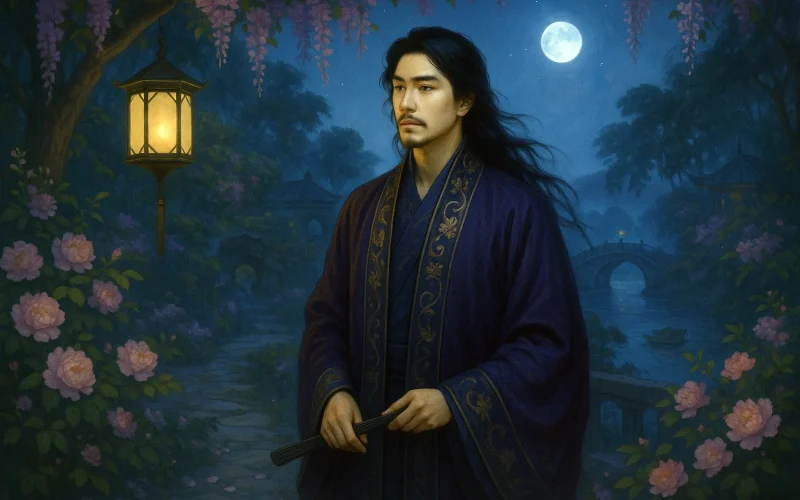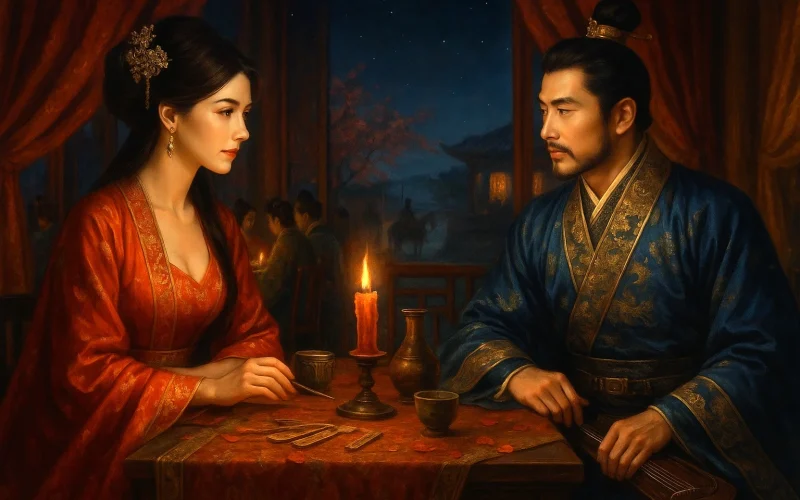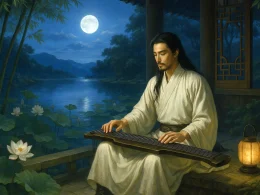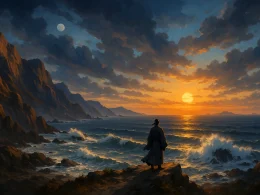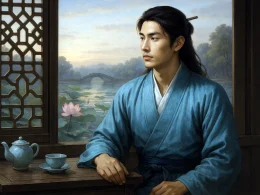



I wonder why my inlaid harp has fifty strings,
Each with its flower-like fret an interval of youth.
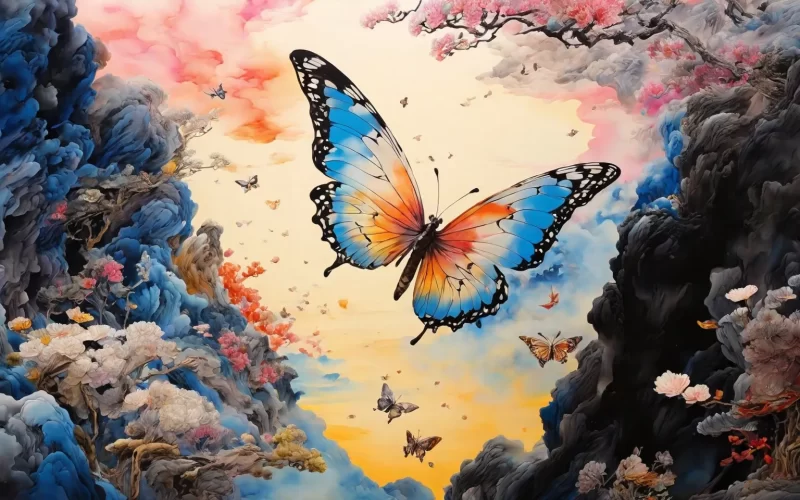
...The sage Chuang-tzu is day-dreaming, bewitched by butterflies,
The spring-heart of Emperor Wang is crying in a cuckoo,
Mermen weep their pearly tears down a moon-green sea,
Blue fields are breathing their jade to the sun...
And a moment that ought to have lasted for ever
Has come and gone before I knew.
Original Poem
「锦瑟」
李商隐
锦瑟无端五十弦,一弦一柱思华年。
庄生晓梦迷蝴蝶,望帝春心托杜鹃。
沧海月明珠有泪,蓝田日暖玉生烟。
此情可待成追忆,只是当时已惘然。
Interpretation
This poem represents the summit of Li Shangyin's late artistry, composed around 858 AD on the eve of his death. By then, the poet had endured life's full measure of turmoil: his career thwarted by partisan strife, his wife (née Wang) deceased early, his own health in decline, living in retirement in Zhengzhou. This work, often celebrated as "the most elusive yet most exquisite in classical Chinese poetry," is fundamentally the poet's poetic summation and philosophical reckoning of an entire lifetime.
The "zither of fifty strings" is frequently read as the poet's self-metaphor—Li Shangyin died around forty-six; "fifty strings" is symbolic, evoking the reflective age associated with "understanding heaven's decree." The poet had transcended specific personal or political concerns, entering a state of ultimate inquiry into the nature of existence. The four couplets, like movements in a quartet, conduct a poetic and philosophical exploration of life's meaning from four dimensions: time, being, value, and understanding.
First Couplet: 锦瑟无端五十弦,一弦一柱思华年。
Jǐn sè wú duān wǔshí xián, yī xián yī zhù sī huánián.
Vain are the ornamented zither's fifty strings,
Each recall, bridge and cord, those bright, untethered springs.
The phrase "vain are" (wuduan) unlocks the entire poem. It signifies not merely "without cause," but conveys a fundamental questioning of existence itself—why does life assume this form? Why does time unravel thus? The "fifty strings," exceeding the standard twenty-five, metaphorically suggest layered and amplified life experience. The parallel of "bridge and cord" transforms the instrument's spatial (bridge) and temporal (cord) elements into memory's warp and weft, constructing a palace of recollection.
Second Couplet: 庄生晓梦迷蝴蝶,望帝春心托杜鹃。
Zhuāng shēng xiǎo mèng mí húdié, Wàng Dì chūnxīn tuō dùjuān.
Master Zhuang, dawn-dreaming, lost to the butterfly;
King Wang's spring heart to the nightjar's echo entrusted by.
This couplet constructs a dual existential dilemma through paired allusions. Zhuangzi's butterfly dream points to the illusory nature of perception: our reality may be a dream in a loftier dimension. King Wang's transformation into a nightjar points to the metaphorical nature of expression: true feeling cannot be uttered directly, only entrusted to another's cry (the nightjar's). Together, they reveal a human predicament: we can neither be sure of our perceptions' reality, nor achieve transparent expression.
Third Couplet: 沧海月明珠有泪,蓝田日暖玉生烟。
Cānghǎi yuè míng zhū yǒu lèi, Lántián rì nuǎn yù shēng yān.
A moonlit sea: pearls harbor tears, or so they show;
Sun-warmed Lantian fields: from jade, faint vapors seem to grow.
The poet creates perhaps the most evocative and precise parallel imagery in Chinese poetry. "Pearls harbor tears" fuses material preciousness (pearl) with emotional fragility (tear), metaphorizing the pain inherent in beauty. "From jade, faint vapors" unites solid substance (jade) with ethereal intangibility (vapor), symbolizing an ideal ever visible, ever out of reach. The vast sea versus fertile Lantian, the cold moon versus warm sun—these paired images form the complete spectrum of an emotional cosmos.
Fourth Couplet: 此情可待成追忆,只是当时已惘然。
Cǐ qíng kě dài chéng zhuīyì, zhǐshì dāngshí yǐ wǎngrán.
Such feeling might be kept for memory's regard,
Yet even in its moment, it was drifting—lost and marred.
The final couplet achieves a startling poetic reversal. Convention holds that we "experience now, recall later." Li Shangyin asserts that at the very moment of experience, a sense of loss (wangran) had already set in. This reveals a profound existential truth: humans are perpetually belated in time. When we experience, we do not fully comprehend; when we recall, we recall a 'then' already reshaped by memory. This "eternal belatedness" is the essence of wangran.
Holistic Appreciation
This is an existential treatise composed in poetic form. It contemplates not life's fragments but four fundamental dimensions of existence: Time (bright springs), Being (the dreaming butterfly), Value (tearful pearls, vaporous jade), and Understanding (wangran). The poem exhibits perfect circularity: from the question "vain are" to the confirmation "drifting—lost," forming a closed loop of contemplation.
The poem's revolutionary achievement is its shattering of the linear "experience-understand-express" logic. For Li Shangyin, experience is loss, understanding is bewilderment, expression is metaphor. The specific content of the "feeling" matters less than the recognition that "feeling," as a state of being, eternally coexists with "loss." This profound insight into emotional structure elevates the poem beyond lyricism into a poetic exploration of consciousness.
Li Shangyin demonstrates that supreme poetry does not explain the world but presents its inexplicability. The image of pearls that seem to weep under a sea-bright moon, of jade that seems to emit vapor under a warm sun—these endure because they are supremely precise yet supremely ambiguous. This precise ambiguity perfectly metaphors the human condition.
Artistic Merits
- Philosophical Re-creation of Allusion: Zhuangzi's butterfly dream, originally about the equality of things, becomes a metaphor for cognitive uncertainty. The legend of King Wang, a tale of loyalty, becomes a symbol of expressive limitation. Allusions are not merely cited; they generate new philosophical contexts.
- Paradoxical Fusion of Imagery: A pearl embodies wholeness; a tear, fragmentation. Jade signifies solidity; vapor, evanescence. Li Shangyin fuses these opposites to create image-compounds bearing complex philosophical weight.
- Multilayered Temporal Folding: The poem contains physical time (implied age), psychological time (recollection), cosmic time (moonlit sea), and cyclical time (spring heart). These interpenetrating layers grant eight lines an epic temporal capacity.
Insights
This masterpiece reveals a fundamental structural condition of human understanding: a chasm of time forever separates experience from its comprehension. The premise "might be kept for memory" depends on "even in its moment, it was drifting—lost." The most profound experiences evade full grasp at their instant, requiring time's sedimentation into memory for belated understanding. Li Shangyin captures this misalignment as the source of emotional depth.
The core images point toward a paradoxical truth: the butterfly dream blurs subject and object; the nightjar's cry shows feeling reliant on metaphorical transfer; pearl-and-tear presents beauty entwined with pain; jade-and-vapor shows substance coexisting with dissipation. Together, they model a cognition: the highest reality we apprehend often manifests as a unity of contradictions. Pursuing singular, clear understanding may thus distance us from existential truth.
Li Shangyin's practice is a creative response to this condition. When experience defies direct statement, he embodies it in image-compounds—presenting rather than explaining, showing indefinable richness. This suggests a cognitive ethic: for core life experiences, preserving their ambiguity, multiplicity, and contradiction may honor truth more than forced clarification.
Ultimately, the work offers not answers but a superior mode of questioning. It teaches recognition of moments inherently "lost"—not from failed understanding, but because they exceed linear logic's grasp. True maturity may involve preserving, amidst a life demanding clear choices, an inner sanctuary for this "loss"; safeguarding, against an ethos of efficiency and clarity, the perceptive capacity for coexisting contradictions and suspended meaning.
Poem translator
Kiang Kanghu
About the poet
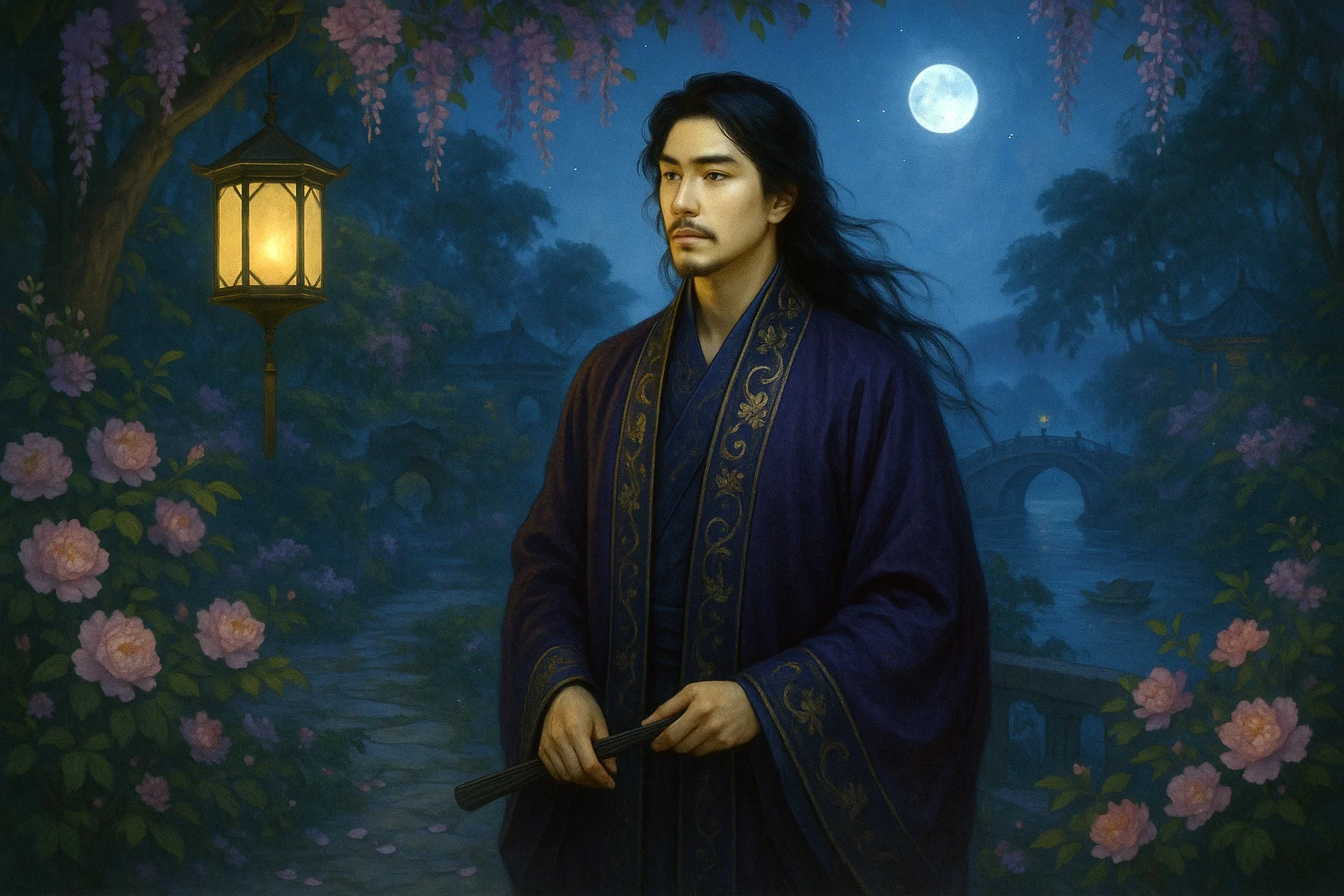
Li Shangyin (李商隐), 813 - 858 AD, was a great poet of the late Tang Dynasty. His poems were on a par with those of Du Mu, and he was known as "Little Li Du". Li Shangyin was a native of Qinyang, Jiaozuo City, Henan Province. When he was a teenager, he lost his father at the age of nine, and was called "Zheshui East and West, half a century of wandering".