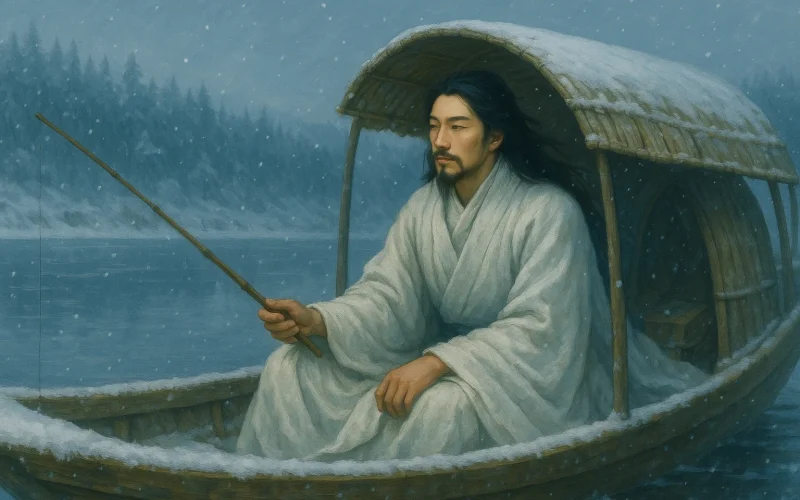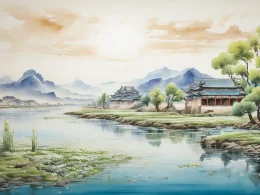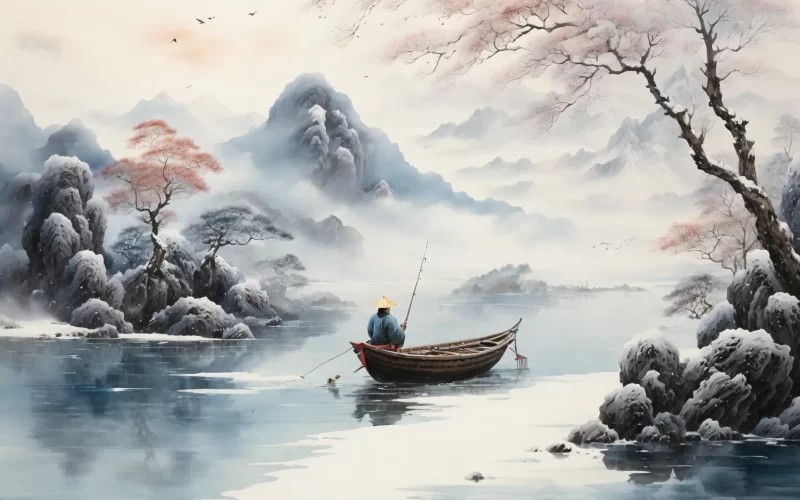
A hundred mountains and no bird,
A thousand paths without a footprint;
A little boat, a bamboo cloak,
An old man fishing in the cold river-snow.
Original Poem
「江雪」
柳宗元
千山鸟飞绝,万径人踪灭。
孤舟蓑笠翁,独钓寒江雪。
Interpretation
This poem was composed during Liu Zongyuan's exile in Yongzhou, roughly between 807 and 810 AD. After the failure of the Yongzhen Reforms, he was demoted from a ministry official to a minor post in Yongzhou, spending a ten-year period of exile in the remote, wild lands of southern Hunan.
Yongzhou was located in southern Hunan, its winters cold, with snow falling on the frigid river. One snowy day, the poet walked alone by the river and saw a lone boat upon it. In the boat was an old man, wearing a straw cloak and hat, fishing alone in the wind and snow. This scene deeply moved him—the old man's loneliness was his own loneliness; the old man's steadfastness in the snowy river was precisely the self-expectation he wished to express. Thus, he wrote this twenty-character short poem. The entire poem contains not a single word directly describing his own state of mind, yet every word is a projection of that state; not a word directly expresses emotion, yet the reader feels a loneliness that penetrates to the bone and an unbreakable resilience.
First Couplet: "千山鸟飞绝,万径人踪灭。"
Qiān shān niǎo fēi jué, wàn jìng rén zōng miè.
From hill to hill no bird in flight;
From path to path no man in sight.
The opening uses extreme hyperbole to create a world of utter silence. "From hill to hill" and "from path to path" emphasize the vastness of space; "no bird in flight" and "no man in sight" emphasize the complete absence of life. In this vast world, there is not a single bird in flight, not a trace of a human traveler—only snow, only silence, only cold.
These two lines describe the snowy scene, and even more, the state of mind. The poet, exiled to Yongzhou, was far from the capital, far from friends and family, politically isolated, socially cut off. That "from hill to hill no bird in flight" is the loneliness of feeling misunderstood in his eyes; that "from path to path no man in sight" is the despair of having no path forward under his feet. This extremely empty, silent world is precisely the externalization of the poet's inner desolation.
Second Couplet: "孤舟蓑笠翁,独钓寒江雪。"
Gū zhōu suō lì wēng, dú diào hán jiāng xuě.
In a lone boat straw-cloaked man,
Fishing alone in river cold.
This couplet shifts from the broad scene to a close-up, from static to dynamic. "In a lone boat"—the boat is alone; "straw-cloaked man"—the man is alone; "Fishing alone"—the action is alone. The superimposition of these three images of "alone/lone" pushes loneliness to its extreme. Yet, within this loneliness lies something else: the old man is "fishing"—he is angling, he is acting, he is persisting. He is not fishing for fish—on a snowy day with "no bird in flight," how could there be fish? What, then, is he fishing for? Is it loneliness itself? Is it time? Is it himself? Perhaps, he is simply using the act of "fishing" to prove that he still exists, that he is still maintaining a connection with the world.
The three characters "寒江雪" (river cold) are the poetic eye of the entire poem. Cold, river, snow—three images placed side by side: the river is cold, the snow is icy, the world is silent. And the old man, right there in the cold river snow, fishes alone. He is not unaware of the cold, not unaware of the loneliness, yet he remains there. This very stance of "being there" is itself a form of strength.
Holistic Appreciation
This masterpiece is the most famous poem of loneliness in the history of Chinese literature, and also the shortest landscape painting. The first two lines, with "from hill to hill" and "from path to path," describe the vastness of the world and the depth of silence; the last two lines, with "in a lone boat" and "fishing alone," describe the minuteness of the figure and the resilience of his steadfastness. Twenty characters accomplish a spatial shift from the immense to the minute, and also an emotional projection from the external scene to the internal world.
The entire poem contains not a word of explicit emotion, yet every line is emotion. The finality of "no" and "in sight" is the poet's inner despair; the superimposition of "lone" and "alone" is the poet's stance of self-affirmation; the action of "fishing" is the poet's last remaining connection to the world. The poet does not say "I am lonely," yet every word speaks of loneliness; he does not say "I am steadfast," yet every image speaks of steadfastness.
Compared to Liu Zongyuan's longer lyrical works, this poem is more condensed, more pure. It needs no explanation, no context; anyone who reads it can feel that loneliness that penetrates to the bone and that unbreakable resilience. This is the power of poetry, and also the power of the poet.
Artistic Merits
- Extremely Simple yet Profound, Concise yet Rich: Twenty characters contain the vastness of the world, the minuteness of the figure, the depth of loneliness, and the resilience of steadfastness—each word carries immense weight.
- Intense Contrast, Full of Tension: The grandeur of "from hill to hill" and "from path to path" forms a strong contrast with the minuteness of "in a lone boat" and "fishing alone," making the loneliness appear deeper, the steadfastness more difficult.
- Pure Imagery, Ethereal Artistic Conception: Hill, bird, path, man, boat, old man, river, snow—eight images constitute a world so pure it is almost abstract, ethereal and profound.
- Not a Word of Explicit Emotion, Yet Every Line is Emotion: The entire poem lacks words like "sorrow," "bitterness," or "grief," yet lets the reader feel the deepest loneliness and toughest resilience.
Insights
This poem first illuminates for us how to affirm the self within loneliness. That old man "独钓寒江雪" is not unaware of loneliness, not unaware of cold, yet he is still there, still "fishing." This act of "fishing" is proof of his existence, his only way of maintaining a connection with the world. It tells us: In extreme loneliness, the smallest action is the most powerful resistance. As long as you are still "fishing," you are not utterly defeated; as long as you are still doing something, you are still alive.
The utter emptiness and silence of "千山鸟飞绝,万径人踪灭" in the poem also leads us to consider the universality of loneliness. The world is sometimes like this—not a bird in flight, not a man in sight, only yourself. This is not an illusion; it is the truth. Liu Zongyuan's poem reminds us: Loneliness is not the exception; it is the norm. Only by accepting this loneliness, acknowledging this loneliness, can we coexist with it, can we find our own place within it.
What the old man in the poem "fishes" for is not fish, but a stance of communion with the spirit of heaven and earth. He does not seek a catch, a result; he simply is "fishing"—using this action to maintain a relationship with the cold river snow, to maintain a relationship with himself. This reveals: The value of life lies not in what one "catches," but in the action of "fishing" itself. You are doing, you are persisting, you are maintaining a connection with the world—that is enough.
Finally, the figure of the old man "独钓寒江雪" is especially moving. He is not a hero, not a sage, just an ordinary old man, in a lone boat, in the sweeping wind and snow, fishing alone. This steadfastness of an ordinary person is more moving than any heroic feat. It teaches us: True strength is not earth-shattering, but is like this old man—in places unseen, at moments unknown, still doing what one should do, guarding the heart one should guard.
Poem translator
Kiang Kanghu
About the poet
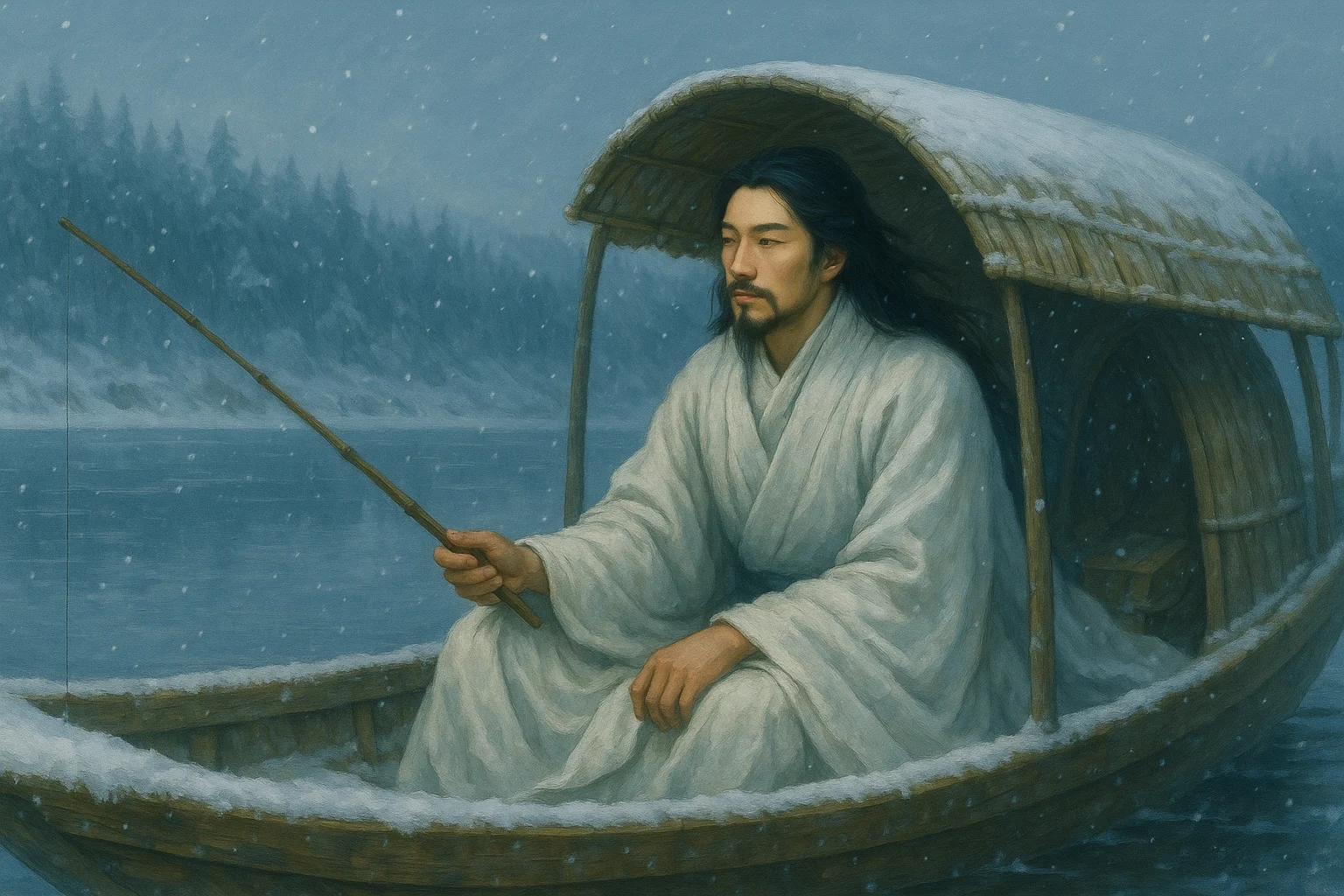
Liu Zongyuan (柳宗元), 773-819 A.D., a native of Yongji, Shanxi, was a progressive thinker, brilliant writer, and revolutionary statesman of the Tang Dynasty. Nineteen years before he was born, the An Shi Rebellion broke out, which dramatically changed the Tang Dynasty from prosperity to decline. The subsequent failure of the Yongzhen Reform was a historical tragedy that cut short Liu Zongyuan's political future, but made him one of the leading thinkers and literary figures of the Tang Dynasty.