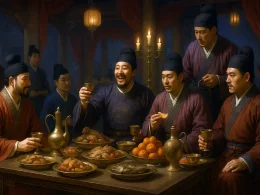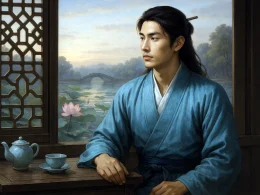



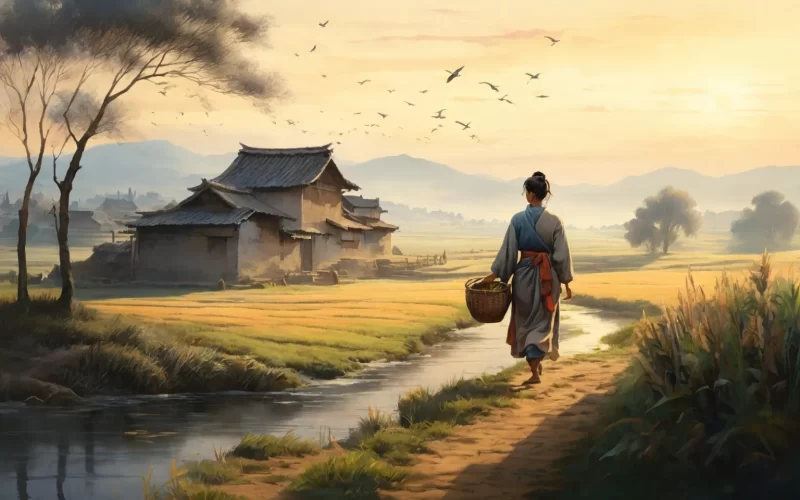
The woods have stored up rain, smoke rises slow from the plain;
Steamed rice and picked greens are sent to the workers in the field.
Over the wide, misty moor a white egret in flight;
In the dense summer woods a golden oriole sings in vain.

I’ve learned to watch in peace the mountain’s morning glory;
To eat sunflower seeds under a pine, with dew yet fresh.
A man of the wilds, I yield my seat to any crude fellow…
Why should I startle gulls on the sea, even in thought?
Original Poem
「积雨辋川庄作」
王维
积雨空林烟火迟,蒸藜炊黍饷东灾。
漠漠水田飞白鹭,阴阴夏木啭黄鹂。
山中习静观朝槿,松下清斋折露葵。
野老与人争席罢,海鸥何事更相疑?
Interpretation
This poem represents the culmination of Wang Wei's later reclusive poetry, a paradigm of the perfect fusion of his fourfold realm of "poetry, painting, Zen, and seclusion." Composed during a period of clarity after the vicissitudes of official life, when he was completely settled in body and mind at Wangchuan, the poem takes a prolonged summer rain as its backdrop. Steeped in the special temporal and spatial context of "accumulated rain," the poet, through his harmonious and unobstructed contemplation, weaves agricultural activity, natural ecology, personal cultivation, and philosophical reflection into a richly layered, vividly animated long scroll of reclusive life. It ultimately arrives at the sublime state of "forgetting both self and objects, uniting heaven and man," marking a significant pinnacle of the philosophical and artistic heights attainable by High Tang landscape and pastoral poetry.
First Couplet: 积雨空林烟火迟,蒸藜炊黍饷东菑。
Jī yǔ kōng lín yānhuǒ chí, zhēng lí chuī shǔ xiǎng dōng zī.
Through soggy woods, smoke from cottages rises slow;
They steam wild herbs and boil millet for field hands' meal.
The opening evokes a world permeated by rain and time—slow and gentle. “Long-accumulated rain” implies a stretching of time and a gathering of latent energy; “empty woods” suggests a spatial serene stillness and a reflection of the mind's own state. The word “slow” in “the smoke rises slow” is masterful, describing both the physical phenomenon of damp air retarding the ascent of cooking smoke and metaphorically evoking the unhurried, leisurely rhythm of mountain life. The second line shifts seamlessly from nature to human activity: “steaming wild herbs and boiling millet” represents the simplest peasant fare; “to send to the field hands’ meal” embodies the most fundamental labor and familial care. This “smoke” is both the warmth of human livelihood and naturally blends into the quiet backdrop of the “empty woods,” presenting a primordial vision of harmonious coexistence between humanity and nature.
Second Couplet: 漠漠水田飞白鹭,阴阴夏木啭黄鹂。
Mò mò shuǐtián fēi báilù, yīn yīn xià mù zhuàn huánglí.
Over the vast and misty paddies herons fly;
In deep and shadowy summer woods orioles cry.
This couplet is a celebrated scenic passage through the ages, depicting the post-rain vitality of the countryside as vividly as a painting. "Vast and misty" describes the open, hazy expanse of the paddies, like ink washes in a painting; "deep and shadowy" conveys the profound density of the summer trees, exuding a sense of coolness. "Herons fly" is movement within stillness, a streak of bright white cutting through the vastness; "orioles cry" is sound within seclusion, clear calls piercing the quiet. Color (white and green), sound (birdsong and silence), and motion (flying and singing) intertwine here perfectly. Particularly exquisite is that this scene is not an isolated landscape painting but a poetic extension and升华 of the labor context from the first couplet's "field hands"—farmers in the fields, herons in the sky—together composing a symphony of life.
Third Couplet: 山中习静观朝槿,松下清斋折露葵。
Shān zhōng xí jìng guān zhāo jǐn, sōng xià qīng zhāi zhé lù kuí.
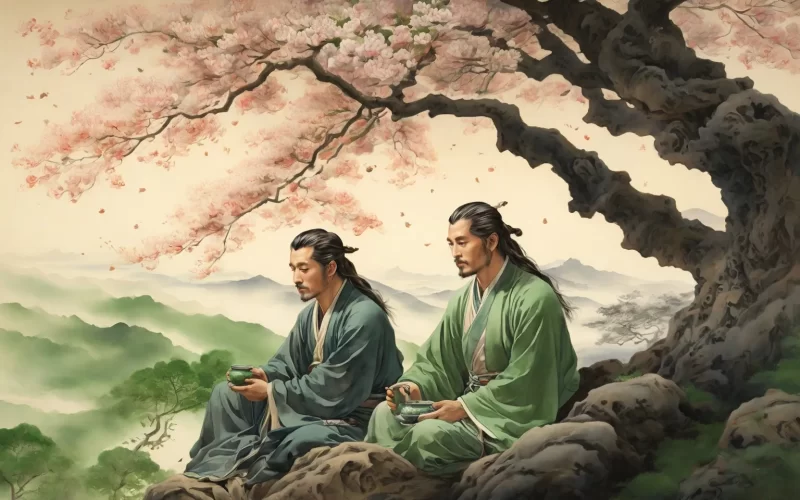
In hills, I watch the morn hibiscus, calm at heart;
Beneath the pines, I take a pure meal, dew-drenched greens I pick.
The brush turns naturally from the external scene to inner cultivation, depicting the poet's own reclusive daily life. "Watch the morn hibiscus, calm at heart" is spiritual practice: observing the transient blooming and fading of the hibiscus in stillness, contemplating the Zen truth of life's impermanence, the fleeting nature of glory and decay. "Take a pure meal, dew-drenched greens I pick" is bodily discipline: matching the purest vegetarian fare (dew-drenched greens) with the purest body and mind. The pine and the greens, one a tree, one a vegetable; one tall, one low, constitute the poet's simple yet noble field of living. This couplet internalizes the external vitality of the previous couplets into spiritual contemplation and life's ritual, showing that the poet's reclusion is not passive escape but an active, mindful art of living.
Fourth Couplet: 野老与人争席罢,海鸥何事更相疑?
Yělǎo yǔ rén zhēng xí bà, hǎi'ōu hé shì gèng xiāng yí?
A simple greybeard, I've done with the world's strife;
Why should the gulls on the sea still be suspicious of my life?
The final couplet employs allusions with exquisite skill, representing the poem's ultimate spiritual leap and the definitive crystallization of the poet's persona. He likens himself to a “simple greybeard of the wilds,” using the allusion of “done with contending for a mat” (from the Zhuangzi) to signify that he has utterly abandoned competitive cunning and dissolved all distinctions, achieving a seamless fusion with the villagers and with nature itself. The rhetorical question employing the allusion of the “suspicious sea-gulls” (from the Liezi) goes a step further: not only is strife absent, but even the consciousness of “being free from strife” has been relinquished; his mind is now pure as a child's—why, then, should external things (using the gulls to symbolize the outer world or any last vestige of self-attachment) still regard him with doubt? This question, seemingly self-deprecating, is in truth the highest expression of confidence—his clarity is beyond question; even the final possibility of being “viewed with suspicion” has dissolved. The two allusions, one affirmative, one interrogative, vividly trace the poet's spiritual progression from “engagement with the world” to “detachment from the world” and finally to “transcendence of the world.”
Holistic Appreciation
This poem is a grandly structured, harmoniously conceived symphony of life. The four couplets resemble four movements: the first is a lento, presenting the gentle foundation of human traces and nature after rain (earth); the second is an allegro, displaying the vibrant vitality between heaven and earth (heaven); the third is an andante, turning inward to personal contemplation and practice (human); the fourth is a cadenza, achieving the ultimate harmony of heaven-human fusion and the forgetting of both self and objects (union). This structure of "heaven, earth, human, union" subtly corresponds to classical Chinese cosmology.
In this poem, Wang Wei demonstrates the full cultivation of a mature poet and philosopher. He observes not only with his eyes but experiences and verifies with his entire being. Every scene in the poem—the slow smoke, the meal for the fields, the herons, the orioles, the morning hibiscus, the dew-drenched greens—is not an isolated object but a meaningful "realm" illuminated by his clear mind. He is both within the pastoral scene and above it; both a recluse and an observer and comprehendor. Finally, through the allusions of the "greybeard" and the "gulls," he declares he is no longer a "guest" or "master" of the countryside but the countryside itself, part of the natural order. This completion of identity is key to this poem's transcendence of ordinary pastoral poetry.
Artistic Merits
- Imagery and Rhythm of Reduplication: The reduplicated words "vast and misty" (漠漠) and "deep and shadowy" (阴阴) not only depict the visual texture and spatial atmosphere of the rain-soaked fields and woods but also, with their elongated sounds, impart a leisurely rhythm and musical cadence to the lines, forming a seamless whole with the prolonged sense of "long-accumulated rain" (积雨).
- Artful Parallelism and Flowing Imagery: The middle two couplets are exquisitely parallel yet full of vibrant energy. "Vast and misty" parallels "deep and shadowy" (spatial atmosphere); "paddies" (水田) parallels "summer woods" (夏木) (fieldscape and forestscape); "herons fly" (飞白鹭) parallels "orioles cry" (啭黄鹂) (motion and sound); "in hills" (山中) parallels "beneath the pines" (松下) (practice locale); "calm at heart" (习静) parallels "pure meal" (清斋) (practice method); "watch the morn hibiscus" (观朝槿) parallels "dew-drenched greens I pick" (折露葵) (practice content). Within the strict parallelism lies subtle variation; within the formal rigor lies an ethereal quality.
- Transformation of Allusions and Projection of Persona: The allusions in the final couplet are employed seamlessly. Drawing effortlessly from stories in the Zhuangzi and Liezi, without explicit discourse, they complete the final sculpting of the self-image and the ultimate demarcation of the spiritual realm, representing the highest attainment of "using allusions to express the mind's intent."
- Synesthetic Creation of Color, Sound, and Rhythm: The poem constructs a complete sensory world: visually, there are the grey-green of empty woods, the pale blue of cooking smoke, the hazy green of paddies, the bright white of herons, the deep shade of summer woods; aurally, there are the songs of orioles (and perhaps the profound silence after rain); rhythmically, it moves from "slow" (迟) to "fly" (飞) and "cry" (啭), then to "watch" (观) and "pick" (折), finally settling into the calm rhetorical questions of "done with" (罢) and "suspicious" (疑), with well-measured tension and release, like a natural harmony.
Insights
This work is not merely a post-rain landscape scroll of Wangchuan but an ancient, poetic response to the question of how to attain spiritual transcendence within this world. It reveals that true peace and freedom lie not in distancing oneself from the warmth of human habitation ("smoke… rises slow"), but in finding one's place within it ("for field hands' meal"); not merely in appreciating nature's beauty ("herons fly," "orioles cry"), but in internalizing it as life's cultivation and contemplation ("watch the morn hibiscus," "dew-drenched greens I pick"); ultimately, in achieving a state of seamless unity where there is no strife with all things, and not even the mind of "no strife" remains ("done with the world's strife," "why should the gulls… still be suspicious").
In modern society, characterized by high division of labor, interpersonal alienation, and inner anxiety, this poem offers an ideal model for life integration: merging labor, aesthetic appreciation, self-cultivation, and philosophical reflection into one, achieving the settling of body and mind and the sublimation of spirit within daily life and natural rhythms. It invites us to consider: Can we find that moment of clarity after the "accumulated rain" in our own "Wangchuan Villa"? Can we maintain the contemplative stillness of "watching the morn hibiscus" amidst the busyness of our own "meal for the fields"? Ultimately, can we cultivate the simplicity of the "greybeard" and the complete trust of the "gulls," achieving the deepest reconciliation and coexistence with this world?
With a single poem, Wang Wei has preserved for us the sound of rain, the colors of the mountains, and a perfectly self-sufficient heart from the High Tang. Each recitation is a spiritual cleansing, a timeless review of "how to dwell poetically."
Poem translator
Kiang Kanghu
About the poet
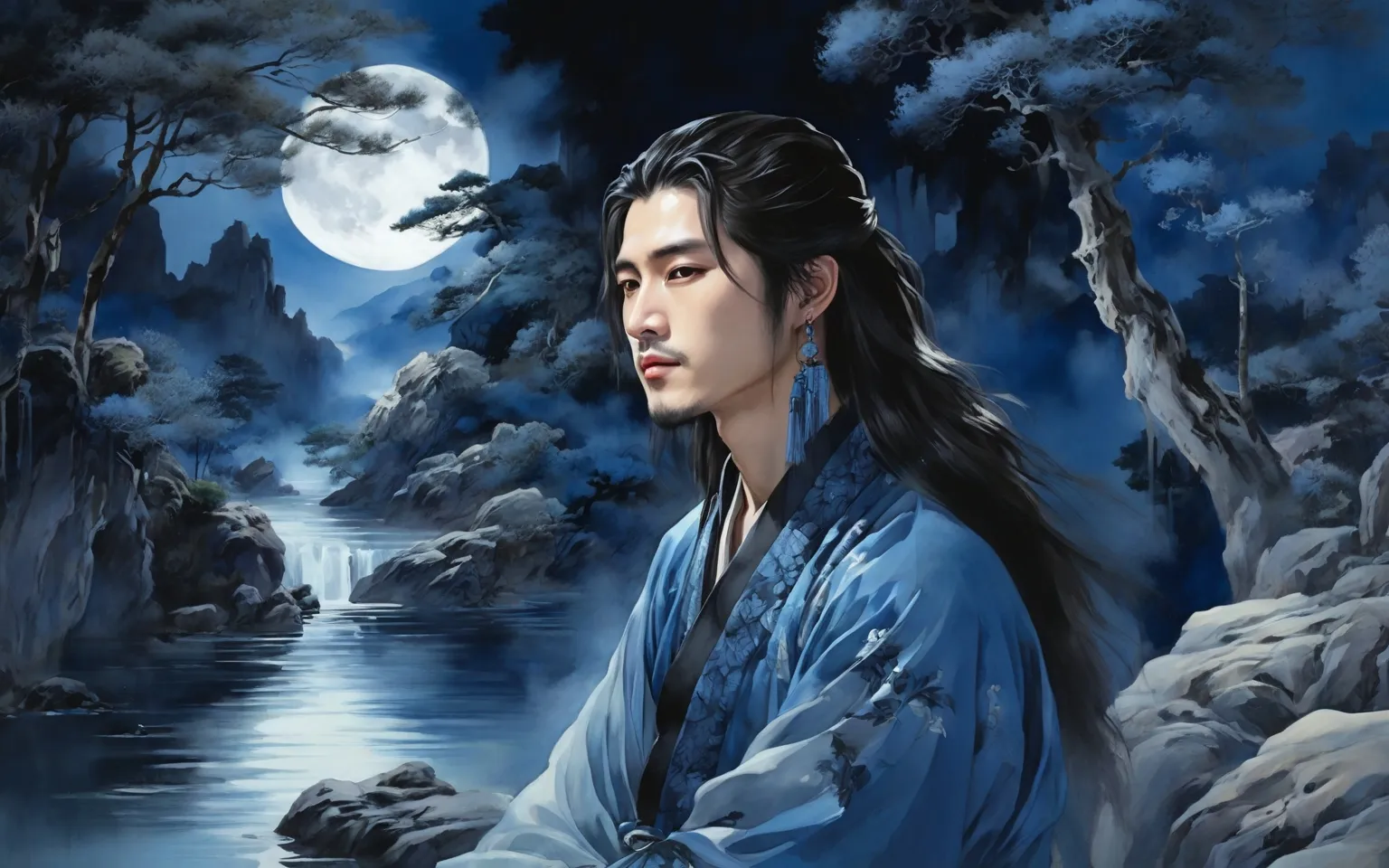
Wang Wei (王维), 701 - 761 A.D., was a native of Yuncheng, Shanxi Province. Wang Wei was a poet of landscape and idylls. His poems of landscape and idylls, with far-reaching images and mysterious meanings, were widely loved by readers in later generations, but Wang Wei never really became a man of landscape and idylls.