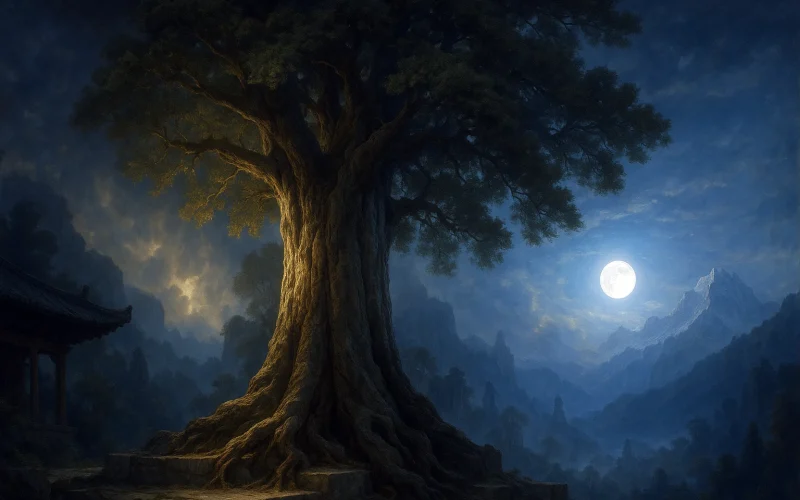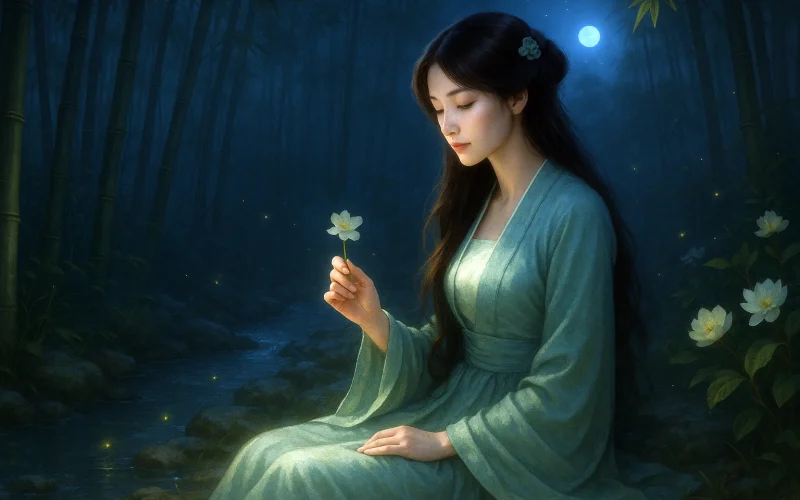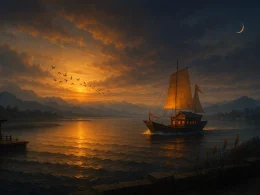




I am sad. My thoughts are in Yo-chou.
I would hurry there—but I am sick in bed.
…Beauty would be facing me across the autumn waters.

Oh, to wash my feet in Lake Tung-t'ing and see at its eight corners
Wildgeese flying high, sun and moon both white,
Green maples changing to red in the frosty sky,
Angels bound for the Capital of Heaven, near the North Star,
Riding, some of them phœnixes, and others unicorns,
With banners of hibiscus and with melodies of mist,
Their shadows dancing upside-down in the southern rivers,
Till the Queen of the Stars, drowsy with her nectar,
Would forget the winged men on either side of her!

…From the Wizard of the Red Pine this word has come for me:
That after his earlier follower he has now a new disciple
Who, formerly at the capital as Emperor Liu's adviser,
In spite of great successes, never could be happy.
…What are a country's rise and fall?
Can flesh-pots be as fragrant as mountain fruit?…

I grieve that he is lost far away in the south.
May the star of long life accord him its blessing!
…O purity, to seize you from beyond the autumn waters
And to place you as an offering in the Court of Imperial Jade.
Original Poem
「寄韩谏议注」
杜甫
今我不乐思岳阳, 身欲奋飞病在床。
美人娟娟隔秋水, 濯足洞庭望八荒。
鸿飞冥冥日月白, 青枫叶赤天雨霜。
玉京群帝集北斗, 或骑麒麟翳凤凰。
芙蓉旌旗烟雾落, 影动倒景摇潇湘。
星宫之君醉琼浆, 羽人稀少不在旁。
似闻昨者赤松子, 恐是汉代韩张良;
昔随刘氏定长安, 帷幄未改神惨伤。
国家成败吾岂敢? 色难腥腐餐枫香。
周南留滞古所惜, 南极老人应寿昌。
美人胡为隔秋水? 焉得置之贡玉堂。
Interpretation
This poem was composed in the autumn of 767 CE, the second year of the Dali era under Emperor Daizong of Tang, during Du Fu's period of exile in Kuizhou. The poet, in his later years, was plagued by illness and poverty while the state remained unstable, with the power of regional warlords growing ever more apparent. Han Zhu (Admonisher Han), a virtuous minister who had contributed to quelling the An Lushan Rebellion but had since been cast aside, was then living in retirement at Yueyang. Confined to his sickbed, Du Fu thought of this like-minded friend now separated by a vast distance, lamenting his personal plight and, more profoundly, worrying about the state's depletion of worthy talent. Thus, he poured his deep feelings of friendship and concern for the nation into this long poem, which masterfully blends stark realism with transcendent fantasy.
First Couplet: 今我不乐思岳阳,身欲奋飞病在床。
Jīn wǒ bù lè sī Yuèyáng, shēn yù fèn fēi bìng zài chuáng.
Now, joyless, my thoughts turn to Yueyang; / My body yearns to soar there, but sickness binds me to my bed.
The opening couplet directly expresses the poet's heart, establishing the poem's somber and earnest tone. "Joyless" and "thoughts turn to Yueyang" pinpoint his mood and its object. The sharp contrast between "yearns to soar" and "sickness binds me to my bed" highlights the poet's confined and frustrated state, foreshadowing the celestial journey of imagination that follows.
Second Couplet: 美人娟娟隔秋水,濯足洞庭望八荒。
Měi rén juān juān gé qiū shuǐ, zhuó zú Dòngtíng wàng bā huāng.
That noble soul, serene, is cut off by autumn waters; / Washing his feet in Dongting Lake, he gazes toward the world's eight ends.
"Beautiful one" (meiren), a traditional metaphor in Chinese poetry for a virtuous and noble person, here refers to Han Zhu. "Cut off by autumn waters" conveys both the literal geographical distance and a sense of unreachable nobility. "Washing his feet in Dongting Lake" subtly alludes to the imagery from the Chuci (Songs of Chu), where the act of cleansing one's feet in the river symbolizes a transcendent withdrawal from worldly affairs and a commitment to purity. "Gazes toward the world's eight ends" reveals that, though in retirement, his heart remains concerned with the wider world. A vivid portrait thus emerges of a noble scholar standing by the lakeside, gazing thoughtfully into the distance.
Third Couplet: 鸿飞冥冥日月白,青枫叶赤天雨霜。
Hóng fēi míng míng rì yuè bái, qīng fēng yè chì tiān yù shuāng.
The wild goose flies into boundless gloom, sun and moon turn pale; / Green maple leaves blaze red, the sky sheds frost.
This couplet uses vast, desolate natural imagery to evoke the bleakness of the times and the worthy's distant retreat. "The wild goose flies into boundless gloom" metaphorically suggests the noble man's withdrawal, his traces lost. "Sun and moon turn pale" and "the sky sheds frost" paint an atmosphere of harshness and a chilling political climate. The description is imbued with a profound sense of anxiety for the era.
Fourth Couplet: 玉京群帝集北斗,或骑麒麟翳凤凰。
Yù jīng qún dì jí Běidǒu, huò qí qílín yì fènghuáng.
*In the Jade Capital, hosts of lords gather round the Northern Dipper; / Some ride *qilin, others are shaded by phoenix wings.
The focus shifts sharply to the court, employing the imagery of transcendent fantasy for pointed satire. "Jade Capital" (abode of the Celestial Emperor) metaphorically represents Chang'an, the capital. "Hosts of lords" refers to the powerful officials at court. "Gather round the Northern Dipper" displays their convergence at the center of power. "Ride qilin, others are shaded by phoenix wings" vividly depicts their extravagant, self-satisfied displays. Superficially describing a celestial gathering, it is in fact a sharp portrayal of the corrupt ruling clique.
Fifth Couplet: 芙蓉旌旗烟雾落,影动倒景摇潇湘。
Fúróng jīngqí yānwù luò, yǐng dòng dàoyǐng yáo Xiāoxiāng.
Lotus banners vanish in mist and smoke; / Their wavering inverted reflections seem to shake the Xiao and Xiang rivers.
Continuing the fantastical imagery, this couplet uses illusion to criticize reality. "Lotus banners" describes the splendid regalia of the court; "vanish in mist and smoke" suggests the obscurity and murkiness of court politics. The line "Their wavering inverted reflections seem to shake the Xiao and Xiang rivers" is particularly striking: the insubstantial, inverted images of the capital's powerful disturb the distant rivers Xiao and Xiang (where Han Zhu lives in seclusion), implying that the corruption and chaos of the court have far-reaching effects, unsettling even those in retirement.
Sixth Couplet: 星宫之君醉琼浆,羽人稀少不在旁。
Xīng gōng zhī jūn zuì qióng jiāng, yǔ rén xī shǎo bù zài páng.
The lords of starry palaces grow drunk on jade nectar; / Feathered immortals are few and far, not at their side.
"Grow drunk on jade nectar" directly censures the ruling class's indulgence in pleasure and neglect of governance. "Feathered immortals are few and far" laments the fact that virtuous and talented men like Han Zhu are marginalized, absent from the seats of power. The sharp contrast between "drunk" and "few" underscores the latent crisis facing the state.
Seventh Couplet: 似闻昨者赤松子,恐是汉代韩张良;
Sì wén zuó zhě Chìsōngzǐ, kǒng shì Hàn dài Hán Zhāngliáng;
I seem to hear of one who lately walks with Master Red Pine; / Could he be that Han Zhangliang of ancient times?
The focus returns from satire to praise for Han Zhu. The ancient transcendent "Master Red Pine" symbolizes his reclusive, lofty life. "Han Zhangliang" refers to Zhang Liang, the brilliant strategist who helped found the Han dynasty, sharing the surname "Han." This apt allusion extols Han Zhu's historical merits and strategic talent while also hinting at his current retired state.
Eighth Couplet: 昔随刘氏定长安,帷幄未改神惨伤。
Xī suí Liú shì dìng Cháng'ān, wéiwò wèi gǎi shén cǎn shāng.
In former days he followed the royal house to secure Chang'an; / His strategic mind remains keen, yet his spirit grieves in pain.
This couplet reflects on Han Zhu's past contributions and present circumstances. "Followed the royal house to secure Chang'an" recalls his service in quelling the An Lushan Rebellion and restoring the capital. "His strategic acumen remains undimmed" honors his enduring wisdom, while "his spirit is shadowed by anguish" conveys the inner sorrow of one whose aspirations are thwarted and whose heart remains troubled by the nation's plight. The juxtaposition of former glory with current despondency paints a poignant portrait of a meritorious statesman cast aside by the times.
Ninth Couplet: 国家成败吾岂敢?色难腥腐餐枫香。
Guójiā chéngbài wú qǐ gǎn? sè nán xīng fǔ cān fēng xiāng.
"How dare I disregard the state's rise or fall? / Yet I sicken at the stench and foulness—on maple's fragrance I dine."
Here, the poet adopts Han Zhu's voice to declare his stance. "How dare I" conveys the sense of duty felt by a loyal minister, even in retirement. "Sicken at the stench and foulness" is a strong rejection of the corrupt court environment. "On maple's fragrance I dine" symbolizes his choice of a reclusive life, maintaining purity and integrity. This deepens the symbolic meaning of "washing his feet in Dongting Lake."
Tenth Couplet: 周南留滞古所惜,南极老人应寿昌。
Zhōunán liúzhì gǔ suǒ xī, Nánjí lǎorén yīng shòuchāng.
Long detained in Zhou-nan—a cause for ancient grief; / May the Old Man of the South Pole enjoy lasting light and life!
Through allusions, complex emotions are expressed. "Long detained in Zhou-nan" refers to the historical figure Sima Tan, father of the historian Sima Qian, who was stranded in the Zhou-nan region and unable to accompany Emperor Wu of Han on a significant ceremonial journey. This allusion metaphorically conveys regret over Han Zhu's own sidelined and neglected state. The line then shifts with "May the Old Man of the South Pole shine in lasting vigor and light!"—a sincere wish for the health and longevity of this national treasure, implicitly expressing the hope that the state may one day again rely on such exceptional talent.
Final Couplet: 美人胡为隔秋水?焉得置之贡玉堂。
Měi rén hú wéi gé qiū shuǐ? Yān dé zhì zhī gòng yù táng.
O noble soul, why must you dwell beyond the autumn flood? / How can we bring you to the Jade Hall, to offer there your gifts?
The poem concludes with a poignant question and a fervent hope. "Why must you dwell beyond the autumn flood?" is a query filled with helplessness and injustice. "How can we bring you to the Jade Hall?" is a heartfelt cry. This is not merely a recommendation for a friend, but a desperate plea for the court to value and employ worthy talent. The poem ends on this resonant, lingering note.
Holistic Appreciation
This poem is a masterpiece of Du Fu's seven-character song-style verse (gexing), showcasing his grand poetic vision that seamlessly merges personal circumstance, friendship, and national destiny. The structure is dramatic: beginning with his own sickbed longing for his friend, the poet's spirit journeys to the autumn waters of Dongting where the friend lives in seclusion, soars to the fantastical, corrupt "Jade Capital" of the court, returns through historical time to praise the friend's achievements, and finally lands back in reality with a grievous appeal. Actual scenes and illusory realms, history and the present, satire and praise interweave and progress, creating a somber, emotionally charged work with magnificent, bold and unconventional imagination.
Its core lies in "using the form of transcendent fantasy to express worldly grief; entrusting the metaphor of the 'beautiful one' to convey the desire to aid the world." The poem constructs two opposing worlds: the pure, lofty, transcendent world symbolized by "the wild goose vanishes in endless gloom" and "washing his feet in Dongting Lake" (embodying Han Zhu and ideal virtue), and the corrupt, benighted world reflected by "hosts of lords gather round the Northern Dipper" and "grow drunk on jade nectar" (a metaphor for the contemporary court). Du Fu's deep anxiety lies in the separation of these two worlds and the latter's rejection of the former. His longing and admiration for Han Zhu are, in essence, a profound lament for a lost political integrity and governing talent.
Artistic Merits
- Seamless Fusion of Transcendent Imagery and Realist Critique
The poem employs the motifs of celestial fantasy—such as the Jade Capital, assemblies of celestial lords, mythical qilin and phoenixes, feathered immortals, and the legendary Master Red Pine—as metaphors for contemporary court politics. By framing its critique of corruption and its praise of virtuous talent within this grand, otherworldly context, the poem maintains a layer of poetic subtlety while intensifying the force of its social commentary and enriching its imaginative scope. - Layered Symbolism with Profound Resonance
Key images like the "noble soul" (beautiful one), the "autumn waters," the "vanishing wild goose," the "fragrance of maple," and the "Old Man of the South Pole" each carry deep symbolic significance. Together, they construct a coherent symbolic system that embodies ideals of personal integrity and political conscience, lending the poem a profound and subtly suggestive meaning. - Dynamic Emotional Flow and Masterful Transitions
The poem's sentiment shifts fluidly and naturally between modes of longing, satire, admiration, anxiety, and hope. It moves from subdued passages, such as "sickness binds me to my bed" and "his spirit grieves in pain," to more impassioned exclamations like "sicken at the stench and foulness" and "how can we bring you to the Jade Hall." This emotional pacing and variation fully embody Du Fu's signature style, characterized by its somber depth, rhythmic complexity, and artistic maturity. - Precise and Profound Use of Allusion
The poem's allusions—including the act of "washing feet" (evoking reclusion), the figures of Master Red Pine and Zhang Liang, and the典故 of being "detained in Zhou-nan"—are meticulously chosen to resonate with the subject's identity, circumstances, and inner spirit. These references add historical depth and universalize the poem's themes, elevating the portrayal of the poet's friend and the lament for his times beyond a specific moment into a timeless expression of principle and longing.
Insights
This work shows how, in times of personal hardship and national peril, a true poet and patriot can transcend his own suffering to focus on the wider world and the fundamental fate of the nation. Du Fu's call to Han Zhu expresses a deep longing for "the Way" and "talent" to occupy their rightful "place," an eternal plea for enlightened governance.
The insight this poem offers across time is this: a key measure of a society's health is its ability to place its most outstanding individuals in appropriate positions where they can fulfill their potential. When the "noble soul" must remain "beyond the autumn flood," while the "Jade Capital" is filled with those who "grow drunk on jade nectar," the signal of crisis is already bright. It reminds us that any era must cherish those who, "though dwelling by rivers and lakes, keep their hearts within the palace gates," and must establish channels and mechanisms to bring the worthy and capable to "offer their gifts in the Jade Hall." Du Fu's sincere devotion—thinking of Yueyang and worrying over the Jade Hall even while "sickness binds me to my bed"—is the most moving portrayal of a scholar's concern for his country and people, and remains an undimmed spiritual inspiration for later generations.
Poem translator
Kiang Kanghu
About the poet
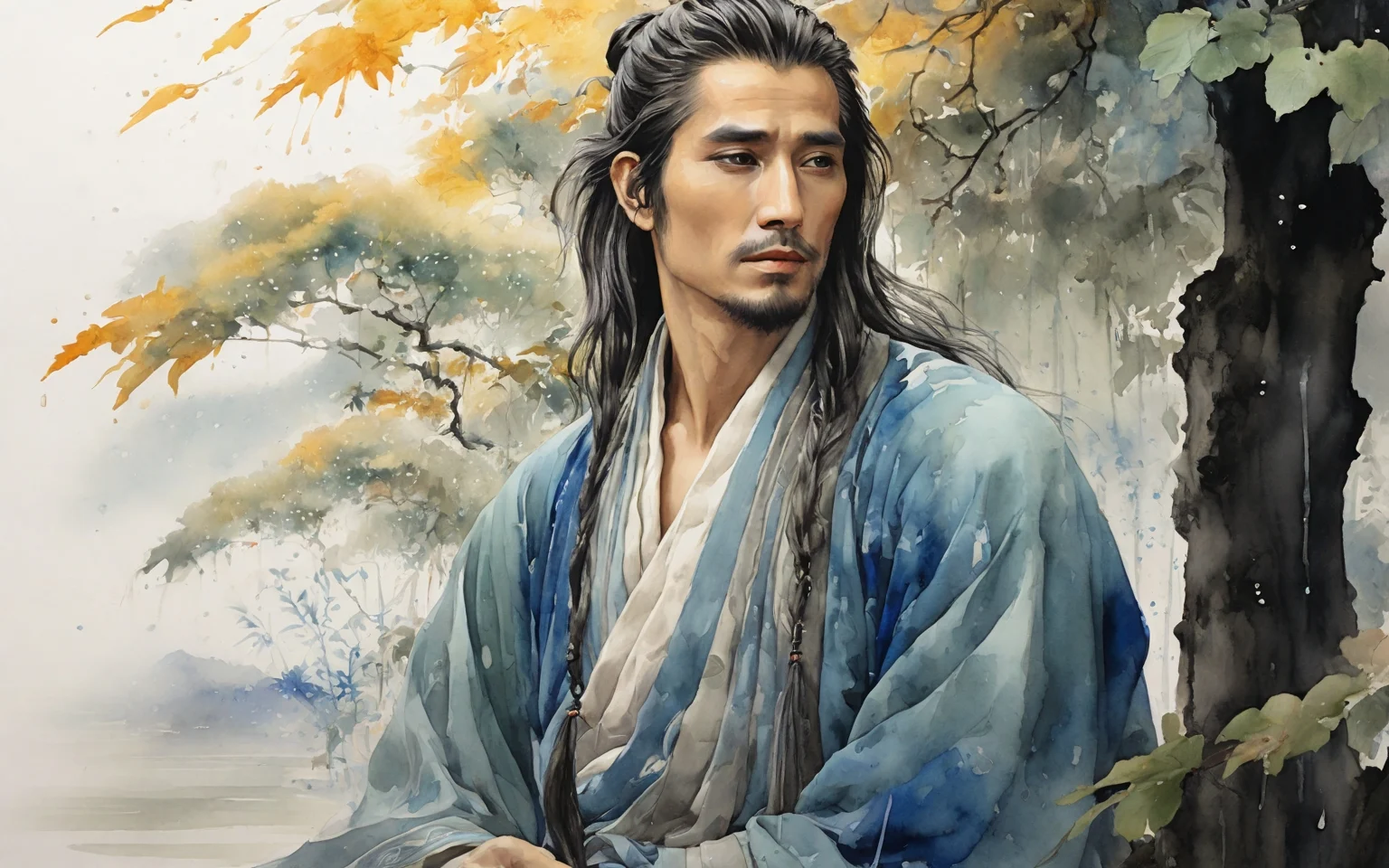
Du Fu (杜甫), 712 - 770 AD, was a great poet of the Tang Dynasty, known as the "Sage of Poetry". Born into a declining bureaucratic family, Du Fu had a rough life, and his turbulent and dislocated life made him keenly aware of the plight of the masses. Therefore, his poems were always closely related to the current affairs, reflecting the social life of that era in a more comprehensive way, with profound thoughts and a broad realm. In his poetic art, he was able to combine many styles, forming a unique style of "profound and thick", and becoming a great realist poet in the history of China.