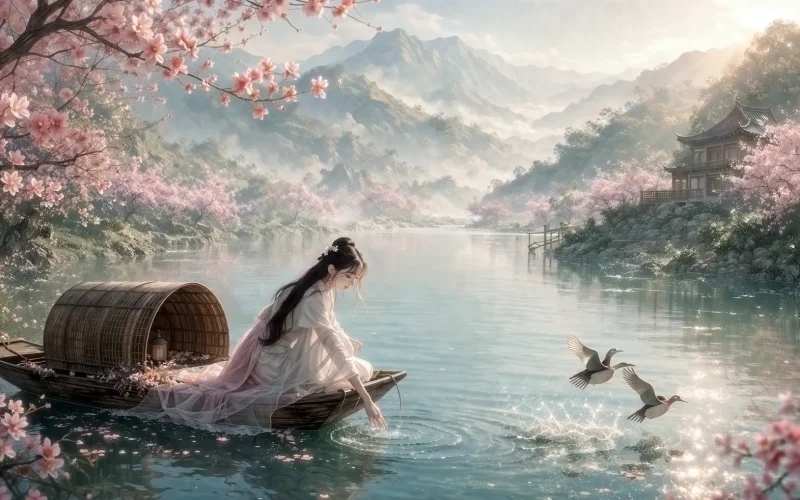
The spring stream winding, winding out of sight,
And on each bank the peach‑trees pink and white

All in the laughing wind that comes and goes —

And there, just where a little boat‑nose
Can push its way, from out the jade‑green tide
Up spring two wingèd lovers, side by side!
Original Poem
「过耶溪」
朱庆馀
春溪缭绕出无穷,两岸桃花正好风。
恰是扁舟堪入处,鸳鸯飞起碧流中。
Interpretation
This poem is a renowned landscape masterpiece by the Mid-Tang poet Zhu Qingyu. Zhu Qingyu's poetry is known for its lucid elegance and grace, and he excels particularly in depicting feminine psychology with delicate touches. However, his landscape poetry also stands in a class of its own, achieving clarity amidst simplicity. Ye Creek, or Ruoye Creek, is located in present-day Shaoxing, Zhejiang. Its water is mirror-clear, and its banks are lush with flowers and trees, making it a place where poets throughout the ages have found inspiration. Legend says the famous beauty Xi Shi once washed silk here; poets like Li Bai, Du Fu, and Meng Haoran have all left verses about it. This poem was composed during a period when Zhu Qingyu, disappointed in his official career, had retired to the Jiangnan region. Having distanced himself from the political arena, he sought solace in mountains and rivers, finding distraction in observing nature. Passing by Ye Creek in spring, he encountered a scene of winding streams, blooming peach blossoms, a place perfect for a small boat, and startled mandarin ducks taking flight—everything before his eyes felt utterly natural and perfectly apt. The poet does not deliberately express emotion; instead, he immerses himself in this spring scenery, allowing the vitality of the landscape and the clarity of his inner world to reflect each other. The spring creek that "winds its way" mirrors the expansiveness of his state of mind. The splendor of "Peach blossoms on both banks enjoy the breeze" reflects his love for life. The casualness of "Here is the very place to push a leaflike boat" signifies his harmony with nature. The liveliness of "lovebirds rise from the green stream" is the externalization of his inner freedom. Not a single word in the entire poem speaks of sorrow, yet it naturally possesses a serene quality of "emotion within stillness, delight within leisure." Not a word is written of Zen, yet it everywhere exudes the aesthetic realm of "Zen within poetry."
In classical poetry, many have written of spring creeks, some describing their clarity, others their seclusion. Zhu Qingyu's poem, however, is unique. It uses "winds its way" to describe the creek's endless winding, "enjoy the breeze" to capture spring's vibrant vitality, "Here is the very place" to portray the harmony between man and nature, and "lovebirds rise" to depict the agile harmony of life. With extremely concise brushstrokes, the poem blends the serene beauty and dynamic motion of the spring creek, the vitality of nature, and the clarity of the poet's mind into one, making it an exemplary work of "writing the heart through scenery" within Tang dynasty landscape poetry.
First Couplet: "春溪缭绕出无穷,两岸桃花正好风。"
Chūn xī liáorào chū wúqióng, liǎng'àn táohuā zhènghǎo fēng.
The spring creek winds its way, its course appears unbound;
Peach blossoms on both banks enjoy the breeze around.
The poem opens with "春溪缭绕" (The spring creek winds its way), sketching the meandering course of Ye Creek. The two characters "缭绕" (winds its way) depict the creek's sinuous, circling posture and also imply the poet's leisurely, carefree mood as he strolls along its banks. "出无穷" (appears unbound) emphasizes the creek's seemingly endless flow, as if stretching into the depths of heaven and earth, also establishing an expansive spatial sense for the entire poem. The next line, "两岸桃花正好风" (Peach blossoms on both banks enjoy the breeze around), shifts focus from the water to the banks, from distance to proximity. "桃花" (Peach blossoms) are the heralds of spring. The three characters "正好风" (enjoy the breeze) combine the blossoms with the spring breeze, engaging both sight and scent—the phrase "正好" (enjoy/just right) indicates the breeze's perfect gentleness, and also the poet's perfectly contented mood. Within this couplet, the poet uses the creek's winding to write of the heart's leisure, and the blossoms' abundance to write of spring's fullness, merging the beauty of nature with the tranquility of the inner world.
Second Couplet: "恰是扁舟堪入处,鸳鸯飞起碧流中。"
Qià shì piānzhōu kān rù chù, yuānyāng fēi qǐ bì liú zhōng.
Here is the very place to push a leaflike boat;
A pair of lovebirds rise from the green stream afloat.
This couplet is the soul of the entire poem, shifting from stillness to motion, bringing the spring creek's vitality to a climax. "恰是扁舟堪入处" (Here is the very place to push a leaflike boat) uses the phrase "恰是" (Here is the very place) to perfectly conclude the preceding lines, its tone utterly natural—as if the poet, wandering here, cannot help but exclaim "just the spot!" in a moment of spontaneous resonance with the scene. This "堪入处" (place to push) is the most suitable stretch of the creek for boating, and also the moment of perfect harmony between the poet's heart and nature. The next line, "鸳鸯飞起碧流中" (A pair of lovebirds rise from the green stream afloat), enlivens the picture with the startled flight of the mandarin ducks. "鸳鸯" (lovebirds), a pair, symbolize love and harmony; "飞起" (rise) breaks the water's stillness, injecting a breath of liveliness into the scene; "碧流中" (from the green stream) describes the clarity of the water's color, and also the lightness of the ducks' takeoff. This couplet uses "恰是" to write the rapport between man and nature, and "飞起" to write the vitality of life, guiding the poem's artistic conception from serene beauty towards agile movement, with a lingering charm.
Holistic Appreciation
This is a divine work among Zhu Qingyu's landscape poetry. The entire poem consists of four lines and twenty-eight characters. Taking the spring scenery of Ye Creek as its entry point, it merges the creek's winding path, the splendor of peach blossoms, the leisureliness of a small boat, and the liveliness of mandarin ducks, revealing the clarity and freedom in the poet's heart after retiring from public life.
Structurally, the poem presents a progressive sequence from stillness to motion, from far to near. The first couplet uses "The spring creek winds its way" to depict the distant view, and "Peach blossoms on both banks" for the close-up, creating a static tableau. The second couplet uses "the very place to push a leaflike boat" to introduce human presence, and "lovebirds rise" to add dynamic detail, bringing the scene from silent stillness to vibrant life. Between the four lines, it moves from far to near, from stillness to motion, progressing layer by layer, forming a seamless whole.
Thematically, the core of this poem lies in the resonance between "正好" (enjoy/just right) and "恰是" (the very place/just is). That "正好风" (enjoy the breeze) describes the perfect harmony between the breeze and the peach blossoms, and also the poet's tranquil and contented mood. The "恰是扁舟堪入处" (Here is the very place to push a leaflike boat) describes the perfect harmony between nature and man, and also the poet's state of accepting things as they come. Between this "正好" and "恰是" lies the poet's deep affection for nature, and the freedom of his spirit after letting go of worldly attachments.
Artistically, the poem's most moving aspect lies in the subtle technique of "writing the heart through scenery, and writing stillness through motion." The poet does not express his feelings directly, but only layers the ordinary images of the creek, flowers, boat, and birds; emotions appear without being spoken, the heart is understood without being written. That creek that "winds its way" is the unfolding of his state of mind; the peach blossoms that "enjoy the breeze" are his love for life; the exclamation of "Here is the very place" is his rapport with nature; the "rise" of the mandarin ducks is the externalization of his inner freedom. This technique of writing the heart through scenery and conveying emotion through objects is precisely the highest realm of Chinese classical poetry: "without a single explicit word, achieving perfect grace and resonance."
Artistic Merits
- Fresh Imagery, Vivid Imagery: Using the four images of "spring creek," "peach blossoms," "leaflike boat," and "lovebirds" to jointly form a dynamic picture of spring scenery, clear but not thin, beautiful but not garish.
- Combination of Stillness and Motion, Setting Each Other Off: The first couplet presents a still scene, the second couplet animates the picture with the taking flight of the lovebirds. Motion resides within stillness, stillness is seen within motion, complementing each other perfectly.
- Concise Language, Natural Rhythm: The poem's phrasing is even, its sound and rhythm light and ethereal, flowing as naturally as water, pleasant to read aloud.
- Emotion Through Scenery, Ethereal and Subtle: Not expressing feelings directly, but reflecting inner clarity and detachment through the natural landscape, achieving an artistic effect of "flavor within plainness, emotion within stillness."
Insights
This poem, through a spring outing by the creek, speaks to an eternal theme—True peace and freedom are not somewhere far away, but in the harmony between the mind and nature.
First, it lets us see "the healing power of nature." The winding of the "spring creek winds its way", the splendor of the "Peach blossoms on both banks enjoy the breeze", the liveliness of the "lovebirds rise from the green stream"—these are nature's most common gifts. The poet, disappointed in his official career, found peace of mind in such scenery. It reminds us: When worldly troubles become wearying, we might as well enter nature, let the creek wash away worries, let the floral scent soothe the heart.
On a deeper level, this poem makes us contemplate the realm of "accepting things as they come." "Here is the very place to push a leaflike boat"—the poet did not deliberately search, but simply followed the creek and encountered the most beautiful scenery. This rapport of "the very place" is not coincidence, but a reflection of a state of mind. It makes us understand: When you let go of obsessions and accept things as they come, life will naturally give you the right gifts at the right moment.
And what is most thought-provoking is the poem's composed attitude of "interest within leisure." The poet does not write about how happy he is, he only writes of the creek, flowers, boat, and birds, letting the scenery itself speak. This composure is not indifference, but restraint born of deep feeling; this leisure is not idleness, but ease born of a clarified mind. True poetry is often not found in bustle, but encountered in tranquility.**
This poem writes of the Ye Creek of the Mid-Tang, yet it allows everyone rushing about in the worldly dust, longing for a moment of peace, to find resonance within it. The "spring creek winds its way" is the direction longed for by every weary soul. The splendor of "Peach blossoms on both banks enjoy the breeze" is the scenery in the eyes of everyone who loves life. The casualness of "Here is the very place to push a leaflike boat" is the rapport in the heart of everyone who accepts things as they come. The liveliness of "lovebirds rise from the green stream" is the most beautiful moment in the life of everyone whose heart is free. This is the vitality of poetry: it writes of Zhu Qingyu's passing by Ye Creek, but one reads of people in all eras, those who seek peace in nature and encounter poetry in tranquility.
About the Poet
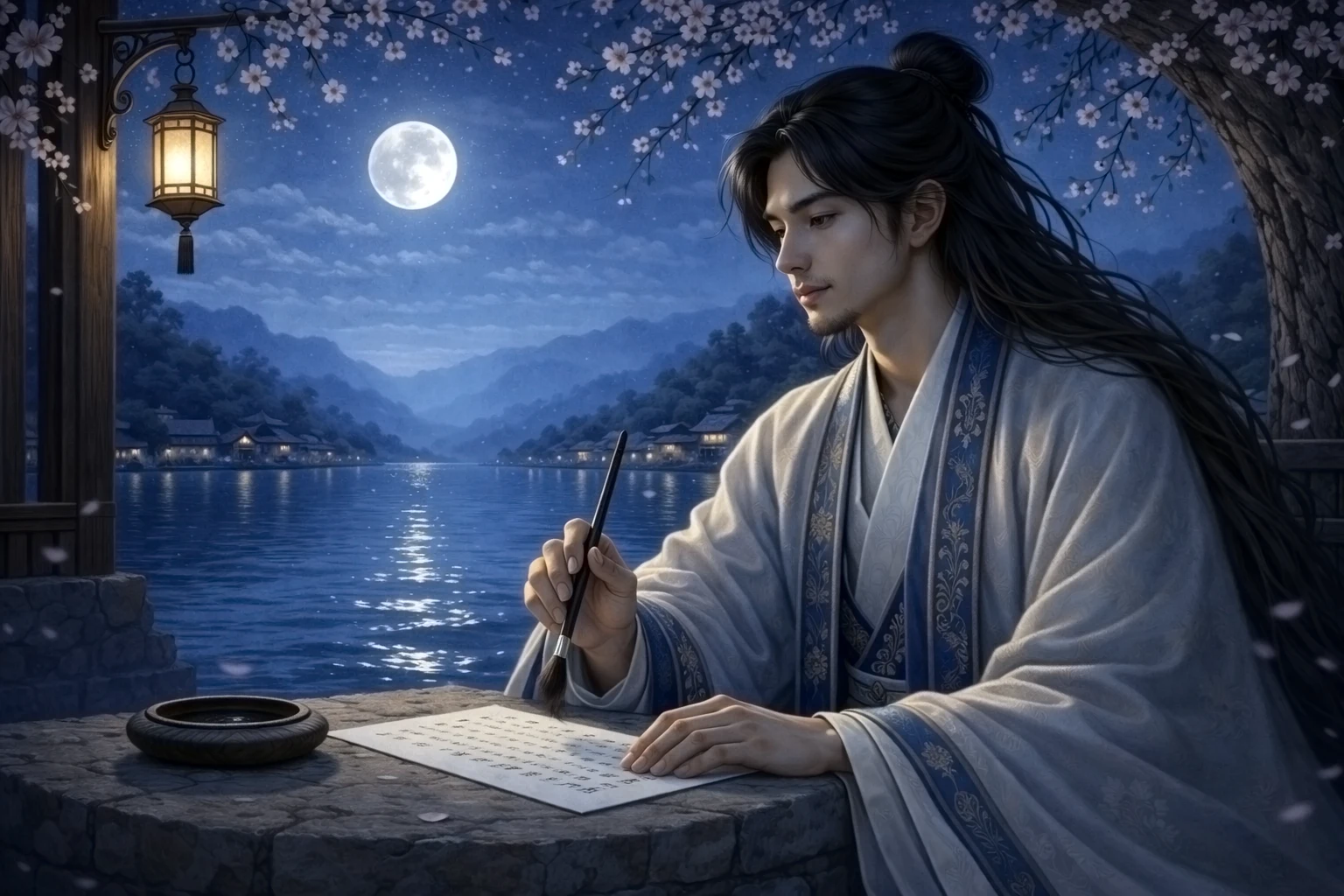
Zhu Qingyu (朱庆馀 dates of birth and death unknown), also known by his given name Kejiu, was a poet of the Mid-Tang period, a native of Yuezhou (present-day Shaoxing, Zhejiang Province). He passed the jinshi examination in the second year of the Baoli era (826 AD) and held the position of Collator in the Imperial Library. His poetry excelled in the five-character regulated verse style, characterized by a refined and subtle elegance, with particular skill in depicting the emotions of boudoir women and palace maidens. In the Complete Tang Poems, two volumes containing 177 of his works are preserved. He was adept at using allegorical and metaphorical techniques, blending everyday emotions with political aspirations. Although not many of his poems survive, his exquisite craftsmanship secures him a unique place in the history of Tang poetry, with his poem Boudoir Sentiments becoming a quintessential example of the fusion of examination-themed and boudoir poetry in later generations.