


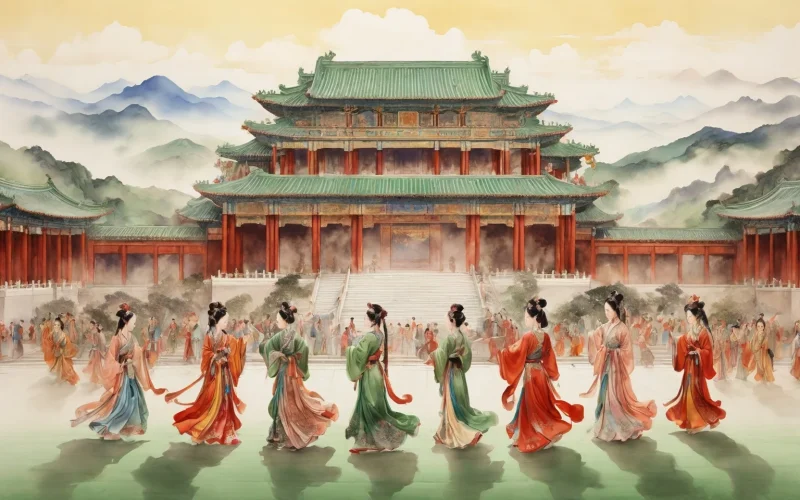
Yellow dust raised by the steeds veiled trees like a screen;
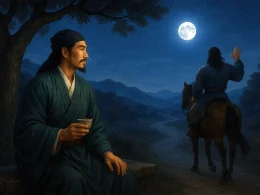
The messenger deceived came to deceive the crown.
The Song of Rainbow Cloak over a thousand peaks green
Would not stop till the Central Plain was broken down.
Original Poem
「过华清宫绝句 · 其二」
杜牧
新丰绿树起黄埃,数骑渔阳探使回。
霓裳一曲千峰上,舞破中原始下来。
Interpretation
This poem belongs to Du Mu's Huaqing Palace series, composed during the Huichang reign period (841-846 AD) while the poet served as an Investigating Censor. Though nearly a century had passed since the An Lushan Rebellion, the chaotic realities of the late Tang—fragmented by military governors and dominated by eunuchs—made this history deeply resonant for Du Mu. The incident of the "envoys to Yuyang" originates from the Comprehensive Mirror for Aid in Government: in 755 AD, Emperor Xuanzong dispatched the eunuch Fu Qiulin to Fanyang to assess An Lushan's loyalty; Fu, heavily bribed, returned with a false report. Du Mu's acute focus on this detail transforms it into a crucial aperture for deconstructing the illusions of a golden age. By juxtaposing the dust of the returning envoys with the dance performed atop the peaks, the poet creates a poetic distillation of a historical turning point.
First Couplet: 新丰绿树起黄埃,数骑渔阳探使回。
Xīnfēng lǜ shù qǐ huáng āi, shù jì Yúyáng tàn shǐ huí.
Through green woods of Xinfeng, yellow dust begins to rise; From Yuyang, a few scouts on horseback meet our eyes.
Explication: "Green woods of Xinfeng" establishes vivid chromatic tension: the verdant trees symbolize the façade of a peaceful, prosperous age, while the yellow dust hints at the turbulent reality breaking through. The verb "begins to rise" masterfully captures both the physical disturbance and metaphorically suggests the ominous stirring of disaster from a placid surface. The modest "few scouts" contrasts sharply with the grave strategic importance of "Yuyang"—the empire's fate hinging on the words of a mere handful. Their "return" is not triumphant but marks the delivery of corrupted falsehoods to the seat of power, an action that pivots history's course. With a historian's precision, Du Mu condenses the informational decay of the Tianbao era into a single, dust-charged image.
Final Couplet: 霓裳一曲千峰上,舞破中原始下来。
Ní cháng yī qǔ qiān fēng shàng, wǔ pò Zhōngyuán shǐ xià lái.
Upon the mountain peaks, the Rainbow Skirt resounds, unfurled; They danced till the heartland broke, then ceased, and left that world.
Explication: This couplet forms one of the most potent metaphors in Chinese historical poetry. "The Rainbow Skirt," the supreme artistic achievement of the Kaiyuan zenith, is here suspended "upon the mountain peaks"—referring literally to Huaqing Palace's lofty perch but symbolizing the delusional heights to which imperial indulgence had ascended, detached from the people's plight. The phrase "danced till the heartland broke" is devastating: making the aesthetic act of "dance" the agent of destruction reveals the cruel logic of how aesthetic excess can metamorphose into political catastrophe. The words "then ceased, and left that world" carry profound pathos: the revelry did not end voluntarily but only when the realm lay in ruins. This "descent" signifies both the dancers' physical departure and the empire's historical trajectory from glorious zenith into chaotic abyss.
Holistic Appreciation
This is a multidimensional poetic reconstruction of a historical moment, engaging both sight and sound. Du Mu's genius lies in condensing the eight-year cataclysm of rebellion into two emblematic instants: the dust of returning envoys (an audiovisual signal) and the dance that "danced till the heartland broke" (an act of aesthetic violence). The poem employs a tightly woven, inverted causal structure: presenting the effect (dust rising, envoys returning) before the cause (the dance, the realm's ruin). This reverse-chronology logic lends the poem the deductive tension of a historical inquiry.
The spatial construction is profoundly meaningful. Horizontally, the poem traces the path of crisis from Xinfeng (near Chang’an) to Yuyang (An Lushan’s base) and finally to the Central Plain. Vertically, it moves from the ground—the green woods and rising dust—up to the mountain peaks where the dance unfolds, and then follows the descent back to earth. This vertical stratification mirrors the social cleavage between the decadent pleasures of the elite atop the summit and the gathering crises ignored below. While the “Rainbow Skirt” resounds upon the peaks, the envoys far below are raising the dust of deceit—a precise metaphor for the concurrent elite indulgence at court and the gathering perils among the people during Xuanzong’s reign.
Particularly striking is the transformation of verbs: "begins to rise" (crisis germinates), "meet our eyes/return" (falsehood arrives), "resounds/danced" (indulgence peaks), "broke" (disaster strikes), "ceased… left" (illusion ends). This chain delineates the dynamic sequence of an empire's collapse. The extraordinary coupling "danced till… broke" not only alludes to the martial elements within the dance's music but assigns historical culpability to an aesthetic pursuit—when art becomes an opiate for power, supreme beauty coincides with profound evil.
Artistic Merits
- The Subtle Use of Color Politics: The contrast between "green trees" and "yellow dust" operates on both natural and political levels. Green symbolizes a false peace; yellow refers literally to dust but also carries ominous connotations of rebellion (echoing, albeit anachronistically, the later Huang Chao Rebellion), achieving historical forewarning through color metaphor.
- The Historical Unfolding Through a Chain of Actions: The sequence "rise—return—play/dance—to ruins—descend" forms a continuous animation of collapse. The abnormal subject-verb pairing in "Danced… to ruins," granting the soft act of dance the power to shatter a realm, exemplifies the essence of Du Mu's satirical art—a violence enacted through syntax.
- Epic Texture Through Synchronized Sight and Sound: The visual imagery of the first couplet (green trees, yellow dust) is accompanied by auditory imagination (the sound of hoofbeats); the auditory motif of the second couplet (the dance melody) is combined with visual spectacle (the dance's shadow upon a thousand peaks). This creates a multimedia-like historical reconstruction. The use of synesthesia allows the poem to achieve expressive dimensions beyond the textual.
Insights
This work reveals a profound historical truth: the collapse of empires often begins with the corruption of information systems, flourishes amidst the alienation of cultural pursuits, and culminates in geographical disintegration. The bribed envoys represent failed intelligence; the ruinous dance symbolizes aesthetic indulgence turned malignant; the final descent marks territorial collapse. The warning for any power structure is clear: when truth is bartered away and artistic expression is co-opted to deceive, even the most glorious civilization cannot escape a fatal fall.
The image of "danced till the heartland broke" demands contemporary reflection. It reminds us that the greatest perils often don the guise of supreme beauty. The Rainbow Skirt Dance, an unparalleled artistic achievement, became an instrument for the powerful to evade reality and anesthetize the populace, its beauty perverted into a destructive force. This poses a timeless question: how do we prevent the pursuit of beauty from becoming a flight from truth? How do we ensure art remains a mirror to reality, not a curtain obscuring it?
Ultimately, the poem provides not merely a critique of a past emperor but a multi-focal lens for examining civilizational health. Du Mu teaches us that diagnosing an era requires looking beyond official reports to its cultural zeniths, and listening not only to public pronouncements but also to the spatial metaphors of power. In this sense, the quatrain is a diagnostic tool: in any age, the higher the "Rainbow Skirt" dances upon the peaks of power, the more diligently we must watch for the telltale dust stirring in the green woods below.
Poem translator
Xu Yuanchong (许渊冲)
About the poet
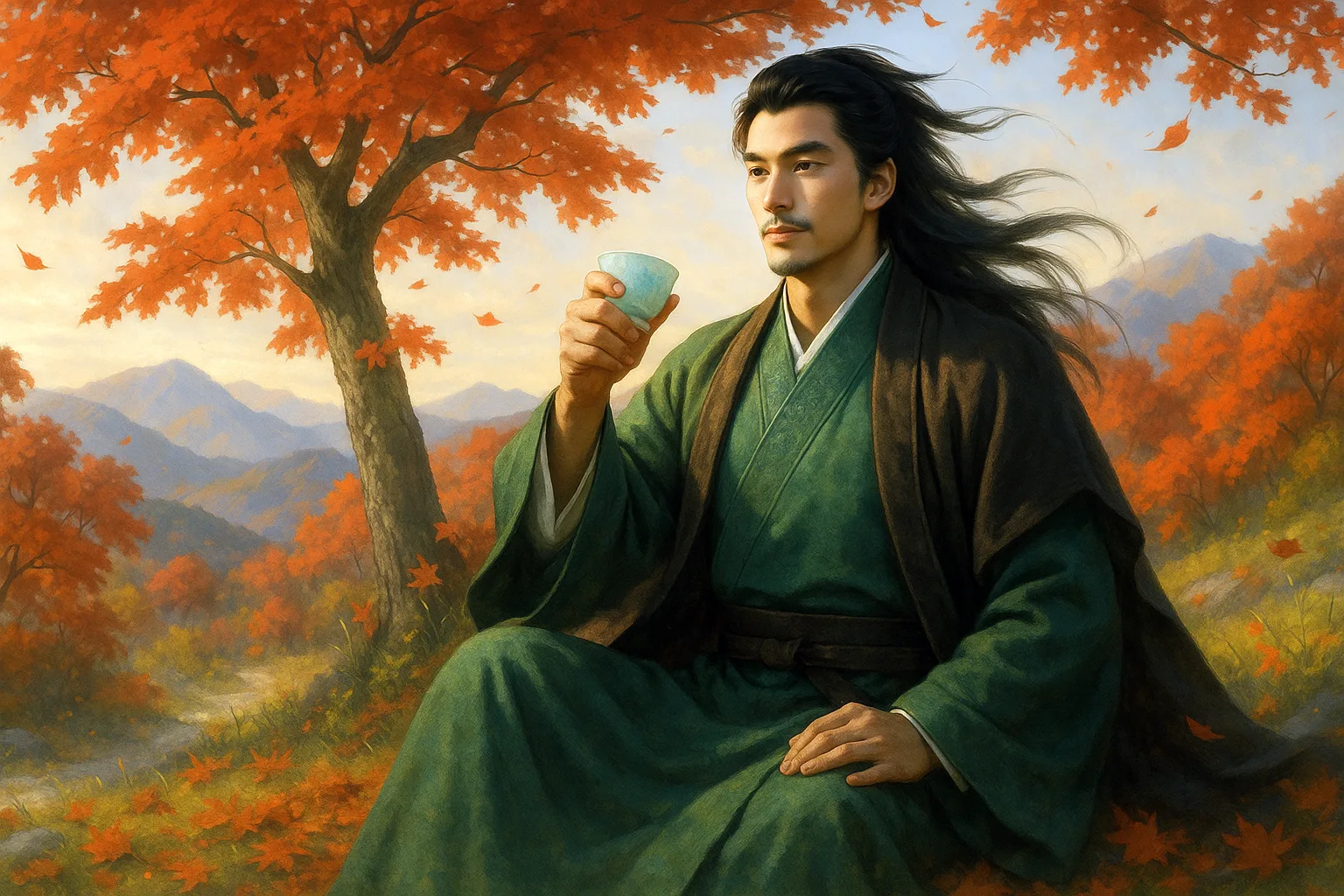
Du Mu (杜牧), 803-853 AD, was a native of Xi'an, Shaanxi Province. Among the poets of the Late Tang Dynasty, he was one of those who had his own characteristics, and later people called Li Shangyin and Du Mu as "Little Li and Du". His poems are bright and colorful.