


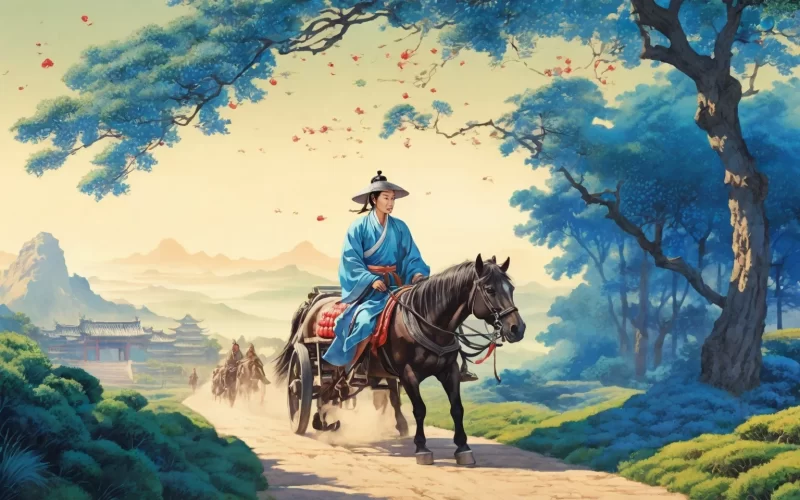
Viewed from afar, the hill's paved with brocade in piles;
The palace doors on hilltops opened one by one.
A steed which raised red dust won the fair mistress' smiles.
How many steeds which brought her fruit died on the run!
Original Poem
「过华清宫绝句 · 其一」
杜牧
长安回望绣成堆,山顶千门次第开。
一骑红尘妃子笑,无人知是荔枝来。
Interpretation
This widely celebrated classic is a representative work of Du Mu's historical quatrains, composed during his tenure as an Investigating Censor or Vice Director of the Bureau of Honors (approximately 842-846 AD). At this time, the poet was in a phase of career advancement and maintained a clear-eyed understanding of the deep-seated political failings of the late Tang. The Huaqing Palace, a symbol of the Kaiyuan Era's prosperity and a witness to the An Lushan Rebellion, lay in ruins by Du Mu's time, yet the historical warnings it carried had become only more pronounced. Du Mu's choice to focus on the minor historical episode of "lychee tributes" constitutes a deliberate design deconstructing the myth of a golden age through a historian's lens.
It is noteworthy that the scene described was not witnessed firsthand by Du Mu but is a literary reconstruction based on historical sources like the New Book of Tang: Biography of the Imperial Consort. This selection of detail is profoundly significant: among the numerous historical facts reflecting Emperor Xuanzong's extravagance, the poet uniquely chose the "lychee"—an image combining immense spatial distance (from Lingnan to Chang'an) with extreme temporal perishability (lychees spoil after three days). This highlights how power forcibly distorts natural laws and reveals how imperial resources were hijacked by personal desire. What Du Mu accomplishes in twenty-eight characters is, in essence, a condensed diagnostic report on the pathology of a golden age's decline.
First Couplet: 长安回望绣成堆,山顶千门次第开。
Cháng'ān huí wàng xiù chéng duī, shāndǐng qiān mén cìdì kāi.
Looking back from Chang'an, brocade-like piles the mountain grace; On its crest, a thousand palace gates open in sequence, apace.
Explication: The opening constructs a grand geography of power from a sweeping perspective. "Looking back" implies the temporal and spatial distance inherent in historical judgment—the poet is not a recorder within the scene but a critic standing on the far side of time. "Brocade-like piles" uses textile imagery to describe the mountain's hues, artificializing and luxurifying the natural landscape, suggesting Mount Li had been transformed into an object of imperial aesthetics, a manicured spectacle. "A thousand palace gates open in sequence" unfolds like a cinematic long shot: the ceremonial act of gates opening layer by layer, originally intended for state functions, here becomes the prelude to receiving a single rider raising red dust. This disconnect between solemn form and absurd substance lays the groundwork for the satire to follow.
Final Couplet: 一骑红尘妃子笑,无人知是荔枝来。
Yī jì hóngchén fēizǐ xiào, wú rén zhī shì lìzhī lái.
A steed stirs red dust—the Consort smiles, her pleasure shown; None know that lychees are what that hurried horseman bore.
This couplet constitutes a classic scene in Chinese satirical poetry. "A steed stirs red dust" sketches with minimalist strokes a scene of the empire's courier system being abused: relay horses (Tang regulation: relay horses traveled 500 li per day), meant for urgent military and state dispatches, now gallop madly for lychees. The three words "the Consort smiles" are particularly piercing—the public revelation of this private expression exposes the usurpation of public resources for private whim. The collective ignorance of "None know" operates on two levels: it is realistic (the common people truly did not know what the horse carried), and more profoundly, it reveals how power systems maintain the legitimacy of their absurd actions through the control of information. The lychee, the poem's only named object, with its southern origin (Lingnan), perishable nature ("color changes in one day, fragrance in two, taste in three"), and connotations of luxury, together form a masterful indictment of the golden age.
Holistic Appreciation
This is a poetic dissection that uses a micro-narrative to deconstruct macro-history. Du Mu's brilliance lies not in directly denouncing Emperor Xuanzong's folly but in presenting a single slice of systemic operation—"lychee transport"—allowing the absurdity of the golden age to reveal itself. The poem follows a strict causal chain: because of the lavish environment of "brocade-like piles" (cause), there is the solemn preparation of "a thousand gates open" (effect); because of the Consort's demand for gratification (cause), there is the frantic delivery of "a steed stirs red dust" (effect); because of the monopoly of power (cause), there is the information void of "None know" (effect). This interlinked narrative logic lends the satire the force of historical inevitability.
The poem's spatial and temporal structure is ingeniously crafted. Spatially: from Chang'an (political center) to Mount Li (imperial retreat) to the courier roads (state arteries) to Lingnan (empire's periphery), it outlines the comprehensive mobilization of national territory by imperial desire. Temporally: it compresses the lengthy lychee transport process (typically over seven days) into the instantaneous image of "a steed stirs red dust," then, through the immediate reaction of "the Consort smiles," creates a cruel synchronization between desire's gratification and its cost. While the Consort savors fresh lychees, the entire imperial courier system pays an incalculable price, all shrouded behind the veil of "None know."
Particularly noteworthy is the subtle shift in perspective: the first couplet is the poet's view ("Looking back"), the second the official view ("gates open"), the third the common people's view ("see red dust"), and the final couplet a quasi-omniscient historical view ("None know… lychees are what…"). This superimposition of multiple perspectives packs the complete spectrum of cognition—from the powerful, to the executors, the observers, and finally the judges—into just four lines. The final focus on the simple truth of "lychees are what" embodies Du Mu's spirit as a historian: stripping away all grand narratives, the essence of history often lies in such concealed details.
Artistic Merits
- Dramatic Juxtaposition of Imagery: "Red dust" (clamorous, urgent motion) versus "lychees" (delicate, perishable luxury); "a thousand gates open" (solemn, state ceremony) versus "the Consort smiles" (private, personal pleasure)—these create multiple layers of contrast. This technique of generating semantic power through the juxtaposition of contrasting images is central to Du Mu's satirical art.
- Verbal Chain Revealing Power Dynamics: "Looking back" (scrutinizing) — "open" (welcoming/accommodating) — "smiles" (being gratified) — "know" (having cognizance). These four verbs outline the complete circuit of power's operation: from creating the spectacle, to servicing the desire, to controlling perception. "Smiles," as the only verb expressing emotion, exposes the true nature of desire at the pinnacle of power.
- Critical Force through Strategic Omission: The poem never mentions Emperor Xuanzong by name. Yet the pomp of "a thousand gates open," the cause for "the Consort smiles," and the system enabling "None know" are all testaments to his presence. This technique of implying presence through absence allows the critique to transcend specific individuals and target the inherent dysfunction of the power structure itself.
Insights
This masterpiece reveals a timeless political parable: when power begins to employ the state apparatus to satisfy private indulgences, the corruption of the system has already reached its core. The lychee tribute may seem a minor affair, yet it mobilized the entire imperial courier system—a system designed for military communications, edict transmission, and official travel. Through this single episode, Du Mu shows us: the collapse of a golden age often begins with the gradual erosion of a system's fundamental purpose by such "minor" excesses.
The state of "None know" in the poem is especially worthy of deep reflection. It is not mere informational opacity but a systemic blinding of awareness: the people did not know what the horse carried, court officials dared not question the emperor's whims, historians might gloss over the details. This collective "not knowing" is more dangerous than individual "folly," for it signifies that the entire society had lost the capacity for legitimate questioning of power. The warning for any era is this: a healthy political ecology must preserve the space for the truth of "lychees are what" to be known and discussed by all.
Ultimately, this poem offers not only historical critique but a methodology for observing power. Du Mu teaches us: to understand the truth of an era, look not only at its official narratives and grand monuments, but observe where its resources flow, see what is conveyed through its most urgent channels, and note on whose face a smile appears and why. In this sense, this quatrain is not merely a historical poem but a scalpel that transcends time and space—whenever and wherever we see "a steed stirs red dust" galloping for private desire while the multitude claims "None know," we should hear the warning bell Du Mu sounds from the depths of history.
Poem translator
Xu Yuanchong (许渊冲)
About the poet
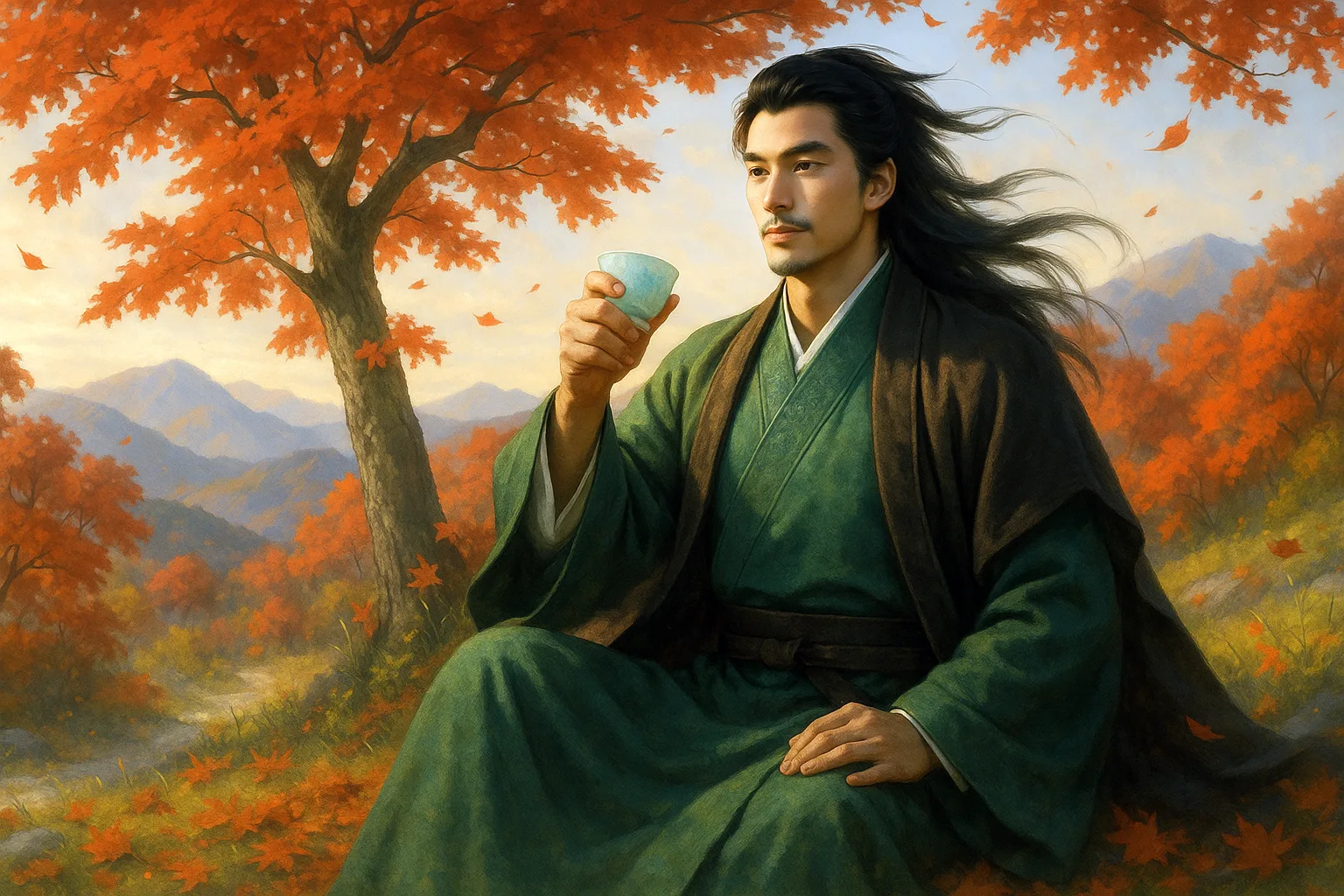
Du Mu (杜牧), 803-853 AD, was a native of Xi'an, Shaanxi Province. Among the poets of the Late Tang Dynasty, he was one of those who had his own characteristics, and later people called Li Shangyin and Du Mu as "Little Li and Du". His poems are bright and colorful.