


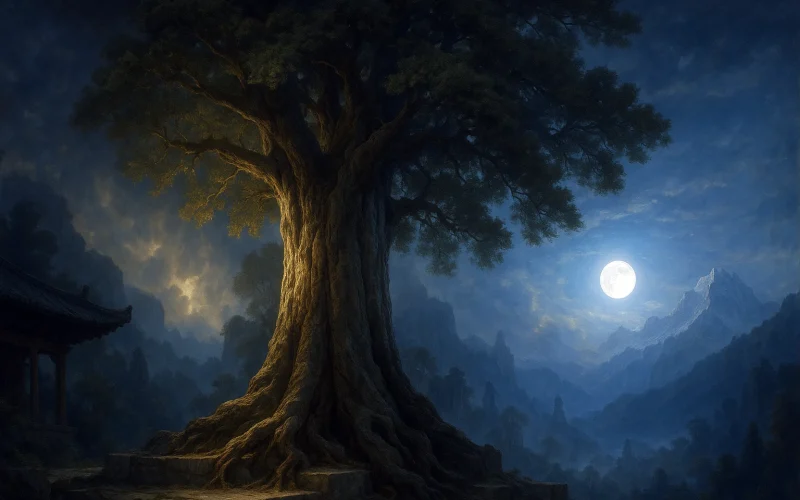
Beside the Temple of the Great Premier stands an ancient cypress
With a trunk of green bronze and a root of stone.
The girth of its white bark would be the reach of forty men
And its tip of kingfish-blue is two thousand feet in heaven.
Dating from the days of a great ruler's great statesman,
Their very tree is loved now and honoured by the people.
Clouds come to it from far away, from the Wu cliffs,
And the cold moon glistens on its peak of snow.

...East of the Silk Pavilion yesterday I found
The ancient ruler and wise statesman both worshipped in one temple,
Whose tree, with curious branches, ages the whole landscape
In spite of the fresh colours of the windows and the doors.
And so firm is the deep root, so established underground,
That its lone lofty boughs can dare the weight of winds,
Its only protection the Heavenly Power,
Its only endurance the art of its Creator.

Though oxen sway ten thousand heads, they cannot move a mountain.
...When beams are required to restore a great house,
Though a tree writes no memorial, yet people understand
That not unless they fell it can use be made of it....
Its bitter heart may be tenanted now by black and white ants,
But its odorous leaves were once the nest of phoenixes and pheasants.

...Let wise and hopeful men harbour no complaint.
The greater the timber, the tougher it is to use.
Original Poem
「古柏行」
杜甫
孔明庙前有老柏, 柯如青铜根如石;
双皮溜雨四十围, 黛色参天二千尺。
君臣已与时际会, 树木犹为人爱惜。
云来气接巫峡长, 月出寒通雪山白。
忆昨路绕锦亭东, 先主武侯同閟宫。
崔嵬枝干郊原古, 窈窕丹青户牖空。
落落盘踞虽得地, 冥冥孤高多烈风。
扶持自是神明力, 正直元因造化功。
大厦如倾要梁栋, 万牛回首丘山重。
不露文章世已惊, 未辞剪伐谁能送?
苦心岂免容蝼蚁? 香叶终经宿鸾凤。
志士幽人莫怨嗟, 古来材大难为用。
Interpretation
This poem was written in the winter of 766 CE, the first year of the Dali era under Emperor Daizong of Tang, during Du Fu’s exile in Kuizhou. While visiting a local temple dedicated to Zhuge Liang, the poet was deeply struck by an extraordinary ancient cypress standing before the shrine—its vigorous form and noble spirit resonated profoundly within him. At a time when the state remained troubled and he himself was drifting in hardship, this weather-beaten, solitary, and upright tree became not only a symbol of Zhuge Liang’s loyal virtue but also stirred the poet’s profound contemplation on the perennial historical theme of “great talent finding little use.” Thus, through this ode to the cypress that reflects on the past and voices the poet’s own aspirations, the work encapsulates the most somber and stirring insights of Du Fu’s later years.
First Couplet: 孔明庙前有老柏,柯如青铜根如石。
Kǒngmíng miào qián yǒu lǎo bǎi, kē rú qīngtóng gēn rú shí.
Before Kongming’s temple stands an ancient cypress, / Its boughs like bronze, its roots like stone.
The opening couplet directly introduces the subject, using concise similes to establish both the visual image and the spiritual quality of the tree. “Boughs like bronze” suggests strength forged through weathering, while “roots like stone” signifies an immovable, deeply grounded foundation. The connection between the tree, the temple, and the spirit of Zhuge Liang is established from the very first lines.
Second Couplet: 双皮溜雨四十围,黛色参天二千尺。
Shuāng pí liū yǔ sìshí wéi, dài sè cāntiān èrqiān chǐ.
Its layered bark lets rain glide down, forty spans round; / Its dark hue pierces the sky, two thousand feet tall.
Exaggerated yet vivid numbers emphasize the cypress’s colossal girth and soaring height. “Lets rain glide down” captures the smooth, dense texture of the bark, hinting at the marks of time. The hyperbolic “forty spans round” and “two thousand feet tall” are not meant literally but serve to magnify the tree’s extraordinary presence, endowing it with a sublime, heaven-reaching majesty.
Third Couplet: 君臣已与时际会,树木犹为人爱惜。
Jūn chén yǐ yǔ shí jìhuì, shù mù yóu wéi rén àixī.
Lord and minister met their hour, now one with their age; / Yet this tree is still cherished, tended by human hands.
The focus shifts from the tree to the human realm, entering a deeper historical reflection. “Lord and minister met their hour” alludes to the legendary meeting between Liu Bei and Zhuge Liang, conveying a sense of longing for that ideal past. “Still cherished, tended by human hands” expresses the genuine reverence later generations hold for this ancient cypress—and by extension, for the noble spirit it embodies. Though the figures are gone, their legacy lives on through what remains.
Fourth Couplet: 云来气接巫峡长,月出寒通雪山白。
Yún lái qì jiē Wū Xiá cháng, yuè chū hán tōng xuěshān bái.
When clouds gather, its aura merges with the lengthy Wu Gorges; / When the moon rises, its chill flows through the snow-white mountains.
Through expansive spatial imagination, the poem elevates the cypress to a grander spiritual plane. “Aura merges with the lengthy Wu Gorges” and “chill flows through the snow-white mountains” place the tree within the majestic landscape of Kuizhou, imbuing it with a monumental presence that seems to merge with heaven and earth. This is not merely a description of a tree but an evocation of Zhuge Liang’s vast mind and enduring spirit.
Fifth Couplet: 忆昨路绕锦亭东,先主武侯同閟宫。
Yì zuó lù rào Jǐn Tíng dōng, Xiānzhǔ Wǔhóu tóng bì gōng.
I recall the path winding east of Brocade Pavilion, / Where the First Ruler and the Martial Marquis share a silent hall.
Sixth Couplet: 崔嵬枝干郊原古,窈窕丹青户牖空。
Cuīwéi zhīgàn jiāo yuán gǔ, yǎotiǎo dānqīng hù yǒu kōng.
Lofty boughs rise over the ancient plain; / Inside, fine murals remain, but doors and windows stand void.
The poet’s thoughts travel from Kuizhou to the Wuhou Temple in Chengdu, creating a spatial juxtaposition. “Share a silent hall” reflects the joint veneration of ruler and minister, a testament to later reverence. “Lofty boughs” echoes the cypress in Kuizhou, emphasizing its antiquity, while “fine murals” describes the temple’s elegant artwork. Yet the phrase “doors and windows stand void” conveys a profound sense of desolation and the passage of time, where glory has faded and the figures are long gone.
Seventh Couplet: 落落盘踞虽得地,冥冥孤高多烈风。
Luòluò pánjù suī dé dì, míngmíng gūgāo duō liè fēng.
Aloof, it holds this ground, favored by the site; / Remote, solitary, lofty, it draws many a fierce wind.
The focus returns to the cypress itself and its fate. “Aloof” conveys its solitary grandeur; “holds this ground” underscores its deep-rooted strength. The turn between “favored by the site” and “draws many a fierce wind” reveals a poignant paradox: precisely because of its “solitary loftiness,” extraordinary beings often attract greater adversity. This is both a law of nature and a metaphor for the fate of exceptional talent.
Eighth Couplet: 扶持自是神明力,正直元因造化功。
Fúchí zì shì shénmíng lì, zhèngzhí yuán yīn zàohuà gōng.
That it stands firm must be a divine force sustaining it; / Its integrity and uprightness spring from the work of Creation.
The couplet offers a poetic explanation for the cypress’s resilience. “Divine force” suggests an external, almost mystical protection, while “work of Creation” points to an inner quality inherent to its nature. This lends the cypress’s character a sacred, essentialized quality, setting the stage for the philosophical reflections that follow.
Ninth Couplet: 大厦如倾要梁栋,万牛回首丘山重。
Dàshà rú qīng yào liángdòng, wàn niú huíshǒu qiūshān zhòng.
When a great hall totters, it needs pillars and beams; / But these weigh like a mountain—ten thousand oxen turn away.
The poem shifts from the tree as a natural object to timber as a metaphor for talent, addressing the core theme. “Great hall totters” symbolizes national crisis; “needs pillars and beams” speaks to the urgent demand for capable leaders. Yet “ten thousand oxen turn away” vividly illustrates the practical dilemma: truly great material, due to its immense “weight” (value and capability), is often too ponderous for ordinary means to move or utilize.
Tenth Couplet: 不露文章世已惊,未辞剪伐谁能送?
Bù lù wénzhāng shì yǐ jīng, wèi cí jiǎnfá shéi néng sòng?
Unadorned, its grain already astounds the world; / It does not shun the ax—yet who can convey it where needed?
This couplet delves into the specific contradiction of “great talent finding little use.” “Unadorned, its grain already astounds the world” praises the cypress’s unpretentious yet innate excellence. “Does not shun the ax” expresses its willingness to be of service. However, “who can convey it” points to the crucial problem: the lack of mechanisms or perceptive individuals to recognize, recommend, and employ such talent. The frustration of unrecognized worth resonates deeply here.
Eleventh Couplet: 苦心岂免容蝼蚁?香叶终经宿鸾凤。
Kǔxīn qǐ miǎn róng lóuyǐ? Xiāng yè zhōng jīng sù luán fèng.
Can its bitter core escape hosting ants? / Yet its fragrant leaves will in time shelter phoenixes.
A dialectical view of the fate of great talent emerges. “Bitter core… hosting ants” acknowledges the inevitable petty vexations and injuries that accompany growth. “Fragrant leaves… shelter phoenixes” affirms the belief that true nobility will ultimately attract kindred spirits of high virtue. Within the acknowledgment of harsh reality lies an enduring idealistic hope.
Final Couplet: 志士幽人莫怨嗟,古来材大难为用。
Zhìshì yōu rén mò yuàn jiē, gǔ lái cái dà nán wéi yòng.
Men of purpose, recluses, sigh no more your grief; / Since ancient times, great timber has been hard to use.
The poem concludes with a heavy, resonant sigh that articulates its central theme. “Sigh no more” offers a consolation tinged with resignation, yet also carries the force of a lament born of bitter experience. The final line, “Since ancient times, great timber has been hard to use,” strikes with the weight of carved stone. It serves as a summation for Zhuge Liang, for the poet himself, and for all great yet unfulfilled talents across history, while delivering a sharp critique of this enduring, tragic paradox.
Holistic Appreciation
This poem represents the pinnacle of Du Fu’s poetry that uses objects to express ideals. Its greatness lies in achieving “a fourfold fusion: the nature of the object, human character, historical insight, and philosophical reflection.” Taking the “ancient cypress” as its central thread and “Kongming” as its thematic counterpart, the poem unfolds three layers of meaning that deepen progressively: first, the majestic physical presence of the cypress as a natural entity; second, the cypress as a symbol of Zhuge Liang’s loyal virtue; and third, the cypress as a vessel for the poignant historical theme of “great talent finding little use.”
The poem’s structure is grand and sweeping, moving fluidly through time and space—from Kuizhou to Chengdu, from the present scene to memory, from concrete description to philosophical elevation. Its emotional tone is somber and rhythmically varied, surging between lofty praise (as in “two thousand feet tall” or “aura merges with the lengthy Wu Gorges”) and desolate lament (as in “doors and windows stand void” or “hard to use”), ultimately coalescing into the timeless, resonant conclusion: “Since ancient times, great timber has been hard to use.”
Artistic Merits
- An Exquisitely Constructed Symbolic System
The ancient cypress in this poem is not merely a simple metaphor or symbolic object but a multi-layered, self-contained, and open symbolic system. It simultaneously embodies Zhuge Liang’s character, carries historical memory, serves as a metaphor for great talent, and epitomizes the fate of the exceptional individual. Its symbolic meaning is rich and profound. - Bold Use of Exaggeration and Imagination
Lines such as “forty spans round,” “two thousand feet tall,” “aura merges with the lengthy Wu Gorges,” “chill flows through the snow-white mountains,” and “ten thousand oxen turn away” employ hyperbole and imagination to their fullest. Their purpose is not literal description but to create a transcendent, sublime, and tragic artistic realm that serves the poem’s spiritual expression. - Integration of Discursive Thought with Poetic Emotion
The latter part of the poem (from “When a great hall totters” onward) is largely discursive, yet its arguments arise organically from the imagery and are charged with emotional force. Discursive lines like “Unadorned, its grain already astounds the world,” “It does not shun the ax,” and “Can its bitter core escape hosting ants?” are infused with the poet’s personal anguish and indignation, achieving a perfect unity of feeling, scene, and reason. - Vigorous Diction and a Potent, Somber Style
The poem’s lines vary in length, its diction is sturdy and robust (e.g., “boughs like bronze, its roots like stone,” “aloof, it holds this ground”), and its rhythm is firm and cadenced. The overall style is somber, potent, and majestic, perfectly matching the rugged character of the cypress and the depth of the poignant themes being explored.
Insights
This work confronts us with a timeless dilemma: the profound tension between society’s pressing need for “pillars and beams”—great talent—and the persistent, sobering reality that “massive timber is hardest to employ.” Du Fu is not merely lamenting the fate of Zhuge Liang or his own plight; he exposes a structural flaw in how talent is recognized and utilized—where exceptional individuals, precisely because of their “greatness” (be it foresight, moral independence, or extraordinary ability), often find themselves at odds with conventional systems.
The reflection this poem leaves for posterity is both profoundly sobering and urgently relevant: How can a civilization truly cherish and wisely deploy its most exceptional “great timber”? It reminds us of the need to build more open and discerning institutions, and to nurture a cultural ethos capable of recognizing latent genius even before it is fully polished—as well as to construct the pathways required to move “mountain-heavy” pillars to where “the great hall totters.” At the same time, the poem offers all “aspiring souls and recluses” a form of solemn consolation: even when deemed “hard to use,” the very “integrity and uprightness” of an ancient cypress, and the soaring vision that “reaches for the sky,” constitute in themselves an enduring force against the erosion of history. This steadfast faith in the value of “timber,” coupled with this penetrating critique of the mechanisms of its “use,” stands among the most compelling expressions of Du Fu’s poetic conscience and historical vision.
Poem translator
Kiang Kanghu
About the poet
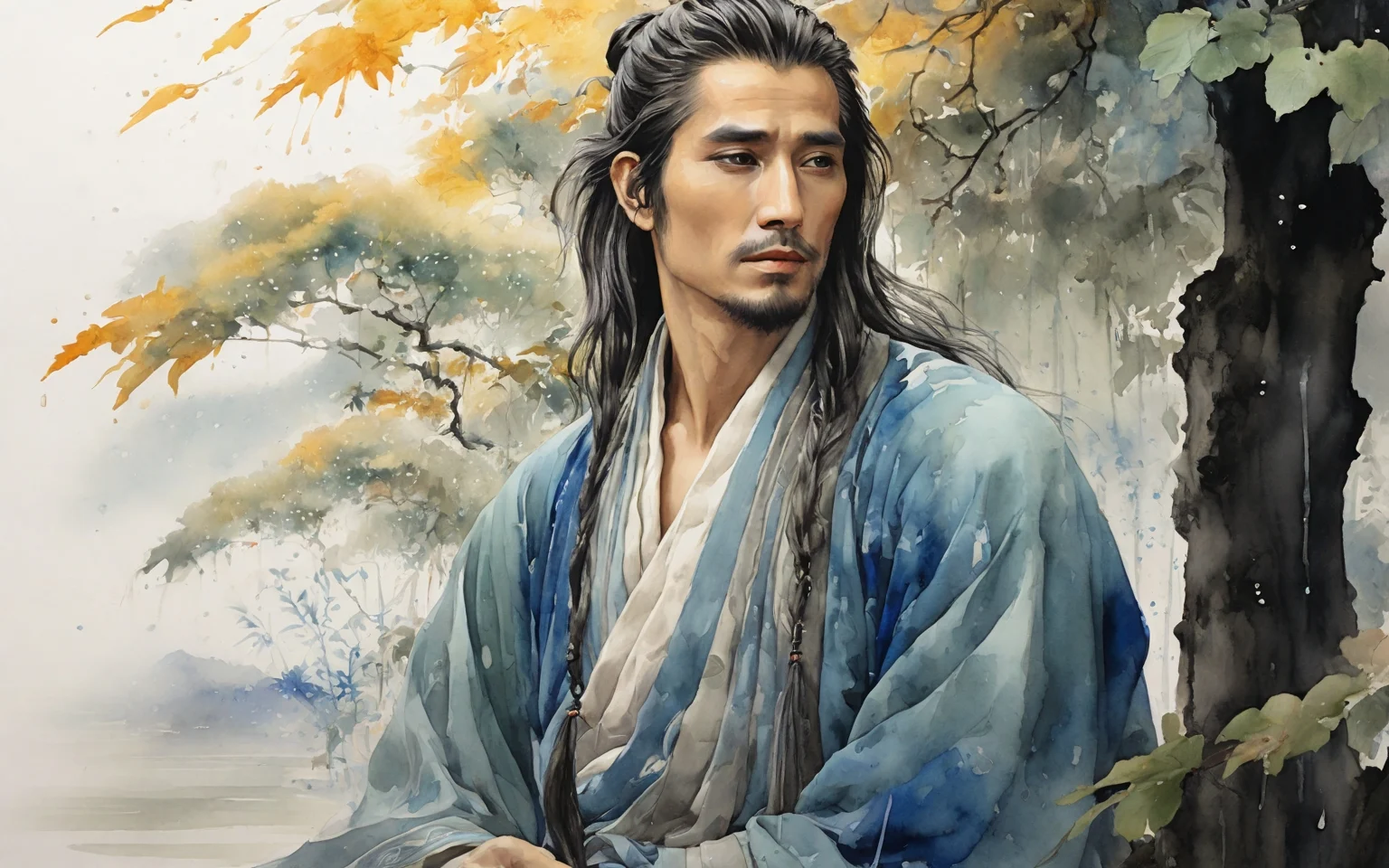
Du Fu (杜甫), 712 - 770 AD, was a great poet of the Tang Dynasty, known as the "Sage of Poetry". Born into a declining bureaucratic family, Du Fu had a rough life, and his turbulent and dislocated life made him keenly aware of the plight of the masses. Therefore, his poems were always closely related to the current affairs, reflecting the social life of that era in a more comprehensive way, with profound thoughts and a broad realm. In his poetic art, he was able to combine many styles, forming a unique style of "profound and thick", and becoming a great realist poet in the history of China.