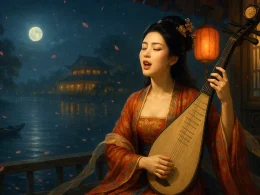



While winter daylight shortens in the elemental scale
And snow and frost whiten the cold-circling night,
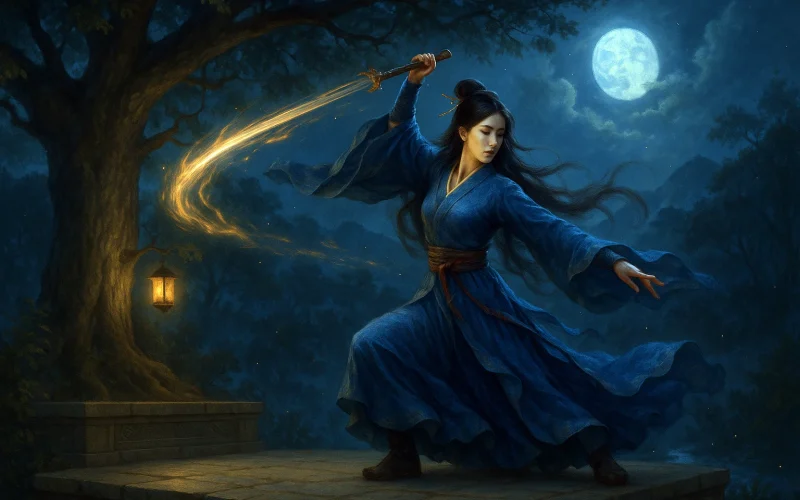
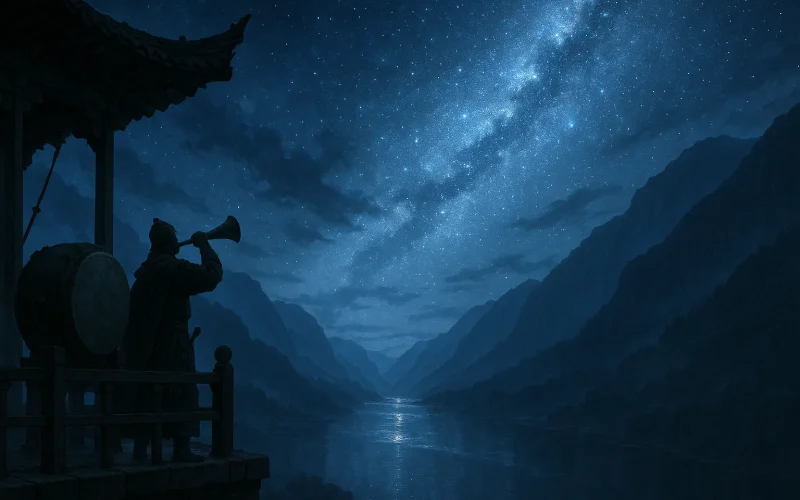
Stark sounds the fifth-watch with a challenge of drum and bugle.
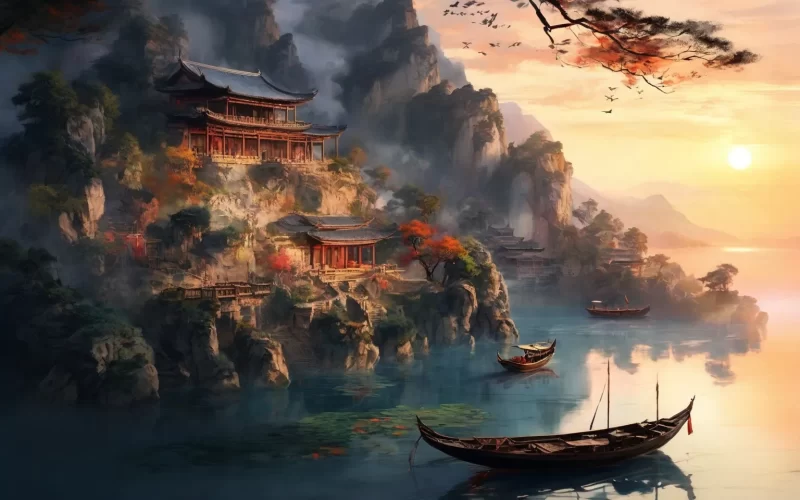
...The stars and the River of Heaven pulse over the three mountains;
I hear women in the distance, wailing after the battle;
I see barbarian fishermen and woodcutters in the dawn.
...Sleeping-Dragon, Plunging-Horse, are no generals now, they are dust --
Hush for a moment, O tumult of the world.
Original Poem
「阁夜」
杜甫
岁暮阴阳催短景,天涯霜雪霁寒霄。
五更鼓角声悲壮,三峡星河影动摇。
野哭千家闻战伐,夷歌数处起渔樵。
卧龙跃马终黄土,人事音书漫寂寥。
Interpretation
This poem was composed in the winter of 766 CE while Du Fu was living at the West Pavilion in Kuizhou. Although the An Lushan Rebellion had been quelled by then, the empire remained divided by regional warlords, troubled by Tibetan incursions, and local conflicts in the Shu region persisted without respite. The poet was now in his later years, frail and ill, grappling with poverty, and had lost several dear friends in close succession. On this bitterly cold night at year's end, isolated in a solitary pavilion at the edge of the world, he listened to the drums and horns, gazed upon the starry river, and reflected on the sufferings of war and the cycles of historical rise and fall. Blending his concern for the nation, grief over his own fate, and contemplation of the cosmos, he created this profoundly solemn work, regarded as the pinnacle of seven-character regulated verse.
First Couplet: 岁暮阴阳催短景,天涯霜雪霁寒宵。
Suì mù yīnyáng cuī duǎn jǐng, tiānyá shuāng xuě jì hán xiāo.
Year's end, dark and light press the shortening day; / At the world's edge, frost and snow clear on this icy night.
The opening lines establish a vast sense of time and space. "Year's end" marks the season, while "dark and light press the shortening day" conveys a philosophical awareness of time's relentless passage and life's brevity. "At the world's edge" signifies both geographical remoteness and profound psychological isolation. "Frost and snow clear on this icy night" depicts a crystalline yet bitterly cold cosmic backdrop, setting the poem's overarching tone of boundless desolation. The wintry scene is already infused with the poet's deep reflection on life and his era.
Second Couplet: 五更鼓角声悲壮,三峡星河影动摇。
Wǔ gēng gǔ jiǎo shēng bēizhuàng, Sān Xiá xīng hé yǐng dòngyáo.
In the fifth watch, drums and horns sound, stern and stirring; / Over the Three Gorges, the River of Stars shimmers, its reflection trembling.
This celebrated couplet juxtaposes the somber sounds of human conflict with the sublime spectacle of the cosmos, creating a震撼意境. "Drums and horns in the fifth watch" are the defining sounds of a war-torn age; "stern and stirring" describes not only their timbre but also the atmosphere of the times and the poet's own state of mind. "The River of Stars over the Three Gorges" presents the magnificent vista of eternal nature; "shimmers, its reflection trembling" is vividly evocative, portraying both the actual scene of starlight quivering on the water and subtly suggesting the instability and unrest of the world. Sound and light, human affairs and cosmic order, are interwoven here, their solemn grandeur and dazzling motion coexisting in powerful tension.
Third Couplet: 野哭千家闻战伐,夷歌数处起渔樵。
Yě kū qiān jiā wén zhàn fá, yí gē shù chù qǐ yú qiáo.
From the wilds, the weeping of a thousand homes—war is heard; / In several places, the songs of the tribes arise from fishers and woodcutters.
The perspective shifts from the cosmic scale to the specific joys and sorrows of human life. "The weeping of a thousand homes from the wilds" is the most direct and harrowing social portrait of war; the sound of lamentation pierces the cold night, striking the heart directly. "Songs of the tribes arise from fishers and woodcutters" seems a casual detail, yet it contrasts with the pervasive weeping: however cruel the war, ordinary life persists. Within this context, however, these folk songs do not convey peace but instead deepen the prevailing desolation. The contrast between "weeping" and "song" captures the raw reality of survival for common people in a troubled age.
Fourth Couplet: 卧龙跃马终黄土,人事音书漫寂寥。
Wò lóng yuè mǎ zhōng huángtǔ, rénshì yīnshū màn jìliáo.
The Crouching Dragon, the Leaping Steed—both in the end return to yellow earth; / Human affairs, letters from friends—all dissolve into boundless silence and solitude.
The poem ascends from present suffering to historical reflection and existential lament. "The Crouching Dragon" (Zhuge Liang) and "the Leaping Steed" (Gongsun Shu)—one a paragon of wisdom and loyalty, the other a symbol of ambition and rebellion—yet "both in the end return to yellow earth." This reveals the ultimate emptiness of all achievement, virtue, vice, and strife before the eternal way of heaven. Yet the poet does not descend into sheer nihilism. The final line, "Human affairs, letters from friends—all dissolve into boundless silence and solitude," draws his thoughts back to his own immediate plight: unceasing warfare ("human affairs"), severed connections with lost companions ("letters from friends"). The feeling of powerlessness and isolation ("silence and solitude") before history and fate spreads limitlessly like the night itself. The void of history and the anguish of the present converge here, the emotion reaching its deepest sorrow.
Holistic Appreciation
This poem stands among Du Fu's seven-character regulated verses with the most majestically austere atmosphere and profound thought. Using "night in the pavilion" as its temporal and spatial framework, it constructs four progressively expanding realms: first, the solitary chill of "year's end at the world's edge"; second, the cosmic solemnity of "drums and horns, the River of Stars"; third, the human suffering of "weeping from the wilds, songs of the tribes"; fourth, the historical and existential void of "return to yellow earth" and "dissolve into boundless silence." These four realms are interlinked, moving from the immediate to the distant, and from cosmic order back to the human heart, forming a complete emotional and intellectual cycle.
Its artistic essence lies in "using finite scenes to contain infinite thought, using transient sounds to pose eternal questions." The poet elevates what he witnessed and heard during a single winter night in a Kuizhou pavilion into a panoramic contemplation and终极 inquiry concerning war, history, the cosmos, and life itself. The poem is charged with powerful contrasts: the "stern and stirring" martial sounds versus the "shimmering and trembling" stellar reflection; the historical heroes who "return to yellow earth" versus the individual's present that "dissolves into boundless silence." From these tensions arises a profound tragic force and philosophical depth.
Artistic Merits
- Expansive Vision, Majestic Atmosphere
Imagery such as "dark and light," "the world's edge," "the River of Stars over the Three Gorges," and "Crouching Dragon, Leaping Steed" carries immense spatial and temporal magnitude. Wielding a brush like a great beam, the poet renders the frontier winter night scene both desolately bleak and grandly imposing, embodying the majestic aspect of Du Fu's "deeply somber and rhythmically potent" style. - Precise Parallelism with Fluid Meaning
The parallelism of the two central couplets is exceptionally refined: "fifth watch" parallels "Three Gorges," "drums and horns" parallels "River of Stars," "sound stern and stirring" parallels "reflection shimmers and trembles"; "weeping from the wilds" parallels "songs of the tribes," "a thousand homes" parallels "several places," "war is heard" parallels "arise from fishers and woodcutters." Yet this technical precision does not constrain the poetic thought. Within the strict form, the solemn sound and the quivering light, the people's lament and the folk songs flow naturally, their resonance far-reaching. - Interplay of Concrete and Abstract, Profound Philosophy
The entire poem blends realistic depiction with symbolic meaning. "Drums and horns," "weeping from the wilds" represent tangible suffering, while "River of Stars… shimmers and trembles," "return to yellow earth" are rich in symbolism and philosophical implication. The final couplet is particularly notable, shifting from contemplating specific historical figures (the abstract) to reflecting on the poet's own circumstance (the concrete), thereby completing a profound inquiry into life's meaning through this interplay. - Condensed Language, Penetrating Force
The use of verbs like "press," "clear," "shimmers and trembles," "heard," "arise," "return," and "dissolve" is precise and potent, imparting dynamism and feeling to static scenes. The word "dissolve" in "dissolve into boundless silence" is especially inspired, rendering the intangible sense of desolation as something permeating all between heaven and earth, inescapable.
Insights
This work demonstrates how a great poet, from the most personal and particular circumstances, can generate the most universal and timeless human concerns and philosophical reflections. What Du Fu experienced on that cold night in the West Pavilion was not merely personal aging and the loss of friends, but the anguish of an entire epoch, the impermanence of history, and the minuteness and loneliness of human existence within the vast cosmos.
The insight offered by this poem transcends compassion for a specific war. It prompts us to consider: Within the ceaseless flow of history and the boundless cosmos, where does meaning reside for the individual life? Du Fu provides no facile answer, yet through his poetry he demonstrates that even when facing the ultimate destiny of "return to yellow earth" and the actual circumstance of "boundless silence," humanity can still—through profound perception, lucid thought, and powerful testimony (such as this poem itself)—affirm its own existence, bear witness to the sufferings of its age, and, in gazing upon the eternal starry river, attain a form of transcendent solace. This is a noble courage that maintains clarity amidst despair, that persists in bearing record within seeming nothingness, and it constitutes the most precious spiritual legacy Du Fu bequeaths to posterity.
Poem translator
Kiang Kanghu
About the poet
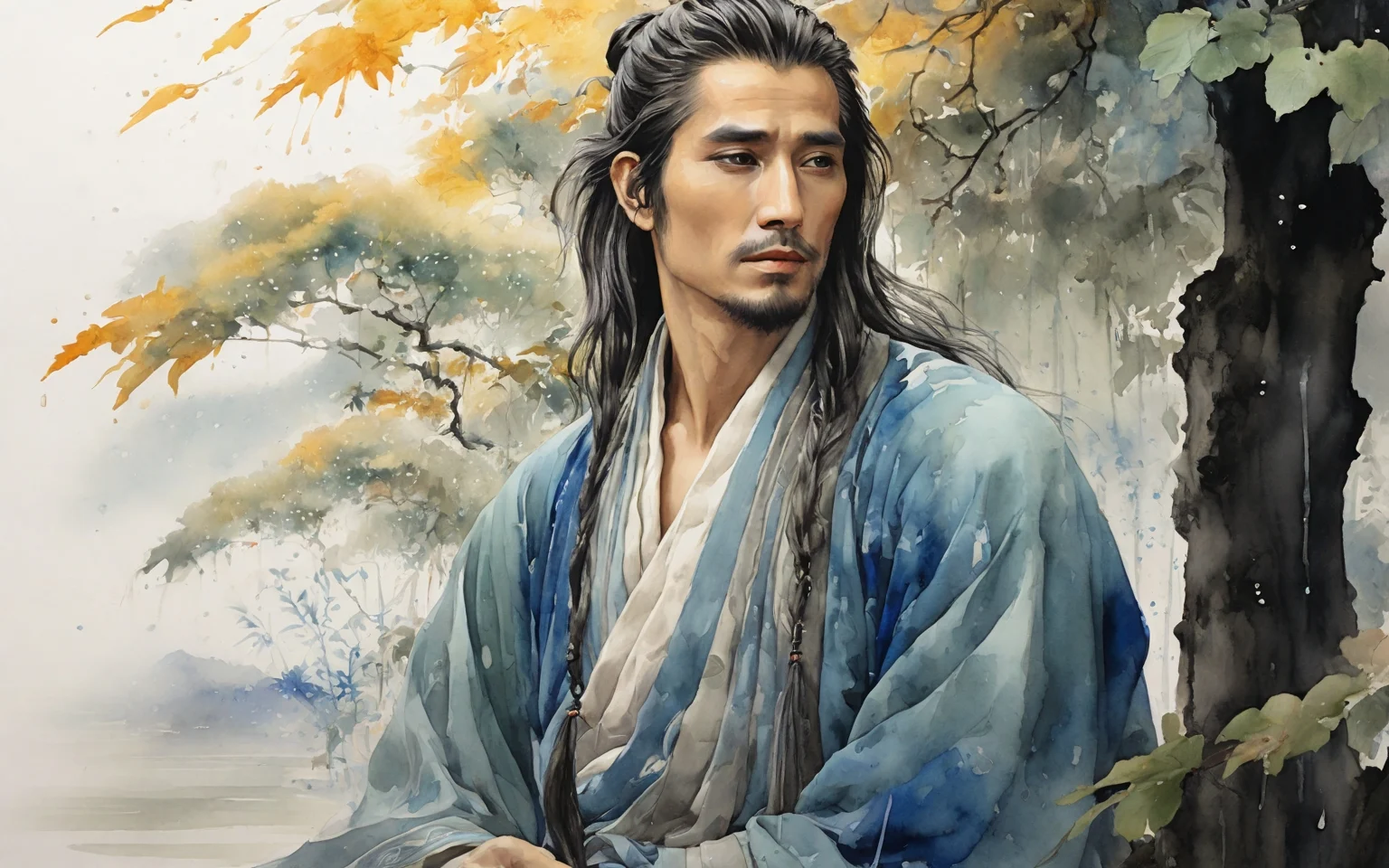
Du Fu (杜甫), 712 - 770 AD, was a great poet of the Tang Dynasty, known as the "Sage of Poetry". Born into a declining bureaucratic family, Du Fu had a rough life, and his turbulent and dislocated life made him keenly aware of the plight of the masses. Therefore, his poems were always closely related to the current affairs, reflecting the social life of that era in a more comprehensive way, with profound thoughts and a broad realm. In his poetic art, he was able to combine many styles, forming a unique style of "profound and thick", and becoming a great realist poet in the history of China.