


The rich of hunger never die;
The poor of their misfortune sigh.
Minister Wei, would you please hear
What I would confide to your ear?
While young, I was a candidate
In Civil Exams of the State.
Having ten thousand volumes read,
I wrote as if by God I was led.
In prose I was second to none;
In verse I vied with the best one.
Ministers would like to know me,
And poets my neighbors would be.
I thought, outstanding as was I,
A job was not hard to come by.
I would help the crown in my strife
To purify the ways of life.
I could not do what I desired;
Singing, I would not be retired.
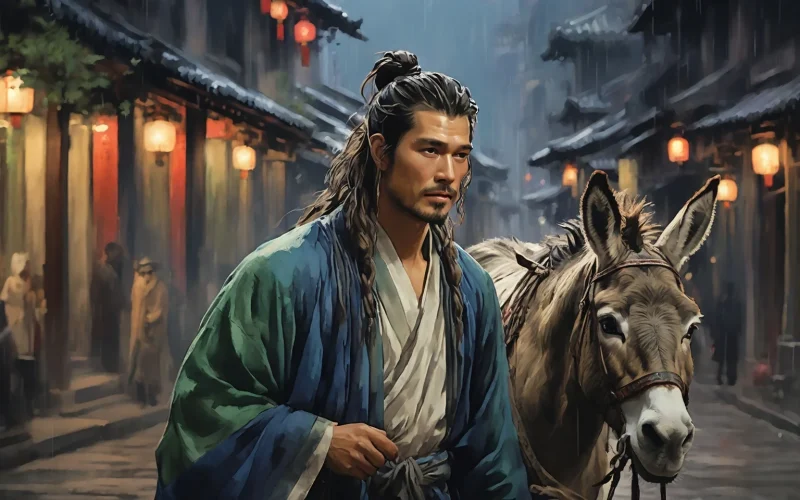
Riding a donkey thirteen years,
I suffered the capital's sneers.
I knock at the mansions by day;
At dusk I hear dusty steeds neigh.
I eat leftovers of a meal;
In vain I suffer a great deal.
The Crown showed his favor and love;
I saw a chance to rise above.
In the sky the roe folds its wings;
On the sea swim no scaly kings.
I thank you for your kindness tuee,
Knowing you're kind in what you do.
Whenever you meet a good friend,
It's my new verse you recommend.
Though glad of your prosperity,
How could I bear my poverty?
I'm not unhappy in my place;
But it's a dilemma I face.
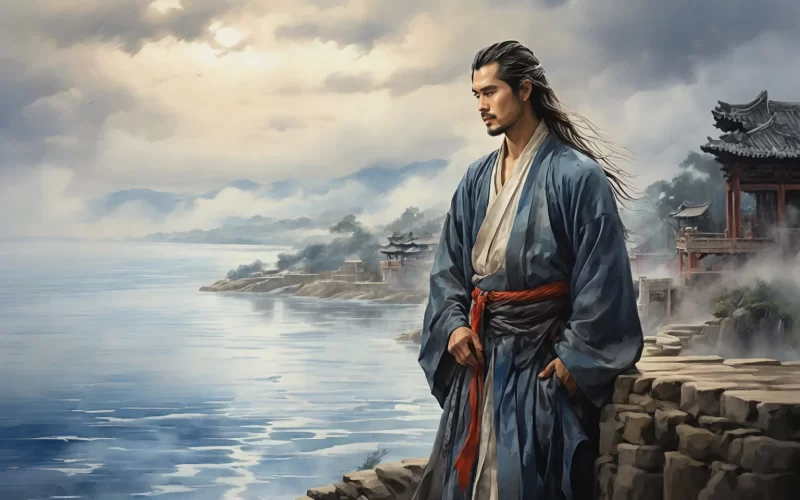
Should I go seaward for my rest,
Or to the capital in the west?
I love the Southern Mountains high
And the clear River flowing by.
I can't forget what I owe you,
Nor what to ministers is due.
Like a white gull on the vast sea,
I'd fly for miles and miles, carefree.
Original Poem
「奉赠韦左丞丈二十二韵」
杜甫
纨绔不饿死,儒冠多误身。
丈人试静听,贱子请具陈。
甫昔少年日,早充观国宾。
读书破万卷,下笔如有神。
赋料扬雄敌,诗看子建亲。
李邕求识面,王翰愿卜邻。
自谓颇挺出,立登要路津。
致君尧舜上,再使风俗淳。
此意竟萧条,行歌非隐沦。
骑驴十三载,旅食京华春。
朝扣富儿门,暮随肥马尘。
残杯与冷炙,到处潜悲辛。
主上顷见征,欻然欲求伸。
青冥却垂翅,蹭蹬无纵鳞。
甚愧丈人厚,甚知丈人真。
每于百僚上,猥诵佳句新。
窃效贡公喜,难甘原宪贫。
焉能心怏怏,只是走踆踆。
今欲东入海,即将西去秦。
尚怜终南山,回首清渭滨。
常拟报一饭,况怀辞大臣。
白鸥没浩荡,万里谁能驯?
Interpretation
This work is a representative example of Du Fu's long-form five-character ancient-style poetry, composed in 748 CE during the Tianbao era of Emperor Xuanzong. By this time, Du Fu had endured nearly a decade of hardship in Chang'an. His ideals were utterly shattered following the farcical imperial examination of 746, orchestrated by Li Linfu, which infamously declared that "no worthy talents remained outside the court." His life had sunk into dire poverty, surviving on "leftover dregs and cold scraps of food." Wei Ji, then serving as Vice Minister of the Department of State Affairs, was one of the few high-ranking officials who recognized Du Fu's talent. In this parting poem presented to Wei Ji, Du Fu employs a tone of impassioned sorrow to provide a comprehensive account of his journey from youthful ambition to middle-aged destitution. The poem delivers his most powerful indictment of a topsy-turvy world where "sons of nobles never starve, while scholars' caps often ruin a man's life," making it a crucial text for understanding Du Fu's state of mind and circumstances during his years in Chang'an.
Part 1: "纨绔不饿死,儒冠多误身。丈人试静听,贱子请具陈。"
Fúkù bù è sǐ, rú guān duō wù shēn. Zhàngrén shì jìng tīng, jiànzi qǐng jù chén.
Sons of nobles never starve, while scholars' caps often ruin a man. / My noble lord, I beg you, lend a patient ear to your humble servant's tale, as best I can.
The poem opens with a startling, manifesto-like contrast. The line "Sons of nobles never starve, while scholars' caps often ruin a man" pierces directly through the facade of High Tang prosperity to expose a society where worth and reward are inverted. This summation of his own plight establishes the poem's foundational tone of indignation and profound grief. The following line, "My noble lord, I beg you, lend a patient ear…" shifts to a tone of respectful entreaty. The formal address "my noble lord" and the self-deprecating "your humble servant" introduce, with solemn deference, the ensuing twenty-couplet account—a narrative brimming with unspoken tears, held within a framework of ceremonial courtesy that itself contains immense emotional tension.
Part 2: "甫昔少年日,早充观国宾读书破万卷,下笔如有神。赋料扬雄敌,诗看子建亲。李邕求识面,王翰愿卜邻。自谓颇挺出,立登要路津。致君尧舜上,再使风俗淳。"
Fǔ xī shàonián rì, zǎo chōng guān guó bīn dúshū pò wàn juǎn, xiàbǐ rú yǒu shén. Fù liào Yáng Xióng dí, shī kàn Zǐjiàn qīn. Lǐ Yōng qiú shí miàn, Wáng Hàn yuàn bǔ lín. Zì wèi pō tǐng chū, lì dēng yào lù jīn. Zhì jūn Yáo Shùn shàng, zài shǐ fēngsú chún.
In my youth, in days now past, I early joined the state's guest-rites. / Ten thousand volumes read, my brush moved as if touched by divine lights. / In rhapsody, a match for Yang Xiong I deemed my art; / In poetry, akin to Cao Zhi's, I thought, was my part. / Li Yong sought my acquaintance, Wang Han wished for me as a neighbor near. / I judged myself outstanding, bound for the strategic pass without delay, / To raise my sovereign above the sage-kings Yao and Shun, / And restore once more a pure and honest way—this was my aim, my sun.
This section recalls past glory with expansive, confident strokes, painting the portrait of a brilliantly talented and soaringly ambitious young Du Fu. The lines "Ten thousand volumes read, my brush moved as if touched by divine lights" have become immortal, his own definitive summary of profound erudition and genius. Citing Yang Xiong and Cao Zhi as literary benchmarks and mentioning the recognition of figures like Li Yong and Wang Han serve to validate this self-assessment. The declaration "To raise my sovereign above the sage-kings Yao and Shun, / And restore once more a pure and honest way" is the core expression of his lifelong political ideal, stated with resolute force and grand vision. This creates a devastating contrast with the plight and disillusionment described later.
Part 3: "此意竟萧条,行歌非隐沦。骑驴十三载,旅食京华春。朝扣富儿门,暮随肥马尘。残杯与冷炙,到处潜悲辛。"
Cǐ yì jìng xiāotiáo, xíng gē fēi yǐn lún. Qí lǘ shísān zài, lǚ shí jīnghuá chūn. Zhāo kòu fù ér mén, mù suí féi mǎ chén. Cán bēi yǔ lěng zhì, dàochù qián bēixīn.
This intent ended in desolation, stark and bare; / Singing as I walked, yet no recluse's true care. / Thirteen years astride a donkey, a guest in Chang'an's vernal glow; / At dawn, knocking on rich men's gates; at dusk, in the dust of sleek horses I'd go. / Leftover wine and cold, discarded scraps of food— / Everywhere, hidden grief and bitterness intrude.
Here, the tone plummets. The line "This intent ended in desolation, stark and bare" forms a pivotal turn, leading from recollection into the bitter depiction of present reality. "Thirteen years astride a donkey" marks the long duration of his stagnant hardship in the capital. The four lines beginning with "At dawn, knocking on rich men's gates…" use intensely condensed imagery to convey the humiliation of seeking patronage from the powerful, the hardship of a vagrant life in the splendid capital, and the depths of both material and spiritual poverty. Each word seems weighted with blood and tears, forming the classic portrayal of the thwarted fate of the impoverished scholar in ancient times.
Part 4: "主上顷见征,欻然欲求伸。青冥却垂翅,蹭蹬无纵鳞。甚愧丈人厚,甚知丈人真。每于百僚上,猥诵佳句新。窃效贡公喜,难甘原宪贫。"
Zhǔshàng qǐng jiàn zhēng, chuā rán yù qiú shēn. Qīngmíng què chuí chì, cèngdèng wú zòng lín. Shèn kuì zhàngrén hòu, shèn zhī zhàngrén zhēn. Měi yú bǎi liáo shàng, wěi sòng jiā jù xīn. Qiè xiào Gòng gōng xǐ, nán gān Yuán Xiàn pín.
Our sovereign lately issued a summons for the wise; / Sudden hope flared that I might yet rise. / But in the azure heights, my wings hung slack, brought low; / Floundering in shallows, no mighty fish's freedom to know. / I am shamed by your deep kindness, know well your heart is true. / Often before the host of officials, you deigned to chant my verses new. / In secret, I felt the joy of Gong Sheng for his friend's success; / Yet Yuan Xian's enduring poverty I cannot bless.
This section describes the blow of the 747 imperial examination, orchestrated by Li Linfu to reject all candidates. The metaphors "But in the azure heights, my wings hung slack" and "Floundering in shallows, no mighty fish's freedom" vividly convey the crushing sense of defeat after a sudden surge of hope. The passage then turns to express gratitude for Wei Ji's recognition ("you deigned to chant my verses new") and reveals an inner conflict: while secretly heartened by the support of a true friend (like Gong Sheng's joy for his friend), he finds the prospect of permanent poverty and obscurity (like Yuan Xian's) unbearable.
Part 5: "焉能心怏怏,只是走踆踆。今欲东入海,即将西去秦。尚怜终南山,回首清渭滨。常拟报一饭,况怀辞大臣。白鸥没浩荡,万里谁能驯?"
Yān néng xīn yàngyàng, zhǐshì zǒu qūnqūn. Jīn yù dōng rù hǎi, jí jiāng xī qù Qín. Shàng lián Zhōngnán Shān, huíshǒu qīng Wèi bīn. Cháng nǐ bào yī fàn, kuàng huái cí dàchén. Bái ōu mò hàodàng, wàn lǐ shuí néng xún?
How can the heart dwell in endless gloom? I can but pace, prepared to leave this place. / Now I wish eastward to go, to lose myself in the sea; / Soon I shall westward depart, from the land of Qin be free. / Yet still I love the Zhongnan peaks, turn my head toward the clear Wei's shore. / I've often thought to repay the debt of a single meal; how much more, parting from a lord like you! / A white gull vanishes into the vast and boundless blue— / Across ten thousand miles, who could ever hope to tame it? Who?
The conclusion is emotionally complex and tumultuous. His resolve to leave is firm ("eastward to the sea," "westward from Qin"), yet he is filled with lingering attachment for Chang'an—for the Zhongnan Mountains and the Wei River ("still I love," "turn my head"). He is also mindful of the debt incurred by Wei Ji's recognition and patronage. The poem culminates in the majestic, symbolic image of "A white gull vanishes into the vast and boundless blue— / Across ten thousand miles, who could ever hope to tame it?" The white gull represents his own unsullied, unyielding spirit yearning for ultimate freedom. The rhetorical question "who could ever hope to tame it?" is a final declaration of personal integrity and spiritual independence, erupting from the depths of despair—revealing an unbroken pride within profound sorrow, and an indomitable character within hopelessness.
Holistic Appreciation
This poem is a concentrated embodiment of Du Fu's use of poetry as personal memoir, as memorial remonstrance, and as a bardic battle cry. Using the act of "stating his case" as its central thread, the poem's emotions surge and plummet dramatically: from the opening indignation at the world, to the mid-section's unbridled confidence, then to the humiliation and bitterness of hardship, followed by gratitude, inner conflict, hesitation, and finally a resolve that carries a tone of proud defiance. The structure unfolds in layered progression, built upon stark contrasts (past glory versus present decline, grand ideals versus sordid reality), tightly weaving personal destiny together with the failings of the age. It possesses a strong epic quality and potent critical force.
The image of Du Fu crafted within the poem is remarkably full and three-dimensional. He is both the brilliantly talented Confucian, heart set on the world's welfare, and the destitute scholar who has tasted every bitterness and seen his dignity trampled. He embodies both the persistent idealism of "raising his sovereign above the sage-kings" and the untamed, soaring spirit of the "white gull in the vast blue." This very complexity forms the profound foundation in character for his poetic style of "deep emotion expressed through measured, forceful rhythm."
Artistic Merits
- Exposition with Grand Momentum: The entire poem employs the expansive, narrative technique of the fu form, detailing everything from his talents and learning to his ideals, from his experiences to his circumstances. It unfolds with a sweeping, declarative force, like a great river in full flow, fully showcasing the narrative and lyrical capacity of the long-form ancient-style verse.
- Contrast for Jarring Effect: The poem is threaded with multiple layers of contrast—social injustice (nobles' sons versus scholars), past versus present circumstances (youthful ambition versus middle-aged hardship), ideal versus reality (serving a sage-king versus surviving on leftovers). These contrasts immensely amplify the poem's emotional impact and the depth of its social critique.
- Apt Metaphor and Vivid Imagery: Metaphors like "wings hung slack in azure heights" and "floundering in shallows" for career setbacks, and the symbolic image of the "white gull vanishing into the vast blue" for spiritual longing, are both strikingly fitting and rich in associative meaning. They greatly enhance the poem's visual and emotional power.
- Language Both Classical and Plain: The first part of the poem alludes to historical figures and employs典故, displaying his classical erudition. Lines like "at dawn, knocking on rich men's gates" in the latter part use pure, unadorned description, simple as speech, yet they exhaustively convey his bitterness. This demonstrates Du Fu's mastery in harmonizing different linguistic registers.
Insights
This is not merely a poet's tear-stained autobiography; it is a portrait of the intellectual's fate in an age of apparent prosperity. It reveals how, within an environment of rigid institutions and corrupt authority, any individual's talent and ideals could be ruthlessly crushed. Du Fu's lament that the "scholar's cap often ruins a man" is a profound exposure of the systemic flaws in the feudal era's mechanism for selecting talent.
Yet, the poem's most enduring power lies in the spiritual height that grows from within its despair. From the worldly commitment of "raising his sovereign above the sage-kings" to the spiritual transcendence of the "white gull" that "who could ever hope to tame?", Du Fu completes a journey of spiritual metamorphosis. It teaches us that true greatness may lie not in the realization of one's aspirations, but in retaining—after those aspirations are utterly shattered and one's dignity has been trampled—that faith in justice, that concern for the common people, and that untamable freedom and pride of the soul. It is this power of character, erupting from the depths of adversity, that forms the very core of Du Fu's poetic spirit, allowing it to resonate powerfully across a millennium.
Poem translator
Xu Yuanchong (许渊冲)
About the poet
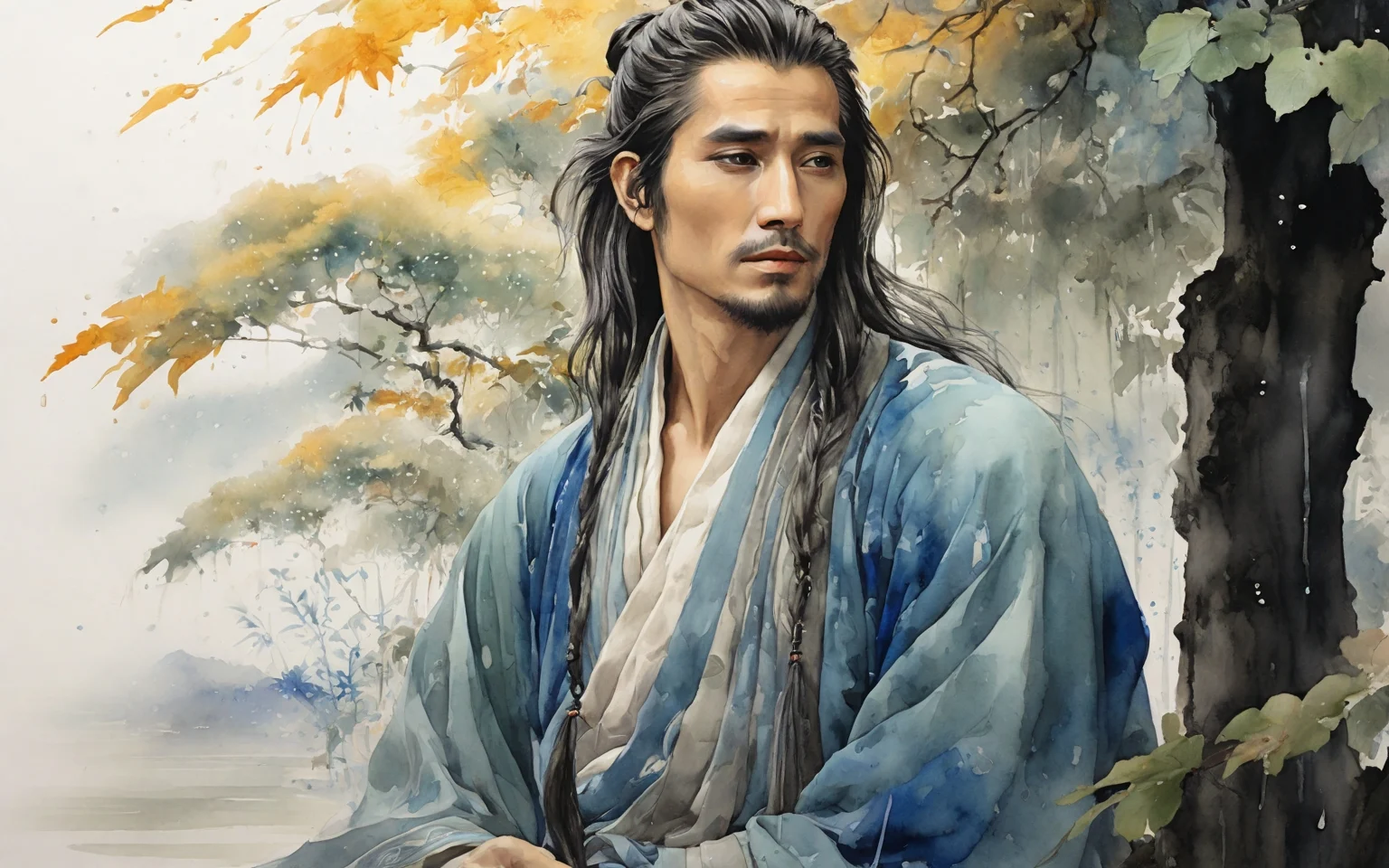
Du Fu (杜甫), 712 - 770 AD, was a great poet of the Tang Dynasty, known as the "Sage of Poetry". Born into a declining bureaucratic family, Du Fu had a rough life, and his turbulent and dislocated life made him keenly aware of the plight of the masses. Therefore, his poems were always closely related to the current affairs, reflecting the social life of that era in a more comprehensive way, with profound thoughts and a broad realm. In his poetic art, he was able to combine many styles, forming a unique style of "profound and thick", and becoming a great realist poet in the history of China.