


Round a turn of the Qin Fortress winds the Wei River,
And Yellow Mountain foot-hills enclose the Court of China;
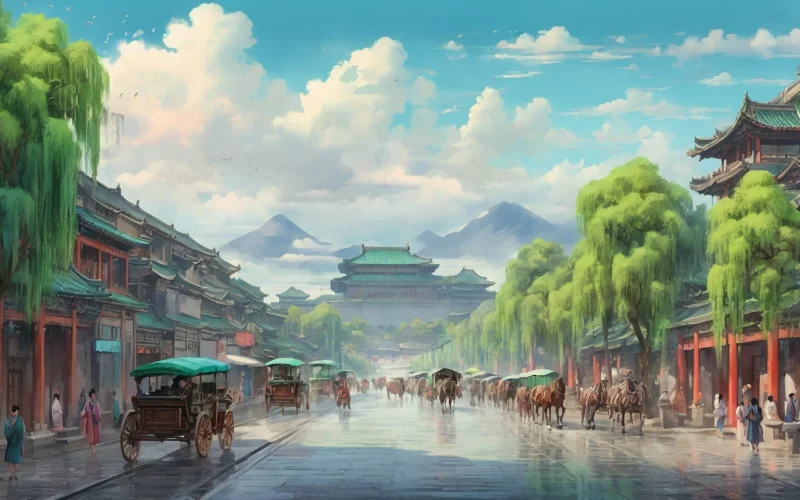
Past the South Gate willows comes the Car of Many Bells
On the upper Palace-Garden Road-a solid length of blossom;
A Forbidden City roof holds two phoenixes in cloud;
The foliage of spring shelters multitudes from rain;
And now, when the heavens are propitious for action,
Here is our Emperor ready-no wasteful wanderer.
Original Poem
「奉和圣制从蓬莱向兴庆阁道中留春雨中春望之作应制」
王维
渭水自萦秦塞曲,黄山旧绕汉宫斜。
銮舆迥出千门柳,阁道回看上苑花。
云里帝城双凤阙,雨中春树万人家。
为乘阳气行时令,不是宸游玩物华。
Interpretation
This poem was composed during the later Kaiyuan era or early Tianbao era of Emperor Xuanzong’s reign. It was a time of High Tang prosperity, and the emperor often toured the palace parks of Chang’an in spring. This is a classic example of a "yingzhi" (应制) poem, written to imperial command, as Wang Wei, then holding a central government post, accompanied the emperor. Confronted with the prescribed theme of praising the sovereign and a specific viewpoint (looking from the elevated covered way), the poet, with his transcendent ability to compose space and his profound historical-cultural consciousness, elevated a royal spring excursion into a vast, multi-layered panorama of imperial splendor. Subtle admonition is hidden within its refined detail, representing the pinnacle of this poetic genre.
First Couplet: 渭水自萦秦塞曲,黄山旧绕汉宫斜。
Wèi shuǐ zì yíng Qín sāi qū, Huáng shān jiù rào Hàn gōng xiá.
The River Wei, of its own will, winds round the Qin frontier’s bends; / Mount Huang, as of old, leans, encircling the Han palaces’ ends.
The poem opens with a grand geographical and historical vision, establishing a majestic, profound tone. The poet looks not at the immediate scene but toward the strategic mountains and rivers beyond Chang’an. "The River Wei" and "Mount Huang" are the capital’s natural geographical markers; "the Qin frontier" and "the Han palaces" overlay a deep historical dimension. The phrases "of its own will" and "as of old" lend the landscape a timeless, eternal quality, as if these features have forever guarded the dynastic heartland, instantly placing the present spring view within a long historical sequence.
Second Couplet: 銮舆迥出千门柳,阁道回看上苑花。
Luán yú jiǒng chū qiān mén liǔ, gé dào huí kàn shàng yuàn huā.
The imperial coach emerges, distant, from willows screening countless gates; / From the skyway, turning back, one sees the flowers of the Royal Park’s estates.
The gaze shifts from distant to near, from static to dynamic, focusing on the subject of the view—the emperor’s procession and its path. "Emerges, distant" captures the awe-inspiring motion of the retinue winding forth from the palace depths; "willows screening countless gates" denotes spring while using "countless gates" to evoke the palace’s fathomless expanse. "Turning back" is both an action and a shift in perspective—looking back from the moving procession, the spring blossoms of the "Royal Park" become a brilliant backdrop. This couplet skillfully merges the emperor’s progress ("emerges") with the act of viewing spring ("sees").
Third Couplet: 云里帝城双凤阙,雨中春树万人家。
Yún lǐ dì chéng shuāng fèng què, yǔ zhōng chūn shù wàn rén jiā.
Through cloud, the Dual Phoenix Towers of the Imperial City loom; / Through rain, spring trees enveloping ten thousand households bloom.
This couplet is the eye of the poem, forming a vertically structured panorama of the flourishing age. "Through cloud, the Dual Phoenix Towers… loom" is an upward gaze, depicting the lofty, mysterious imperial towers as if in heaven; "Through rain, spring trees enveloping ten thousand households bloom" is a downward glance, showing the thriving, peaceful common life spread across the earth. Above and below, high and low, palace and people harmoniously coexist within the unified atmosphere of "through cloud" and "through rain." The perfect parallelism, majestic imagery, and expansive vision make this a quintessential High Tang poetic tableau.
Fourth Couplet: 为乘阳气行时令,不是宸游玩物华。
Wéi chéng yáng qì xíng shí lìng, bù shì chén yóu wán wù huá.
To ride the season’s vital force, to promulgate the timely rite— / Not for imperial excursion, to delight in lovely sight.
The conclusion clarifies the theme, returning to the duty of an "imperial command" poem: to praise the sovereign. Yet Wang Wei’s expression is masterful. He justifies the spring tour with the Confucian political ideal of "to ride the season’s vital force, to promulgate the timely rite" (aligning with spring’s energy to conduct agricultural rituals), thereby elevating a recreational "imperial excursion" to the political height of "harmonizing with heaven and the seasons." The line "Not for imperial excursion, to delight in lovely sight" superficially negates mere pleasure-seeking but is, on a higher level, affirmation—affirming the political correctness and exemplary nature of the emperor’s act. This couplet perfectly fulfills the genre’s requirements while subtly reflecting the poet’s Confucian stance of "praising without forgetting to admonish."
Holistic Appreciation
This poem is a model of Wang Wei’s application of painting techniques—"scattered perspective" and "deep-recess composition"—to poetry. Using the spring view from the covered way as the visual anchor, it constructs three levels of magnificent scenery: the first couplet provides a distant backdrop of history and geography (Wei River, Mount Huang, Qin passes, Han palaces); the second narrates the mid-ground royal procession (coach emerging from willows, looking back at the park); the third presents a macro-view of the capital panorama (towers in cloud, households amid spring rain); the fourth elevates the theme with a clarifying touch (riding the vital force, not mere sightseeing). The four couplets unfold like a slowly opening handscroll, where time and space intertwine, the tangible and intangible coalesce. While praising imperial prosperity and majesty, it also implies the Confucian ideal that a ruler should govern diligently, love his subjects, and accord with the heavenly order. The tone is dignified and splendid, the meaning profound and enduring.
Artistic Merits
- Multi-Dimensional Spatial Composition and Order: The handling of poetic space is masterful, moving from the outer mountains and rivers to the inner palace parks, from the ground procession to the aerial walkway, from cloud-wreathed towers to rain-shrouded households. The perspective shifts between high and low, the pictorial layers are rich, yet all are unified by the thread of the "spring view," achieving a clear, orderly composition that reflects a strong painterly sensibility.
- Layering of Historical and Present Time: Juxtaposing "Qin passes," "Han palaces" with "Imperial City," "ten thousand households" makes Chang’an’s present glory bear the weight of deep history, enhancing the poem’s temporal-spatial depth and cultural gravitas.
- Exquisite Parallelism and Majestic Vision: The parallelism of the two middle couplets is exceptionally fine, particularly "Through cloud, the Dual Phoenix Towers… loom; / Through rain, spring trees enveloping ten thousand households bloom." Not only is the verbal symmetry perfect, but the imagery (cloud/rain, Imperial City/spring trees, Phoenix Towers/households) creates multiple layers of contrast and complementarity. Within precision, there is flow; within detail, there is grandeur—a full display of the High Tang poetic spirit.
- Elevation and Deepening of the "Imperial Command" Theme: The poet cleverly combines the simple praise of a spring excursion with the Confucian political philosophy of "riding the season’s vital force," granting the poem a dimension of statecraft and a dignified, solemn style beyond mere flattery. This reflects the advanced scholar-official’s learning and judgment.
Insights
This work demonstrates Wang Wei’s ability, as a "master writer for the court," to handle prescribed composition and elevate it to an artistic exemplar. It reveals that even within the constraints of a set theme and form, a true artist can create works of grand structure and rich meaning through profound cultural cultivation, superb artistic skill, and deep insight.
In a contemporary context, this poem shows us that depictions of a prosperous age ("spring trees enveloping ten thousand households") can attain an enduring appeal that transcends their moment if placed within the long river of history ("The River Wei… winds round the Qin frontier’s bends") and framed by lofty ideals ("To ride the season’s vital force"). It reminds us that in any creative form, the pursuit of scope, depth, and transcendence remains key to its artistic value. Wang Wei’s poem, through its supreme achievement of "thought harmonizing with scene," has transformed an imperial spring outing from a thousand years ago into an eternal cultural memory.
Poem translator
Xu Yuanchong (许渊冲)
About the poet
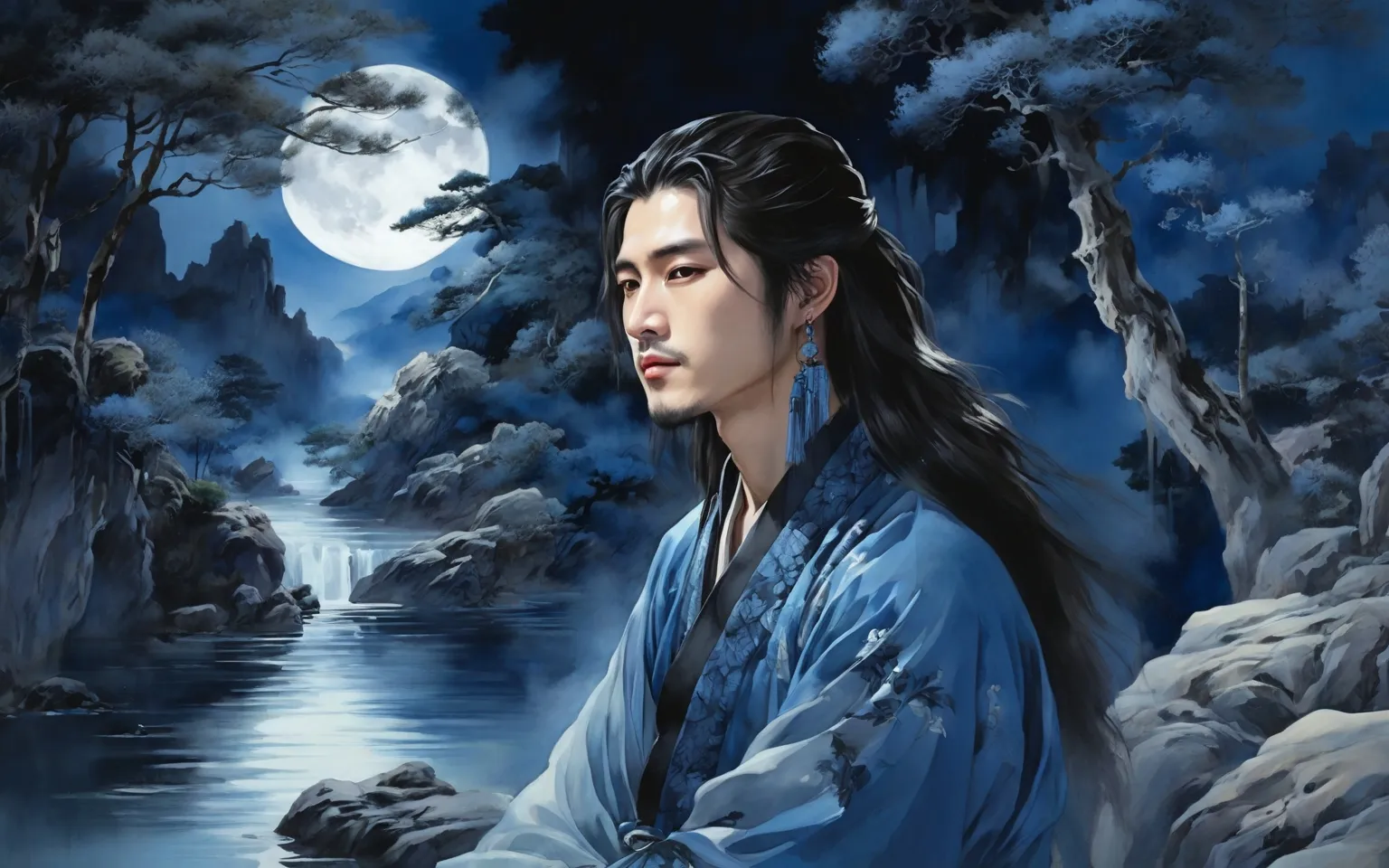
Wang Wei (王维), 701 - 761 A.D., was a native of Yuncheng, Shanxi Province. Wang Wei was a poet of landscape and idylls. His poems of landscape and idylls, with far-reaching images and mysterious meanings, were widely loved by readers in later generations, but Wang Wei never really became a man of landscape and idylls.