Flowers, as high as my window, hurt the heart of a wanderer
For I see, from this high vantage, sadness everywhere.

The Silken River, bright with spring, floats between earth and heaven
Like a line of cloud by the Jade Peak, between ancient days and now.

...Though the State is established for a while as firm as the North Star
And bandits dare not venture from the western hills,
Yet sorry in the twilight for the woes of a longvanished Emperor,
I am singing the song his Premier sang when still unestranged from the mountain.
Original Poem
「登楼」
杜甫
花近高楼伤客心,万方多难此登临。
锦江春色来天地,玉垒浮云变古今。
北极朝庭终不改,西山寇盗莫相侵。
可怜后主还祠庙,日暮聊为梁父吟。
Interpretation
This poem was composed in the spring of 764 AD, shortly after Du Fu's return to his thatched cottage in Chengdu. Prior to this, Tibetan forces had briefly captured Chang'an and continued to harass the western regions, leaving the state in precarious turmoil. In the first month of that year, Du Fu's close friend Yan Wu was reappointed as Military Governor of Jiannan, bringing a measure of stability to the Shu region. Amidst the spring scenery, the poet ascended a tower to gaze into the distance. Confronted with the "multitude of woes on every side" and his own brief respite at the cottage, complex feelings of concern for the nation, sorrow for the times, and personal lament surged within him, culminating in this renowned seven-character regulated verse, majestic in scope and profound in sentiment.
First Couplet: 花近高楼伤客心,万方多难此登临。
Huā jìn gāo lóu shāng kè xīn, wàn fāng duō nàn cǐ dēng lín.
Blossoms crowd the tall tower, grieving the traveler’s heart; / In a time of woes on every side, I climb to this place.
The opening line strikes with sudden, conflicted intensity. "Blossoms crowd the tall tower" presents a scene of natural joy, yet it directly "griev[es] the traveler’s heart," using contrast to highlight the depth of the poet's inner worry. The phrase "woes on every side" strikes like a hammer, naming the fundamental cause of his grief and linking personal sorrow directly to the suffering of the age. "I climb to this place" imbues this ascent with specific historical gravity—it is not for leisure but for troubled reflection.
Second Couplet: 锦江春色来天地,玉垒浮云变古今。
Jǐn jiāng chūn sè lái tiān dì, yù lěi fú yún biàn gǔ jīn.
Spring hues of Brocade River flow from heaven and earth; / Over Mount Jade Fort, floating clouds shift through past and now.
This couplet depicts the vista with a grand brush, vast in atmosphere and deep in implication. "Spring hues of Brocade River flow from heaven and earth" evokes infinite space, with spring's vitality filling the cosmos. "Over Mount Jade Fort, floating clouds shift through past and now" speaks of the flow of time; the shifting clouds metaphorically suggest the rise and fall of dynasties and the impermanence of worldly affairs. "Flow" and "shift," one dynamic and one illusory, elevate the natural scene into contemplation of history and the universe. The beauty of spring ironically underscores how state affairs are as changeable as clouds; the vastness of heaven and earth mirrors the boundlessness of the poet's concern.
Third Couplet: 北极朝庭终不改,西山寇盗莫相侵。
Běi jí cháo tíng zhōng bù gǎi, xī shān kòu dào mò xiāng qīn.
The court, like the Polar Star, shall never change its reign; / Let bandits from the western hills dare not invade again.
The focus shifts from scene to discourse, expressing the poet's mind with forceful conviction. "The court, like the Polar Star" symbolizes the Tang dynasty's sovereignty; "shall never change" asserts an unshakeable faith in the nation's endurance despite adversity, serving as the poem's sole emotional anchor. "Let bandits… dare not invade again" is a stern warning to the invaders, brimming with dignified resolve. One line affirms, the other rebukes; one praises, the other condemns—together they embody the poet's deep patriotism and strong will to uphold the nation's unity.
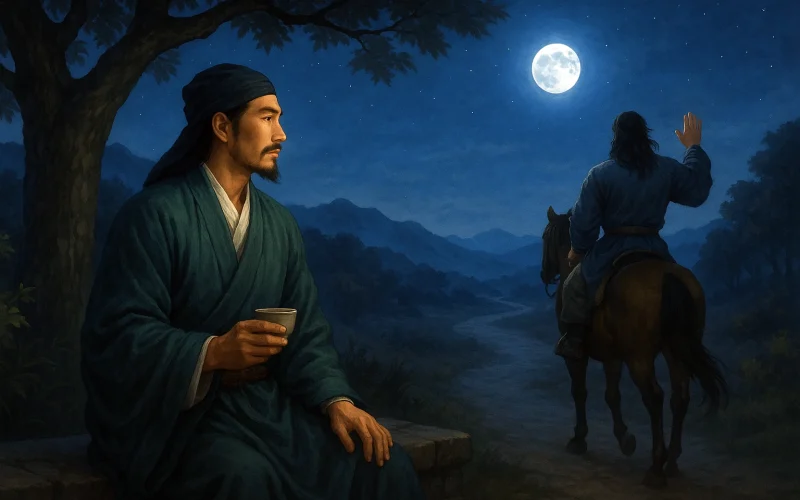
Fourth Couplet: 可怜后主还祠庙,日暮聊为梁父吟。
Kě lián hòu zhǔ huán cí miào, rì mù liáo wéi Liáng Fǔ yín.
Pitiful, that the Later Lord still has his shrine and rite; / At day's decline, I murmur the "Liangfu" song in twilight.
The closing couplet uses history to convey complex, profound feeling. "The Later Lord still has his shrine" alludes to Liu Shan, the feckless last ruler of Shu-Han, subtly implying criticism of Emperor Daizong's court—a veiled yet painful lament over imperial incompetence and political decline, mixed with a grim relief that the dynasty, however weakened, still receives sacrifice. "At day's decline, I murmur the 'Liangfu' song" ingeniously invites self-comparison: "day's decline" refers both to the actual evening and symbolizes the poet's old age and the dynasty's twilight; "the 'Liangfu' song" was chanted by Zhuge Liang before his rise, expressing lofty aspirations. The poet thus conveys his own unfulfilled desire to save the world, reduced to murmuring alone in the gathering dark—a sigh of helplessness and solitude. Historical allegory and personal lament merge here, leaving a desolate, lingering resonance.
Holistic Appreciation
This poem is a representative work of Du Fu's seven-character regulated verse, characterized by its majestic solemnity and vast atmosphere. Using "ascending" as its thread, the poem's emotion surges and recedes: the first couplet uses joyful scenery to express sorrow, setting the worried tone; the second expands into vast time and space, embedding history within the scene; the third shifts to resolute discourse, revealing concern for the nation; the fourth borrows from the past to reflect on the present, ending in lament and self-pity. The four couplets seamlessly integrate description, lyricism, discourse, and allusion.
Its core appeal lies in "infusing vast spatial and temporal imagery with deep anxiety over current reality and historical reflection." The poem holds in tension the vastness of "spring hues… from heaven and earth" and "floating clouds shift through past and now" against the anguish of "woes on every side" and "the Later Lord… shrine." The steadfast belief in "The court… shall never change" contrasts sharply with the personal sorrow of "I murmur the 'Liangfu' song in twilight." It is precisely within these contradictions—between the immense and the insignificant, the resolute and the resigned—that Du Fu gives full expression to a poet's deep care for his country's fate in troubled times, his keen insight into historical patterns, and his own frustration at unrealized ideals, achieving remarkable artistic power and intellectual depth.
Artistic Merits
- A Defiant Opening, Stark Contrast
The line “Blossoms crowd the tall tower, grieving the traveler’s heart” overturns the conventional association of ascending a tower with joyful sightseeing. By using beauty to underscore sorrow, this striking contrast immediately foregrounds the poet’s profound inner turmoil, creating an extraordinary and memorable opening. - Majestic Imagery, Fused Time and Space
“Spring hues… flow from heaven and earth” captures immense spatial grandeur, while “floating clouds shift through past and now” evokes the vast depths of time. By linking the immediate vista to the sweep of historical change and cosmic principle, the poem is endowed with a powerful sense of historical perspective and an expansive cosmic awareness. - Discourse within Poetry, Unyielding Resolve
The third couplet directly articulates a political stance. Its tone is resolute and its sentiment morally firm, masterfully blending the elegant, structured form of regulated verse with the robust force of discursive commentary. This embodies Du Fu’s distinctive practice of “treating poetry as history” and “employing poetry for political expression.” - Precise Allusion, Profound Conveyance
The final couplet skillfully employs two allusions—“the Later Lord’s shrine” and “the ‘Liangfu’ song”—seamlessly weaving together critique, lament, and self-comparison. With subtlety yet profound depth, it expresses complex political anxieties and personal grief that are difficult to articulate directly, leaving the reader with endless resonance.
Insights
This work shows us how a true poet, even amidst the predicament of "woes on every side" and the personal "day's decline" of his wanderings, can still direct his gaze and broaden his heart beyond the immediate "blossoms crowd the tall tower" toward the expanse of "spring hues… from heaven and earth" and the depth of "floating clouds shift through past and now." What Du Fu reveals in this poem is not only steadfast faith in the nation's destiny but also an ability to situate present reality within the long river of history and the cosmic order, and to contemplate his own responsibility therein.
The insight this poem offers is this: Confronted with the hardships of an era and the limits of the self, the highest spiritual stance is not to wallow in sorrow, but to maintain faith in enduring values (such as national unity, justice) even after recognizing present difficulties, and to elevate personal feeling into profound reflection on history and civilization. Even if one can only, in the end, "murmur the 'Liangfu' song," the very effort to keep thinking, expressing, and caring amidst adversity constitutes a precious force against nihilism and chaos. With his ascent and gaze, Du Fu establishes for us an eternal model of how to settle the spirit and assume responsibility in a turbulent world.
Poem translator
Kiang Kanghu
About the poet
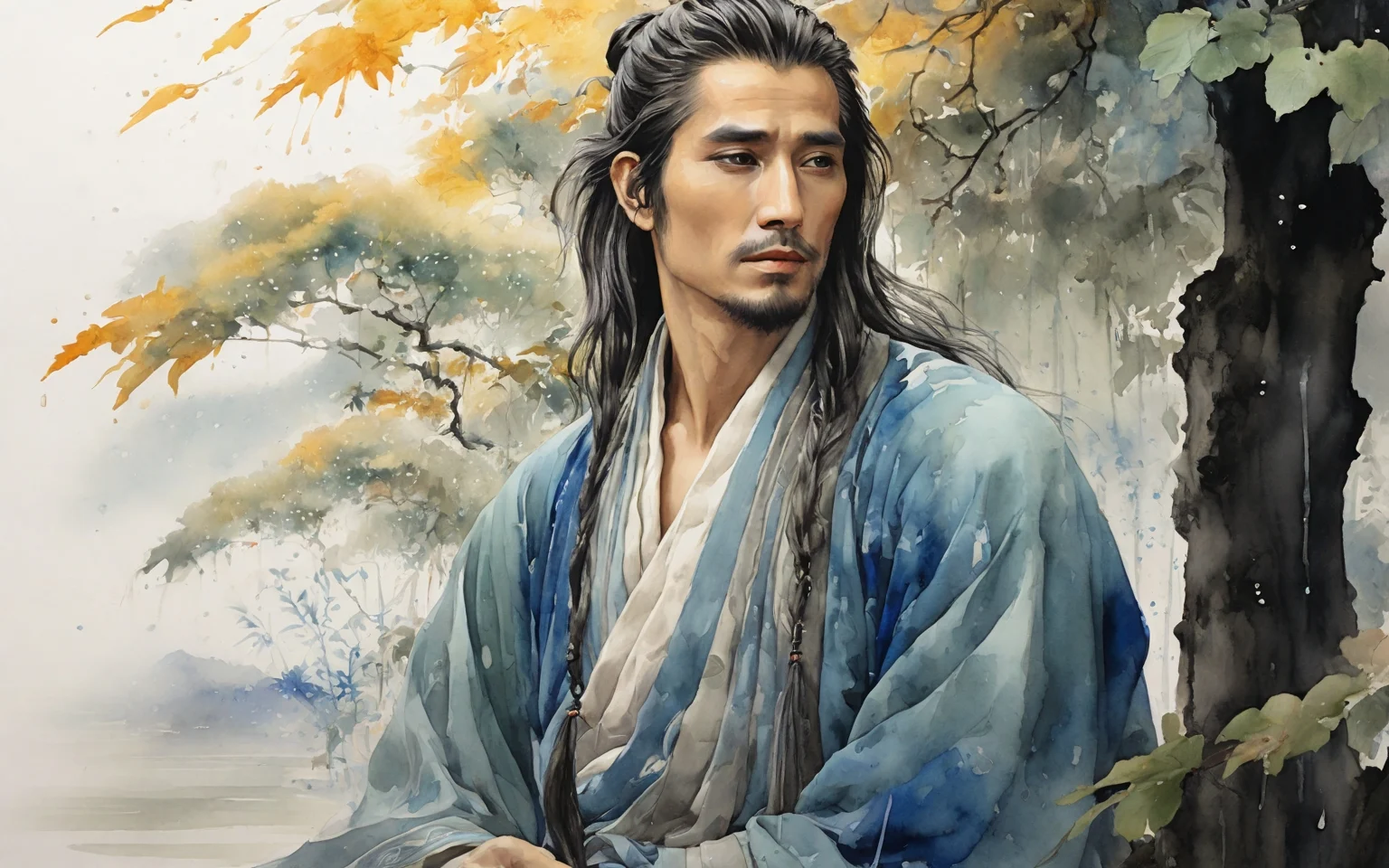
Du Fu (杜甫), 712 - 770 AD, was a great poet of the Tang Dynasty, known as the "Sage of Poetry". Born into a declining bureaucratic family, Du Fu had a rough life, and his turbulent and dislocated life made him keenly aware of the plight of the masses. Therefore, his poems were always closely related to the current affairs, reflecting the social life of that era in a more comprehensive way, with profound thoughts and a broad realm. In his poetic art, he was able to combine many styles, forming a unique style of "profound and thick", and becoming a great realist poet in the history of China.