


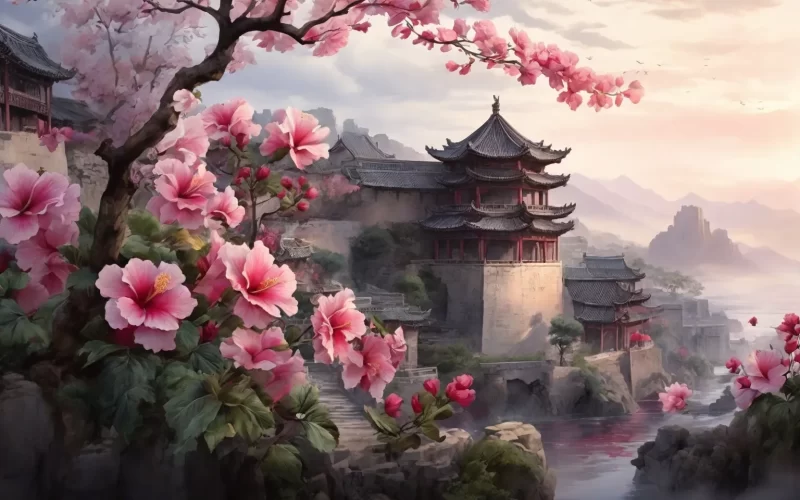
At this lofty tower where the town ends, wilderness begins;
And our longing has as far to go as the ocean or the sky…
Hibiscus-flowers by the moat heave in a sudden wind,
And vines along the wall are whipped with slanting rain.

Nothing to see for three hundred miles but a blur of woods and mountain --
And the river's nine loops, twisting in our bowels…
This is where they have sent us, this land of tattooed people --
And not even letters, to keep us in touch with home.
Original Poem
「登柳州城楼寄漳汀封连四州」
柳宗元
城上高楼接大荒,海天愁思正茫茫。
惊风乱飐芙蓉水,密雨斜侵薜荔墙。
岭树重遮千里目,江流曲似九回肠。
共来百越文身地,犹自音书滞一乡。
Interpretation
This poem was composed in the summer of 815 AD, soon after Liu Zongyuan first arrived in Liuzhou to take up his post as Prefect. This year was the most dramatic and painful year of his life. In the spring of 815, Liu Zongyuan, Liu Yuxi, and others concluded their ten-year exile and were summoned back to the capital. They were full of hope, thinking they could finally return to the political stage. Yet, barely a month later, due to the machinations of political opponents, they were exiled again—to even more remote locations: Liu Zongyuan was appointed Prefect of Liuzhou, Liu Yuxi Prefect of Lianzhou, Han Tai Prefect of Zhangzhou, Han Ye Prefect of Tingzhou, and Chen Jian Prefect of Fengzhou. The five men, all key figures of the Yongzhen Reforms, were once again bound by fate, dispatched separately to exile posts across Lingnan.
Liu Zongyuan arrived first at Liuzhou. He climbed the city tower, gazed north towards where his old friends were, and wrote this seven-character regulated verse. The "Zhang, Ting, Feng, and Lian" in the title refer to Zhangzhou (Han Tai), Tingzhou (Han Ye), Fengzhou (Chen Jian), and Lianzhou (Liu Yuxi). Scattered across the "tattooed lands of the Hundred Yue," communication was difficult; they could only send their thoughts through poetry. This poem is written for his old friends, and also for himself; it is a lament for fate, and a steadfast declaration of integrity.
First Couplet: "城上高楼接大荒,海天愁思正茫茫。"
Chéng shàng gāo lóu jiē dà huāng, hǎi tiān chóu sī zhèng máng máng.
On the tower, I look out toward the wild lands;
My sorrows stretch as far as the sea and the sky.
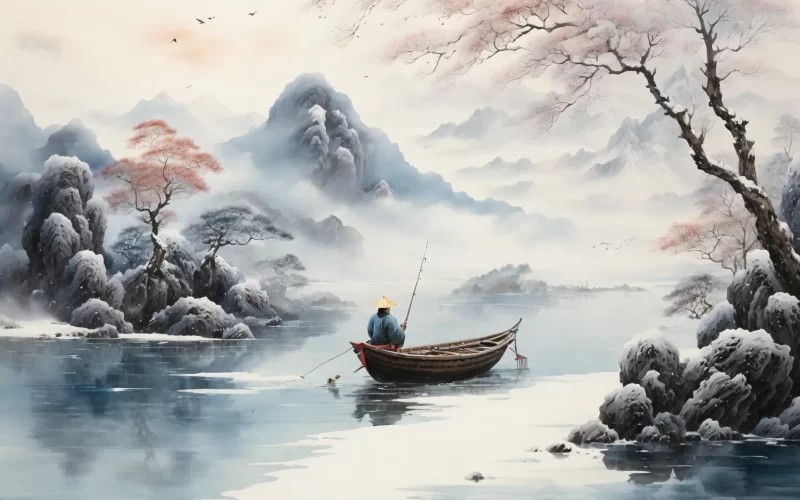
The opening starts with ascending to a height to gaze into the distance, grand in conception and deep in emotion. "On the tower"—the poet climbs the tower, originally to gaze far, to look towards where his old friends are. Yet what he sees is "toward the wild lands"—a desolate, boundless expanse. This "wild lands" is both the actual scene before his eyes and a reflection of his inner state: cast into this wild borderland, the road ahead is uncertain, the hope of return is lost.
"My sorrows stretch as far as the sea and the sky"—"sea and sky" emphasizes vastness, "stretch" emphasizes depth. The poet's sorrow is as vast as the sea, as distant as the sky, boundless, with nowhere to lodge. The word "now" indicates this sorrow is not occasional, but constantly lingering; climbing the tower at this moment makes it surge forth all the more. This couplet uses a vast, open scene to write of deep, heavy sorrow; the vaster the realm, the deeper the sorrow.
Second Couplet: "惊风乱飐芙蓉水,密雨斜侵薜荔墙。"
Jīng fēng luàn zhǎn fú róng shuǐ, mì yǔ xié qīn bì lì qiáng.
A sudden gale blows madly over lotus on the lake;
A slanting rain soaks the vines along the wall.
This couplet moves from distance to closeness, depicting the stormy scene before his eyes. "A sudden gale" describes the storm's violence; "blows madly" describes its wanton destruction. "A slanting rain" describes the rain's density; "soaks" describes its all-pervasive nature. "Lotus" and "vines" are both plants symbolizing purity and integrity from Qu Yuan's "Li Sao"—lotus rises unsullied from mud; vines grow fragrant in secluded valleys. Now, they are tossed and soaked in the wild wind and rain.
This is both realistic description (Lingnan summers have many storms) and symbolism. The "sudden gale" and "slanting rain" are precisely a portrayal of the dark political situation. The "lotus" and "vines" being destroyed symbolize the pure character of the poet and his friends. In the political storm, they are "blown madly" and "soaked," yet they still hold fast to their integrity. This couplet, using scene to lodge feeling, using objects to symbolize ideals, is a model of Liu Zongyuan's technique of "metaphor within description."
Third Couplet: "岭树重遮千里目,江流曲似九回肠。"
Lǐng shù chóng zhē qiān lǐ mù, jiāng liú qū sì jiǔ huí cháng.
Range on range of mountains shut out the distant view;
The river winds like my nine-bends of intestine.
This couplet turns the gaze towards the distance, towards where his old friends are. "Range on range of mountains shut out the distant view"—layer upon layer of mountains and trees block the poet's line of sight into the distance. That "distant view" is the eager gaze hoping to see his old friends, but blocked by the impassive landscape. The phrase "shut out" conveys the weight of the obstruction, and the poet's helplessness.
"The river winds like my nine-bends of intestine"—the Liujiang River winds and twists, and in the poet's eyes, it is exactly like his own knotted, sorrowful intestines. "Nine-bends of intestine" comes from Sima Qian's "Letter to Ren An" ("my bowels twisted nine times a day"), emphasizing the depth of sorrow and torment. The poet projects his inner sorrow onto the external scene, making the river a vessel for his emotion. This couplet uses scene to write feeling, fusing scene and emotion, concentrating the pain of longing and the torment of exile into one.
Fourth Couplet: "共来百越文身地,犹自音书滞一乡。"
Gòng lái bǎi yuè wén shēn dì, yóu zì yīn shū zhì yī xiāng.
Here, together, we have come to this tattooed land;
Yet letters cannot travel, and we are each confined.
The final couplet returns to reality, pointing to the deepest sorrow. "Here, together, we have come to this tattooed land"—"tattooed land" refers to the Lingnan region, "tattooed" being an ancient custom of the Yue people, representing a wild, uncivilized place. The poet and his four friends are exiled together to this land beyond civilization, their fates tightly bound. Logically, sharing the same misfortune, they should be able to comfort each other more. Yet, "yet letters cannot travel, and we are each confined"—even letters cannot get through, each is trapped in his own corner, cut off from news.
The phrase "yet" expresses the absurdity and sorrow of this situation. Already together in the wilds, already fellow exiles at the ends of the earth, yet they cannot even send a letter. This contradiction between "together" and "confined" is the poet's deepest pain—it is not enduring suffering alone, but suffering together with old friends, yet unable to know each other's state, unable to comfort each other. This is more agonizing than suffering alone.
Holistic Appreciation
This seven-character regulated verse uses climbing the tower to gaze into the distance as its thread, unfolding layers of emotion through the shifting of space. The first couplet climbs the tower, sees the vast wilds, sorrow as vast as the sea; the second couplet describes the near scene, using the lotus and vines in the storm to symbolize steadfast integrity; the third couplet describes the distant view, using the mountains blocking the view and the river like knotted intestines to write the pain of longing; the final couplet concludes, pointing to the sorrow of being "together" yet "letters cannot travel."
The entire poem's structure is rigorous, its layers distinct. It moves from far to near (wild lands → storm), then from near to far (mountains → river), finally concluding with human affairs (together → letters). The description of scenery and the expression of emotion are highly fused; each couplet is both scene and feeling. The language is somber and resonant, the parallelism precise and exquisite; it is a representative work among Liu Zongyuan's regulated verse. Compared to poems expressing indignation directly, this one is more implicit and restrained, and also more profound and weighty. The lotus and vines in the "sudden gale" and "slanting rain," the "range on range of mountains" that "shut out," the "nine-bends" of the river—all are externalizations of the poet's inner world. And the phrase "yet" in the final couplet, with a light touch, pushes the poem's lament to its climax—not with loud cries, but with quiet narration, making it all the more desolate.
Artistic Merits
- Fusion of Feeling and Scene, Unity of Object and Self: Each couplet of the poem is scene, and also feeling; the lotus and vines in the storm are the poet's self-metaphor; the winding river is a portrayal of his sorrowful bowels.
- Metaphor within Description, Profound Allegory: Using "sudden gale" and "slanting rain" to metaphorize the dangerous political situation; using "lotus" and "vines" to metaphorize pure character; embedding critique of reality within scenic description.
- Layered Progression, Deepening Emotion: From far to near, then near to far, finally concluding with human affairs, progressing layer by layer, step by step, the emotion grows ever deeper.
- Somber Language, Exquisite Parallelism: "A sudden gale blows madly" parallels "A slanting rain soaks"; "Range on range of mountains shut out" parallels "The river winds like"; precise yet not rigid, condensed yet full of tension.
Insights
This poem first illuminates for us how to maintain integrity amidst hardship. The lotus "乱飐" by the "sudden gale," the vines "斜侵" by the "slanting rain"—though suffering destruction, they are still lotus, still vines—their essential purity has not changed. This is precisely a portrayal of Liu Zongyuan and his friends: though exiled, though destroyed, they still hold fast to their integrity and character. It tells us: External circumstances can destroy us, but they cannot change our essence. As long as we guard our inner selves, we can never be truly broken.
The obstruction of "岭树重遮千里目" in the poem also leads us to consider the contradiction between longing and distance. The poet wishes to see his old friends, but is blocked by mountains and rivers; wishes to send letters, but "音书滞一乡" and they cannot get through. This torment of longing yet not obtaining is an experience familiar to modern people as well. It reveals: Some longings are fated not to arrive; some distances are fated not to be crossed. But the longing itself is proof of value—precisely because we care, we suffer; precisely because we have feeling, we long.
Looking deeper, the sorrow of "共来百越文身地,犹自音书滞一乡" also leads us to consider the spiritual connection of those who share a fate. Though the poet and his friends cannot communicate, though each is confined to his own corner, they know: in the distance, in another place of exile, there is a person enduring the same hardship, holding fast to the same belief. This silent mutual understanding is deeper than any words. It reveals: True resonance needs no words; true connection can transcend time and space.
Finally, the figure climbing the tower, gazing into the distance, is especially moving. He knows well the "岭树重遮" but still must climb the tower; he knows well "音书滞一乡" but still must write the poem. This stance of "knowing it cannot be done, yet doing it anyway" is the most precious spiritual legacy Liu Zongyuan leaves us. It teaches us: Even if we cannot see, we must still climb the tower; even if it cannot be sent, we must still write the poem. Because climbing the tower is our attitude towards the distance; writing the poem is our answer to the world.
Poem translator
Kiang Kanghu
About the poet
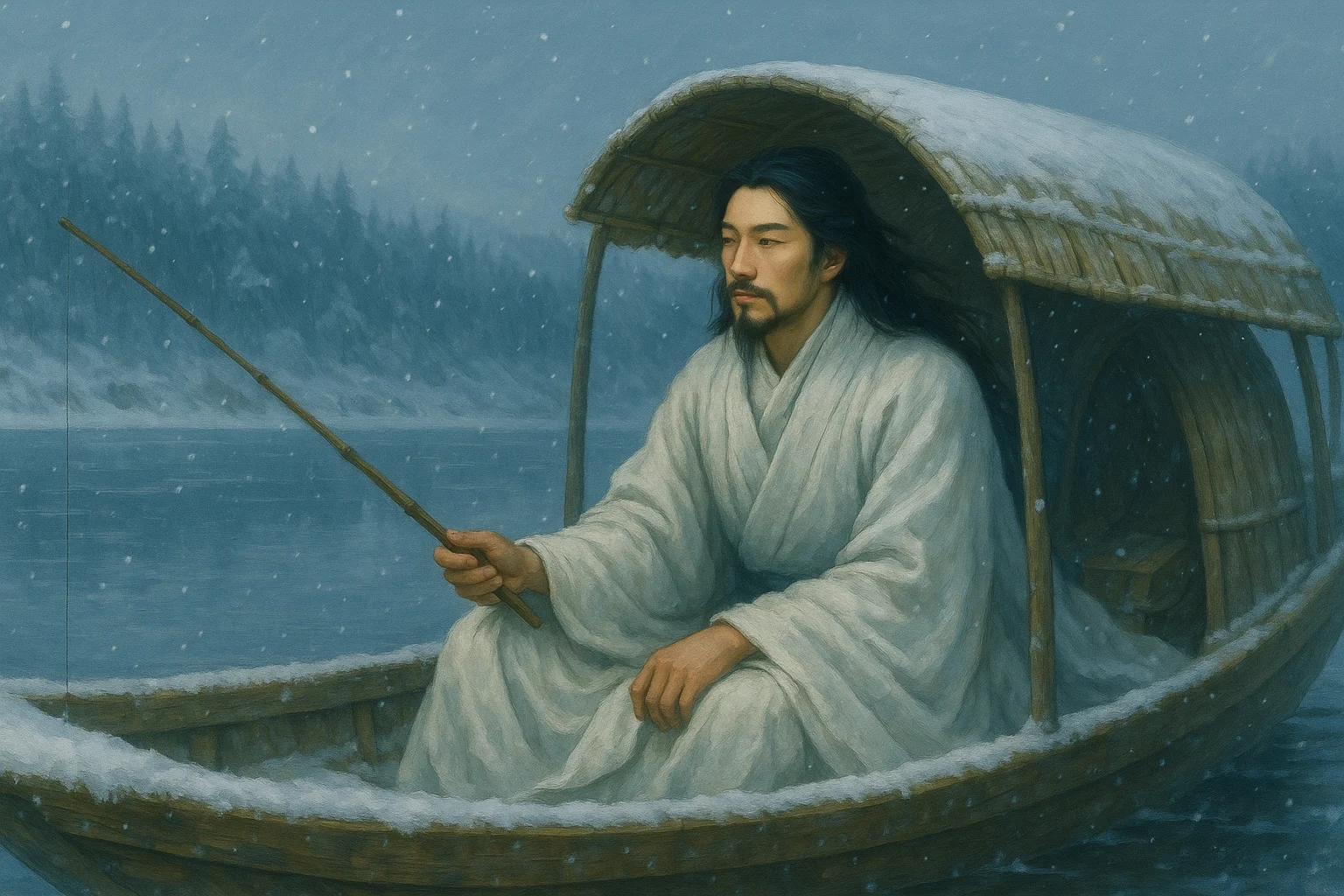
Liu Zongyuan (柳宗元), 773-819 A.D., a native of Yongji, Shanxi, was a progressive thinker, brilliant writer, and revolutionary statesman of the Tang Dynasty. Nineteen years before he was born, the An Shi Rebellion broke out, which dramatically changed the Tang Dynasty from prosperity to decline. The subsequent failure of the Yongzhen Reform was a historical tragedy that cut short Liu Zongyuan's political future, but made him one of the leading thinkers and literary figures of the Tang Dynasty.