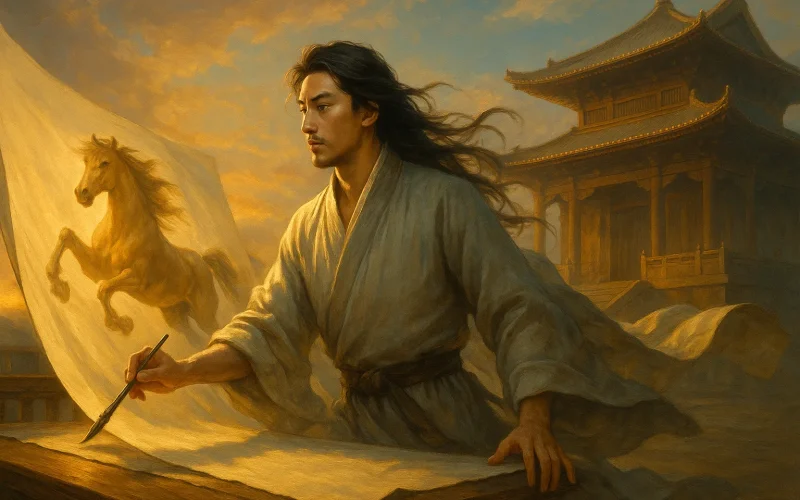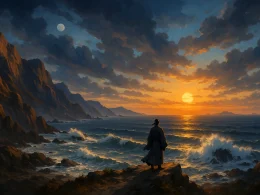




In a sharp gale from the wide sky apes are whimpering,
Birds are flying homeward over the clear lake and white sand,
Leaves are dropping down like the spray of a waterfall,
While I watch the long river always rolling on.

I have come three thousand miles away. Sad now with autumn
And with my hundred years of woe, I climb this height alone.
Ill fortune has laid a bitter frost on my temples,
Heart-ache and weariness are a thick dust in my wine.
Original Poem
「登高」
杜甫
风急天高猿啸哀,渚清沙白鸟飞回。
无边落木萧萧下,不尽长江滚滚来。
万里悲秋常作客,百年多病独登台。
艰难苦恨繁霜鬓,潦倒新停浊酒杯。
Interpretation
This poem was composed in the autumn of 767 CE, during Du Fu's residence in Kuizhou (present-day Fengjie, Chongqing). By this time, the An Lushan Rebellion had been suppressed, but the Tang dynasty was left severely weakened. Regional warlords maintained their autonomy, Tibetan incursions persisted, and the glory of its prosperous era had long faded. Having abandoned his official post in 759 CE and traveled westward, Du Fu had been drifting for nearly a decade through the Qin-Long and Shu regions. Kuizhou, located at the strategic gateway to the Yangtze's Three Gorges with its steep mountains, turbulent rivers, and desolate autumn atmosphere, presented a landscape that deeply resonated with the poet's state of mind in his later years.
On the Double Ninth Festival of that year, Du Fu climbed alone to a high terrace outside White Emperor City. The festival, traditionally a time for family reunions, wearing dogwood, and drinking wine, found the poet solitary before the vast, rolling Yangtze and the endless autumn mountains. He was fifty-six, afflicted with multiple illnesses including a lung ailment, partial paralysis, and deafness. Half his teeth were gone, and his right arm was frail—he was truly in the twilight of his life. Even more burdensome was his profound spiritual isolation and hardship: old friends were scattered, a return home seemed impossible, and his livelihood depended on the support of local officials, requiring him to personally oversee orchards and manage communal fields to feed his family. Yet, it was precisely during these years of greatest material deprivation and physical decline that Du Fu's poetic art reached its zenith. Climbing the Heights is a masterpiece from this period. It fuses the frailty of an individual life with the immense sweep of history and nature, standing not only as the poet's personal elegy but also as a profound spiritual portrait of his age.
First Couplet: 风急天高猿啸哀,渚清沙白鸟飞回。
Fēng jí tiān gāo yuán xiào āi, zhǔ qīng shā bái niǎo fēi huí.
The wind so keen, the sky so high, gibbons wail their grief; / The islet gleams clear, sand glints white, where wheel and whirl the birds.
The opening lines interweave tactile, visual, and auditory sensations to establish the stark, formidable atmosphere of a Three Gorges autumn. "The wind so keen, the sky so high" evokes a severe and desolate sense of space; the gibbons' mournful cries intensify the feeling of austere solitude. The focus then shifts to "The islet gleams clear, sand glints white," where the crisp, clear imagery holds no warmth. The birds wheeling in flight seem to mirror the poet's own rootless, uncertain journey. The scene is already saturated with poignant emotion.
Second Couplet: 无边落木萧萧下,不尽长江滚滚来。
Wúbiān luò mù xiāoxiāo xià, bùjìn Cháng Jiāng gǔngǔn lái.
Boundless, the falling leaves go rustling down; / Unending, the Long River surges onward, on and on.
The poet's vision expands to a vast temporal and spatial horizon. "Boundless, the falling leaves go rustling down" conveys not only their overwhelming quantity but also, through the onomatopoeic "rustling," the collective whisper of decay and decline. "Unending, the Long River surges onward" depicts the river's eternal, mighty flow, hinting at the permanence of time and the inexorability of history. One line looks down upon perishing life, the other out toward ceaseless motion. Within this grand natural contrast lies the poet's profound contemplation on life's brevity and the world's relentless change.
Third Couplet: 万里悲秋常作客,百年多病独登台。
Wànlǐ bēi qiū cháng zuò kè, bǎinián duō bìng dú dēng tái.
A thousand miles from home, grieving for autumn, a perpetual wanderer; / A lifetime of illness, alone I climb this terrace now.
The focus turns inward, concentrating on the poet's personal destiny. "A thousand miles from home" stresses the immense spatial distance of his exile; "a lifetime of illness" summarizes the temporal weight of his aging and frailty. "A perpetual wanderer" speaks to the enduring reality of his displacement; "alone I climb this terrace now" captures his present isolation. This couplet distills a lifetime's sorrow of wandering, the pain of solitude, and the grief of old age into remarkably condensed language laden with profound emotional weight.
Fourth Couplet: 艰难苦恨繁霜鬓,潦倒新停浊酒杯。
Jiānnán kǔ hèn fán shuāng bìn, liáodǎo xīn tíng zhuó jiǔ bēi.
Hardship, bitter regret have thronged my hair with frost; / Ill-fated and worn, I quit at last this humble wine.
The poem concludes with a stark declaration of his present circumstances. "Have thronged my hair with frost" is the physical mark etched by years of trouble and care. "I quit at last this humble wine" signifies that the poet has forsaken even the transient solace of wine; his sorrow has reached a depth beyond such fleeting relief. The emotion here is overwhelming, merging personal anguish with the era's afflictions, ending with a finality that leaves sorrow echoing in silence.
Holistic Appreciation
Hailed as the "supreme example of the seven-character regulated verse," this poem achieves perfection through its "majestic vision, profoundly somber emotion, and exquisitely crafted language." Its structure is meticulously composed: the four couplets correspond to "the immediate scene," "the cosmic vista," "personal circumstance," and "existential lament," moving from the outer world to the inner self in layered progression until grief overflows. The poet completely merges the autumn of Kuizhou with his own fate, making the season a symbol for the autumn of a life and of an era, presenting a vast, desolate scroll where the individual and history are one.
Artistic Merits
- Profound Integration of Scene and Emotion: Every natural detail is imbued with the poet's subjective feeling, achieving the ideal state where "all descriptive language is ultimately an expression of sentiment."
- Exquisite Parallelism with Dynamic Rhythm: All four couplets employ strict parallelism, yet avoid rigidity. Pairings like "wind so keen" / "islet gleams clear", "boundless" / "unending", "a thousand miles" / "a lifetime", and "hardship" / "ill-fated" are structurally precise yet fluid, mirroring the poem's emotional cadence.
- Extreme Linguistic Concentration: As the Song dynasty critic Luo Dajing noted of the third couplet, "these fourteen words contain eight distinct layers of meaning," demonstrating Du Fu's masterful concision and depth.
- Congruence of Sound and Sense: The skillful use of abrupt, checked tones and reduplicatives like "keen," "white," "rustling," and "on and on" creates a sharp, urgent, and somber rhythm that perfectly complements the poem's elegiac power.
Insights
This poet demonstrates that even amidst the tribulations of his time and the personal twilight of his life, his gaze could transcend immediate sorrow to encompass the grandeur of "spring hues flowing from heaven and earth" and the timeless perspective of "shifting clouds over Mount Jade Fort." What Du Fu achieves is not merely faith in his nation's endurance but a capacious vision that situates the self within the flow of history and the cosmic order, using that vantage to confront reality and assume responsibility.
The poem's enduring lesson is this: Confronted with an oppressive era and personal limitations, the highest spiritual stance is not surrender to lament, but rather—after a clear-eyed acknowledgment of hardship—the steadfast upholding of enduring values, and the transformation of personal experience into profound reflection on history and civilization's fate. Even if one is finally reduced to "murmuring the 'Liangfu' song," the very persistence in thought, expression, and compassion within adversity constitutes a spiritual force that resists emptiness and transcends chaos. In his posture of climbing and gazing into the distance, Du Fu bequeaths to posterity an eternal example of how to steady the soul and bear one's burden in a tumultuous world.
Poem translator
Kiang Kanghu
About the poet
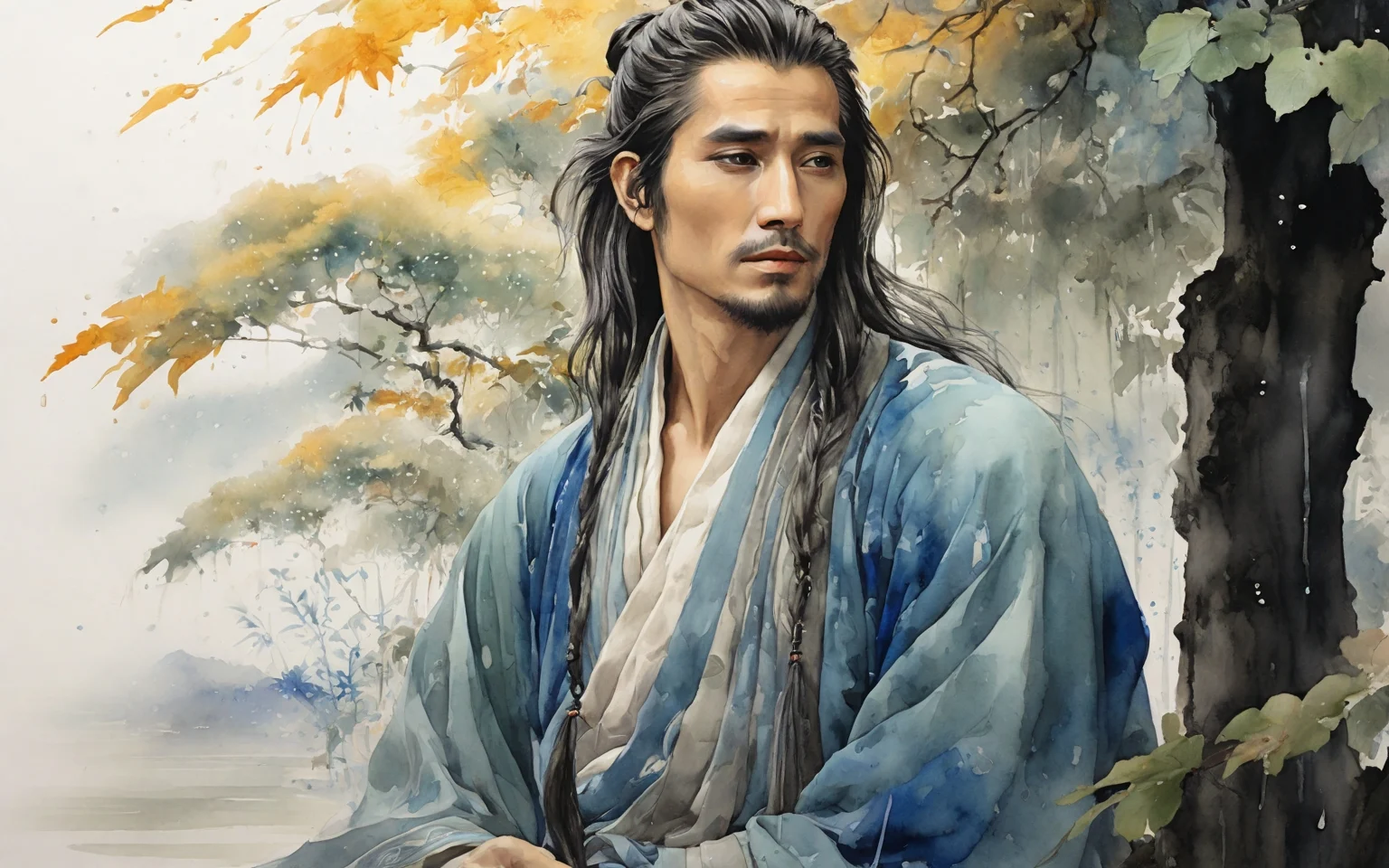
Du Fu (杜甫), 712 - 770 AD, was a great poet of the Tang Dynasty, known as the "Sage of Poetry". Born into a declining bureaucratic family, Du Fu had a rough life, and his turbulent and dislocated life made him keenly aware of the plight of the masses. Therefore, his poems were always closely related to the current affairs, reflecting the social life of that era in a more comprehensive way, with profound thoughts and a broad realm. In his poetic art, he was able to combine many styles, forming a unique style of "profound and thick", and becoming a great realist poet in the history of China.