
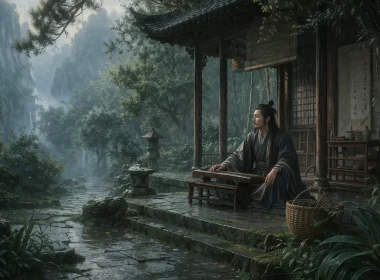
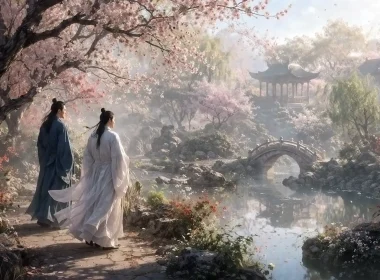

Fresh-washed, I don a light hood's shade,
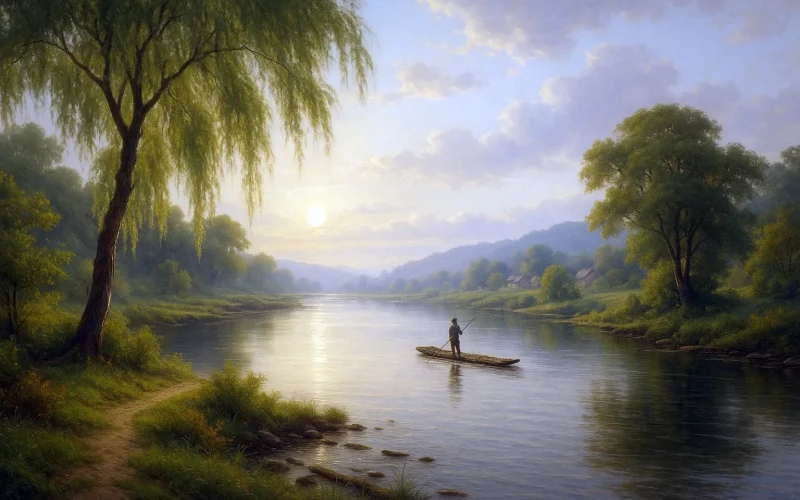
Yu Pool at dawn—wind and dew cascade.
In tune with realms beyond the dust,
How much more with this hermit just!
Rosy clouds scatter—peaks stretch wide,
Sky's vault—a few wild geese cried.
Leave cunning ways to those in power,
Let me be Fuxi's fool this hour!
Original Poem
「旦携谢山人至愚池」
柳宗元
新沐换轻帻,晓池风露清。
自谐尘外意,况与幽人行。
霞散众山迥,天高数雁鸣。
机心付当路,聊适羲皇情。
Interpretation
This poem was composed around the fifth year of the Yuanhe era (810 AD) under Emperor Xianzong of Tang. By then, Liu Zongyuan had been exiled in Yongzhou for over five years. That year, he moved to the west bank of the Xiao River, to Ranxi, which he renamed "Fool's Stream" ("Yu Xi"). By the stream, he built a dwelling and gradually constructed the "Eight Fools" scenic spots, including Fool's Pond, Fool's Pavilion, and Fool's Hall. Naming them with "Fool" ("Yu") was both self-mockery and self-preservation—in the world's eyes, his participation in the failed reforms and subsequent exile made him a "fool"; but in the poet's heart, this "foolishness" was precisely a rejection of worldly cunning and stratagems.
"Recluse Xie" ("Xie Shanren") in the title was a hermit; "Shanren" means a mountain dweller. One dawn, the poet, having just washed his hair, visited Fool's Pond with Recluse Xie. Faced with the clear breeze and dewy whiteness, the dust of worldly cares in his heart instantly dissolved, and he wrote this clear, expansive, and transcendent work. On the surface, it is a leisurely landscape poem; but a closer reading reveals that behind the words "taste the feelings" ("聊适") lies a poet's inability to truly find release. This is precisely the unique quality of Liu Zongyuan's "recluse poetry"—he never completely disguises himself as a transcendent hermit aloof from the world; rather, even amidst mountains and waters, he still carries the imprint of his life's circumstances.
First Couplet: "新沐换轻帻,晓池风露清。"
Xīn mù huàn qīng zé, xiǎo chí fēng lù qīng.
At dawn, with hair new-washed, a light cap on my head,
I find the morning pool, the wind and dew, all clear and fresh.
The opening uses the person's freshness to describe the environment's seclusion. "Hair new-washed" makes the whole person feel renewed; putting on a "light cap" makes one feel even more relaxed and at ease. The second line, "the morning pool, the wind and dew, all clear and fresh," in just five words captures the full essence of a dawn at Fool's Pond: the wind is clear, the dew is clear, and even the pond water seems imbued with a clear, cool air. This "clear" is both the clarity of nature and the clarity of the heart's state—at this moment, the poet, like Fool's Pond in the morning light, seems to have been washed clean of dust, returned to clarity.
Second Couplet: "自谐尘外意,况与幽人行。"
Zì xié chén wài yì, kuàng yǔ yōu rén xíng.
My own mind is in tune with what is past the world of men;
What's more, I have a man of seclusion for a friend.
This couplet moves from scene to feeling, pointing out the spiritual resonance between the poet and Recluse Xie. "My own mind is in tune with what is past the world of men"—the poet says he has always been in harmony with the "beyond the world" spirit. This is both an affirmation of his true self and a silent protest against reality: it is not that I want to flee the world, but that the world will not have me; I can only seek a home "beyond the world." "What's more, I have a man of seclusion for a friend." The word "What's more" ("况") expresses the doubled joy of traveling with Recluse Xie—traveling alone is good, but with a kindred spirit, it is a great joy of life. The two words "man of seclusion" refer to Recluse Xie's identity and also hint at the poet's own self-conception: I, too, am a "man of seclusion"; we are of a kind.
Third Couplet: "霞散众山迥,天高数雁鸣。"
Xiá sàn zhòng shān jiǒng, tiān gāo shǔ yàn míng.
Cloud-racks disperse; the hills stretch far away;
Sky-high, I hear a few geese honk.
This couplet pushes the gaze into the distance, the artistic conception suddenly broadening. "Cloud-racks disperse" describes the scene at dawn on the horizon; as the rosy clouds dissipate, the mountains are fully revealed. The word "stretch far away" ("迥") conveys the mountains' expanse and the vastness of space. "Sky-high, I hear a few geese honk" is what is seen looking up—in the distant sky, a few wild geese fly past, leaving behind their clear cries. This goose cry indicates the season (autumn) and adds an ethereal quality. The first two couplets depict the near scene and the self; this couplet depicts the distant scene and heaven and earth. Moving from near to far, from self to things, the poetic realm broadens, and the mood of the heart becomes transcendent accordingly.
Fourth Couplet: "机心付当路,聊适羲皇情。"
Jī xīn fù dāng lù, liáo shì Xīhuáng qíng.
Artful thoughts I leave to those upon the official road;
Here I shall taste the feelings of Lord Fuxi's golden age.
The final couplet is the finishing touch and emotional culmination of the poem. "Artful thoughts" ("机心") refers to thoughts of cunning and scheming, alluding to the Zhuangzi: "Where there are contrivances, there must be artful thoughts." The poet leaves all this "to those upon the official road"—to those bustling on the official path; he will no longer be tainted by it. "Here I shall taste the feelings of Lord Fuxi's golden age" means that he will temporarily experience the pristine life of the ancient era of Fuxi. "Lord Fuxi" ("羲皇") refers to the mythical sovereign Fuxi; in the minds of the ancients, his era was idealized as a golden age of effortless governance and simple, honest customs.
However, the most intriguing word is "shall taste" ("聊适"). "聊" ("shall") implies "for now," "temporarily." It is not "forever taste" or "always taste," but merely "shall taste"—experiencing it temporarily, for the moment. This word reveals the secret deep in the poet's heart: he has not truly found a home, nor can he truly and completely transcend. This "feelings of Lord Fuxi's golden age" is merely a form of self-comfort after being exiled, a temporary spiritual refuge. Those "artful thoughts" can be "left to those upon the official road," but the sorrows of fate, the pain of politics—can they truly be "left" to flow away? With the emergence of the word "shall" ("聊"), the earlier clarity, expansiveness, and transcendence are tinged with a faint layer of helplessness and sorrow.
Holistic Appreciation
This short poem begins with "clear" ("清") and ends with "shall" ("聊"). Beneath the appearance of clarity, expansiveness, and transcendence lies a deep helplessness. The first two couplets describe the dawn excursion: the person is refreshed, the environment secluded, the mood clear. The third couplet pushes the gaze into the distance: clouds disperse, hills stretch far; sky high, geese honk—the conception broadens. The final couplet abruptly concludes: with "Artful thoughts I leave to those upon the official road," he declares his intention to abandon the world; with "Here I shall taste the feelings of Lord Fuxi's golden age," he points to his wish for transcendence, yet the word "shall" ("聊") reveals helplessness.
The poem's structure is natural, moving from near to far, scene to feeling, progressing layer by layer, concluding powerfully. The dawn at Fool's Pond under the poet's brush, with clear wind and white dew, dispersing clouds and honking geese, is supremely beautiful. And behind all this beauty is an exiled soul seeking a moment's peace amidst mountains and waters. This peace is real, yet also temporary; this transcendence is sincere, yet also helpless. It is precisely this complex layering of emotion that elevates this poem beyond ordinary landscape or recluse poetry, making it a fine work among Liu Zongyuan's exile poems.
Artistic Merits
- Clear, Light Scene-Painting, Lofty Artistic Conception: The poem's depiction of scenery is concise and lively, yet the conception is profound. Lines like "the morning pool, the wind and dew, all clear and fresh" and "Cloud-racks disperse; the hills stretch far away" use simple, light brushstrokes to depict lofty realms.
- Feeling Lodged in Scene, Subtle and Deep: Superficially describing the joy of excursion, it actually harbors feelings about personal fate. Especially the word "shall" ("聊") in the final line is most evocative, containing complex emotions within a single character.
- Natural Structure, Layered Progression: From near to far, from self to things, from reality to ideal, the four couplets progress step by step; the structure is rigorous, and the flow of thought is smooth.
- Apt Allusions, Deepening Meaning: "Artful thoughts" alludes to the Zhuangzi; "Lord Fuxi" uses ancient legend. Both fit the theme perfectly, deepening the philosophical implications within the poem.
Insights
This poem first enlightens us about the wisdom of finding a spiritual refuge in adversity. Liu Zongyuan, exiled to Yongzhou with his official career ruined, could still construct the "Eight Fools" by Fool's Stream, settling his body and mind amidst mountains and waters. This is not escapism but a form of active self-redemption—since reality cannot be changed, change one's relationship with reality, rebuilding the meaning of life in nature. In our current stressful era, we similarly need this wisdom: beyond the clamor, find for oneself a "Fool's Pond" where the soul can perch.
The line "My own mind is in tune with what is past the world of men" also makes us contemplate the relationship between the individual and the mundane world. Liu Zongyuan says his own mind has always been in tune with the "beyond the world" spirit. This is both an affirmation of his true heart and a certain distancing from worldly values. It enlightens us: we need not be completely bound by worldly standards, need not live according to others' expectations. Those choices the world sees as "foolish" may precisely be faithfulness to one's true heart.
Looking deeper, the subtlety of the word "shall" ("聊") in the poem is especially worthy of contemplation. Liu Zongyuan does not portray himself as a completely transcendent hermit but honestly admits: this "feelings of Lord Fuxi's golden age" is merely "shall taste," only a temporary refuge. This clear self-awareness avoids the affectation and pretentiousness common in recluse poetry. It enlightens us: True transcendence is not completely severing worldly ties, but, with clarity about the mundane world, still choosing to seek peace amidst mountains and waters. We need not demand of ourselves to "completely let go"; being able to "shall taste" momentarily amidst pressure is already precious.
That resolve of "Artful thoughts I leave to those upon the official road" is also deeply thought-provoking. "Artful thoughts" are the survival rules of officialdom, synonymous with scheming and calculation. Liu Zongyuan leaves them all "to those upon the official road"—for those enamored with such ways. This is not passive escape but an active choice of values: I would rather be a "fool" than be "artful"; I would rather be cast aside than join the corrupt flow. This steadfast adherence to values even in adversity is precisely the most precious spiritual legacy Liu Zongyuan leaves us.
About the Poet

Liu Zongyuan (柳宗元, 773 - 819), a native of Yuncheng in Shanxi province, was a pioneering advocate of the Classical Prose Movement during China's Tang Dynasty. Awarded the prestigious jinshi degree in 793 during the Zhenyuan era, this distinguished scholar-official revolutionized Chinese literature with his groundbreaking essays. His prose works, remarkable for their incisive vigor and crystalline purity, established the canonical model for landscape travel writing that would influence generations. As a poet, Liu mastered a distinctive style of luminous clarity and solitary grandeur, securing his place among the legendary "Eight Great Masters of Tang-Song Prose" - an honor reflecting his enduring impact on Chinese literary history.