


O General, descended from Wei's Emperor Wu,
You are nobler now than when a noble...
Conquerors and their velour perish,
But masters of beauty live forever.
...With your brush-work learned from Lady Wei
And second only to Wang Xizhi's,
Faithful to your art, you know no age,
Letting wealth and fame drift by like clouds.

...In the years of Kaiyuan you were much with the Emperor,
Accompanied him often to the Court of the South Wind.
When the spirit left great statesmen, on walls of the Hall of Fame
The point of your brush preserved their living faces.
You crowned all the premiers with coronets of office;
You fitted all commanders with arrows at their girdles;
You made the founders of this dynasty, with every hair alive,
Seem to be just back from the fierceness of a battle.

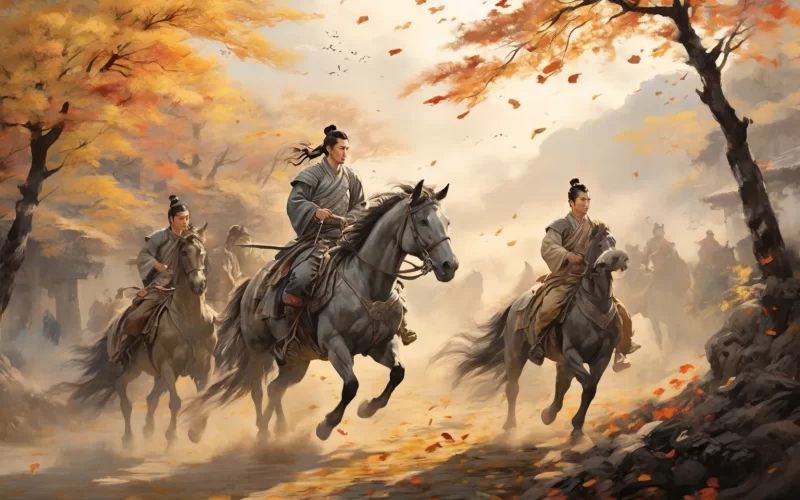
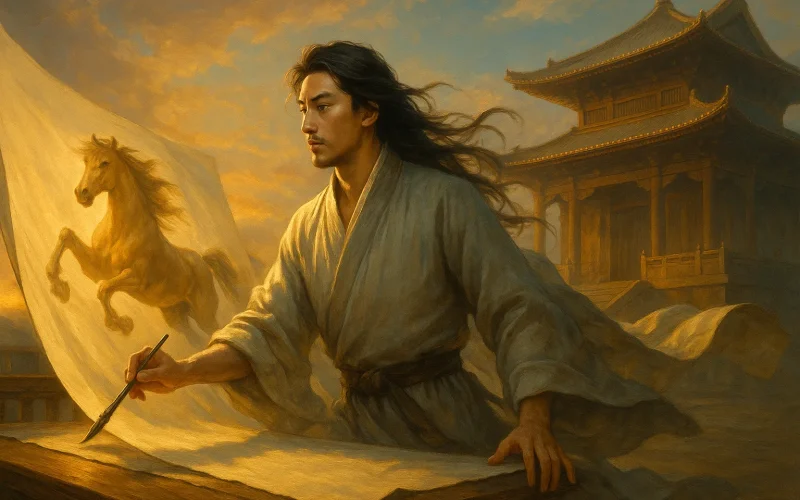
...The late Emperor had a horse, known as Jade Flower,
Whom artists had copied in various poses.
They led him one day to the red marble stairs
With his eyes toward the palace in the deepening air.
Then, General, commanded to proceed with your work,
You centred all your being on a piece of silk.
And later, when your dragon-horse, born of the sky,
Had banished earthly horses for ten thousand generations,
There was one Jade Flower standing on the dais
And another by the steps, and they marvelled at each other...
The Emperor rewarded you with smiles and with gifts,
While officers and men of the stud hung about and stared.

...Han Gan, your follower, has likewise grown proficient
At representing horses in all their attitudes;
But picturing the flesh, he fails to draw the bone-
So that even the finest are deprived of their spirit.
You, beyond the mere skill, used your art divinely-
And expressed, not only horses, but the life of a good man...

Yet here you are, wandering in a world of disorder
And sketching from time to time some petty passerby.
People note your case with the whites of their eyes.
There's nobody purer, there's nobody poorer.
...Read in the records, from earliest times,
How hard it is to be a great artist.
Original Poem
「丹青引赠曹将军霸」
杜甫
将军魏武之子孙, 于今为庶为青门;
英雄割据虽已矣! 文采风流今尚存。
学书初学卫夫人, 但恨无过王右军。
丹青不知老将至, 富贵于我如浮云。
开元之中常引见, 承恩数上南熏殿,
凌烟功臣少颜色, 将军下笔开生面。
良相头上进贤冠, 猛将腰间大羽箭。
褒公鄂公毛发动, 英姿飒爽犹酣战。
先帝天马玉花骢, 画工如山貌不同。
是日牵来赤墀下, 迥立阊阖生长风。
诏谓将军拂绢素, 意匠惨淡经营中;
斯须九重真龙出, 一洗万古凡马空。
玉花却在御榻上, 榻上庭前屹相向;
至尊含笑催赐金, 圉人太仆皆惆怅,
弟子韩干早入室, 亦能画马穷殊相;
干惟画肉不画骨, 忍使骅骝气凋丧。
将军画善盖有神, 偶逢佳士亦写真;
即今漂泊干戈际, 屡貌寻常行路人。
涂穷反遭俗眼白, 世上未有如公贫;
但看古来盛名下, 终日坎壈缠其身。
Interpretation
This poem was composed in 764 AD. While the Central Plains had achieved a semblance of stability, the western frontier remained in turmoil, with Tibetan forces repeatedly threatening the capital. The glorious twilight of the Great Tang had thoroughly faded. At this time, Du Fu was living temporarily in Chengdu. Though sustained by the support of friends, his heart was perpetually burdened by the sufferings of his war-torn homeland and the separation from loved ones. It was during this period that he met the renowned painter Cao Ba, who had also drifted into the Shu region. A descendant of Cao Cao, Cao Ba had been a celebrated court painter during the Kaiyuan and Tianbao eras. Emperor Xuanzong had personally commissioned him to restore the faded portraits of meritorious officials in the Lingyan Pavilion and to depict prized steeds from the imperial stables, granting him exceptional favor. However, in the wake of the An Lushan Rebellion, the court painters of old scattered and fell from grace. Cao Ba, too, had "become a commoner of an impoverished house," adrift in the southwest and forced to sell his paintings for a living.
The meeting in Chengdu of these two kindred spirits—one a poet of towering reputation yet a lifelong wanderer, the other a painter whose skill once dazzled the court but was now reduced to the marketplace—became a profound moment of recognition in literary history. Du Fu not only used his poetic craft to compose a biography of Cao Ba but also channeled his own pent-up frustrations through it. The lament within the poem serves as a summation of Cao Ba's fate and a reflection on the destiny of the poet himself, indeed of all talented souls throughout history. Thus, the poem transcends the conventional farewell or dedicatory piece, becoming an "artist's epic" that refracts the transformation of an era through the prism of a single life—a profound meditation on art, recognition, and the relentless tides of history.
First Section: “将军魏武之子孙,于今为庶为清门。英雄割据虽已矣!文采风流今尚存。学书初学卫夫人,但恨无过王右军。丹青不知老将至,富贵于我如浮云。”
Jiāngjūn Wèi Wǔ zhī zǐsūn, yú jīn wéi shù wéi qīng mén. Yīngxióng gējù suī yǐ yǐ! Wéncǎi fēngliú jīn shàng cún. Xué shū chū xué Wèi fūrén, dàn hèn wú guò Wáng Yòujūn. Dānqīng bù zhī lǎo jiàng zhì, fùguì yú wǒ rú fúyún.
A general, scion of the Martial Lord of Wei, / Today a commoner, in a poor house dwells he. / His forebear's heroic feats, long faded from the stage; / Yet grace and talent live on in this scion's heritage. / In youth, from Lady Wei his brushstrokes first he learned, / Yet sighed he could not match Wang Xizhi's skill he discerned. / To painting then he turned, forgetting age's advance; / Wealth and high station? To him but passing clouds' brief dance.
This section opens with the stark contrast between Cao Ba's illustrious lineage and his present humble circumstances, hinting at the dramatic turns of his fate. The focus then shifts to his artistic journey: from calligraphy to painting, a dedication so complete he became oblivious to aging, embodying a spirit detached from worldly gain and wholly devoted to his craft.
Second Section: “开元之中常引见,承恩数上南薰殿。凌烟功臣少颜色,将军下笔开生面。良相头上进贤冠,猛将腰间大羽箭。褒公鄂公毛发动,英姿飒爽犹酣战。”
Kāiyuán zhī zhōng cháng yǐnjiàn, chéng ēn shuò shàng Nánxūn diàn. Língyān gōngchén shǎo yánsè, jiāngjūn xià bǐ kāi shēngmiàn. Liáng xiàng tóu shàng jìnxián guān, měng jiàng yāo jiān dà yǔ jiàn. Bāo gōng È gōng máofà dòng, yīngzī sàshuǎng yóu hān zhàn.
In Kaiyuan's prime, often summoned to attend, / By royal favor to South-Breeze Hall he'd ascend. / Lingyan's heroes, their colors dimmed and faint; / The General took brush, and gave them features quaint. / Wise ministers' "Promote-the-Worthy" caps upright; / Fierce generals' great-plumed arrows girded tight. / Dukes Bao and E—their hair and beards seemed stirred by air; / Their bold and vibrant stance as if still locked in warfare.
This section captures the zenith of Cao Ba's career. The poet acclaims his creative power to re-imagine and revitalize historical figures. Through meticulously detailed objects, Du Fu demonstrates Cao Ba's mastery of realistic depiction, breathing vivid life and heroic energy into the painted figures, showcasing the supreme achievement of his portraiture: the conveyance of vital essence.
Third Section: “先帝天马玉花骢,画工如山貌不同。是日牵来赤墀下,迥立阊阖生长风。诏谓将军拂绢素,意匠惨淡经营中。斯须九重真龙出,一洗万古凡马空。玉花却在御榻上,榻上庭前屹相向。至尊含笑催赐金,圉人太仆皆惆怅。弟子韩干早入室,亦能画马穷殊相。干惟画肉不画骨,忍使骅骝气凋丧。”
Xiāndì tiānmǎ Yùhuā cōng, huàgōng rú shān mào bù tóng. Shì rì qiān lái chì chí xià, jiǒng lì chānghé shēng cháng fēng. Zhào wèi jiāngjūn fú juàn sù, yìjiàng cǎndàn jīngyíng zhōng. Sīxū jiǔ chóng zhēnlóng chū, yī xǐ wàn gǔ fán mǎ kōng. Yùhuā què zài yù tà shàng, tà shàng tíng qián yì xiāng xiàng. Zhìzūn hánxiào cuī cì jīn, yǔrén tàipú jiē chóuchàng. Dìzǐ Hán Gàn zǎo rù shì, yì néng huà mǎ qióng shū xiàng. Gàn wéi huà ròu bù huà gǔ, rěn shǐ huáliú qì diāo sàng.
The late Emperor's divine steed, Jade-Flower Piebald; / Painters like hills attempted, but its likeness none recalled. / That day led to crimson steps below the palace gate, / It stood aloof, as if stirring wind from heaven's state. / The sovereign bid the General silk to spread and prime; / His mind conceived, through deep and concentrated time. / Soon from the silk a true dragon of Nine Heavens sprung, / Washing away all common steeds since time begun. / Painted Jade-Flower upon the royal couch was lain; / Couch and courtyard, image and true steed, stood without stain. / The Emperor, smiling, urged that gifts of gold be sped; / Grooms and stablemasters watched with wistful dread. / His pupil Han Gan learned his craft within the room, / Could paint all forms of horses, capture every plume. / Yet Gan paints only flesh and not the inner bone, / Leaving noble steeds their spirit lost, forlorn, alone.
This section forms the brilliant core of the poem's artistic depiction. The failed attempts of countless painters highlight the challenge, while the horse's divine bearing builds anticipation for Cao Ba's work. The creative process is rendered in focused detail, culminating in an unparalleled achievement. The marvelous effect of the finished work and the poignant reaction of the horse keepers elevate Cao Ba's skill to the miraculous. Finally, his pupil Han Gan serves as a foil to underscore Cao Ba's supreme artistic principle: capturing the underlying spirit and structure.
Fourth Section: “将军画善盖有神,偶逢佳士亦写真。即今漂泊干戈际,屡貌寻常行路人。途穷反遭俗眼白,世上未有如公贫。但看古来盛名下,终日坎壈缠其身。”
Jiāngjūn huà shàn gài yǒu shén, ǒu féng jiā shì yì xiězhēn. Jí jīn piāobó gāngē jì, lǚ mào xúncháng xínglùrén. Tú qióng fǎn zāo sú yǎn bái, shìshàng wèi yǒu rú gōng pín. Dàn kàn gǔ lái shèngmíng xià, zhōngrì kǎnlǎn chán qí shēn.
The General's skill in painting, touched by the divine; / He'd sometimes sketch true likeness for scholars fine. / But now adrift in these times of spear and shield, / He must paint common passersby he meets in field. / At road's end, he meets vulgar eyes' disdainful stare; / Under the sun, none is as poor as in his care. / But look since ancient times at those with glorious name: / Hardship and frustration ever dogged their fame.
Here, the poem turns sharply, plummeting from the heights of memory to the harsh ground of present reality. The artist's hand, once touched by the divine, is now reduced to painting common passersby amidst chaos. The chasm in social standing and the fickleness of the world are condensed into a bitter image. The poet's outraged sigh ultimately crystallizes into a profound insight on a historical pattern: great renown and great hardship are often inseparable companions. This serves as both a summation of Cao Ba's personal tragedy and a lament on the eternal paradox between talent and fortune, where Du Fu's own feelings find powerful resonance.
Holistic Appreciation
This poem is a "portrait of a painter's fate" rendered with a poet's brush. Employing a grand, quasi-epic structure and meticulous narrative detail, Du Fu masterfully interweaves Cao Ba's personal vicissitudes with the Tang dynasty's decline from prosperity. Within this vast panorama, the poem celebrates the artist's pure, obsessive spirit and his peerless skill, but also lays bare the loss of dignity and the cruelty of worldly judgment he faces. Ultimately, the poet elevates his reflection into a philosophical contemplation of a historical truth, imbuing the poem with a tragic resonance and intellectual depth that transcend its specific time.
Artistic Merits
- Epic Scale, Precise Narrative: Following a clear chronological arc, it constructs a complete biography, seamlessly integrating family history, artistic achievement, and historical context.
- Powerful Contrasts, Heightened Tension: The juxtapositions—between past glory and present poverty, between supreme mastery and extreme hardship—build upon each other, creating immense dramatic force.
- Vivid Detail, Nuanced Critique: Whether in evocative portrayal or penetrating artistic criticism, the poem displays Du Fu's sharp observational eye and refined aesthetic judgment.
- The Guest as Mirror for the Host: While ostensibly a portrait of Cao Ba, the poem is deeply self-reflective. The shared experience of artistic devotion and worldly frustration lends the work exceptional emotional and philosophical gravity.
Insights
This poem retains its power across centuries because it touches upon the core dilemma of the relationship between art, genius, and destiny. It sings of that pure realm where one transcends utility to embrace art with one's very life, yet it also unflinchingly exposes the potential for neglect and isolation that genius may suffer. Through the lens of Cao Ba's life, Du Fu expresses profound sympathy for talented individuals thwarted by circumstance and prompts a vital question: How should a civilization cherish and protect its creative spirits? For the individual, when external trappings prove fleeting, perhaps only the spirit captured within art and the detachment maintained amidst adversity can serve as an enduring bulwark against time and fate. Cao Ba's paintings may have been lost, but his character and destiny have gained another form of everlasting life through Du Fu's poetry.
Poem translator
Kiang Kanghu
About the poet
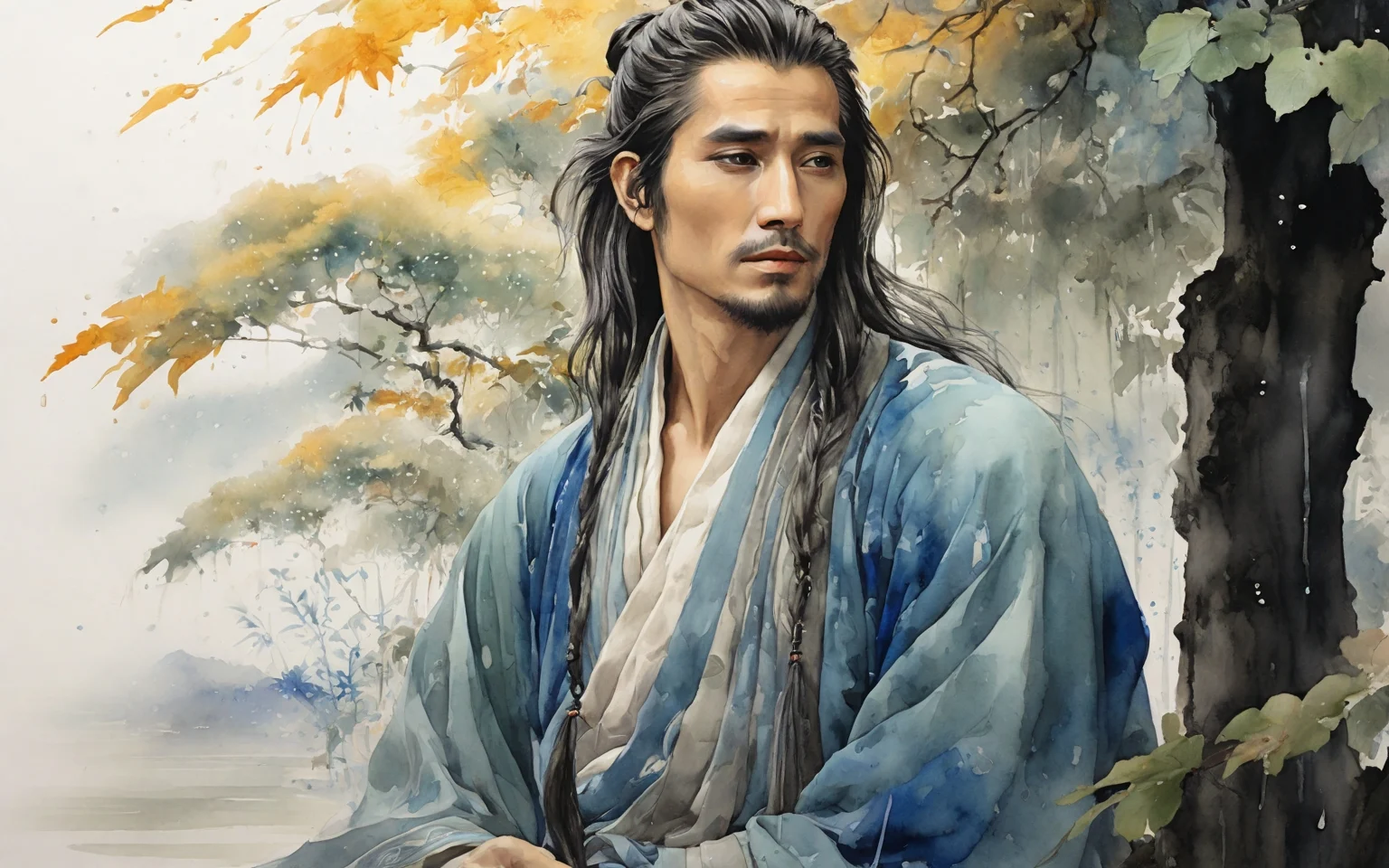
Du Fu (杜甫), 712 - 770 AD, was a great poet of the Tang Dynasty, known as the "Sage of Poetry". Born into a declining bureaucratic family, Du Fu had a rough life, and his turbulent and dislocated life made him keenly aware of the plight of the masses. Therefore, his poems were always closely related to the current affairs, reflecting the social life of that era in a more comprehensive way, with profound thoughts and a broad realm. In his poetic art, he was able to combine many styles, forming a unique style of "profound and thick", and becoming a great realist poet in the history of China.