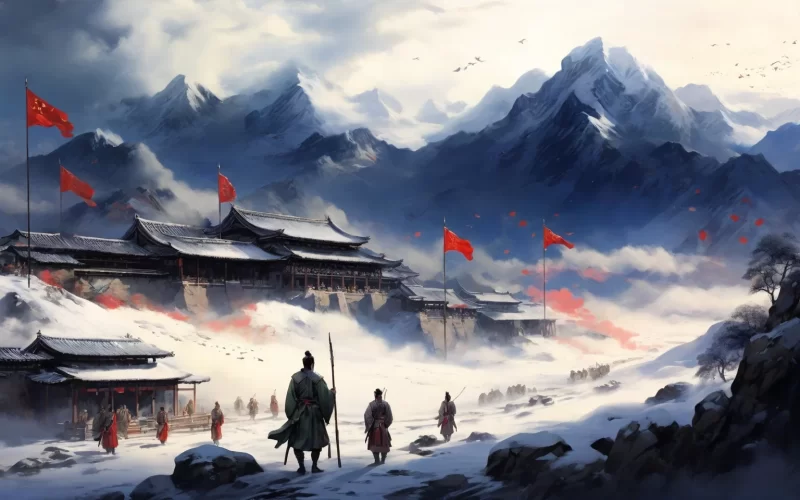



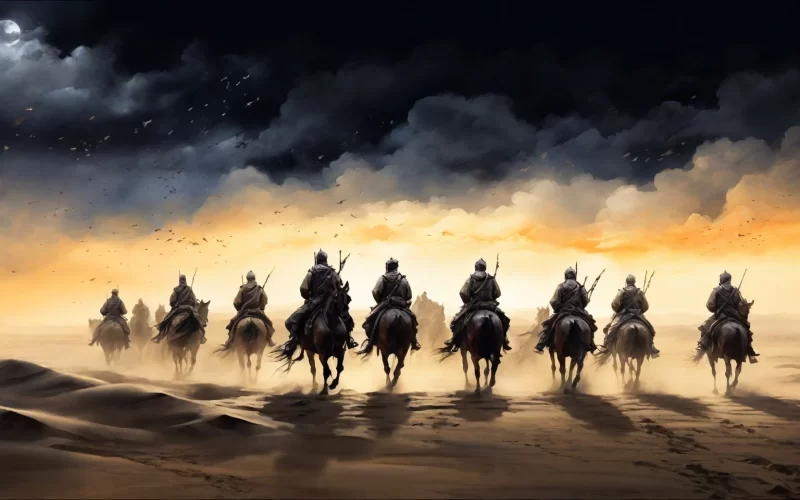
The wind and sand in the desert have dimmed sunlight;
With red flags half unfurled we go through the camp gate.
North of River Tao, after nocturnal fight,
Our vanguards have captured the chief of hostile State.
Original Poem
「从军行 · 其五」
王昌龄
大漠风尘日色昏,红旗半卷出辕门。
前军夜战洮河北,已报生擒吐谷浑。
Interpretation
Wang Changling lived during the High Tang period, an era of illustrious frontier achievements and soldiers devoted to duty. From Emperor Taizong to Emperor Xuanzong, the Tang dynasty engaged in a protracted tug-of-war spanning a century with peoples like the Tibetans and Turks along the northwestern frontier. The region around the Tao River (in present-day Gansu) was precisely the frontline of contention between Tang and Tibetan forces. Wang Changling traveled extensively in the northwestern frontier regions in his youth, experiencing frontier life firsthand. The seven poems of the "Poems on Army Life" series are the crystallization of his frontier experiences. This poem, the fifth in the series, depicts news of victory—a night battle has just concluded, and joyous tidings of the capture of the enemy chieftain arrive from the front lines.
In this work, the poet does not describe the battle directly. Instead, through the atmospheric depiction of "Desert winds have blotted out the sun," the imagery of the march in "Red banners furl'd," and the delivery of the victory report in "And now we hear the news," he completes the narrative of an entire battle from the side. This technique is more concise and impactful than direct description.
First Couplet: "大漠风尘日色昏,红旗半卷出辕门。"
Dà mò fēng chén rì sè hūn, hóng qí bàn juǎn chū yuán mén.
Desert winds have blotted out the sun,
Red banners furl'd, we leave the camp gate, on the run.
The opening instantly creates a tense battlefield atmosphere with a visually striking scene. "Desert winds have blotted out the sun"—seven characters depict the harsh frontier environment: sandstorms darken the sky, daylight dims, heaven and earth are plunged into gloom. This is both realistic description and symbolism—the tension of battle and the peril of the situation are both conveyed in the word "blotted out."
"Red banners furl'd, we leave the camp gate, on the run"—Against the gloomy expanse, that red banner stands out vividly. The phrase "furl'd" is exquisite. Red banners are meant to flutter in the wind; here they are "furl'd," indicating the troops are not marching leisurely but advancing swiftly, the banners unable to fully unfurl due to their speed. The word "leave" conveys the urgency of the action; "camp gate" specifies the military headquarters. This couplet uses the harshness of the environment to contrast the high morale, and the 'furl'd' banners to depict the speed of the advance; the battle is not described, yet it feels imminent.
Second Couplet: "前军夜战洮河北,已报生擒吐谷浑。"
Qián jūn yè zhàn Táo hé běi, yǐ bào shēng qín Tǔyùhún.
Our vanguard fought at night north of the River Tao,
And now we hear the news: they've captured the Tuyuhun chief.
This couplet shifts from the departure to the victory report, accomplishing a leap in time and a change of scene. "Our vanguard fought at night north of the River Tao"—seven characters establish the battle's location (north of the Tao River), time (night battle), and participants (vanguard). The poet does not elaborate on the night battle's progression; a brief mention hands the scene over to the reader's imagination. Immediately following, "And now we hear the news: they've captured the Tuyuhun chief"—the victory report has arrived! "Now we hear" conveys both the swift transmission of the message and the rapid achievement of victory. "Tuyuhun" refers to a northwestern tribal confederation of the time, here representing the enemy chieftain. Capturing the enemy leader alive is the greatest triumph and the highest honor.
The brilliance of this couplet lies in the temporal dislocation created by "now we hear." While we are still imagining the fierceness of the "night battle," the victory report has already arrived; while we might still worry for the departing soldiers, victory is already theirs. This technique of "describing not the battle itself but its victorious conclusion" makes the triumph seem more effortless, more inevitable, and the Tang army's prowess more convincing.
Overall Appreciation
The first two lines of this work depict the departure, the last two the victory report, completing the narrative of an entire battle within an extremely concise format. The first two lines use "Desert winds have blotted out the sun" to establish the harsh setting and "Red banners furl'd" to depict the swift departure, foreshadowing what follows. The last two lines use "fought at night" to hint at the battle and "now we hear" to announce the victory, conveying the most glorious outcome with the most economical language.
The entire poem contains no direct depiction of combat, yet allows the reader to sense the battle's intensity; it offers no direct praise for the soldiers, yet lets the reader feel their bravery. That red banner amidst the "Desert winds," that victory report following the "night battle"—these are concrete manifestations of the Tang army's spirit. This technique of implying the direct through the indirect, suggesting reality through implication is a hallmark of Wang Changling's frontier poetry.
Compared to Poem IV, this piece is more spirited and triumphant. Poem IV expresses the oath of perseverance in "We'll not go home until we beat the foe"; this poem celebrates the instant of victory in "they've captured the Tuyuhun chief." The two complement each other, together portraying the dual aspects of frontier life: hardship and glory, endurance and triumph.
Artistic Features
- Indirect Description, Suggesting Reality Through Implication: Avoids direct depiction of the battle, instead using the scenes of departure and victory to let readers imagine the combat's ferocity—a masterful approach.
- Atmospheric Setting, Mood Enhancement: "Desert winds have blotted out the sun" uses environmental harshness to contrast the soldiers' valor, paving the way for the victory report.
- Temporal Leap, Concise Narrative: The time between "leave the camp gate" and "now we hear" is omitted, leaving room for imagination and making the narrative tighter and more forceful.
- Concise Language, Vivid Imagery: "Red banners furl'd" conveys the speed of the advance; "now we hear… they've captured" conveys the swiftness of the victory; every character is precise and potent.
Insights
This poem first illuminates for us how to act amidst adversity. The harsh environment described in "大漠风尘日色昏" is enough to make anyone hesitate. Yet the soldiers do not wait or falter; instead, "红旗半卷出辕门"—they strike decisively and act swiftly. It teaches us: The greater the difficulty, the more action is required; the tougher the situation, the more one must not remain stagnant. Waiting only allows the storm to intensify; hesitation only lets opportunity slip away.
The victory report in "已报生擒吐谷浑" also prompts us to reflect on the inevitability and contingency of triumph. What transpired between "出辕门" and "已报"? We do not know. The poet omits the process, presenting only the result. This reflects both trust in the soldiers' bravery and faith in victory's inevitability. It reveals: When we perfect the process, the outcome arrives naturally. There is no need to embellish the struggle, for the result itself is the ultimate testament.
Furthermore, the imagery of "红旗半卷" invites contemplation on the relationship between speed and power. A banner meant to fly unfurled is "半卷" due to excessive velocity. This "半卷" is precisely an expression of strength—not an inability to unfurl, but moving too swiftly to allow it. It reveals: True power is often not ostentatious but restrained; true speed is often not thunderous but lightning-fast. Those who are truly formidable are often those who, with banners still "半卷", have already charged through the camp gates.
Finally, the word "夜" (night) in "前军夜战" is particularly worthy of savoring. Night battles are the most perilous and arduous. Yet the poet does not dwell on the horrors of nocturnal combat; he merely hints at it before swiftly transitioning to the victory report of "已报生擒". This brief mention of hardship contrasted with emphatic celebration of victory is itself an attitude: hardship is not worth sensationalizing; victory is worth commemorating. It teaches us: When facing adversity, we can acknowledge its existence without dwelling on it excessively. What matters is to look forward, toward victory, toward that moment of "已报".
Poem translator
Xu Yuanchong (许渊冲)
About the poet

Wang Changling (王昌龄), circa A.D. 690 - 756, was a native of Xi'an, Shaanxi Province. Wang Changling's poems were mostly about the Border Places, love affairs and farewells, and he was well known during his lifetime. His seven poems are equal to those of Li Bai, and he is known as the “Master of seven lines”.