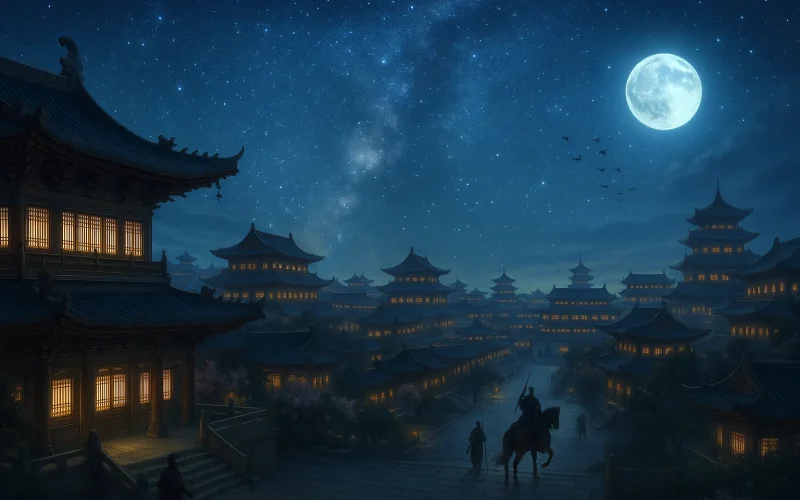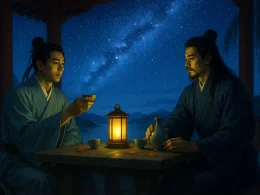



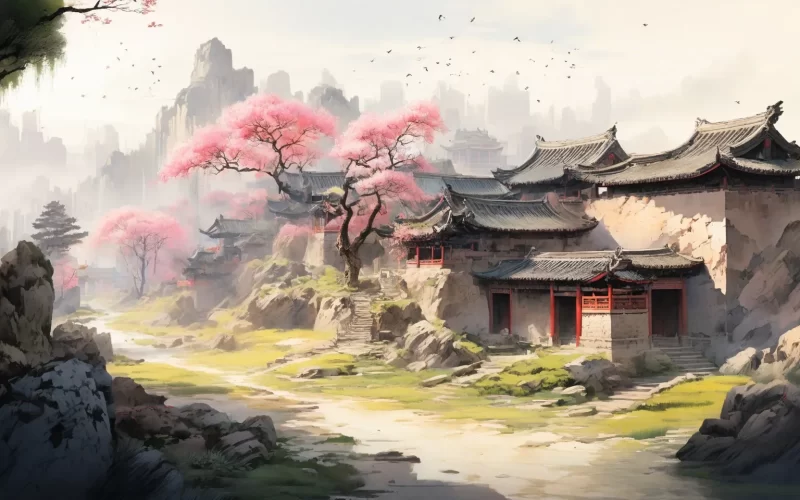
Though a country be sundered, hills and rivers endure;
And spring comes green again to trees and grasses
Where petals have been shed like tears
And lonely birds have sung their grief.

...After the war-fires of three months,
One message from home is worth a ton of gold.

...I stroke my white hair. It has grown too thin
To hold the hairpins any more.
Original Poem
「春望」
杜甫
国破山河在,城春草木深。
感时花溅泪,恨别鸟惊心。
烽火连三月,家书抵万金。
白头搔更短,浑欲不胜簪。
Interpretation
This poem was composed in the spring of 757 AD, during Du Fu's captivity in Chang'an, which was then occupied by the rebel forces of the An Lushan Rebellion. This was the third year of the catastrophic rebellion. Both imperial capitals had fallen, Emperor Xuanzong had fled to Shu, and the nation lay in ruins. Separated from his family and trapped alone in the occupied city, the poet witnessed firsthand how the former splendor of his homeland had turned to rubble, with spring vegetation now cloaking the desolation. At this confluence of immense historical trauma and personal destiny, the poet forged his anguish for his shattered country, his grief over separation, and his lament for life into this timeless masterpiece, hailed as "the most poignant expression of grief for its age."
First Couplet: 国破山河在,城春草木深。
Guó pò shānhé zài, chéng chūn cǎomù shēn.
A nation shattered, hills and streams remain; / A city in spring, grass and trees grow dense.
The opening couplet, in just ten characters, sketches the stark opposition between a colossal historical tragedy and the enduring natural world. "A nation shattered" strikes with definitive force, naming the cataclysm of the era. The immediate follow-up, "hills and streams remain," creates a poignant irony, highlighting the vast gulf between human affairs and unchanging nature. "A city in spring" should evoke vibrancy, yet it is paired with "grass and trees grow dense"—the word "dense" fully conveys the overgrown, desolate scene of a place emptied of human presence. The two lines form a precise parallel, charged with intense emotional tension, establishing the poem's profoundly sorrowful and desolate tone.
Second Couplet: 感时花溅泪,恨别鸟惊心。
Gǎn shí huā jiàn lèi, hèn bié niǎo jīng xīn.
Stirred by the times, flowers seem to shed tears; / Grieving for parting, birdsongs startle the heart.
This couplet is a classic example of the pathetic fallacy. The poet projects his inner torment onto the external world: the lovely spring blossoms appear to scatter drops of sorrow; the harmonious songs of spring birds, instead of bringing joy, agitate his anguished heart. This is a quintessential instance of "using joyful scenery to express sorrowful feeling." Its artistic power lies precisely in this contrast: the vibrant vitality of nature stands in sharp opposition to the poet's heartbreak, intensifying the depth and poignancy of the grief. "Seem to shed tears" and "startle the heart" are not merely expressions of personal emotion; they imbue the indifferent flowers and birds with the tragic color of the entire age.
Third Couplet: 烽火连三月,家书抵万金。
Fēnghuǒ lián sān yuè, jiāshū dǐ wàn jīn.
Beacon fires burn for three months unending; / A letter from home is worth ten thousand in gold.
The focus shifts from generalized sorrow to a specific, piercing experience of life amidst turmoil. "Beacon fires burn for three months unending" uses the prolonged passage of time to convey the cruelty and torment of the war, summarizing the persistent instability of the times. "A letter from home is worth ten thousand in gold" employs a hyperbolic comparison to express how a communication insignificant in peacetime becomes priceless amid the isolation and life-and-death uncertainty of war. The language of this couplet is plain, almost proverbial, yet its emotion is weighty as a mountain. It distills the common longing of all separated families in a wartime era from the poet's personal circumstance, granting it a timeless, resonant power and capacity for universal empathy.
Fourth Couplet: 白头搔更短,浑欲不胜簪。
Báitóu sāo gèng duǎn, hún yù bùshèng zān.
White hair scratched grows ever sparser, / Pinned, it can barely hold a hairpin.
It condenses the intangible sorrow for country and family onto the poet's own aging, physical form. Inner anxiety, bitterness, and helplessness externalize into the highly visual, fretful action of scratching one's head; "grows ever sparser" and "can barely hold a hairpin" build progressively, vividly depicting a state where care hastens aging, even to the point of physical decline. The single word "scratched" fully reveals a condition of restless, unresolved anxiety. It concludes with the detail of the hairpin barely holding, pushing the poem's沉重 emotion to its climax. The image of a poet, careworn and haggard for his country and the times, becomes palpably present, profoundly moving.
Holistic Appreciation
This poem is a paradigm of Du Fu's "deeply somber and powerfully cadenced" style. The entire piece uses "viewing" as its lens, with emotion advancing layer by layer in a tightly structured progression. The first couplet sets the tone with a vast, desolate scene, depicting a broken nation and a barren city. The second couplet projects feeling onto the scenery, deepening the sorrow to a state where the observer and the world share the grief. The third couplet focuses on the specific wounds inflicted by war (the beacon fires) and the longing it creates (the letter from home). The fourth couplet finally converges on the poet himself, making the immense inner pain concrete through physical decline. Across the four couplets, the perspective moves from distant to near, from external to internal, from nation to family, and finally to the self, completing a full and profound cycle of emotion and reflection.
Its artistic essence lies in "using highly condensed imagery to bear immensely broad historical content and profound personal feeling." The poet's anguish over the nation's fate, his concern for his family's safety, and his sigh over life's transience are perfectly fused into concise yet concrete expressions like "grass and trees grow dense," "flowers seem to shed tears," "worth ten thousand in gold," and "can barely hold a hairpin," achieving a supreme unity of thought and artistry.
Artistic Merits
- Potent Contrast and Juxtaposition
The pairings "A nation shattered" / "hills and streams remain" and "A city in spring" / "grass and trees grow dense" use eternal nature to juxtapose the drastic changes in human affairs. The beauty of "flowers" and "birds" contrasted with the sorrow of "seem to shed tears" and "startle the heart" uses joyful scenery to heighten sorrow, redoubling its impact. These potent contrasts generate the poem's intense inner emotional force. - Projection of Feeling, Fusion of Scene and Emotion
The poet imbues the unfeeling flowers and birds with his own intense emotions of "Stirred by the times" and "Grieving for parting." This deep fusion of subjective feeling and objective scenery creates an artistic realm where self and object merge, and scene and emotion mutually illuminate each other. - Condensed Language, Far-Reaching Meaning
Each word in the poem carries immense weight. Characters like "shattered," "dense," "shed," "startle," "unending," "worth," "scratched," and "sparser" are precise and expressive, depicting both the physical scene and revealing deeper psychological and historical conditions. "A letter from home is worth ten thousand in gold" uses utterly plain language to articulate an utterly universal and profound human sentiment. - Integration of Personal Fate and Historical Epic
The poet situates his personal ordeal of confinement and longing for family entirely within the grand historical backdrop of "A nation shattered." Thus, personal suffering gains the representative quality of the era, and personal lament becomes the era's elegy. This is the core manifestation of the "poetic-historical" quality of Du Fu's poetry.
Insights
The value of this work far exceeds mere personal lament. It is an elegy for its age, a "poetic history" written with the emotions of a living soul. With a heart of innocence and the brush of a historian, Du Fu made the grand historical event of "A nation shattered" concrete as the barren city with "grass and trees grow dense," the priceless "letter from home," and the white hair that "can barely hold a hairpin." He makes us viscerally understand that the dust of history, falling upon an individual's head, becomes a mountain heavy enough to crush a life; yet great literature is precisely about shouldering that mountain, transforming it into a monument that later generations can perceive and remember.
This poem teaches us that true compassion begins with a deep and empathetic observation of the concrete circumstances of individual lives within the torrent of history. Du Fu does not speak abstractly of loyalty and patriotism; instead, he writes of the priceless value of a single letter from home amid war, of the physiological detail of worry hastening aging. This perspective, returning from grand narrative to the essence of lived experience, grants his work a universal power that traverses time and space. It reminds us that regardless of how times change, the cherishing of peace, the safeguarding of kinship, and the pursuit of individual dignity and happiness are eternal, shared human concerns. Furthermore, the profound power of observation, the surging emotional force, and the noble strength of character that Du Fu maintained even in extremity also herald a kind of spiritual immortality: **Even if one is oneself submerged by the currents of fate, one must bear witness to the sufferings of the age and ponder the human condition. This is the highest dignity and mission of literature and of the soul.
Poem translator:
Kiang Kanghu
About the poet

Du Fu (杜甫), 712 - 770 AD, was a great poet of the Tang Dynasty, known as the "Sage of Poetry". Born into a declining bureaucratic family, Du Fu had a rough life, and his turbulent and dislocated life made him keenly aware of the plight of the masses. Therefore, his poems were always closely related to the current affairs, reflecting the social life of that era in a more comprehensive way, with profound thoughts and a broad realm. In his poetic art, he was able to combine many styles, forming a unique style of "profound and thick", and becoming a great realist poet in the history of China.