


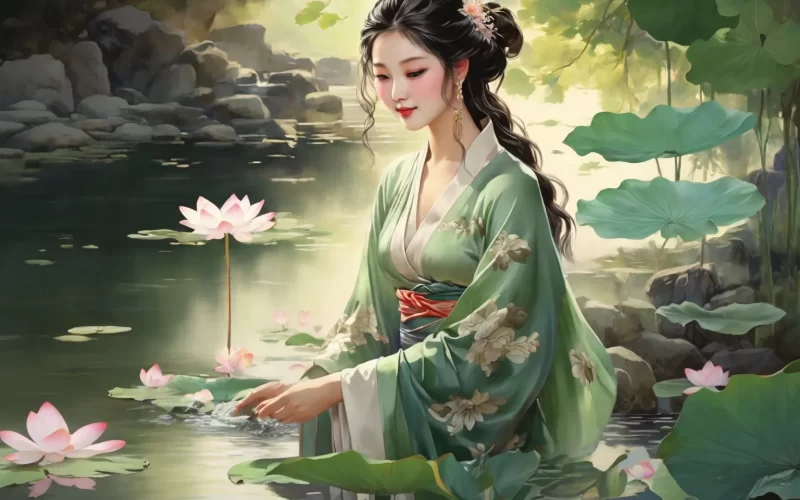
Beauty betrays — it did from the start.
The mirror waits. I have no heart.
If the royal eye feeds on more than skin,
What mask should this face screw itself in?

A warm wind. Bird‑cries splinter the air.
High sun. The flowers’ shadows press, everywhere.

Each year, the stream‑girls — they remember,
Fingers in the wet, plucking the summer.
Original Poem
「春宫怨」
杜甫
早被婵娟误,欲妆临镜慵。
承恩不在貌,教妾若为容?
风暖鸟声碎,日高花影重。
年年越溪女,相忆采芙蓉。
Interpretation
This poem was composed by the late Tang poet Du Xunhe. Born into humble circumstances, Du repeatedly failed the imperial examinations in his youth, finally passing the jinshi at the age of forty-six. However, his official career remained troubled due to the turbulent times, and he ultimately never gained significant recognition. During the late Tang period, political corruption and the darkness of the examination system meant talented individuals often languished in lowly positions, while the incompetent ascended rapidly by currying favor with the powerful. Living in such an era, the poet harbored deep frustration and resentment, yet had no outlet for it. Thus, he borrowed the traditional theme of "palace resentment," using the metaphor of a neglected palace lady to express his own frustration at unrecognized talent. The line "To win the king’s favor depends not on a lovely face" is both a portrayal of palace reality and a sharp critique of the unfairness in official appointments during the late Tang. This technique of "using the romantic to symbolize the political" has a long tradition, and Du Xunhe employs it masterfully.
First Couplet: "早被婵娟误,欲妆临镜慵。"
Zǎo bèi chánjuān wù, yù zhuāng lín jìng yōng.
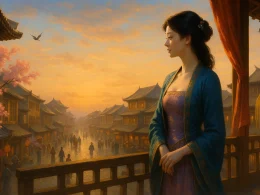
Too soon the lure of loveliness undid me;
Now, facing the mirror, I am too listless to paint my brows.
The opening is striking. The word "undid" in "Too soon the lure of loveliness undid me" is the poem's linchpin. Beauty, a natural gift, became the source of a life "undone"—selected for the palace because of her looks, she anticipated glory but instead found herself trapped in a gilded cage. The single word "undid" conveys a profound reflection on and helplessness towards fate. "Now, facing the mirror, I am too listless to paint my brows" depicts her present state: she wishes to adorn herself, yet feels too languid to begin. The word "listless" appears lazy on the surface but reveals a heart grown cold in essence—if no one will admire her, for whom should she adorn herself? This couplet, with its concise brushstrokes, outlines the palace lady’s life trajectory from "undone in youth" to "heart-dead in the present."
Second Couplet: "承恩不在貌,教妾若为容?"
Chéng ēn bù zài mào, jiào qiè ruò wéi róng?
To win the king’s favor depends not on a lovely face;
Then how can I hope to please by making myself up?
This couplet contains the poem’s sharpest edge. "To win the king’s favor depends not on a lovely face"—within the palace, winning favor relies not on beauty, but on flattery, pandering, and political machinations. These five words are both an exposé of palace secrets and a pointed allegory for the corruption in the contemporary bureaucracy. The rhetorical question, "Then how can I hope to please by making myself up?" carries self-mockery and bitter indignation: if beauty is useless, for whom, and for what purpose, should I adorn myself? This couplet pushes the palace lady’s despair to a deeper level and also foreshadows the recollection in the following lines.
Third Couplet: "风暖鸟声碎,日高花影重。"
Fēng nuǎn niǎo shēng suì, rì gāo huā yǐng chóng.
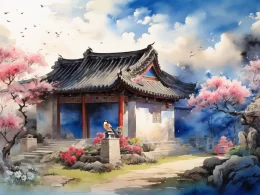
A warm wind brings a broken twitter of birdsong;
The sun is high, thick shadows of flowers lie.
Here, the brush takes a sharp turn, focusing purely on the spring scenery, yet this constitutes the poem’s most exquisite moment. Superficially, it depicts the bright, beautiful scene of a palace spring: the birdsong is "broken," suggesting its profusion and fragmented nature; the flower shadows are "thick," suggesting the luxuriance of blooming clusters. However, this lively spring scene starkly contrasts the inner loneliness and desolation of the palace lady. Writing sorrow amid joyful scenery redoubles the sorrow. The more vibrant the spring light outside the window, the colder the heart within; the more "broken" the birdsong, the more profound the palace’s silence seems; the "thicker" the flower shadows, the more intensely she feels her own solitude. This couplet does not utter a single word of complaint, yet the complaint emerges of itself.
Fourth Couplet: "年年越溪女,相忆采芙蓉。"
Nián nián Yuè xī nǚ, xiāng yì cǎi fúróng.
Year after year, the girls by the stream in her old homeland
Are still remembering the day they went lotus-gathering together.
The final couplet shifts from the present scene to memory, from the palace confines to her homeland. "The girls by the stream in her old homeland" refers to the companions of her youth before she entered the palace. The phrase "year after year" expresses the passage of time and the persistence of longing. "Are still remembering the day they went lotus-gathering together"—they still recall the days when they gathered lotus together, while the one who once gathered lotus is now confined deep within the palace, never to return. This touch is both a recollection of a freer past and a voiceless indictment of her present cage. The poet does not write about how the palace lady longs for home, but instead writes about her hometown companions still remembering her. This technique of writing from the opposite perspective makes the emotion more profound and nuanced.
Overall Appreciation
This poem is a masterpiece among late Tang "palace resentment" poetry. In its eight lines and forty characters, it encapsulates the entire life of a palace lady, from her entry into the palace to her fall from favor, from despair to memory. The poem unfolds in a first-person voice, with emotions progressing layer by layer, containing sighs about fate, critiques of reality, and nostalgia for the past.
Structurally, the poem presents a clear emotional progression. The first couplet begins with the word "undid," pinpointing the source of the tragedy. The second couplet continues with a rhetorical question, exposing the darkness of the palace. The third couplet turns with a spring scene, using joyful scenery to convey sorrow. The final couplet concludes with memory, using past freedom to contrast present imprisonment. The four couplets are tightly interlocked, with emotions deepening from resentment to indignation, from indignation to sorrow, and from sorrow to remembrance.
In terms of conception, this poem transcends ordinary "palace resentment" verse. It is not merely the lament of a neglected palace lady; it is also the vessel for the poet’s own frustration at unrecognized talent. The five words, "depends not on a lovely face," are both a truth of the palace and a portrait of the bureaucracy; they convey the sorrow of a woman and the indignation of a scholar. This double allegory gives the poem a universal significance of social critique.
Artistically, the poem’s most exquisite aspect lies in its use of contrast: the disparity between beauty and fate (first couplet), the paradox between winning favor and possessing beauty (second couplet), the juxtaposition of lively spring scenery and a desolate inner state (third couplet), and the contrast between past freedom and present imprisonment (final couplet). Multiple layers of contrast intertwine, enriching the poem’s meaning and leaving endless resonance.
Particularly noteworthy is the brilliance of the third couplet, "A warm wind brings a broken twitter of birdsong; / The sun is high, thick shadows of flowers lie." These two lines are purely descriptive, yet they become the emotional climax of the entire poem. The "broken" birdsong and the "thick" flower shadows are both realistic scenes and reflections of her state of mind—is not her heart similarly "broken"? Are not her sorrows similarly "thick" and heavy? This state of perfect fusion of scene and emotion represents the highest pursuit of classical Chinese poetry.
Artistic Features
- Dual Allegory, Using Objects to Express Ideals: The surface subject is the neglected palace lady, but the true subject is the unrecognized scholar. "Depends not on a lovely face" is both palace reality and a portrayal of the official world. This technique of "using the romantic to symbolize the political" imbues the poem with profound social critical significance.
- Using Joy to Write Sorrow, Redoubling the Sorrow: The third couplet uses bright spring scenery to contrast a lonely state of mind. The more "broken" the birdsong and the "thicker" the flower shadows, the colder the heart and the more desolate the palace seem. This technique of contrast makes the emotion more intense and moving.
- Vivid Contrasts, Rich Layers: The paradox of beauty and fate, the misalignment of favor and looks, the contrast between lively spring scenery and a desolate inner world, the antithesis of past freedom and present imprisonment. Multiple interwoven contrasts allow the poetic meaning to deepen progressively.
- Condensed Language, Far-reaching Meaning: Words like "undid," "listless," "broken," "thick," and "remembering" are precise, vivid, and rich in implication. The entire poem has no superfluous words, yet contains boundless meaning.
- Writing from the Opposite Perspective, Subtle and Profound: The final couplet does not describe the palace lady longing for home but describes the folks at home remembering her. This technique of writing from the opposite angle makes the emotion more profound and subtle. The single word "remembering" expresses the shared sorrow of two separated parties.
Insights
Using the lament of a palace lady, this poem reveals a timeless human predicament: True worth is often ignored, while superficial glamour is eagerly pursued. The five words, "depends not on a lovely face," speak not only to the darkness of the palace but also to the alienation possible in any era—when talent is no match for connections, when actual achievement is less valued than flattery, the individual’s sense of loss and indignation becomes as profound as that of the palace lady in the poem.
Yet, the palace lady in the poem does not choose to pander; she faces the mirror with "listlessness," confronting injustice with silence. This adherence is a final defense of her self-worth. It teaches us: when external systems of evaluation are distorted, inner clarity and self-respect are the most precious bottom line.
On a deeper level, the concluding line, "Year after year, the girls by the stream in her old homeland / Are still remembering the day they went lotus-gathering together," shows us the power of memory. Reality may be unchangeable, but the memory of those lotus flowers, that time of freedom, forever belongs to her. It reminds us: no matter what predicament we find ourselves in, we can preserve a pure land in our hearts, allowing those beautiful past moments to become a sanctuary for the spirit.
In this era of pluralistic values and confused standards, this poem still holds strong contemporary relevance. It reminds us: Do not be swept away by external evaluations; do not deny yourself because of temporary setbacks. True worth will eventually reveal itself in the long river of time; and those who remain true to themselves will ultimately find their own lotus flowers in memory.
About the Poet
Du Xunhe (杜荀鹤 846 - 904), a native of Shitai, Anhui, was a realist poet of the late Tang Dynasty. He became a jinshi (presented scholar) in the second year of the Dashun era (891 AD). During the Later Liang Dynasty, he was appointed to the Hanlin Academy but passed away just five days later. His poetry carried forward the spirit of the new yuefu (Music Bureau) tradition established by Du Fu and Bai Juyi, focusing exclusively on the sufferings of the common people. His poetic style was simple, unadorned, and deeply poignant. He often employed a relatively free metrical form, later known as the "Du Xunhe Style," which stood out as a unique and powerful voice amidst the ornate and decadent poetic trends of the late Tang period.