


As years advance, all I crave is peace of mind;
To be free from the world’s myriad ties, resigned.
I ask myself, and this answer I always find:
What compares to the joy of home, so kind?

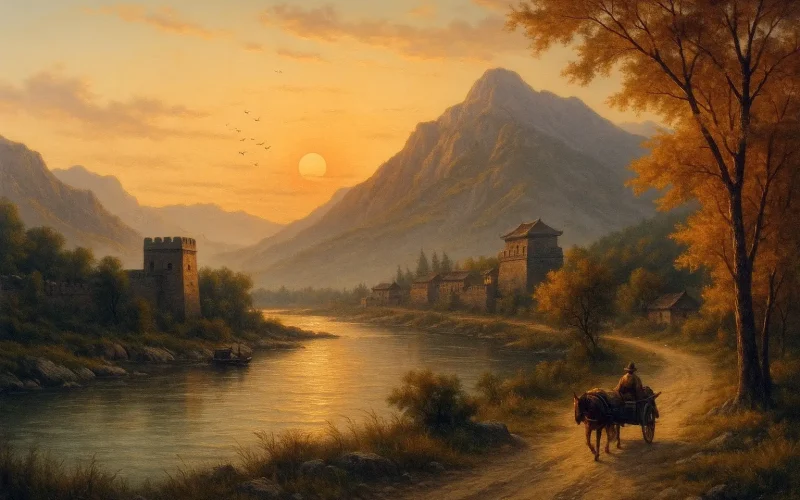
A breeze through the pines loosens the sash I wear;
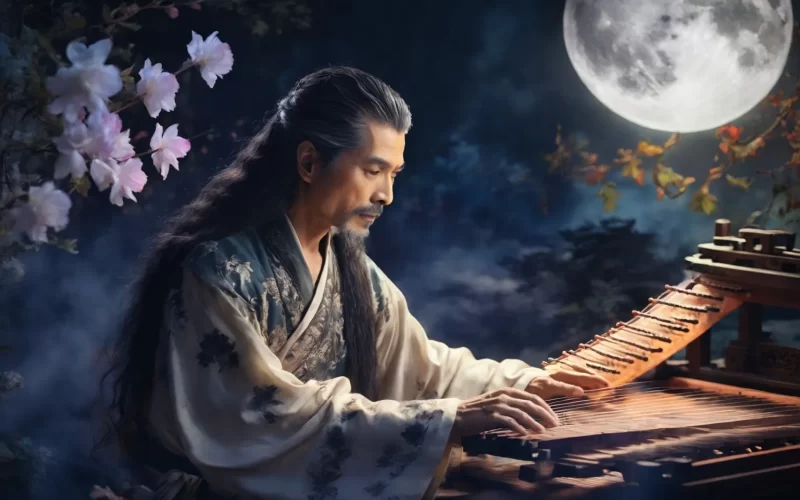
The mountain moon brightens the lute I play there.
You ask of success or failure, loss or gain?…
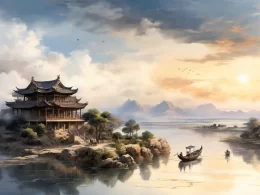
Hark! A fisherman’s song wafts over the lake, clear and plain.
Original Poem
「酬张少府」
王维
晚年惟好静,万事不关心。
自顾无长策,空知返旧林。
松风吹解带,山月照弹琴。
君问穷通理,渔歌入浦深。
Interpretation
This poem, a product of Wang Wei’s late years, is a deceptively light yet profoundly meaningful philosophical piece and a spiritual confession. Composed during his lucid period of complete retirement to the hills and streams of Wangchuan after experiencing the An Lushan Rebellion and the vicissitudes of official life, the word "A Reply" in the title indicates a spiritual dialogue between friends. Wang Wei’s poetic response not only addresses Vice-Prefect Zhang’s concern but also serves as a profound self-analysis and solemn affirmation of his own state of being in old age. In minimalist language, the poem constructs a complete spiritual map moving from "introspection" to "externalization," from "resignation" to "transcendence," ultimately arriving at a realm of "wordless" understanding. It stands as a prime example of Wang Wei's ability to infuse worldly sentiment with Zen insight and express profound truth through understated language.
First Couplet: 晚年惟好静,万事不关心。
Wǎnnián wéi hào jìng, wàn shì bù guānxīn.
In my later years, I've learned to love repose;
Worldly affairs no longer trouble my mind.
The opening states the poet's mind directly, with a calm yet definitive tone. "In my later years" locates him in time and declares a stage of life. "I've learned to love repose" is a concentrated expression of his value orientation; the word "only" exclusively highlights the supreme status of "repose." "Worldly affairs no longer trouble my mind" is not indifference but a conscious act of spiritual unloading and attention reclamation after the tumult of life's experiences. This is both a description of his current state and a gentle declaration: the boundaries of his world have been redrawn, with "repose" at its center. These two lines establish the poem's introverted, self-sufficient, and slightly defensive emotional tone.
Second Couplet: 自顾无长策,空知返旧林。
Zìgù wú chángcè, kōng zhī fǎn jiùlín.
Looking within, I see no lasting plan to serve;
Only this I know: I must return to the woods of old.
This couplet reveals the deeper reasons for "loving repose" and an "untroubled mind," disclosing complex feelings. "Looking within, I see no lasting plan to serve" is clear self-awareness and an indirect expression of the era's predicament—it is not that he would not act, but that he cannot, or perhaps the times offer no scope for action. Here lies humility, resignation, and perhaps a touch of irony. The word "only" in "Only this I know" is powerfully poignant: it signifies that this "knowing" is the sole possibility remaining after others have been excluded, carrying a desolate sense of having no other choice, and the relief that comes with clear-sighted acceptance. The "woods of old" are not merely the hills of Wangchuan but a symbol of his spiritual homeland and authentic state of being.
Third Couplet: 松风吹解带,山月照弹琴。
Sōngfēng chuī jiě dài, shānyuè zhào tánqín.
Through pines, the breeze plays with my loosened sash;
Over the hill, the moon shines on my lute.
The focus shifts abruptly from inward confession to a scene of poetic dwelling, the source of the poem's ethereal beauty. These two lines sketch a silhouette of reclusive life where heaven and man unite, and mind and object blend. "Through pines, the breeze plays with my loosened sash" depicts perfect intimacy between body and nature: the breeze is the active comforter, the man the passive receiver. The "loosened" sash signifies physical relaxation and, more importantly, the lowering of psychological defenses and the unfurling of spirit. "Over the hill, the moon shines on my lute" is a deep, silent dialogue between spirit and the cosmos: the moon is the eternally serene witness, the lute the externalization of the heart's music. The shining and the playing, silence and sound converge, creating a self-sufficient, perfectly realized present moment. The self seems absent here, yet is present everywhere.
Fourth Couplet: 君问穷通理,渔歌入浦深。
Jūn wèn qióng tōng lǐ, yúgē rù pǔ shēn.
You ask about the truth of Failure and Success…
Hark, on the stream, the fisherman's song grows faint, lost mid the river bends.
The poem concludes with an open-ended, Zen-like and poetic response, its resonance enduring. "You ask about the truth of Failure and Success" connects to the title, pinpointing the core of Vice-Prefect Zhang's question—the way of adversity and prosperity, the eternal anxiety of the scholar-official. The poet's reply is not a logical argument but an image: "Hark, on the stream, the fisherman's song grows faint, lost mid the river bends." The fisherman's song symbolizes reclusion, freedom, and detachment from worldly strife; "grows faint, lost mid the river bends" describes the sound gradually fading, merging into the vastness of nature. This answer seems irrelevant yet is profoundly pertinent: it speaks by not speaking, answers by not answering. It implies that the true "truth of Failure and Success" lies not in linguistic discrimination but in the practice of life and the experience of existence, like the fisherman's song merging with nature and dissolving into formlessness. The questioner should cease questioning and instead listen, and merge.
Holistic Appreciation
This is a finely crafted poem of "spiritual dialectics," rich in layered artistic conception. It follows an internal logic of "presenting the dilemma—depicting liberation—implying the resolution": the opening couplet states the outcome (a preference for tranquility); the second reveals the reasons (lacking grand plans, yet knowing to return to nature); the third provides tangible evidence (the present life of breeze, moon, lute, and pines); and the fourth offers the poem's spiritual ascent—a poetic response to life's ultimate question. Through these four couplets, the poem moves from introspection to outward expression, from the concrete to the abstract, completing a spiritual leap from "having something to express" to "transcending the need for words."
Wang Wei's genius lies in transforming what might be seen as a resigned and defensive "love of repose in old age" into an active and fulfilling mode of existence, rich in aesthetic value and existential depth, through the consummate poetry of "Through pines, the breeze plays with my loosened sash; / Over the hill, the moon shines on my lute." His response to the question of "failure and success" in the final couplet further reveals his wisdom in harmonizing Daoist insight—where "the meaning grasped, the words are forgotten"—with the Zen tenet of "not setting up words." He does not dismiss the question itself but instead offers a realm of experience that transcends it. By immersing oneself in the scene of "the fisherman's song lost down the river bend," the very distinction between failure and success naturally fades away. Here, philosophy becomes poetry, and poetry becomes philosophy.
Artistic Merits
- Dissolution and Transformation of Opposites: "Repose" versus "worldly affairs" (activity); "no lasting plan" (powerlessness) versus "return to the woods" (empowerment); "Failure and Success" (worldly values) versus "fisherman's song" (natural values). Through life practice and poetic imagery, the poem quietly resolves these oppositions, guiding them toward a higher harmony.
- Minimalist Imagery, Rich Symbolism: The "pine breeze," "mountain moon," "loosened sash," "playing the lute," "fisherman’s song," and "deep inlet"—each image is fresh and simple, yet each serves as a culturally encoded symbol. Together, they evoke an ideal realm of reclusion, integrity, freedom, and harmony between humanity and nature. The language is concise, yet its suggestiveness is boundless.
- Skillful Use of Question-and-Answer Form and Elevation of Realm: The poem implies a Q&A structure. The poet first "answers himself" regarding his state of life (the first six lines), then "answers" his friend's question (the final couplet). This ultimate answer replaces discourse with scene, substitutes reasoning with image, elevating the poem from a conventional reply to an ineffable realm of philosophy.
- Utmost Understatement and Lasting Resonance: The poem uses no obscure words and contains no intense lyrical outbursts; its tone is even and serene. Yet, the desolation in "only," the contentment in "plays with my loosened sash," and the boundlessness in "lost down the river bend" all contain, within their plainness, an emotionally moving power and a philosophically evocative charm, truly achieving the artistic pinnacle of "understated yet rich, seemingly near yet profoundly far."
Insights
This poem is like a serene yet profound evening song of the soul, echoing in the depths of every heart facing life's transitions and seeking peace. It reveals that when external "lasting plans" fail and the "worldly affairs" of the world grow wearisome, turning inward to "love repose" is not a retreat but can be a profound wisdom and necessary strategy for being. This "repose" needs to be nourished by nature and art, as in "pine breeze" and "moon over the hill," and ultimately manifests as the ability to treat life's fundamental questions with detachment, merging into a greater rhythm of existence, much like the "fisherman's song lost down the river bend."
In a modern society filled with anxiety over "Failure and Success" and craving for "lasting plans," this poem offers a dose of cool clarity. It reminds us that perhaps the real answer lies not in calculating "Failure and Success" more shrewdly, but in whether we can cultivate the art of living that "loosens the sash" to the pine breeze and "plays the lute" under the hill's moon. Finally, we must let our lives, like that fading fisherman's song, passionately yet untethered, be "lost down the river bend"—merging into a current of meaning broader and more eternal than personal gain or loss. Wang Wei's reply, spanning a millennium, remains one of the most elegant and powerful poetic answers to the eternal questions of "how to spend one's later years" and indeed, "how to live a whole life well."
Poem translator
Kiang Kanghu
About the poet
Wang Wei (王维), 701 - 761 A.D., was a native of Yuncheng, Shanxi Province. Wang Wei was a poet of landscape and idylls. His poems of landscape and idylls, with far-reaching images and mysterious meanings, were widely loved by readers in later generations, but Wang Wei never really became a man of landscape and idylls.