


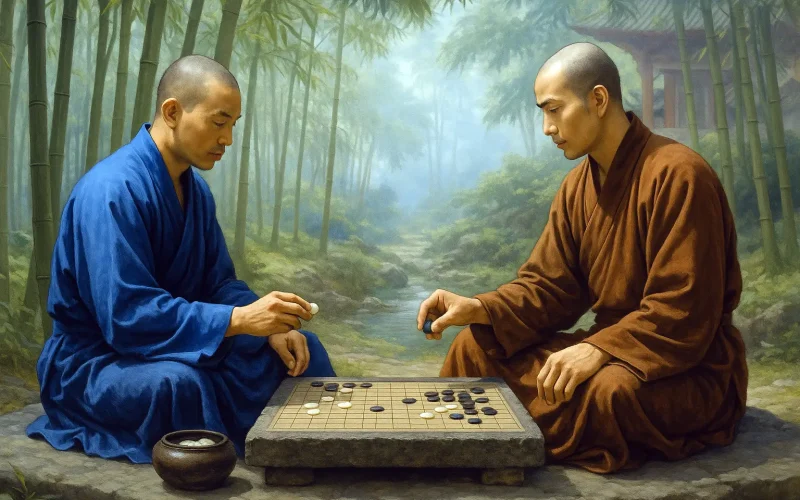
Two monks sit face to face to play;
Bamboo shade cools the chessboard grey.
Their shadows lost in bamboo gloom,
We hear but stones’ taps in the room.
Original Poem
「池上二绝 · 其一」
白居易
山僧对棋坐,局上竹阴清。
映竹无人见,时闻下子声。
Interpretation
This poem resembles a miniature zen-like tableau, capturing and crystallizing the most profound moment within the mundane scene of mountain monks playing chess, all within the brief span of twenty characters. The poet discards all external narration and lyrical expression, employing only pure auditory and visual description to construct a deep, tranquil realm that is both still and vivid, both present and hidden. It showcases his supreme poetic skill in "hearing thunder in silence and perceiving the ultimate truth in the ordinary."
First Couplet: 山僧对棋坐,局上竹阴清。
Shān sēng duì qí zuò, jú shàng zhú yīn qīng.
Two mountain monks sit facing, intent upon their game; / Upon the board, the bamboo shade is cool and clear of frame.
Explication: The opening directly presents the core figures and action of the scene with clean precision. "Mountain monks" establishes their identity, carrying an aura of reclusion beyond worldly concerns. "Sit facing… their game" freezes the action, hinting at a static, intellectual exchange. "The bamboo shade is cool and clear upon the board" is key to rendering the atmosphere. The shade of the bamboo not only blocks the sun but, with its "cool and clear" quality (suggesting purity, solitude, and refinement), permeates the entire chess game and the surrounding mood. The word "clear" ("清" qīng) is both a visual sensation and a psychological one, establishing the ethereal, lucid tone for the entire poem. Bamboo and monk here merge in harmony, co-creating a realm of clarity.
Second Couplet: 映竹无人见,时闻下子声。
Yìng zhú wú rén jiàn, shí wén xià zǐ shēng.
Shrouded by bamboo, their forms to no one’s sight appear; / At times, the sound of stones placed on the board alone we hear.
This couplet is the soul of the poem. Through the skillful handling of "unseen" and "hearing the sound," it elevates the poetic meaning to a depth of serene mystery. "Shrouded by bamboo, their forms to no one’s sight appear" creates spatial separation and concealment: the bamboo grove becomes a natural screen, isolating the monks from worldly gaze, emphasizing the privacy and transcendent nature of their activity. Yet, "the sound of stones placed on the board" breaks the absolute silence and hiddenness. "At times" indicates the occasional, crisp, and rhythmic nature of the sound. This sound penetrates the bamboo curtain, becoming the only clue for the outside world to perceive their presence. Here, the classic technique of "using sound to highlight stillness" is employed, and taken a step further: This "sound of placing stones" not only sets off the stillness but is itself the sound of stillness condensed—the clear resonance of formless zen-mind cast into the world of form. Not seeing the people but hearing their sound gives rise to limitless imagination, instantly rendering the mood vast and distant.
Holistic Appreciation
This pentasyllabic quatrain is a paradigm of "atmosphere creation through extreme economy, seeking the boundless." Its structure masterfully presents a perceptual process of "visual focus – visual disappearance – auditory prominence." The first line establishes the figures and event; the second implants the environment and mood with "bamboo shade"; the third line, however, makes the visual subject (the people) disappear into the environment (bamboo); the final line elevates an auditory detail (the sound of stones) into the pivot of the atmosphere. The four lines complete an aesthetic cycle moving from "presence" (people, chess, bamboo) to "absence" (unseen), and then generating a new "presence" (sound) from within that "absence." The poet acts like a masterful director, first giving a close-up, then pulling the shot back to hide the figures in the depth of the scene, finally leaving only the most suggestive auditory symbol, guiding the audience (reader) to complete the picture with imagination. This achieves the highest artistic realm of "sound emerging from profound silence" and "perceiving the infinite within the finite." The poem deeply captures the zen delight of "direct pointing to the mind, beyond words." The "contention" of the chess game dissolves into the "clarity" of the bamboo shade; the "forms" of the monks disappear into the "sound" of the stones. All opposites dissolve into harmony within the stillness.
Artistic Merits
- Economy and Symbolism of Imagery: The poem's core images are only three: monk, chess, bamboo. The monk symbolizes transcendence; chess symbolizes wisdom (and can metaphorically represent worldly affairs); bamboo symbolizes pure integrity. Their combination naturally forms an ideal realm rich in cultural metaphor and zen thought—concise in words yet abundant in meaning.
- Layered Auditory-Visual Fusion: The first two lines emphasize vision (sitting, bamboo shade); the last two focus on hearing (the sound). "Shrouded by bamboo" cleverly connects vision (bamboo) with the absence of vision (unseen). The shift between sight and sound is natural, creating rich layers that together build a three-dimensional sense of space and mystery.
- The Art of Suggestion in "Hearing Sound Without Seeing People": This is the poem's most distinctive artistic feature. Concealing the subjects and revealing only their sound (of placing stones) greatly stimulates the reader's imagination. This sound is singular yet sufficient. It gives life and depth simultaneously to the still bamboo grove and the unseen players, representing the ultimate application of the art of suggestion.
- Extreme Purity and Restraint of Language: The entire poem uses not a single ornate word or explicit lyrical phrase. It relies purely on the most basic combinations of nouns and verbs, nearly vernacular, yet achieves an effect as subtle and far-reaching as an ink wash painting. This language, where "the utmost brilliance returns to simplicity," embodies the poet's consummate skill.
Insights
This work reveals that the highest art and deepest artistic conception often arise from minimal intervention and the most subtle discernment. Bai Juyi teaches us that genuine "silent observation" is not about seeing everything, but rather knowing when to cease looking—and instead, to employ other senses, such as hearing, to capture the delicate traces that reveal true essence. The "sound of stones" passing through the bamboo serves as the aesthetic key that penetrates surface appearances to touch the core.
In our contemporary era of information overload and fractured attention, this poem offers a moment of soothing clarity. It reminds us that what is essential may not lie in pursuing more "sight," but in learning the wisdom of being "shrouded by bamboo, unseen"—of actively creating spaces of isolation and privacy for ourselves. Concurrently, we should cultivate the sensitivity to perceive "the intermittent sound of stones"—the ability to distinguish truly meaningful and beautiful resonances, whether in the physical world or within the heart, amidst the prevailing noise. This capacity for focused attention within seclusion, and for profound listening within silence, may represent a vital form of cultivation for preserving spiritual independence and inner tranquility in our age. It inspires us to recognize that upon the reflective "pond" of our own minds, we too may engage in a game of unseen wisdom, where only the lucid sound of stones falling is heard.
About the Poet
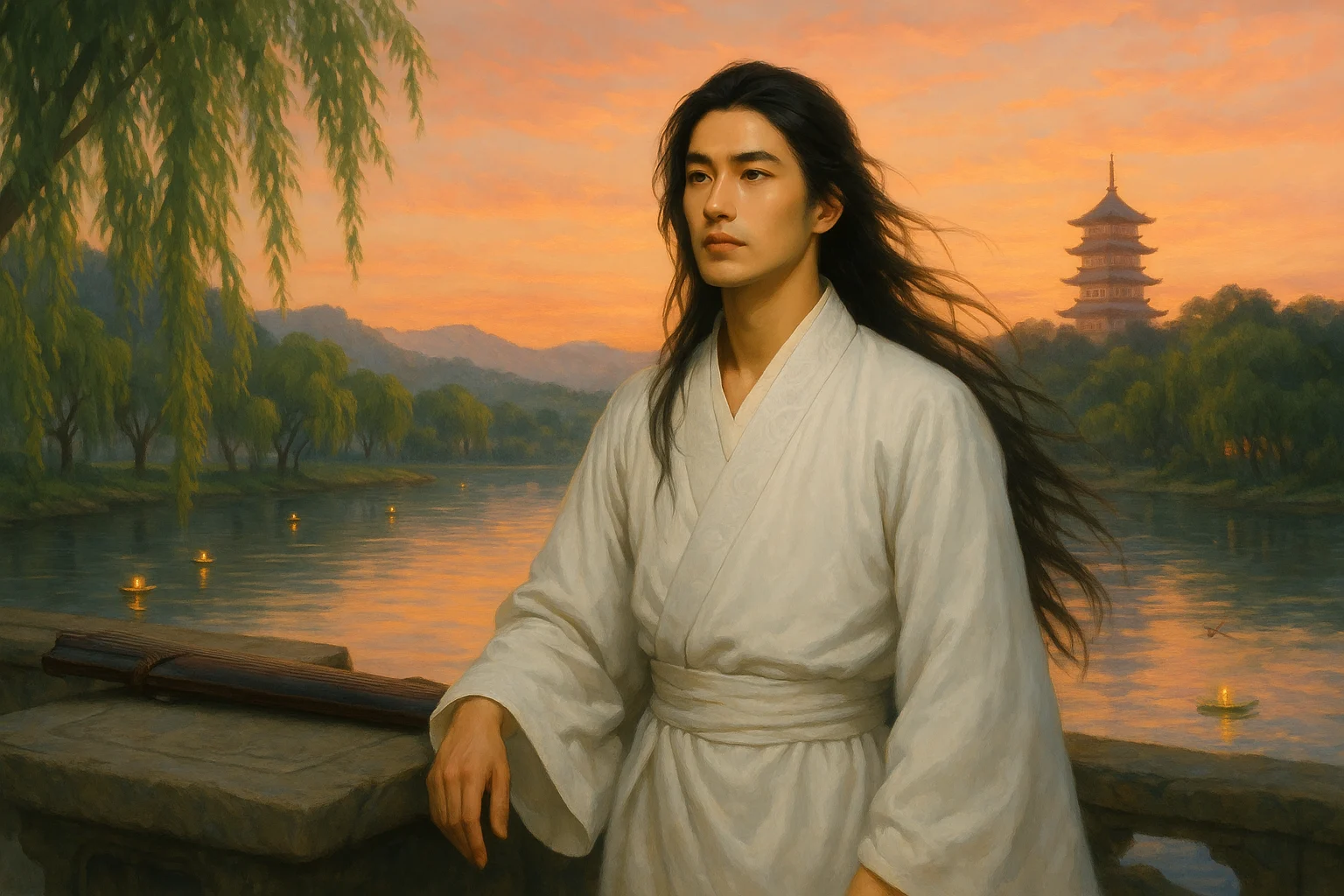
Bai Juyi (白居易), 772 - 846 AD, was originally from Taiyuan, then moved to Weinan in Shaanxi. Bai Juyi was the most prolific poet of the Tang Dynasty, with poems in the categories of satirical oracles, idleness, sentimentality, and miscellaneous rhythms, and the most influential poet after Li Bai Du Fu.