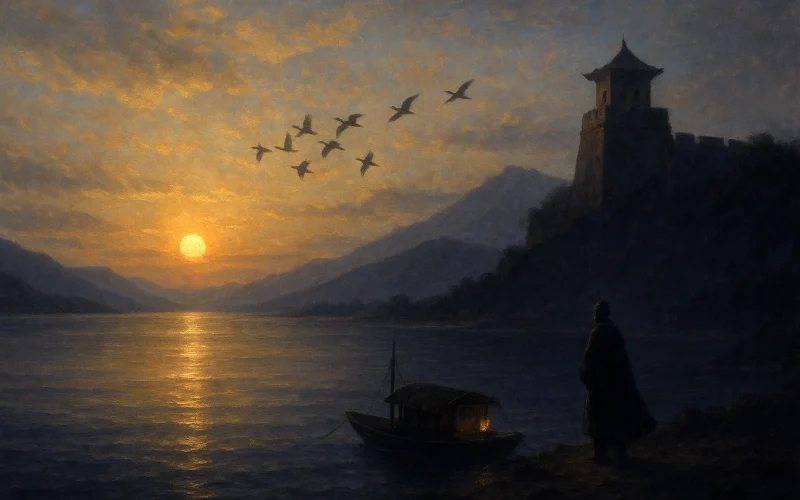



Here, where you spent your three years' exile,
To be mourned in Chu ten thousand years,
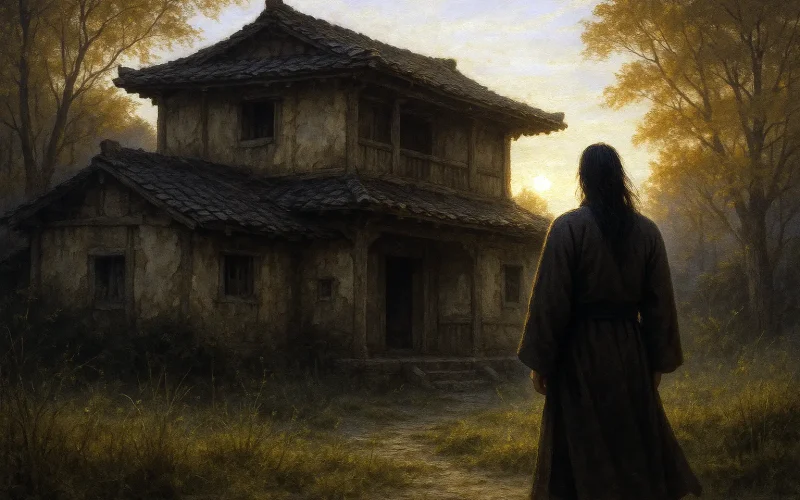
Can I trace your footprint in the autumn grass --
Or only slanting sunlight through the bleak woods?

If even good Emperor Wen was cold-hearted,
Could you hope that the dull river Xiang would understand you,
These desolate waters, these taciturn mountains,
When you came, like me, so far away?
Original Poem
「长沙过贾谊宅」
刘长卿
三年谪宦此栖迟, 万古惟留楚客悲。
秋草独寻人去后, 寒林空见日斜时。
汉文有道恩犹薄, 湘水无情吊岂知?
寂寂江山摇落处, 怜君何事到天涯?
Interpretation
This poem was composed around AD 766, at a time when Liu Zhangqing, having once again been demoted for "careless speech," was traveling to assume the lesser post of Sima of Muzhou, having been transferred from his position as Liuhou of E-Yue. The poem was written as he passed through Changsha on this journey. "刚而犯上,两遭迁谪"—these eight characters almost entirely describe the trajectory of Liu Zhangqing's later life. This latest demotion came only a few years after his previous one; the hardship of his official career and the profound pain in his state of mind are easy to imagine.
Changsha, anciently known as Tanzhou, was the place where Jia Yi of the Western Han was exiled. Jia Yi, brilliant and young, was valued by Emperor Wen of Han, yet due to slander was demoted to Tutor to the Prince of Changsha, where he died in despondency. While journeying in exile, Liu Zhangqing visited Jia Yi's former residence at night. Facing the desolate shrine, ancient trees, cold mist, and withered grass, the figure of that "fellow sufferer" from a thousand years past seemed to merge with him quietly across time and space. The character "过" (guò) in the title does not mean a casual passing-by, but implies a deliberate search, a visit to pay respects. One cold night, one desolate residence, two disheartened literati separated by a millennium meet in this poem.
Liu Zhangqing held a special affinity for Jia Yi, frequently alluding to him in his poems precisely because their fates were so similar—both were esteemed in the world for their talent, both were cast aside by the court for their integrity and outspokenness, both were exiled to this land of Chu. Was not Jia Yi, that "banished official for three years," a portrait of the poet himself? Was not that sorrow "left for all ages" the shared sigh of talented scholars throughout history? This poem is both a lament for antiquity and a sorrow for the present; it pities another, and pities the self.
First Couplet: "三年谪宦此栖迟,万古惟留楚客悲。"
Sān nián zhé huàn cǐ qīchí, wàn gǔ wéi liú Chǔ kè bēi.
Banished three years, you lived here, lonely and forlorn; An exile’s grief is left for ages yet unborn.
The poem opens by introducing Jia Yi's exile as a reflection of the poet's own situation. "三年谪宦" refers to Jia Yi's years in Changsha, and also metaphorically alludes to the poet's own life in exile; "此栖迟" specifies the location in Changsha, and further implies the helplessness of "dwelling here, lingering here." The next line, "万古惟留楚客悲", abruptly expands time and space—Jia Yi has been gone for a thousand years; only this sorrow of the "Chu exile" remains, unending as the Xiang River. The term "楚客" has a double meaning, referring both to Jia Yi, who died in exile in Chu, and to the poet himself, now adrift in the land of Chu. From the very start, the poem establishes a somber, sorrowful tone.
Second Couplet: "秋草独寻人去后,寒林空见日斜时。"
Qiū cǎo dú xún rén qù hòu, hán lín kōng jiàn rì xié shí.
Alone, I seek your footprints 'mid autumn grasses dead; In the dreary wood I see but the sun turning red.*
This couplet describes the desolate scene of the old residence, and also the poet's mood as he pays his respects. "独寻" reveals the poet's loneliness—a thousand years later, only he remembers to come here and mourn this ancient; "空见" reveals his disappointment—searching and seeking, he finds only the desolation of the cold woods, the vastness of the setting sun. The three images "秋草", "寒林", and "日斜" layer upon each other, pushing the bleakness of the ancient shrine and old residence to its extreme. The phrase "人去后" refers both to after Jia Yi's departure, and to after the poet's own eventual departure—a thousand years from now, who will come to mourn this "Chu exile"?
Third Couplet: "汉文有道恩犹薄,湘水无情吊岂知?"
Hàn wén yǒu dào ēn yóu báo, Xiāng shuǐ wú qíng diào qǐ zhī?
The emperor, though wise, gave ear not to your advice; The river, feelingless, knows not your sacrifice.*
The previous two couplets describe scenes; this couplet suddenly introduces reflection, the brush turning sharply to point directly at the core. The four characters "汉文有道" are exceptionally clever—Emperor Wen of Han is historically known as an enlightened ruler; he appreciated Jia Yi, yet in the end could not employ him fully, leaving him to die in despondency. That an "enlightened" ruler still showed "thin favor" precisely reveals the ruthlessness of fate and the peril of official life: if even a wise ruler was thus, how much more so the present age? The next line, "湘水无情", alludes to the典故 of Qu Yuan drowning himself, and also subtly implies the fickleness of the world. Qu Yuan once wandered and drowned himself by the Xiang River; Jia Yi, crossing the Xiang, wrote a rhapsody mourning Qu Yuan. Now Liu Zhangqing passes this place again, mourning Jia Yi, yet knows deeply that "吊岂知"—the river is heartless, unknowing of his grief; the ancients are gone, unheard of his sigh. This loneliness, with no one to tell, no confidant to speak to, is precisely the most painful point of the entire poem.
Fourth Couplet: "寂寂江山摇落处,怜君何事到天涯?"
Jìjì jiāngshān yáoluò chù, lián jūn hé shì dào tiānyá?
O Master, why should you, banished, come to this riverside, To share with the stream in silence the mountains' grief and pride?*
The final couplet closes the emotion with a scene, ending in a long sigh. "寂寂江山摇落处" is both the actual scene before his eyes—dusk gathering, the autumn wind bleak, plants withering; and also a portrayal of the poet's inner world—a rootless life, like these falling, withered leaves. The two characters "怜君" seem to pity Jia Yi, but in reality pity the self; they seem to ask of the ancient, but in reality ask of Heaven: for what reason are we scholars banished to this distant end of the world? This question has no answer, and needs none. The indignation, the helplessness, the unwillingness—all are contained within this single sigh, its lingering sound faint but unbroken.
Holistic Appreciation
This is a pivotal work among Liu Zhangqing's poems of exile. The entire poem consists of eight lines and fifty-six characters. Using the visit to Jia Yi's residence as its entry point, it merges lament for antiquity with sorrow for the present, pity for another with self-pity, description with reflection, revealing the poet's deep questioning of his own fate during his journey of exile.
Structurally, the poem presents a progressive layering from past to present, scene to emotion, external to internal. The first couplet opens with Jia Yi's exile, naming the object of reverence, establishing the tone of sorrowful lament. The second couplet describes the desolate scene of the old residence, using "独寻" and "空见" to outline the poet's figure paying respects. The third couplet suddenly introduces reflection, using Emperor Wen's "enlightened rule" to contrast the "thinness" of his favor, using the Xiang River's "heartlessness" to contrast the depth of his own feelings. The final couplet closes emotion with a scene, gathering the emotion accumulated in the first six lines with the question "怜君何事到天涯?" Between the four couplets, the poem moves from past to present, scene to emotion, narration to reflection, reflection to sigh, deepening layer by layer, forming a seamless whole.
Thematically, the core of this poem lies in the character "怜" (lián, to pity, to lament). The "sorrow of the Chu exile" in the first couplet pities the ancient, and also pities the self. The "独寻" and "空见" of the second couplet pity the poet's own loneliness, and also pity the ancient's solitude. The "thin favor despite enlightenment" and "who knows my mourning?" of the third pity the ancient's lack of recognition, and also pity the poet's own lack of recognition. The two characters "怜君" in the final couplet gather all of this to a single point—pity for Jia Yi is also self-pity; self-pity is also pity for all under heaven who, talented, are cast aside, or loyal, are banished. This technique of extending personal sorrow to a lament shared throughout the ages is precisely where Liu Zhangqing surpasses the ordinary.
Artistically, the poem's most moving aspect lies in the dual reflection of "past and present interwoven, other and self as one." The poet writes of Jia Yi, yet every stroke is of himself; he writes of Emperor Wen, yet every line is of the present age; he writes of the Xiang River, yet every word is of the heartless world; he writes of the withering landscape, yet everywhere is his own rootlessness. Jia Yi and the poet are nearly indistinguishable in this poem—to pity Jia Yi is to pity the self, to mourn the ancient is to mourn oneself. This technique of merging personal fate into the long river of history is precisely the highest achievement of the classical Chinese poetic method of "borrowing the past to express present feeling."
Artistic Merits
- Past and Present Interwoven, Other and Self as One: The entire poem uses Jia Yi as a reflection of the self; every stroke writes of the ancient, yet every stroke writes of the self. Pity for another and self-pity merge into one; sorrow from past to present runs as a single thread.
- Scene Contains Emotion, Emotion Contains Reflection: The second couplet describes scene yet emotion lies within; the third couplet reflects yet emotion grows deeper. Scene, emotion, and reflection intertwine, somber and forceful, deeply moving.
- Allusion Used Exquisitely, Contrast Powerful: "Emperor Wen was enlightened" contrasts "favor was still thin"; "the Xiang River is heartless" contrasts "who knows my mourning?" Using historical facts as a mirror, it reflects the coldness of reality, the hardship of fate.
- Concise Language, Lingering Resonance: The entire poem has no superfluous words. The question "怜君何事到天涯" transforms a heart full of sorrow and indignation into a single sigh. The words end, but the meaning is endless.
Insights
Using the visit to Jia Yi's residence as a thread, this poem speaks to an eternal theme—the unrecognized scholar, a sorrow shared across all ages.
It first allows us to hear the "echo of history." Liu Zhangqing and Jia Yi, separated by nearly a millennium, yet through similar circumstances, complete a dialogue across time and space in this poem. Jia Yi was "a banished official for three years" here; Liu Zhangqing also passed through in exile. Jia Yi, "concerned for the Han," was distanced; Liu Zhangqing was also exiled for "careless speech." History seems to repeat itself; tragedy seems endless. This writing of sorrow shared across the ages gives individual grief historical weight, elevating a moment's indignation into an eternal question.
On a deeper level, this poem prompts us to contemplate the paradox of the "enlightened ruler and thin favor." Emperor Wen of Han is historically known as enlightened, yet still could not fully employ Jia Yi; the ruler of the present age may also not be foolish, yet similarly cannot tolerate loyal, outspoken men. "Enlightened" yet "favor was still thin"—these five characters describe the deepest helplessness of literati through the ages: it is not because the ruler is foolish, but because of fate; not for lack of talent, but because of fortune. This helplessness is more sorrowful than encountering a foolish ruler—because there is no one to blame, it can only be ascribed to heaven's will.
And what is most moving is that unyielding persistence in the poem, that sense of "though I die nine times, I still shall not regret." Jia Yi, banished to Changsha, still worried for the Han; Liu Zhangqing, twice demoted, still held to his resolve. That figure "独自寻觅" amidst the autumn grass is lonely, yet also persistent; that "寂寂江山" in its withering is bleak, yet also a reflection of the poet's spiritual world. Amidst the vicissitudes of fate, they may sigh, they may grieve, but they never abandon their commitment to ideals, their sense of moral responsibility. This character is precisely the most precious tradition of China's scholar-officials through the ages—a person may sink low, but aspiration cannot; the body may be banished, but the heart cannot.
This poem writes of a Tang dynasty exiled literatus, yet allows everyone who encounters injustice or hardship in reality to find resonance within it. That solitary figure amidst the autumn grass and cold woods is the figure of every disappointed person; that sigh of "怜君何事到天涯" is the shared voice of all unrecognized talent. This is the vitality of poetry: it writes of one person's experience, but reads as the heart's concern of all.
Poem Translator
Kiang Kanghu
About the Poet
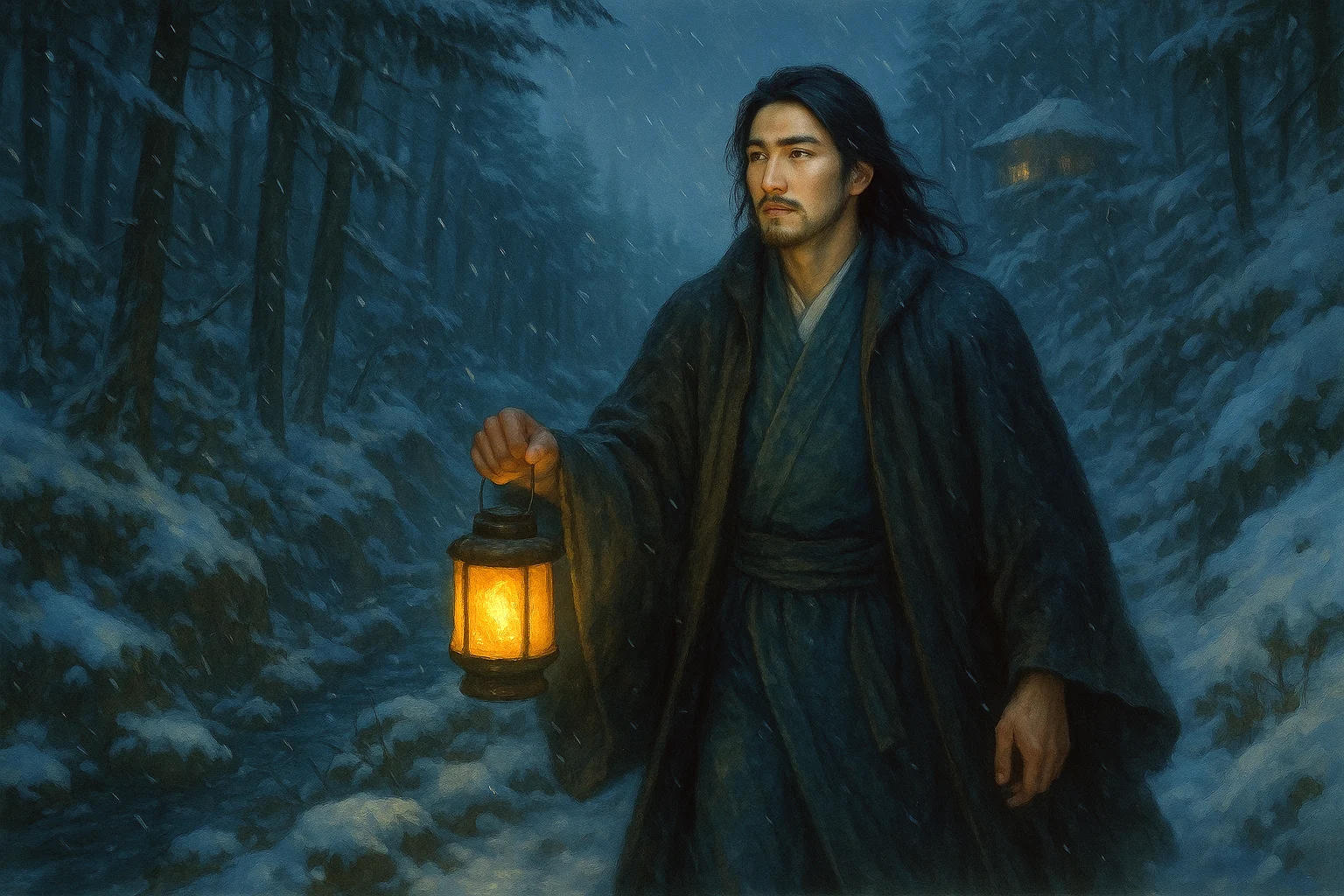
Liu Zhangqing (刘长卿 c. 726 – c. 786), a native of Xuancheng, Anhui Province, was a poet of the Mid-Tang Dynasty. He obtained the jinshi degree (presented scholar) in the late Tianbao era and successively held official posts such as Sheriff of Changzhou and Investigating Censor. Due to his upright and unyielding character, he was exiled twice. His poetry, particularly his five-character verses, achieved the highest distinction, often depicting the melancholy of exile and the joys of reclusion in landscapes. His poetic style is refined, elegant, and ethereal, blending a desolate undertone with the meticulousness characteristic of the Ten Talented Poets of the Dali era. He excelled in using plain sketching to create an atmosphere of tranquil emptiness and profound remoteness. As a pivotal poet bridging the High Tang and Mid-Tang periods, his work inherits the idyllic charm of Wang Wei and Meng Haoran while foreshadowing the bleak and cool elegance of Dali poetry. He exerted a certain influence on late Tang poets such as Yao He and Jia Dao, who belonged to the "painstaking school."