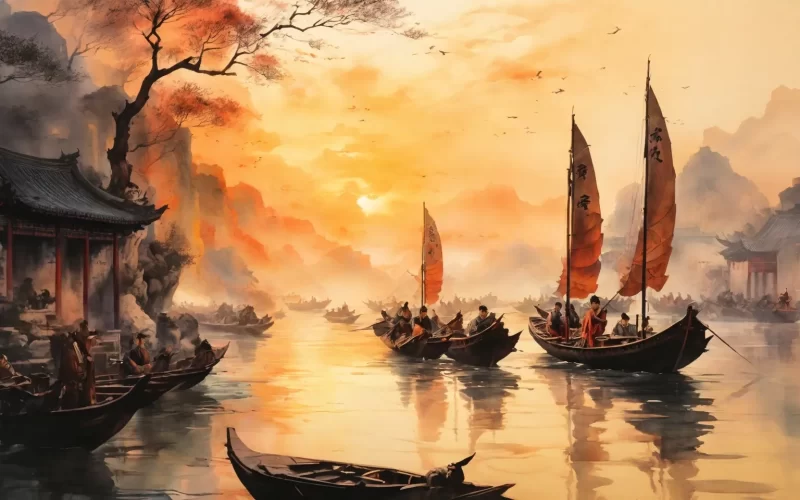
"Yes, I live here, by the river;
I have sailed on it many and many a time.
Both of us born in Changgan, you and I!
Why haven't we always known each other?"
Original Poem
「长干行 · 其二」
崔颢
家临九江水,来去九江侧。
同是长干人,生小不相识。
Interpretation
This is the second poem in Cui Hao's lyrical series set in the river towns south of the Yangtze. Changgan Lane, situated on the southern bank of the Qinhuai River in Tang-dynasty Jinling (present-day Nanjing), was a bustling marketplace and busy ferry landing, a place of constant movement and lively street life. During his wanderings in the region, Cui Hao captured with keen sensitivity a slice of human interaction from this waterside world, recording this simple yet evocative riverbank dialogue in the style of a Music Bureau folk song.
This piece and the first poem of the pair form a complete narrative scene: the first captures a maiden's spontaneous question; this second presents the man's quiet, steady reply. Together, they depict the instant familiarity born of a shared hometown, and the subtle sense of life's transience carried within the phrase "yet strangers from our youth." Cui Hao's use of this dialogue form and the narrative link between the two poems demonstrates his mastery of folk-song technique and his skill in weaving poetry from the threads of everyday life.
The poem was born during the High Tang period, a time when literati actively drew inspiration from folk traditions. Cui Hao distilled his observation of human nature and circumstance into this brief exchange, creating a work that is both vividly local and universally resonant. In only four lines, it defines a character, advances a moment, and—within the quiet regret of "strangers from our youth"—reflects on the individual's small but poignant place within the broader currents of life.
First Couplet: "家临九江水,来去九江侧。"
Jiā lín Jiǔjiāng shuǐ, lái qù Jiǔjiāng cè.
My home has always by these waters lain; / Upon their tide I go, and come again.
The man's reply is plain, bearing the quiet weight of a life lived. The words "by" (lín) and "go, and come again" (lái qù) sketch a figure whose world is the river, whose boat is his stead. The "Nine Rivers" (Jiǔjiāng) are both the specific waterways and a symbol of life's unceasing flow. His existence is defined by these waters—broad yet bounded.
Second Couplet: "同是长干人,生小不相识。"
Tóng shì Chánggān rén, shēng xiǎo bù xiāng shí.
Though we in Riverside Town were born and bred, / We grew up strangers, as you just have said.
This response holds the poem's emotional core. "Were born and bred" (tóng shì… rén) brings recognition, a spark of kinship. "Strangers from our youth" (shēng xiǎo bù xiāng shí) gently unfurls a wistful thread of fate. The most familiar of roots, the most unfamiliar of faces—this simple contradiction speaks volumes of life in a society where people, sharing a common origin, are scattered by the tides of livelihood. Within its faint regret lies a trace of consolation: the meeting, though late, has come.
Holistic Appreciation
If the first poem is the maiden's bright, initiating spark, this one is the man's calm and grounded acknowledgment. Through sparse dialogue, the poet deepens the moment from a shared geography to a shared feeling.
The man's words hold no direct sentiment, yet they contain a riverside dweller's simple understanding of his own path: a life tethered to the water's edge, his hometown both the point of origin and the entire compass of his days. Meeting a woman from the same town on the river, his reflection on being "strangers" reaches beyond their two lives, touching all ordinary lives that pass like currents, missing and sometimes, by chance, meeting.
Here, the scene lifts from a personal exchange to a glimpse of shared fate. It remains a vivid snapshot of a chance meeting, yet now, in its depths, one sees the reflection of countless similar figures and lives.
Artistic Merits
- Narrative Economy: In four lines, it answers the first poem, defines the speaker's life, and conveys a world of feeling. The language is lean, the emotion layered.
- Space and Destiny: "Upon their tide" maps the tangible space of his wandering life; "born and bred" names the shared, unchanging root. The tension between movement and belonging arises naturally between the lines.
- Depth in Restraint: The tone is measured, quiet. The murmured realization "strangers from our youth" resonates more deeply than any lament. It is feeling weathered by life—subdued, yet profoundly felt.
- Meaning in Pairing: The poem's full power emerges only when read with the first. Her question is eager and alive; his reply is steady and worn. One is quick and bright, the other slow and deep. Together, they form a complete and moving human portrait.
Insights
This poem continues Cui Hao's practice of finding poetry in the common life of streets and wharves, shaped by the spirit of folk song. He excels at discovering life's universal conditions within ordinary speech, turning a fleeting encounter into a gentle meditation on wandering and belonging, on the faintness and depth of human connection.
Reading it today, that quiet wonder of "strangers from our youth" still travels across the centuries to find us. In an age of constant movement, are we not all living "by these waters," forever "going and coming again"? Our native places may remain, yet the familiar faces grow ever fewer. This poem reminds us that on life's endless journey, these chance meetings, these moments of shared origin, may be the wanderer's truest solace. It gives no answers, only shows us a true fragment of life, and asks us to see our own reflection there.
Poem translator
Kiang Kanghu
About the poet
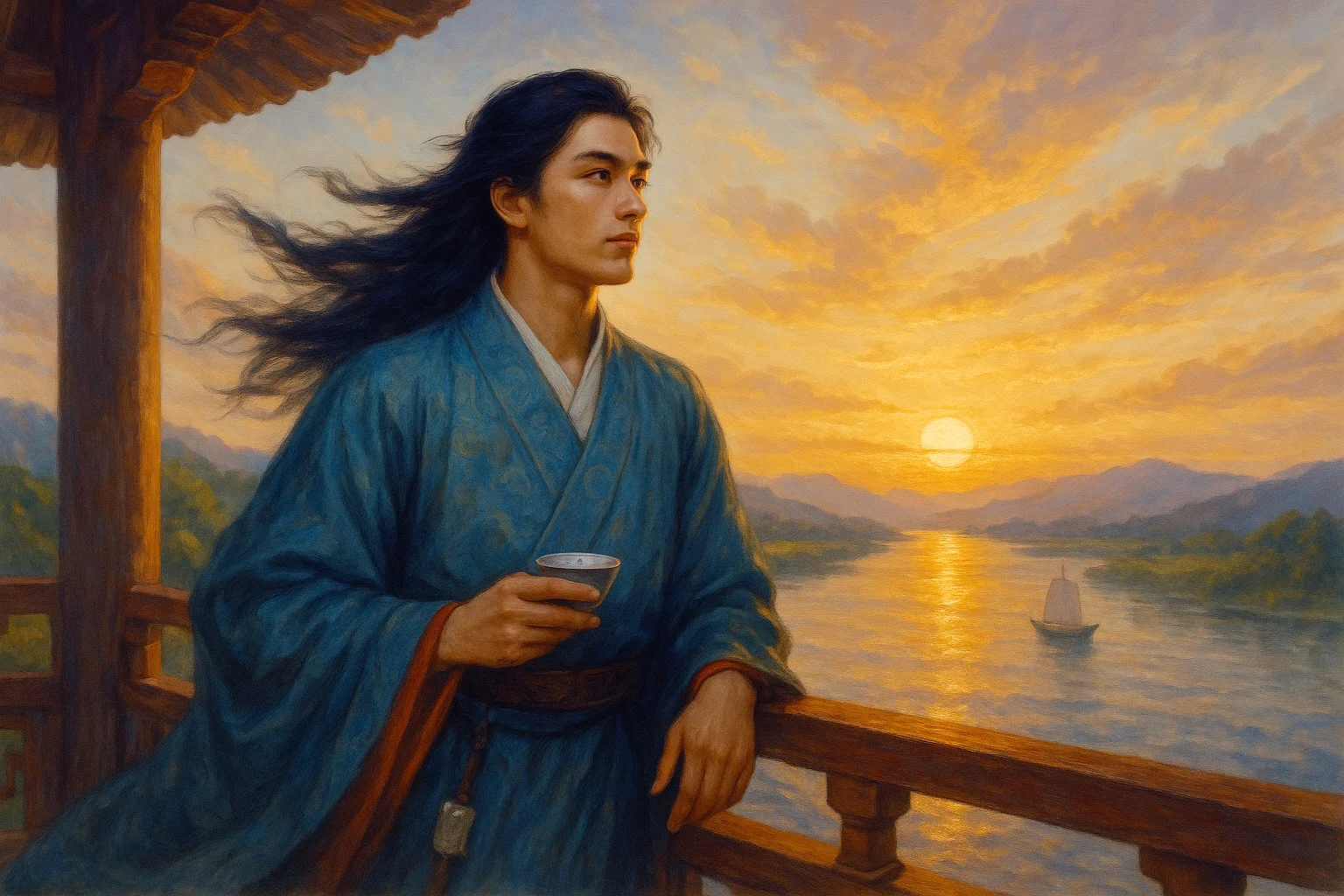
Cui Hao (崔颢), A.D. ? – 754, a native of Kaifeng, Henan Province. He was admitted as a scholar in 723 AD. At that time, Cui Hao was well known, along with Wang Changling, Gao Shi, Meng Haoran, and Wang Wei.