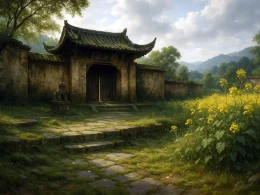




Pray, where’s your home? — on riverside, I’d know.
I live in Hengtang, — the first stop where boats go.
I’ve stopped my boat to ask, on waters wide,
Lest I should find in you a townsman by my side.
Original Poem
「长干行 · 其一」
崔颢
君家何处住,妾住在横塘。
停船暂借问,或恐是同乡。
Interpretation
This brief poem by the Tang Dynasty poet Cui Hao is richly imbued with the charm of a folk song. Comprising only four lines and spoken entirely from a young maiden's perspective, it vividly captures a lively, chance encounter upon the river, portraying the sincerity and warmth of everyday life. The poem originates from Cui Hao's genuine experiences during his early wanderings in the region south of the Yangtze River. Changgan Lane, situated along the Qinhuai River, was a bustling market district and crucial waterway hub in Tang-era Jinling (present-day Nanjing). Alive with the constant coming and going of boats and the endless flow of merchants and travelers, it thrummed with the vibrant energy and unadorned kindness of common life. As Cui Hao passed through, he was not merely a traveling poet but a keen listener and observer. The distinctive tableau of riverside life—the exchanges between boatfolk, chance meetings on the water, the maiden's direct yet demure manner—deeply stirred him. Thus, he chose to depict a scene of his time using an old Music Bureau ballad style, employing the most concise language to seize a moment rich with the texture of lived experience.
This creative approach also resonates with a significant tendency in High Tang poetry: the conscious emulation of folk songs by literati, drawing poetic vitality from the ordinary. Cui Hao condensed his insight into the beauty of human connection into this short verse of merely twenty characters. It thereby continues the fresh, guileless spirit of Music Bureau folk poetry while showcasing the distilled, suggestive craft of the literati tradition, becoming a timeless vignette of human feeling.
First Couplet: "君家何处住?妾住在横塘。"
Jūn jiā hé chù zhù? Qiè zhù zài Héngtáng.
"Pray, where might your home be, sir?" / "My home is there by Riverside Den."
The opening is as straightforward as speech, instantly revealing the maiden's forthright and uninhibited nature. Unbound by formal etiquette, she inquires directly and promptly states her own origin. "Héngtáng" (Riverside Den) is a specific place name, yet it also evokes the soft, misty atmosphere unique to the river towns of the south. In this brief exchange, a sense of strangeness quietly dissolves, as if two small boats gently draw together on the water.
Second Couplet: "停船暂借问,或恐是同乡。"
Tíng chuán zàn jiè wèn, huò kǒng shì tóngxiāng.
"I paused my boat to ask a word, / Thinking we might be from the same hometown."
The final two lines reveal an even more artful turn of mind. Using "we might be from the same hometown" as her pretext, she sustains the conversation while betraying a maidenly cleverness and hint of shyness. The word "might" (huò kǒng) is particularly fine, conveying a trace of hope and a touch of disquiet, depicting with striking fidelity the subtle, natural sense of kinship arising between strangers.
Holistic Appreciation
The poem is akin to a vivid snapshot of southern life. The poet skillfully isolates the moment of a chance river encounter. Through scant dialogue, the characters' demeanor and the riverside scenery materialize before our eyes. The image of the maiden is especially poignant—she is warm yet not forward, candid yet tinged with bashfulness, curious yet veiling her hope, entirely a figure sprung naturally from the soil of everyday life.
The language of the entire poem is pure as water, unadorned, yet possesses a fresh, flowing cadence. Drawing upon the folk song's dialogue form and plain descriptive technique, the poet constructs layers of narrative and emotional space within just twenty characters. This is not merely a poem; it is a slice of life that can be heard, seen, and touched.
Artistic Merits
- Form Through Speech, Feeling Through Question: The work unfolds entirely through dialogue. Without a single word directly describing appearance or manner, the characters come vividly alive through their speech. The maiden's candor, wit, and that faint shyness reside wholly within her words.
- Scene as Mindscape, the Moment as Eternity: The poet captures the transient instant of boats passing, yet through the slight action of pausing to ask, he stretches the psychological dimension of time. The chance nature of the meeting and the impulse to speak intertwine here.
- Local Color Fused with Human Warmth: "Riverside Den" roots the scene in the waterside landscape; "same hometown" evokes a shared local bond. The emotion is personal, yet it also carries the open, genial character of southern market-town culture.
- The Art of Suggestion, Lingering Resonance: The poem concludes with "might be from the same hometown." It seeks no resolution, demands no answer. This open ending grants the reader boundless room for imagination, lending the brief verse a resonance that extends far beyond its words.
Insights
This small poem is like a breeze drifting across time, reminding us that life's most touching emotions are often nestled within the most commonplace encounters and simplest words. In an age where human interaction grows ever more complex and language more polished, the directness, curiosity, and innate goodwill in the poem feel particularly precious.
It shows us that poetry need not dwell in distant realms; it can blossom quietly in the act of pausing a boat, in a single question asked. The maiden's use of "same hometown" to forge a connection also whispers of the deep human longing for belonging and shared understanding—the wish to find a thread of common warmth amidst life's vast currents.
These four lines are a clear mirror, reflecting the most genuine, simple beauty of human exchange. In the hurried rhythm of modern life, it invites us to occasionally "pause our boat," to regard the world nearby with gentle curiosity, and in simple dialogue, to rediscover life's warmth and its inherent poetry.
About the poet
Cui Hao (崔颢), A.D. ? – 754, a native of Kaifeng, Henan Province. He was admitted as a scholar in 723 AD. At that time, Cui Hao was well known, along with Wang Changling, Gao Shi, Meng Haoran, and Wang Wei.