


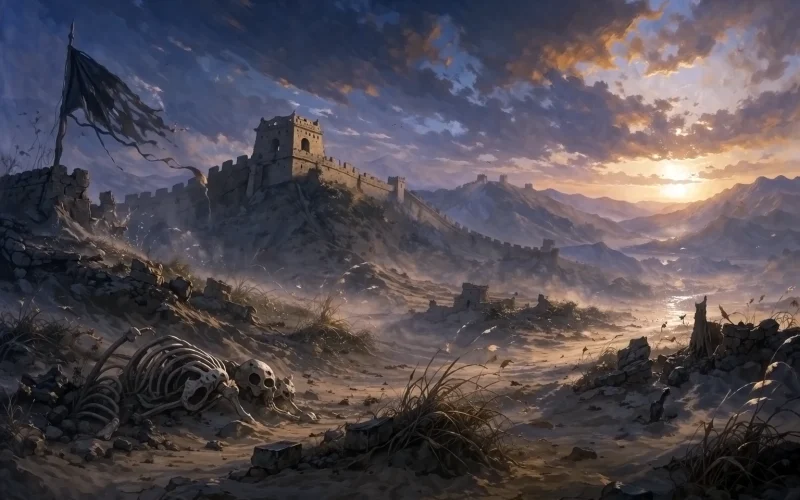
O the First Emperor, who against the Northern horde
Did rear thy wall! — a “care” that wakes a bitter chord.

If but One Man were with the sense of right possessed,
Under the cope of heaven all nations would find rest.

The deeds are of the Past; the World, it does not die;
The wreck’d foundations with the bramble‑weeds we spy.

And still the bones of those who perish’d at thy call
Do in the wind‑swept sands sob out their curse on all!
Original Poem
「长城」
朱庆馀
秦帝防胡虏,关心倍可嗟。
一人如有德,四海尽为家。
往事乾坤在,荒基草木遮。
至今徒者骨,犹自哭风沙。
Interpretation
This poem is a work of historical reflection by the Mid-Tang poet Zhu Qingyu. Zhu Qingyu's poetry is known for its elegance and grace, and he excels particularly in depicting female psychology with delicate brushstrokes. However, his poems on history and reflection on the past also form a distinctive style of their own, revealing depth within their plain surface. The Great Wall, the massive project built by the First Emperor of Qin to defend against the Xiongnu, conscripted millions of laborers, causing countless deaths and injuries. It stands as one of the heaviest symbols in Chinese history. Taking "The Great Wall" as its title, this poem uses the history of the First Emperor's wall construction to reflect on the difference between tyranny and benevolent governance, expressing deep sympathy for the tragic fate of the laborers. The poet does not directly describe the wall's magnificence. Instead, with "The First Emperor built walls against the Northern foe" he points to its purpose; with "Much concerned, it’s sad that it was built woe on woe" he subtly criticizes its harsh governance; with "If the ruler had virtue, all would be at home" he proposes the ideal of benevolent rule; with "What is past is past, but heaven and earth still stand; / Only weeds o’ergrow the ruined wall" he writes of history's vicissitudes; and with "Up to now the bones of the dead still weep in vain / And wail in wind and sand" he concludes, condensing a millennium of sorrow and grievance into the three words "哭风沙" (wail in wind and sand).
In classical poetry, many who wrote of the Great Wall described its grandeur or lamented its monumental achievement. Zhu Qingyu's poem, however, is unique. It does not write of the wall's majesty, but of its desolation; it does not praise the First Emperor's accomplishment, but mourns his people. With "What is past is past, but heaven and earth still stand" he writes of history's constancy; with "Only weeds o’ergrow the ruined wall" he writes of the ruins' desolation; with "the bones of the dead" and "wail in wind and sand" he writes of the unquiet souls of the dead, transforming a military fortification of brick and stone into an epic of the people's suffering, interwoven with blood and tears. The poem's language is concise, its意境 (artistic conception) vast and desolate, its emotion profound. It is a model of "people-oriented" thought in Tang dynasty historical and reflective poetry.
First Couplet: "秦帝防胡虏,关心倍可嗟。"
Qín dì fáng húlǔ, guānxīn bèi kě jiē.
The First Emperor built walls against the Northern foe; Much concerned, it’s sad that it was built woe on woe.
The poem opens with "The First Emperor built walls against the Northern foe" (秦帝防胡虏), pinpointing the purpose of building the wall. "防胡虏" (against the Northern foe) was the First Emperor's original intention, the reason for the wall's existence. Yet the next line, "Much concerned, it’s sad that it was built woe on woe" (关心倍可嗟), hides satire within the three words "倍可嗋" (sad that it was built woe on woe)—he was so concerned about border defense, yet disregarded the lives of the common people; he so valued national security, yet neglected human life. These two words "可嗋" (sad/alas) are the poet's sigh for the First Emperor, and also a veiled critique of tyranny. Within the couplet, the poet uses "关心" (much concerned) to write of his diligent governance, and "可嗋" to write of his harsh rule. Between praise and blame, his stance is clear.
First Couplet: "秦帝防胡虏,关心倍可嗟。"
Qín dì fáng húlǔ, guānxīn bèi kě jiē.
The First Emperor built walls against the Northern foe; Much concerned, it’s sad that it was built woe on woe.
The poem opens with "The First Emperor built walls against the Northern foe" (秦帝防胡虏), pinpointing the purpose of building the wall. "防胡虏" (against the Northern foe) was the First Emperor's original intention, the reason for the wall's existence. Yet the next line, "Much concerned, it’s sad that it was built woe on woe" (关心倍可嗟), hides satire within the three words "倍可嗟" (sad that it was built woe on woe)—he was so concerned about border defense, yet disregarded the lives of the common people; he so valued national security, yet neglected human life. These two words "可嗟" (sad/alas) are the poet's sigh for the First Emperor, and also a veiled critique of tyranny. Within the couplet, the poet uses "关心" (much concerned) to write of his diligent governance, and "可嗟" to write of his harsh rule. Between praise and blame, his stance is clear.
Second Couplet: "一人如有德,四海尽为家。"
Yī rén rú yǒu dé, sìhǎi jìn wéi jiā.
If the ruler had virtue, all would be at home; The empire’s people wouldn’t be forced afar to roam.
This couplet is the poem's turning point, shifting from critiquing tyranny to expressing longing for benevolent rule. "一人如有德" (If the ruler had virtue)— "一人" (one man) refers to the ruler. This is the core Confucian idea of "governing with virtue": if the ruler possesses virtue, the hearts of all under heaven will turn to him. "四海尽为家" (all would be at home) describes the ideal state of benevolent rule—the people would not need to build walls to defend against enemies, would not be forced to leave their homeland; within the Four Seas, all is home. This couplet uses the two words "如有" (if...had) to set a condition, and "尽为" (all would be) to describe the ideal outcome, forming a sharp contrast with the first couplet's "防胡虏" (against the Northern foe): a virtuous ruler would not need to build a Great Wall; a ruler without virtue, building a wall is useless. With concise language, the poet articulates the essential difference between "benevolent rule" and "tyranny."
Third Couplet: "往事乾坤在,荒基草木遮。"
Wǎngshì qiánkūn zài, huāng jī cǎomù zhē.
What is past is past, but heaven and earth still stand; Only weeds o’ergrow the ruined wall built on the land.
This couplet shifts from discussion to describing the scene, writing of the Great Wall's present state. "往事乾坤在" (What is past is past, but heaven and earth still stand) writes of history's immutability—the First Emperor is gone, dynasties have changed, yet heaven, earth, and the cosmos remain. "荒基草木遮" (Only weeds o’ergrow the ruined wall) writes of the wall's desolation—the once-majestic structure is now only ruined foundations, overgrown with weeds and trees. The word "遮" (o’ergrow) writes of time's power to obscure, and also of history's ruthlessness. This couplet juxtaposes "往事" (what is past) with "荒基" (ruined wall), contrasts "乾坤" (heaven and earth) with "草木" (weeds), writing the vicissitudes of history with penetrating depth.
Fourth Couplet: "至今徒者骨,犹自哭风沙。"
Zhìjīn tú zhě gǔ, yóu zì kū fēngshā.
Up to now the bones of the dead still weep in vain And wail in wind and sand, unable to forget their pain.
This couplet is the soul of the entire poem, concluding with highly impactful imagery. "至今徒者骨" (Up to now the bones of the dead) writes of the laborers conscripted to build the wall, long turned to bleached bones—"至今" (up to now) writes of the distant past; "徒者" (the dead) identifies their status: conscripted commoners, not volunteers, but forced. The next line, "犹自哭风沙" (And wail in wind and sand), uses personification to write the wailing of wronged souls—that "哭声" (wail) in the wind and sand is the grievance of the dead over a thousand years, and also the poet's most profound condemnation of tyranny. These three words "哭风沙" (wail in wind and sand) are the "pivotal phrase" of the entire poem: it is not the wind and sand weeping, but the bones weeping; it is not a natural sound, but history's echo. The poet concludes with this mournful imagery, pushing the poem's emotion to its climax, with a poignant resonance that makes one sigh deeply.
Holistic Appreciation
This is a powerful work among Zhu Qingyu's historical reflections. The entire poem consists of eight lines and forty characters. Taking the Great Wall as its entry point, it merges the First Emperor's tyranny, the laborers' suffering, history's vicissitudes, and the ideal of benevolent rule, revealing the poet's deep identification with the "people-oriented" political philosophy.
Structurally, the poem presents a progressive sequence from history to discussion, discussion to scene, scene to emotion. The first couplet uses "The First Emperor built walls against the Northern foe" to state historical fact, using "sad that it was built woe on woe" to subtly criticize tyranny. The second couplet uses "If the ruler had virtue, all would be at home" to propose the ideal of benevolent rule, forming a contrast with the first couplet. The third couplet uses "What is past is past, but heaven and earth still stand; / Only weeds o’ergrow the ruined wall" to describe the desolation of the Great Wall ruins, shifting to history's vicissitudes. The fourth couplet concludes with "Up to now the bones of the dead still weep in vain / And wail in wind and sand," condensing a millennium of sorrow and grievance within the wind and sand. Between the four couplets, it moves from history to discussion, discussion to scene, scene to emotion, progressing layer by layer, forming a seamless whole.
Thematically, the core of this poem lies in the resonance between "可嗋" (sad/alas) and "哭" (weep/wail). That "可嗋" in "Much concerned, it’s sad that it was built woe on woe" is the poet's sigh for the First Emperor's tyranny; that "哭" in "wail in wind and sand" is the wailing of the dead over a thousand years. Between this "可嗋" and "哭" lies the poet's deep reflection on "benevolent rule" and "tyranny": under tyranny, the people's bleached bones lie exposed in the wilderness, wailing in the wind and sand for a millennium; under benevolent rule, all within the Four Seas is home. This contrast gives the poem a depth of thought that transcends ordinary historical reflection.
Artistically, the poem's most moving aspect lies in the subtle technique of "concluding emotion with scene, writing of people through objects." The poet does not directly write of the people's suffering, only writes of the desolation of "Only weeds o’ergrow the ruined wall"; he does not directly voice grievances, only writes of the wailing in "wail in wind and sand." Those three words "哭风沙" use the sounds of nature to write the pain of history, giving voice to formless grievances, giving shape to a millennium of sorrow and resentment. This technique of concluding emotion with scene, writing of people through objects, is precisely the highest realm of Chinese classical poetry: "without a single explicit word, achieving perfect grace and resonance."
Artistic Merits
- Vivid Contrast, Profound Theme: Contrasting the First Emperor's tyrannical "against the Northern foe" with the benevolent rule of "If the ruler had virtue." Using the uselessness of the Great Wall to highlight the fundamentality of benevolent rule.
- Using Scene to Convey Feeling, Subtle and Profound: Using "Only weeds o’ergrow the ruined wall" to write history's vicissitudes, using "wail in wind and sand" to write the wronged souls of the dead. The language of scene is the language of feeling; the images of objects are images of the heart.
- Precise Diction, Each Word Carries Weight: "可嗋" (sad) writes of sighing, "遮" (o’ergrow) writes of obscuring, "哭" (wail) writes of lamenting—each word is plain, yet each word is startling.
- Seeing the Large from the Small, Using Objects to Imply History: Using the Great Wall's ruined foundations, the wailing in the wind and sand, to reflect the tragedy of an entire era, seeing the large from the small, knowing the significant from the subtle.
Insights
This poem, through the Great Wall, speaks to an eternal theme—True national security lies not in high walls of brick and stone, but in the allegiance of the people's hearts; true peace and prosperity lie not in the deterrence of military force, but in the prevalence of benevolent governance.
First, it lets us see "the cost of tyranny." The First Emperor built the Great Wall for "against the Northern foe," yet it caused countless commoners' bones to bleach in the wilderness, still wailing in the wind and sand a thousand years later. That wall became a monument to tyranny, not a barrier of security. It reminds us: "Security" achieved at the cost of the people's lives will ultimately prove illusory; "achievements" not based on the people as the foundation will ultimately be rejected by history.
On a deeper level, this poem makes us contemplate "the power of benevolent rule." "If the ruler had virtue, all would be at home"—the poet tells us that what can truly bring peace to the world is not the Great Wall, but the ruler's virtue. It makes us understand: A nation's strength lies not in the height of its walls, but in the inclination of its people's hearts; social stability lies not in the strictness of its defenses, but in the goodness of its governance.
And what is most moving is the poem's compassion of "speaking for the dead." Those laborers who built the Great Wall have long turned to bleached bones. Their names are unknown, their stories unrecorded. Yet Zhu Qingyu, with a single poem, lets their wailing in the wind and sand be heard by later generations. This compassion of "giving voice to the voiceless" is the poet's most precious quality, and also literature's noblest mission.**
This poem writes of Mid-Tang reflection on the past, yet it allows everyone who contemplates "power versus the people's livelihood," "tyranny versus benevolent rule," to find resonance within it. The original intention of "The First Emperor built walls against the Northern foe" is the arrogance of every powerful ruler. The sigh of "Much concerned, it’s sad that it was built woe on woe" is the detached gaze of every clear-sighted person. The ideal of "If the ruler had virtue" is the aspiration of every benevolent person. The wail of "wail in wind and sand" is the echo of every forgotten soul. This is the vitality of poetry: it writes of the First Emperor's Great Wall, but one reads of people in all eras who groan under tyranny and dwell in peace under benevolent rule.
About the Poet

Zhu Qingyu (朱庆馀 dates of birth and death unknown), also known by his given name Kejiu, was a poet of the Mid-Tang period, a native of Yuezhou (present-day Shaoxing, Zhejiang Province). He passed the jinshi examination in the second year of the Baoli era (826 AD) and held the position of Collator in the Imperial Library. His poetry excelled in the five-character regulated verse style, characterized by a refined and subtle elegance, with particular skill in depicting the emotions of boudoir women and palace maidens. In the Complete Tang Poems, two volumes containing 177 of his works are preserved. He was adept at using allegorical and metaphorical techniques, blending everyday emotions with political aspirations. Although not many of his poems survive, his exquisite craftsmanship secures him a unique place in the history of Tang poetry, with his poem Boudoir Sentiments becoming a quintessential example of the fusion of examination-themed and boudoir poetry in later generations.